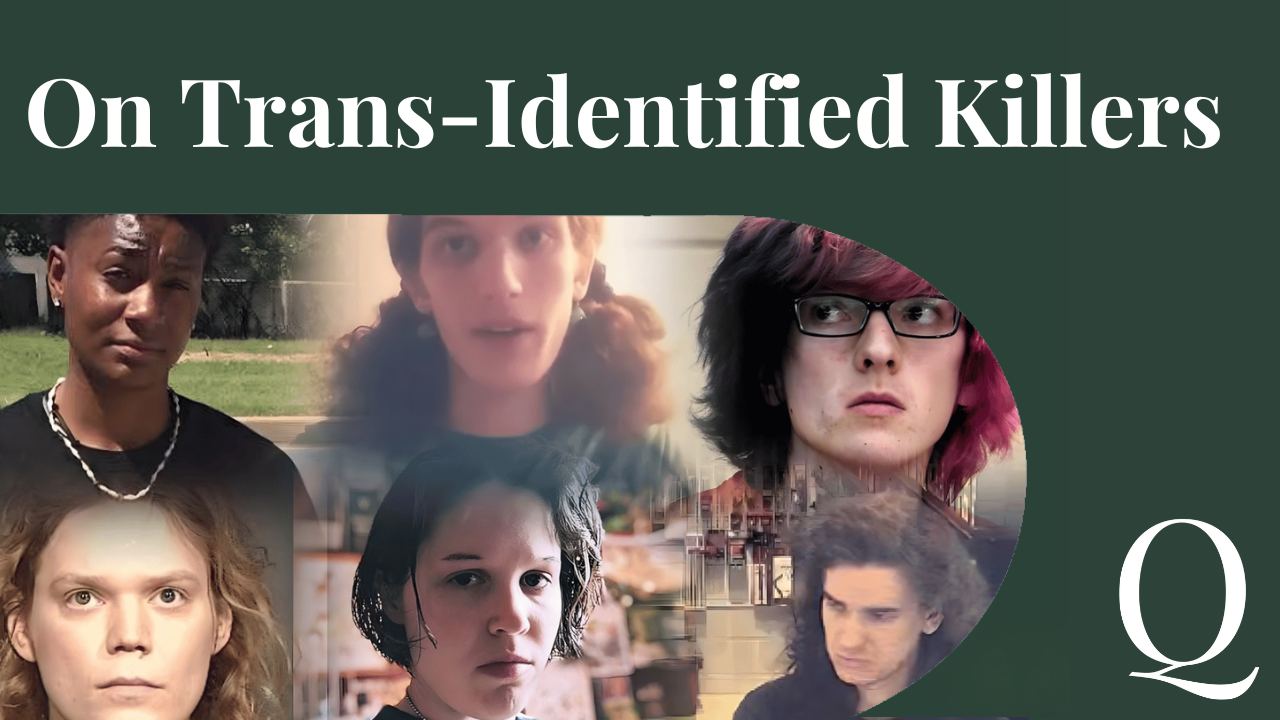

Video essay written by Forest Romm and Kevin Waldman and narrated by Zoe Booth.
On 27 August, Robin Westman opened fire during the first Mass of the school year at Annunciation Catholic School in Minneapolis, killing two children before taking his own life. In the aftermath, public debate focused largely on political extremism and online radicalisation. Yet Westman’s journals and online activity suggest a more complicated psychological picture—one in which gender dysphoria, ideological grievance, and untreated mental illness intersected.
This video essay examines what is known about Westman’s background, including his adolescent gender transition, documented psychological distress, and immersion in polarised online subcultures. It also considers a broader question: whether the contemporary “gender-affirming” model in psychology risks obscuring deeper psychiatric comorbidities in vulnerable young people. Drawing on emerging research, recent high-profile cases, and internal communications from clinicians, the essay argues for renewed clinical independence and a return to exploratory therapeutic methods grounded in evidence rather than ideology.
Transcript
View full transcript
On the morning of 27 August, Robin Westman approached Annunciation Catholic School in Minneapolis armed with a pistol, a shotgun, and a revolver. He opened fire during the first Mass of the new school year, killing two young children and wounding many others before turning one of the guns on himself. In the wake of such senseless violence, Americans instinctively perform cultural autopsies, looking for explanations. But Westman’s behaviour didn’t lend itself readily to the usual analyses. Hours before the shooting, he uploaded a video in which he can be seen pacing his room in pixelated shadow, flaunting his arsenal. The slogans scrawled in white marker across his guns and ammunition revealed a disturbed mind, shaped by dehumanising online memes drawn from trolling subcultures across the political spectrum. “Burn Israel,” “Sponsored by Blackrock,” and “Kill Donald Trump” appeared alongside right-coded catchphrases such as “We Wuz Kangz,” “Nuke India,” and “Kick a spic.” In a grotesque illustration of horseshoe theory, slogans such as “Extra thicc Jew gas” and “6 million wasn’t enough” could be shoehorned into either category of extremism. Like the murder of conservative political activist Charlie Kirk two weeks later, the crime became a Rorschach test for America’s competing cultural projections. While Westman’s political ideology (insofar as he had one) is unknown, one thing is clear: the killer was a biologically male 23-year-old who identified as transgender. Robert Westman became “Robin Westman” at the age of seventeen—a fact that many media outlets initially chose not to report. In keeping with the taboo against “deadnaming” trans-identified individuals—even murderers—they posthumously honoured Westman’s asserted gender identity, thereby giving the impression that the carnage had been committed by a woman. Westman left a notebook filled with references to gender dysphoria: “I don’t know if I am a trans girl”; “my face never matches how I feel”; and “I am tired of being trans, I wish I never brainwashed myself.” While today’s mass shooters are more likely to be radicalised online than their predecessors, they often exhibit the same longstanding risk factors—including mental instability and an obsessive fixation on perceived grievances. Elliott Rodger, the self-styled “Supreme Gentleman” of incel lore who murdered six and injured fourteen in Isla Vista, California eleven years ago, was enraged by his perceived sexual rejection. Westman, by contrast, fixated on identity and self-perception. Gender dysphoria is comorbid with a number of serious mental-health conditions. A 2023 Danish study found that trans-identified individuals were five times more likely to exhibit at least one psychiatric comorbidity than members of a non-trans control group. In recent years, several high-profile violent crimes have involved trans-identified perpetrators. In 2018, Snochia Mosley shot and killed three co-workers in Aberdeen, Maryland. The following year, Maya McKinney—who asserted a male gender identity and had begun calling herself “Alec”—opened fire at a Colorado school, killing one and wounding eight. In 2023, Audrey Hale, a woman who identified as male, killed three children and three staff members at The Covenant School in Nashville. The fact that a killer is trans-identified does not in itself establish motive. However, it is notable that some extremist movements and sects have attracted severely mentally unwell trans-identified individuals, including the so-called Zizians—a self-described “rationalist” cult linked to multiple homicides. Two months ago, a day after Westman’s attack, Snehal Ansh Srivastava (also known as “Sasha Shakur”) shot and killed a neighbour in Shrewsbury, Massachusetts following a dispute over political graffiti. Days later, Olivia G. Wilkins attempted to run over a Border Patrol agent. Around the same period, Alexia Willie, previously convicted of threatening a school shooting, praised Westman’s attack online. Nicholas John Roske, the man who attempted to assassinate Supreme Court Justice Brett Kavanaugh, was later reported in court filings to identify as a woman. Some media coverage referred to Roske almost exclusively by a female name and pronouns, with minimal clarification regarding biological sex. There has been no systematic study examining whether—and to what extent—violent crime is associated with gender dysphoria, trans ideation, or related ideological movements. Further empirical research is required. The climate of self-censorship surrounding such crimes also warrants attention. In most cases, details about perpetrators’ identities and motives are freely reported. In cases involving trans-identified offenders, however, some media outlets have obscured relevant background details out of adherence to norms against “deadnaming.” As Forest Romm and Kevin Waldman have argued, leaders in clinical psychology should face scrutiny for their broad embrace of “gender-affirming care.” Professional organisations have frequently insisted that transphobia represents the central mental-health threat facing this population, while downplaying the documented association between gender dysphoria and other psychiatric conditions. In some jurisdictions, practitioners risk professional sanction for failing to immediately affirm a patient’s asserted gender identity. This can collapse differential diagnosis and produce diagnostic overshadowing, whereby diverse forms of distress are interpreted primarily as symptoms of unaffirmed identity. Some individuals adopt a transgender identity as part of a broader ideological posture rejecting mainstream political and social norms. In such cases, political extremism may precede, rather than follow, trans identification. The 2024 “WPATH Files” contained internal communications suggesting that some clinicians were willing to initiate medical transition despite severe, unresolved psychiatric conditions, reflecting a belief that transition itself would stabilise mental health without additional intervention. Jaime Reed, a former case manager at a youth gender clinic in St. Louis, has publicly stated that many patients exhibited serious mental-health concerns that, in her view, were insufficiently addressed before medical transition was pursued. It remains unclear whether Westman received medical interventions for gender dysphoria. His social transition was supported by his parents, who facilitated a name change and publicly celebrated it. In his final writings, Westman indicated that affirmation did not alleviate his distress. “Gender and weed fucked up my head,” he wrote. “I wish I never tried experimenting with either.” He also confessed, “I am tired of being trans. I wish I never brainwashed myself.” Westman blamed his mother’s early scepticism for fuelling his anger: “When I was first out to my mother, she was VERY antagonistic.” Later he wrote, “You were right mama… But the way you handled it led me to wanting to kill so so many people.” This represents a profoundly disordered response to personal conflict. Gender identity was only one component in a broader pathology. Reform within the helping professions is overdue. Psychologists need to re-emphasise exploratory therapy that addresses underlying distress rather than presuming gender identity as the primary explanatory framework. Greater clinical independence, better differential diagnosis, and renewed investment in youth mental-health services are essential. Only through such reforms can the full complexity of psychological suffering be addressed. As recent events illustrate, failures in this domain can carry consequences not only for vulnerable patients but, in rare and tragic cases, for innocent bystanders.Chapters
00:00 The Westman Shooting
02:02 Dysphoria and Mental Health Risk
05:00 Extremism and Trans-Identified Subcultures
07:03 Media Framing and Gender Identity
09:10 Research Gaps and Self-Censorship
11:10 The Gender-Affirming Care Debate
13:26 Family Affirmation and Psychological Decline
15:42 Reforming Youth Mental Health
Further reading
- Jonathan Kay, Showing Us Their True Colours
- Jonathan Kay, Stop Pretending the Tumbler Ridge Killer Was Female
- Forest Romm, Kevin Waldman, The Rise and Fall of ‘Gender-Affirming’ Therapeutic Care
If you found this video essay useful, subscribe to the Quillette YouTube channel and browse our video archive.
Keep reading

A Costly Misconception

Addressing the Academic Skew
Letters to the Editor

Podcast #332: The Historical Case for Israel
The IOC Is Protecting Female Athletics. Canada’s Secretary of State for Sport Isn’t Happy About It