Activism
The Southern Poverty Law Center’s New Enemy: Americans Who Accept Biology
A new SPLC propaganda document claims to ‘expose’ a vast ‘Anti-LGBTQ+ Pseudoscience Network’ that’s supposedly targeting trans people.

The Montgomery, Alabama-based Southern Poverty Law Center (SPLC) was founded in 1971 with a mission to fight poverty and racial discrimination. Its early litigation campaigns, which targeted the Ku Klux Klan and other overtly racist organizations, met with success, and the group soon came to be seen as an authoritative source in regard to right-wing extremism more generally.
Another form of expertise the organization developed was in the area of marketing—especially when the market in question consisted of deep-pocketed urban liberals. As former SPLC staffer Bob Moser reported in a 2019 New Yorker article, the group has consistently taken on attention-grabbing urgent-seeming causes that its leaders knew could be leveraged as a means to gain publicity and—more importantly—donations. It’s no coincidence that the SPLC’s co-founder and long-time fundraising guru, Morris Dees, had previously operated a direct-mail business that sold cookbooks and tchotchkes. “Whether you’re selling cakes or causes, it’s all the same,” Dees told a journalist in 1988.

Dees’ big fundraising break at the SPLC came when he got access to the direct-mail list from the 1972 presidential campaign of Democrat George McGovern. The SPLC co-founder went on to maximize the SPLC’s revenues through what would now be known as targeted methods. According to one former legal colleague, for instance, Dees rarely used his middle name—Seligman—in SPLC mailings, except when it came to “Jewish zip codes.”
Thanks to Dees’ slick marketing expertise, the SPLC was eventually taking in more money than it paid out in operational expenses. (As of October 2022, its endowment fund was valued at almost US$640 million.) But over time, his hard-sell tactics began to alienate co-workers, as there was an obvious disconnect between the real class-based problems they observed in society and the fixations of the naïve northern donors whose wallets Dees was seeking to pry open.
“I felt that [Dees] was on the Klan kick because it was such an easy target—easy to beat in court, easy to raise big money on,” former SPLC attorney Deborah Ellis told Progressive writer John Egerton. “The Klan is no longer one of the South’s biggest problems—not because racism has gone away, but because the racists simply can’t get away with terrorism any more.”


On March 14, 2019, Dees—by now 82 years old, but still listed as the SPLC’s chief trial lawyer—was fired amid widespread rumors that he’d been the subject of internal sexual-harassment accusations. His affiliation was scrubbed from the group’s web site; and the organization’s president, Richard Cohen, cryptically (but damningly) declared that, “when one of our own fails to meet [SPLC] standards, no matter his or her role in the organization, we take it seriously and must take appropriate action.” (Less than two weeks later, Cohen himself left the organization, casting his resignation as part of a transition “to a new generation of leaders.”)
In describing his tenure at the SPLC during the early 2000s, Moser argued that the very structure of the organization betrayed its hypocrisy: Here was an entity dedicated to social justice (as we would now call it), yet which was run by an extremely well-paid, almost exclusively white, corps of lawyers, administrators, and fund-raisers who ruled over a mixed-race corps of junior staff. As far back as the 1980s, Dees was openly admitting that he saw the fight against poverty as passé, and admitted that the “P” in SPLC was an anachronism. Jaded staff began ruefully referring to their own flashy headquarters as the “Poverty Palace.”
Dees and Cohen may have left the Poverty Palace, but the SPLC’s tendency to betray its founding principles clearly remains a problem, as illustrated by a new SPLC report released under the auspices of what the group dubs “Combating Anti-LGBTQ+ Pseudoscience Through Accessible Informative Narratives.” (This verbal clunker seems to have been reverse-engineered in order to yield the acronym, “CAPTAIN.”)
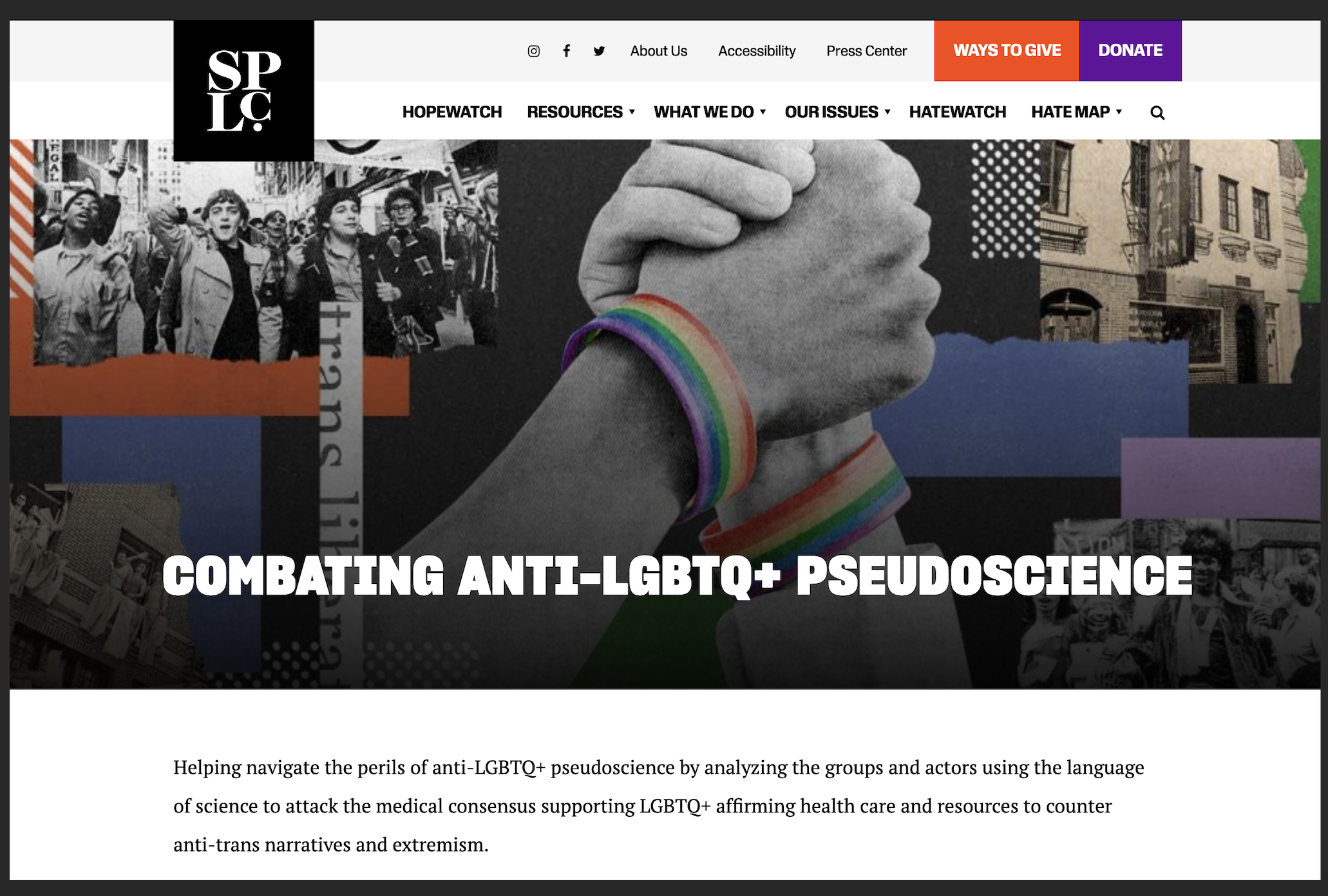
The report purports to demonstrate “the perils of anti-LGBTQ+ pseudoscience” and “anti-trans narratives and extremism.” Much like the dramatically worded hard-sell direct-mail campaigns that the SPLC started up under Dees, it’s marketed as a matter of life and death: According to the deputy director of research for the SPLC’s “Intelligence Project,” the “anti-LGBTQ+ pseudoscience” uncovered by the SPLC has “real-life, often life-threatening consequences for trans and non-binary people.”
At this point, it should be stressed that there is certainly nothing wrong with the SPLC—or anyone else—campaigning for the legitimate rights of people who are transgender. Such a campaign would be entirely in keeping with the SPLC’s original liberal ethos. Just as no one should be denied, say, an apartment, a marriage license, or the right to vote based on his or her race, religion, sex, or sexual orientation, no trans person should be denied these rights and amenities simply because he or she experiences gender dysphoria.
But the SPLC’s report hardly confines itself to such unassailable liberal principles. The real point of the project, it seems, was to catalogue and denounce public figures who’ve expressed dissent from the most extreme demands of trans-rights activists—specifically, (1) the demand that children and adolescents who present as transgender must instantly be “affirmed” in their dysphoric beliefs, even if such affirmation leads to a life of sterility, surgical disfigurement, drug dependence, and medical complications; and (2) the demand that biological men who self-identify as women must be permitted unfettered access to protected women’s spaces and sports leagues.
The SPLC’s authors seek to cast their ideological enemies as hate-addled reactionaries whose nefarious activities must “be understood as part of the historical legacy of white supremacy and the political aims of the religious right.” And it is absolutely true that some of the organizations they name-check are hard-right, socially conservative outfits that endorse truly transphobic (and homophobic) beliefs.
But many of the supposed transphobes targeted by the report aren’t even conservative—let alone members of the religious right. In a multitude of cases, they’re simply parents, therapists, and activists who argue the obvious fact that human sexual biology doesn’t evanesce into rainbow dust the moment that a child—or middle-aged man—asserts that he or she was “born in the wrong body.”
It’s also interesting to note who gets left out of the SPLC’s analysis. The most influential figures leading the backlash against (what some call) “gender ideology” are women such as author J.K. Rowling and tennis legend Martina Navratilova, both of whom come at the issue from explicitly feminist perspectives. Being successful public figures, neither woman needs a cent from the conservative think tanks that the SPLC presents as being back-office puppet-masters of the alleged anti-trans conspiracy outlined in the CAPTAIN report.
In keeping with the conspiracist motif that runs through the document, the authors have provided spider-web diagrams that set out the connections binding this (apparently) shadowy cabal. In this regard, it seems that Quillette itself served as one of the SPLC’s sources: In a section titled, “Group Dynamics and Division of Labor within the Anti-LGBTQ+ Pseudoscience Network,” the authors footnote “an August 23, 2023 podcast for Quillette,” wherein
it was revealed that [Colin] Wright is in a relationsihp [sic] with journalist Christina Buttons, who is an advisoary [sic] board member of [the Gender Dysphoria Alliance] with Drs. Lisa Littman and Ray Blanchard, an editoral [sic] board member of Springer’s Archives of Sexual Research [a mistaken reference to the Archives of Sexual Behavior] with J. Michael Bailey. Notably, Buttons and Wright are interviewed by host Jonathan Kay. In addition to hosting Quillette’s podcast, Kay serves on FAIR’s board of advisors.
We’ve chosen to highlight this particular (typo-riddled) text from the report not just because of the absurd suggestion that our publication has enlisted in an imaginary “anti-LGBTQ+ pseudoscience network,” but also because the above-quoted roll call of supposed gender villains illustrates the intellectual dishonesty that suffuses the whole report.
Let’s go through the references one by one, in the order in which they are presented. The Gender Dysphoria Alliance (GDA) is a group led by people who are themselves transgender, and who are “concerned about the direction that gender medicine and activism has taken.” Are we to imagine that its members are directing transphobia—against themselves? Lisa Littman, formerly of Brown University, is a respected academic who’s published a peer-reviewed analysis of Rapid Onset Gender Disorder. Ray Blanchard is a well-known University of Toronto psychiatrist. The Archives of Sexual Behavior is a peer-reviewed academic journal in sexology. Michael Bailey is a specialist in sexual orientation and gender nonconformity at Northwestern University. Colin Wright is a widely published writer (including at Quillette) with a PhD in evolutionary biology from UC Santa Barbara. (The SPLC’s claim that he is in a relationship with journalist Christina Buttons, who also writes about gender issues, is completely true. But the fact that the group saw fit to report this fact as if it were evidence of sinister machinations says far more about the report’s authors than it does about either Wright or Buttons.) FAIR, the Foundation Against Intolerance & Racism, is a classically liberal group led by a Harvard Law School graduate named Monica Harris. Do any of these people or groups sound like extremists?
The fact that the SPLC is attempting to market its report as a blow against the “anti-LGBTQ+” movement, writ large, is itself quite laughable, since many of the activists who’ve been arguing for a more balanced approach to gender rights are themselves either gay (as with Navratilova and Julie Bindel) or (as with the founders of the GDA) transgender.
Others on the SPLC gender-enemies list are author Abigail Shrier, and therapists Sasha Ayad, and Stella O’Malley. These women openly broadcast their views in best-selling books, as well as mainstream magazines and newspapers. The idea that the SPLC has successfully “exposed” these women through some kind of investigation, as suggested by the title that’s been slapped on the CAPTAIN report, would be ludicrous even if they’d said anything scandalous (which they haven’t).
And what course of future action does the SPLC endorse? For one, it concludes that educators should stigmatize gender-critical views as analogous to “racism, sexism, and heteronormativity.” The report's authors also want academic journals to sniff out groups that “espouse an anti-LGBTQ+ ideology” (as that latter term is speciously defined by the SPLC). And in a final flourish, the group urges reporters to “be aware of the narrative manipulation strategies and the cooptation of scientific credentials and language by anti-trans researchers when sourcing stories about trans experiences.”
With this last point, we get to the real nub: The apparent goal is for this report to be read as a catalogue of people, ideas, and groups that must be shunned. Indeed, the authors explicitly cite the work of one Andrea James, a once-respected arts producer who, as Jesse Singal has documented, now runs a creepy (“stalker” is the word Singal uses) web site called Transgender Map, which lists personal details of anyone whom James deems a gender heretic. When it comes to one-on-one communication, James’ manner of dealing with critics is exemplified by an email sent to bioethicist Alice Dreger, in which James referred to Dreger’s then-five-year-old son as a “womb turd.”
 Jesse Singal
One way to describe the CAPTAIN report is as an SPLC-branded rehash of the information contained on Transgender Map. And one can understand why the authors thought that such a gambit might work. The SPLC already publishes other curated lists of hatemongers—e.g., its “Hatewatch” service, “Hate Map,” and “Intelligence Report.” It wasn’t such a long shot to imagine that this new report might convince readers to treat the listed “Anti-LGBTQ+ Pseudoscience Network” acolytes as equally disreputable.
Keep reading
How France Lost Control of Its Streets

How to Suppress Men’s Writing
Back to the Dark Ages

Prison or Peer Review

France’s Imaginary Austerity