Education
The Drayton Icon and Intellectual Vice
Nevertheless, Drayton’s diatribe does reveal something important—not much about me, something about him, but mostly about the vices that fester in certain reaches of our universities, which serve to undermine rational dialogue and public norms of liberal civility.

Some attacks are best absorbed, not fended off. Some accusations are best let past, not answered. Life is far too short to slap down every slight, and those of a determined ill will won’t be moved anyway. Besides, too thin a skin betrays a touchy insecurity that suggests the critic’s barbs have found their target.
For those reasons, I have hesitated to respond to Richard Drayton’s essay, “Biggar vs Little Britain: God, War, Union, Brexit and Empire in Twenty-First Century Conservative Ideology,” which was published last month in a collection entitled, Embers of Empire in Brexit Britain.1 His assault is at once morally vicious and rationally weak. Moreover, it displays such an incontinent hostility that it’s doubtful anything I say would make an impression on him or his allies.
Nevertheless, Drayton’s diatribe does reveal something important—not much about me, something about him, but mostly about the vices that fester in certain reaches of our universities, which serve to undermine rational dialogue and public norms of liberal civility. For that reason, I take up the cudgels here.
What Richard Drayton has written seems to have two aims. The first is to achieve some insight into the mentality of the Brexiteers, by treating me as an icon—that is, a particular picture that opens a window onto a much larger reality. As he puts it:
[A] journey into the mind-world of Biggar can help us to understand the larger, and less articulate and visible cultural currents in late twentieth and twenty-first century Britain. It may provide insight into how some of the embers of empire continue to burn, and even to kindle obscure new flames…. The Biggar phenomenon is a sign of the times to which we should pay attention. (pp. 143, 145)
His second aim is to trash the authority of anything I have to say about Britain’s imperial past or future global role, and thereby to expose Brexit as a delusion.
Flattered as I am by the cultural importance Drayton attaches to me, I’m not going to dwell on his Brexit thesis. That’s because I’m unaware of any hard and comprehensive empirical data that substantiates the claim that voters were moved to vote Leave in the June 2016 referendum by “imperial nostalgia.” What’s more, I voted to Remain (just), which ought to be a rather large fly in Drayton’s narrative ointment, but somehow isn’t.2 It’s true that I believe that Britain should continue its imperial tradition of playing a global role, sometimes deploying hard power in faraway places to uphold international order and halt massive atrocities. But that’s a view shared by plenty of Remainers and repudiated by plenty of Leavers. The proposition that imperial nostalgia is a major force behind Brexit just doesn’t stack up.
So, let me turn to Drayton’s attempted trashing and what it reveals. One of its extraordinary features is how very personal it is. He takes an odd, almost obsessive interest in my genealogy, upbringing, and career. It drips with an ugly condescension, choosing to describe my stint as Chaplain of Oriel College, for example, as a “rather snug billet” (p. 145). (Drayton might think an opening salary of £13,000 and responsibility for coping with student suicides and college funerals snug, but others won’t.)
At one point here, his antipathy plainly overreaches itself. The matter itself is trivial, but what it shows is not. In the story he concocts, I was a protégé of the Anglican evangelical theologian, Jim Packer, followed him to Regent College in Vancouver, and was eventually “fixed up” with a post at Latimer House in Oxford, which Packer himself had helped found (p. 145). The insinuation is that I didn’t earn my position; I got it by cosy, uncompetitive, slightly dodgy means. But this story is pure fantasy. I met Packer only once in my life, for an hour in early 1976. I went to Regent College in 1977 and left in 1979, before he had arrived there. I completed my master’s degree for Regent while I was a student at the University of Chicago in 1981. In 1985, I responded to an advertisement for a post at Latimer House, made a formal application, was interviewed, and offered the job. Packer had nothing to do with it; he didn’t “fix up” anything. Drayton’s narrative is simply false.
This is not the only instance of a gratuitously unkind insinuation. Another appears when he notes that I attended Monkton Combe School, and then comments that “Sir Richard Dearlove, best known as Tony Blair’s head of MI6 during the production of the ‘dodgy dossier,’ is another Old Monktonian” (p. 145). What on earth has that got to do with me? It can only be relevant, if the whispered logic is this: Biggar went to Monkton; Dearlove also went to Monkton; Dearlove was dodgy; so is Biggar. Drayton doesn’t say that out loud, of course, but he poisons the air with suggestion.
Drayton makes several more false claims. At one point, he tells us that all but one Oxford historian “has run as quickly and as far as he or she can from Biggar’s ‘Ethics and Empire’ project’” (p. 149). In fact, 25 historians have taken part in the project to date, including four from Cambridge and six from Oxford. The data are available for all to see on the project’s webpage.3 He goes on to say that I avoid anything that might contradict my pro-empire “intuitions” (p. 149), ignoring hostile facts (p. 150). Yet, on the same webpage, which he has clearly read, I am entirely frank about the morally ambiguous record of the British Empire:
In the British case, on the one hand, [empire] presided over the ‘genocide’ of Tasmanian aboriginals in the early 1800s, the Irish Famine in 1845-52, and the massacre of unarmed civilians at Amritsar in 1919. On the other hand, it suppressed the Atlantic and African slave-trades after 1807, granted black Africans the vote in Cape Colony seventeen years before the United States granted it to African Americans, and offered the only centre of armed resistance to European fascism between May 1940 and June 1941.4
And in a Times article in November 2017, I made it clear that I think that their imperial past bequeaths Britons reasons for shame, as well as pride.5
He further claims that I “wittingly or unwittingly, directed the swarm of wasps of right-wing Twitter trolls and Daily Mail columnists to attack the Cambridge lecturer Priyamvada Gopal” (p. 145). Observe the equivocation, “wittingly or unwittingly.” If Drayton had any evidence that I had wittingly directed the trolling, he’d have provided it. But he didn’t, because it doesn’t exist. And as for unwitting direction, how exactly is that supposed to work? I can cause something unwittingly, but I can’t direct it, by definition. So, one part of the claim is groundless and the other part, incoherent. But that didn’t stop Drayton from making it anyway.6
In addition to making malicious insinuations and false claims, Drayton likes to stand on the authority of his own professional expertise. He did this on the only occasion we’ve met—during a 2016 debate in the Oxford Union on the proposition that “Rhodes Must Fall.” At one point he argued that, if he were to presume to offer his opinions on the theology of the eucharist, he, as an historian, wouldn’t deserve to be taken seriously. The implication was clear: that no one should take my view of Rhodes seriously, since I am a mere theologian. My position was that everybody’s opinions deserve to be taken on their merits.
Now, after complaining that I failed to identify him as the Rhodes Professor of Imperial History in a subsequent article,7 he counters that history is not about “views” at all, but about “achieving robust and measured knowledge of the past by the weighing of evidence and interpretations based on deep immersion in contemporary sources and traditions of scholarship” (p. 150). The implication of this is that only professional historians of empire are in a position to speak the truth about the imperial past—and the rest of us should know our place. In one sense that is true, but in another, it’s astonishingly naïve. It’s true that only those who have dug deep into archives or archaeological sites can tell us what the hard, empirical data is. But when it comes to making sense of that data, all manner of anthropological, moral, and political assumptions come into play.8
Strangely enough, Tory historians and Whig historians, pro-Western historians and Marxist historians, interpret the same data differently—because of their conflicting philosophical views. Unfortunately, since historians are not philosophers, they’re not always very good at recognising the extent to which these views shape their reading of the data. Evidently, Drayton is one such historian. What’s more, he doesn’t seem to understand that when it comes to the ethical evaluation of empire, he doesn’t have a professional leg to stand on. As a professional ethicist, I do. Yet if I were to claim a monopoly of wisdom about the ethics of empire, I doubt that he would doff his cap. Nor should he.
So nor will I. Drayton chides me for arguing that Rhodes was not a racist on the basis of “a single account of Rhodes having Zulu friends as a child, and his will’s intention that the Rhodes Scholarships be open to all South African races (by which the old rogue of course meant only Afrikaners as well as English, not Khoisan, Xhosa, Zulu, Malays, Indians, or Chinese)” (p. 149). But, once again, he misrepresents. He fails to mention a third reason, which I gave in my 2016 Standpoint article: namely, that Rhodes did not believe that Africans were destined by biology to be forever culturally inferior and that they could become civilised.9 (Drayton might regard that as racist; I don’t. The difference between us lies not in the historical data, however, but in our ethical views.)
He also neglects to mention two reasons I gave for doubting the conventional interpretation of Rhodes’s stipulation in his will that his scholarships should be awarded without regard for “race”: that by this he meant only the English and the Afrikaners. The first is that, while much of his career had been devoted to fostering reconciliation between the two white races, after the end of the 1896 Matabeleland uprising he told a friend that he intended to turn his attention to building confidence between blacks and whites.10 (As an earnest of this he had already bought back 100,000 acres of prime farming land from white settlers and given much of it to the dispossessed Ndebele. This, presumably, explains why, after Rhodes’ funeral in 1902, the Ndebele leaders agreed to tend his grave—and did so for decades afterwards.11) The second reason is that Rhodes’s will was not drafted in South Africa, where “race,” unqualified, probably would have had the narrower connotation, but in England, where it would not.12
 Holly Lawford-Smith
At two further points Drayton derides my use of history. One is where I refer to a moment during the Battle of El Alamein in 1942, when General Montgomery ordered a unit to undertake an operation, even though he knew that it might involve a casualty rate of 100 percent. This, I say, “teaches that a certain kind of professional callousness is a condition of military success.” Drayton comments: “It is quite extraordinary: from a story told about Montgomery by a single historian, Biggar feels able to deduce a truth which can somehow affect ethical thinking in some enduring portable way” (p. 149). But he misunderstands. I’m not deducing a controversial ethical point from a single historical fact—which would be a slender basis indeed. Rather, I’m using a single historical fact to bring to mind a general truth that is obvious once it’s contemplated: that those who carry responsibility—most notably generals in the field, but also hospital surgeons in pre-anaesthetic days and heads of downsizing university departments—sometimes have to make emotionally difficult decisions that they know will expose their own people to grave risk or harm. And in order to make such decisions, they have to thicken their skins—make themselves callous. The historical reference is a revealing illustration, not a deduction.
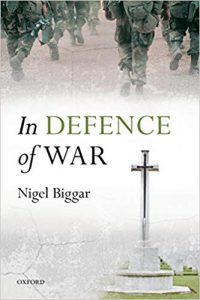
At the foot of the same page, Drayton takes me to task for appealing “repeatedly” to Peter Hart’s The IRA and its Enemies: Violence and Community in Cork, 1916-1923.13 He complains that I do so “without noting the accusations of academic fraud raised by its critics, nor any alternative histories of that crisis,” and he cites a fine 2018 article by Ian McBride (pp. 149-50 and 155n.50). In fact, I have referred to Hart’s work on just two occasions. In In Defence of War, I used it to illustrate what I take to be another general truth that, once articulated, is obvious—namely, that violent revolutionary movements tend to be populated by young, unattached, and often frustrated males.14 That is not, I think, controversial. Then, in Between Kin and Cosmopolis, I invoked The IRA and its Enemies, in order to substantiate two historical claims: that the behaviour of the British “Black and Tans” during the Republican insurgency had the counter-productive effect of causing most Irish people to transfer their loyalty to nascent Republican institutions; and that the IRA’s campaign of assassination and guerrilla war was “less than scrupulously discriminate.”15 Again, the first claim is not disputed. The dispute focuses on the support that Hart gave the second claim, when he concluded that the killing of Protestants in Dunmanway and the Bandon Valley in April 1922 was driven by “sectarian antagonism … interwoven with political hysteria and local vendettas.”16
What Ian McBride concludes about the controversy over what he call’s Hart’s “brilliant, prize-winning monograph … remarkable for its combination of quantitative as well as qualitative research … [which] was hailed, with much justice, as an instant classic,”17 is this. On the one hand, there is “the obvious and easily substantiated fact that the Bandon Valley killings were not typical of the IRA campaign as a whole.”18 On the other hand:
It is possible that the Bandon Valley killings saw a number of scores impulsively settled at a time when local IRA volunteers were not only free from the control of their commanders but knew there was little prospect of retaliation from crown forces. None of the elaborate disagreements over Hart’s scholarship affects fundamentally his profoundly disenchanted picture of revolutionary violence as “an intimate war,” driven by tit-for-tat cycles, or as directed at unarmed individuals kidnapped or killed near their own homes.19
When all is said and done, then, the only qualification that the controversy over Hart’s work might require of my use of him is the addition of the word “sometimes” to the beginning of my phrase, “less than scrupulously discriminate.” Drayton’s complaint is almost completely irrelevant and amounts to pedantry, not argument.
The truth is that Drayton never really argues at all. He never takes what I actually say and wrestles methodically with its reasons. Instead, he fabricates caricatures that can be brushed aside without further comment. So, for example, he tells us that Biggar makes “an ethical case for torture, or as he prefers to call it, ‘aggressive interrogation’” (pp. 144, 148). But I don’t. On the contrary, I distinguish between torture and aggressive interrogation, and argue that there should be absolute legal right against both, even though there might be a rare case where aggressive interrogation is morally justified.20
Then he reports that I argue “in defence of the killing of wounded combatants on the battlefield as an ethical option (since Afghan rebels have no modern medical care), but against euthanasia within the West, because here we have the means to cure and relieve pain” (p. 144). But this fumbles the exact point, implying that my distinction is between medically primitive Afghanistan and the medically sophisticated West, and hinting that it is racist. However, the distinction I actually make is between uncivil conditions and civil ones: what may be permitted in the extra-ordinary, uncivil conditions of war should not be normalised in the civil conditions of peacetime.
On another occasion, Drayton, noting that I was born just fifty miles west of the birthplace of Thomas Carlyle, asserts that:
Biggar’s … pro-empire violence apologetics, and his closely linked “just war” arguments and justifications for torture, are certainly in continuity with how Carlyle … found fine words to defend the brutal repression of the Morant Bay Rebellion in Jamaica in 1865 when British troops killed 439 people, flogged hundreds with cat-o-nine tails made up mostly of brass piano wire, killed pregnant women, even smashed babies’ heads. (p. 148)
Keep reading
How to Suppress Men’s Writing
Back to the Dark Ages

Prison or Peer Review

France’s Imaginary Austerity
The Limits of Perfectionism