Art & Culture
Groups, Groups, and the IDW
John Nerst suggests that what is actually at issue is whether the discussion of the racial IQ gap is a matter of science or of politics.


Over the past year or so, Sam Harris and Ezra Klein spent several tweets, a dozen emails, and a two-hour podcast vehemently disagreeing with one another. The ostensible cause of this disagreement was a dispute about whether or not there’s a genetic component to the black-white IQ gap in the US. However, neither was willing to commit to a concrete position on the issue. Both danced around the actual claim while deferring to various experts who may or may not suggest that a genetic component is more or less probable.
Did they disagree about Charles Murray? In the podcast, Klein says that he opposes Murray’s social policies but allows that Murray is “a lovely guy interpersonally” who should not be silenced. Sam Harris agrees that Murray is a good guy who shouldn’t be silenced but caveats that “his social policies are not social policies I’m advocating.”
So, what are these men actually disagreeing about?
In a thorough analysis of the Harris-Klein controversy, John Nerst suggests that what is actually at issue is whether the discussion of the racial IQ gap is a matter of science or of politics. Harris sees Murray as a scientist whose arguments and conclusions fall well within the academic consensus of genetic and cognitive science. Klein sees Murray as a ‘policy entrepreneur’ who advocates for reprehensible conservative policies. The notion that racial differences are genetic (and, in Klein’s understanding, therefore immutable), Klein argues, has historically been used to support destructive policies of bigotry and discrimination.
This isn’t merely a difference in emphasis. Underlying this debate is a divergence in modes of thought so wide that the two men were left practically at cross-purposes.
Harris is a scientist by training, and scientists depend on what rationality researcher Keith Stanovich1 calls “cognitive decoupling.” Decoupling separates an idea from context and personal experience and considers it in the abstract. It is the approach used in the scientific method, when performing thought experiments, and when generalizing principles from individual examples. In decoupling thought, arguments follow one another according to the formal rules of deductive logic.
The contrary mode of thinking sees every argument embedded in a particular context. The context of an idea includes its associations, implications, and the motivations and identities of those who advance it. In a lengthy written response to Harris published before their podcast, Klein makes use of all of the above:
The belief in black deficiency has been instrumental. It was used to justify slavery and to quiet moral qualms over unyielding oppression and violence.
(Association)
If the disparities we see in American life are the result of an intrinsic inferiority on the part of black Americans, then that diminishes the responsibility white Americans have to correct those disparities.
(Implications)
This also feeds into Murray’s proposal to devolve the entirety of the government’s social supports into a more regressive version of a universal basic income.
(Motivation)
For two white men to spend a few hours discussing why black Americans are, as a group, less intelligent than whites isn’t a courageous stand in the context of American history; it’s a common one.
(Identity)
To put this simply: You cannot discuss this topic without discussing its toxic past and the way that shapes our present.
(Context)
Klein is a political journalist. In politics, one rarely encounters an argument posed as a neutral thought experiment or research query. If a subject is under discussion, the arguments marshaled by both sides are usually advocacy in the service of one group or another. A political thinker always sees ideas in context, and the most important context is: who does this argument benefit and who does it disadvantage?
This pattern should be familiar to Quillette readers who have followed the adventures of the Intellectual Dark Web. The IDW is a nascent group of thinkers mainly composed of high- decoupling scientist types, like Jordan Peterson (Ph.D.), Steven Pinker (Ph.D.), Christina Hoff Sommers (Ph.D.), Bret Weinstein (Ph.D.), James Damore (dropped out of a Ph.D. program to join Google), and, of course, Sam Harris (Ph.D.).
IDW members attempt to discuss highly charged issues like gender and race differences, material progress, free speech, or religious belief in a dispassionate way. In response, contextualizing journalists (almost universally from non-science backgrounds) accuse the IDWs of being against some group or other: against trans people, against women, against blacks, against Muslims, and so on. The IDWs are indignant. “We’re not against anyone,” they retort, often from the pages of this very magazine. “We’re just looking at the data.”
If these were simply disputes over facts, there would be no need for vitriol: each side could just point to the evidence that has persuaded them to date, and describe the weight of future research needed to convince them otherwise. Instead, these conflicts create the impression of two alien species speaking different languages, utterly incapable of comprehending, let alone adopting, one another’s point of view.
There are two main reasons why contextualizers and decouplers clash: they each see the other’s mode of thinking as both hypocritical and self-defeating.
To a decoupler, contextualizers are fighting a losing battle against facts. If Klein’s stance on the racial IQ gap doesn’t depend on science, and his moral ideology depends on that stance, then science threatens his morality. Papers on the genetics of intelligence are published every other month. Who would defend a morality that can be discredited by a single study?
Defending a position without regard for the evidence supporting it is at best a failure to think straight, and at worst a naked power grab. It looks even worse when someone simply assumes that the research is on their side, but can’t be bothered to actually check. Back in late 2015, I published an analysis of an article in FiveThirtyEight in which Hayley Munguia had claimed that “Banning affirmative action hurts Hispanic enrollment.” But in making her case, Munguia managed to ignore two rather important points:
- The data presented in the article itself showed no effect of affirmative action on Hispanic enrollment.
- Hispanic high-school graduates enroll in college at higher rates than white graduates.
Munguia’s article offered no support to Hispanic students, it was simply a defense of affirmative action and, by extension, any political party prepared to support that particular policy. A contextualizer will usually invoke higher motives, such as aiding the oppressed. But, in reality, they are simply promoting their in-group. So runs the decoupler argument.
To a contextualizer, decouplers are allowing themselves to be manipulated. Science is biased by the motivations of scientists, and decouplers betray their lack of morals when they surrender to odious ideologies cloaked in a veneer of scientific authority. The initial response to Harris published at Vox called him “the latest to fall for Murray’s junk science about race and IQ.”
Decouplers rarely admit to being driven by tribalism or identity politics, but the virtues of decoupled and ‘rational’ thought are promoted mainly by white and Asian men who are good at math. They congregate in places like Silicon Valley and Wall Street, which seem to enrich white and Asian men who are good at math while ignoring the concerns of the rest of the world. The libertarian policies they promote are also suspiciously attuned to the needs of rich, educated people like themselves.
 B Winegard and B Winegard with B Boutwell and TK Shackelford
A decoupler can always claim higher motives, like the objective pursuit of truth. In reality, they are simply promoting their in-group. So runs the contextualizer argument.
So who, then, are the real hypocrites?
Robin Hanson (Ph.D.) is a black-belt decoupler. He says his main drive in life is intellectual curiosity and insight, and his insights have in turn earned him the scornful ire of journalists. But according to Hanson’s recent book, The Elephant in the Brain, we are all hypocrites, and most of the time we’re not even aware of it:
Our brains are built to act in our self-interest while at the same time trying hard not to appear selfish in front of other people. And in order to throw them off the trail, our brains often keep “us,” our conscious minds in the dark.2
And what are these selfish motives? Sex, status, power—motives which often share the instrumental goal of allying people with powerful groups, and of convincing these groups of our loyalty.
To be persuasive, we need to send signals that are costly. Cheap signals can easily be faked by those who don’t actually possess the desired attribute in question, such as loyalty. Quietly expressing one’s admiration for the group is cheap. Instead, the best signal of commitment to an in-group is attacking the out-group, loudly and publicly. To understand people’s hidden motives, therefore, one must understand who their out-group is.
In an essential inquiry into out-group hostility, Scott Alexander noted that out-grouping isn’t purely reciprocal. The chart below offers a handy-if-simplified picture of groups and out-groups in America. Everyone’s out-group is, perhaps not surprisingly, the group just outside them. Anyone further than one layer outward isn’t important, and any hostile group inside one’s tribe is presumed to be in league with the external out-group.
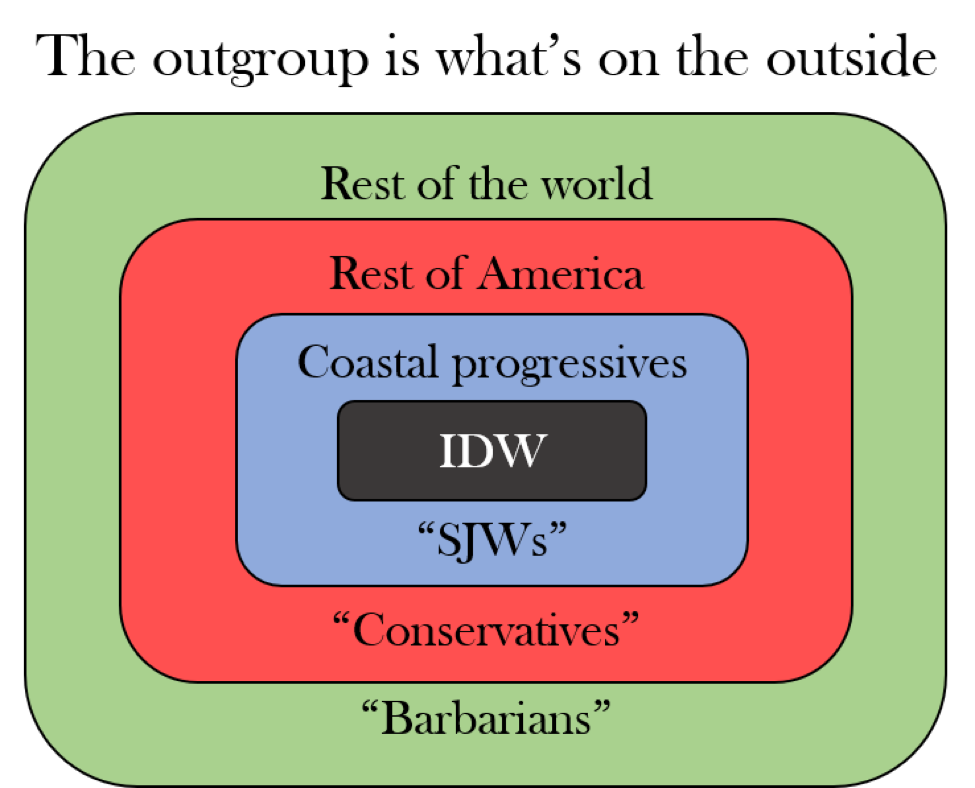
In most parts of America, ‘American exceptionalism’ is a point of pride. These people prefer traditional American culture, American football, BBQ, and country music, and are hoping to conserve it. Conservatives’ main out-group is foreigners who threaten the American way of life, e.g., immigrants and Muslims. They accuse American progressives of conspiring with the outsiders to sabotage American culture, which is how they end up writing articles arguing that soccer is a sign of the nation’s moral decay.
America’s coastal enclaves are mostly populated by educated urban progressives. They prefer cosmopolitan culture: soccer, sushi, Despacito. Their out-group is American conservatives. Any enemy of those conservatives is their ally, which is why they end up writing articles arguing that the killing of Osama bin Laden was vigilantism rather than justice.
And now another tribe has found its voice, and it has emerged from within traditional bastions of progressive thought like academia. This tribe comprises the Intellectual Dark Web and those who follow its thinkers on YouTube, Twitter, and Quillette. The members of this tribe are often educated and live in coastal cities, but they have no love for progressives or their ideology. In fact, aside from a decoupling mindset, this distaste for progressives seems to be the main thing uniting liberal atheists like Sam Harris with conservative monotheists like Ben Shapiro.
Although a number of IDW members self-identify as liberal, this signals a fidelity to ideas and not to the liberal ‘tribe.’ About criticizing one’s own tribe, Scott Alexander had this to say:
People do not have fun writing articles savagely criticizing their in-group. People can criticize their in-group, it’s not humanly impossible, but it takes nerves of steel, it makes your blood boil, you should sweat blood. It shouldn’t be fun.
The IDW loves to criticize progressives, and they have fun doing it. It’s not a coincidence that every conflict in which they end up embroiled is with progressives. Ross Douthat has plenty of criticism for the likes of Harris and Pinker, but it doesn’t seem to sting quite as much as Klein’s does.
The progressive tribe’s journalists love to disparage members of the IDW as ‘conservative’ or even ‘alt-right,’ but that’s because each group understands the world mainly in the context of their out-group: if you’re not with us, you’re the out-group. These accusations are entirely off-the-mark; even the ideologically conservative members of the IDW have little to do with the football-BBQ-country tribe, let alone white nationalism. But the IDW’s out-group is, quite clearly, those journalists on the ideological Left.
The IDW isn’t against women, or blacks, or trans people, or Muslims. It is opposed to progressives and the doctrines that bind the progressive tribe together.
Having an out-group doesn’t make the IDW wrong or evil or conservative. But if the IDW’s calling card is an unflinching pursuit of truth, then picking fights isn’t necessarily helpful to that mission. This is what made Alice Dreger decline her IDW member’s card:
[The IDW] regularly made progressives angry with “politically incorrect” statements about gender, race, genetics, and so on. This troubled me the most—that one might think of pissing people off as an inherent good, a worthy end. […]
Opinion is not scholarship, it is not journalism, and we are dying for lack of honest, fact-based, slow inquiry. […]
I don’t see it as a sign of intellectual progress when a bunch of smart people find a way to make money off of niche political audiences by spewing opinions without doing much new research.
Life would be a lot easier if discerning the truth of a complex scientific issue simply required someone to ask progressives for their opinion and then believe the opposite. Unfortunately, reversed stupidity is not intelligence. As Keith Stanovich noted in his own Quillette article, there isn’t much to distinguish the two political parties in their willingness to accept or deny scientific facts.
Keep reading
How to Suppress Men’s Writing
Back to the Dark Ages

Prison or Peer Review

France’s Imaginary Austerity

The Limits of Perfectionism