Economics
Universal Basic Income — A Threat to Tyranny?
In the suggested world of universal basic income, what puts pressure on the government to maintain democracy and political rights?
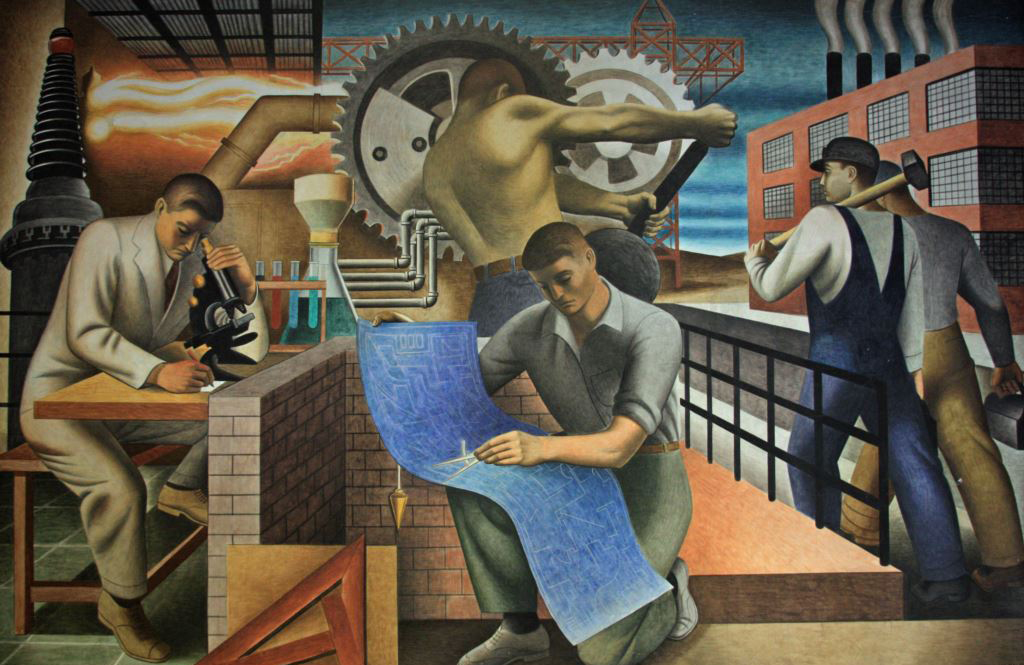

Much praise has been heaped on the idea of a universal basic income in recent years. Experiments have begun in many countries, some mainstream politicians are starting to advocate it, and if we listen to many thinkers, especially among the Internet and tech crowds, it seems like our inevitable future. This is quite understandable, as the idea attempts to solve a real problem: with the advance of technology, fewer and fewer people are required to produce the amount of wealth required to sustain more and more people. Rather than invent more and more artificial jobs and scarcities, why not just accept the reality of this changing world, where not all people are needed for working, and instead release them to pursue their hobbies, studies, or charity?
There has been criticism of the idea, but so far the debate tends to focus on two issues: the economic reasoning behind a universal basic income, and the ethics of allowing a majority of non-workers to live off the fruits of the labour of a small minority. What is not discussed enough, however, are the political implications–what would a universal basic income do to the relations between citizens and government. Because when we examine historical trends in politics and economics, we can spot a basic pattern: political rights are strongly correlated with economic participation. Societies where the state economy depends on small inputs from many different citizens tend to give their citizens significantly more rights, including the right of participation in the government itself. Societies where the state economy comes from natural resources, or other sources that require only a small, fixed number of people to defend or maintain them, tend to develop autocratic regimes with little concern for the welfare of their citizens.
This is far from a new observation. Already in classical Greece, Plato reached the same conclusion about the Greek city-states, though in his time the main factor was military more than economic. He observed that city-states with a military based on hoplites (elite infantry who came from the upper classes of society, mostly through the requirement that they finance the expensive armor and equipment for themselves, meaning poor people could not be included) tend to develop an oligarchic government; city-states whose army was based on warships (which in those days required a great number of rowers, a job which did not require much equipment or training, therefore was available for the lower classes) would develop democracy.
Similar trends continue wherever we look: European feudalism developed in fertile lands, where mostly independent farmers grew their crops and needed nothing but protection from violence, which they got from their decentralized states, led by weak kings who depended heavily on more and more layers of nobles and professionals who could assert their rights; to the East, meanwhile, the dry lands of Mesopotamia and Egypt required large-scale irrigation projects to cultivate, which could not be done by single families – they depended on the state to create them, and those states developed centralized, absolute monarchies.
We don’t have to go back to ancient history to see this trend – these days we have many countries in the world whose incomes are based on extracting resources from the ground, requiring little to no participation from the common people. Which countries are functioning democracies, and which are autocracies? The World Bank gives us a list of countries ordered by what percentage of their merchandise exports comes from fuels. At 50% or more we find, in this order: Iraq, Angola, Algeria, Brunei, Kuwait, Azerbaijan, Qatar, Saudi Arabia, Kazakhstan, Russia, Oman, Norway, Colombia, Bolivia and Bahrain. Can we notice a trend? How many of these countries provide a good set of political rights for their citizens?
 Quillette
This should not be surprising. This pattern is not often discussed, as it conflicts the image we like to have of political rights as being the result of enlightenment and struggle, of the heroes of our past who overthrew despotic regimes and created a better world for everyone. But reality, unfortunately, seems more cynical than that. We do not get our rights because we deserve them, or even because we fight for them – we get our rights because the government needs us. It is a common hope that countries that escape poverty will move on to adopt democracy, and this indeed happened in some notable cases, like South Korea or Taiwan. But South Korea and Taiwan became rich from industry, which means their wealth came from the work of their citizens; meanwhile, Qatar or Angola became rich from natural resources, and their political situation became no better. A country that generates its wealth from its citizens has no choice but to keep those citizens happy, at least to some degree; a country that generates its wealth from oil wells, only needs to keep a handful of mercenaries happy as they guard the access to those wells.
And this is the real danger of a universal basic income – it makes the citizens unnecessary to the government. In the suggested world of universal basic income, what puts pressure on the government to maintain democracy and political rights? Will they be afraid of a popular uprising? The people have nothing to threaten them with. A person who does not pay taxes cannot threaten to stop paying them. Violent revolution? History shows that governments tend to be significantly better than common people in using violence. All the citizens have left is the good will of the people in power, which can last for one or two generations, but past examples give little reason to be optimistic about long term sustainability. We have no shortage of examples from recent years – how much of the “Arab Spring” was made of people demanding political rights from governments who had no need for them? If tens of thousands of people in an industrial country start an uprising, it can paralyze the national economy and create serious problems for the government. If millions of people start an uprising in an oil state, what can they do? Unless they have support from some external force, as in some examples we have seen in recent years, they will be no more than a nuisance for a heartless regime. We might wish that were not the case, but the world is full of dead protesters and revolutionaries who say otherwise.
Keep reading
How Genetics Rewrote History

Equal Pay, Unequal Work

The Genetics of Crime and Punishment

Jerry Kaplan on AI Doomers