Politics
Genocide and Its Jurors
In 1967, left-wing intellectuals accused America of genocide in Vietnam—they were wrong then, and they’re wrong again now.
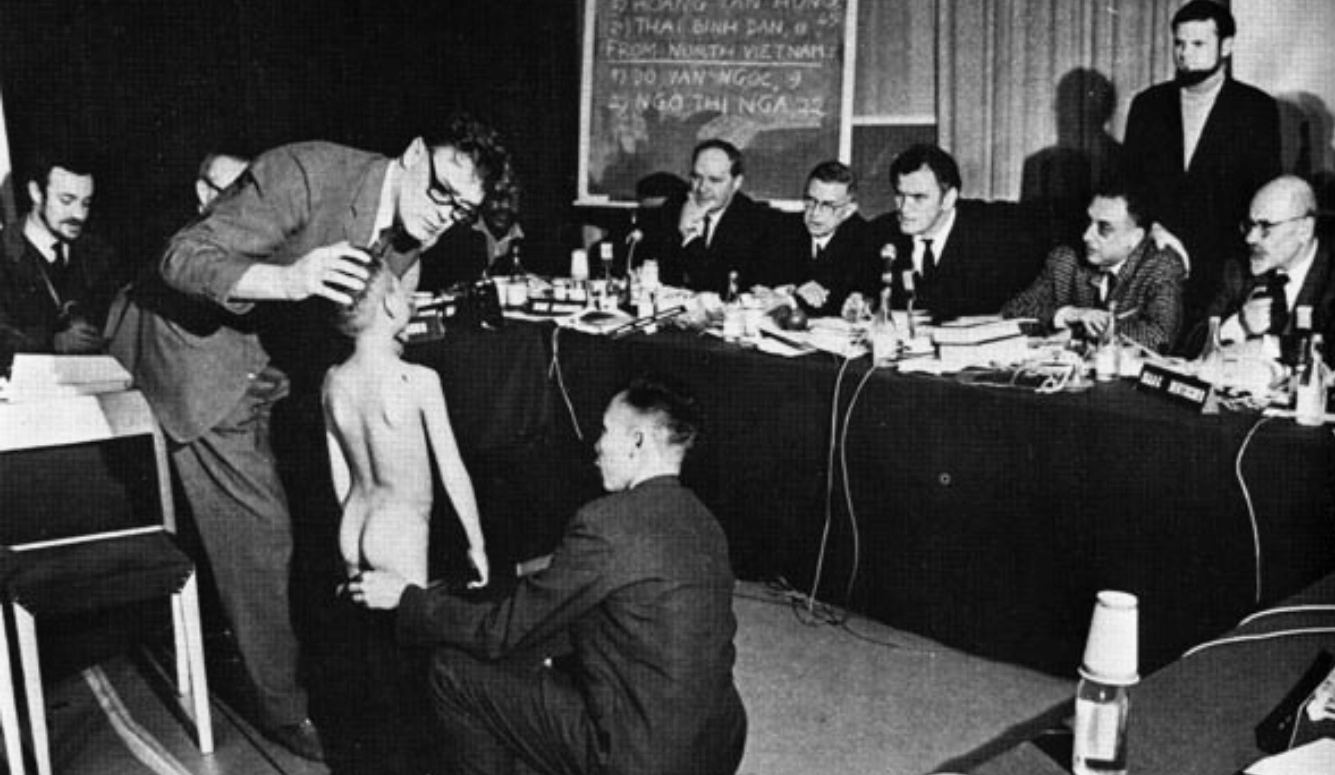

On a November afternoon in 1967, at a hall in Roskilde, Denmark, a panel of the most celebrated left-wing intellectuals in the world delivered a unanimous verdict at the second session of its “International War Crimes Tribunal”: the United States government was perpetrating a genocide against the people of Vietnam. The event was organised by Bertrand Russell, and Jean-Paul Sartre had spent months building the legal case. The tribunal’s investigators had made five fact-finding trips to Vietnam, where they collected testimony and documents, and assembled reports on everything from the origins of American intervention to the use of fragmentation bombs and the destruction of civilian areas.
By the time the tribunal convened for its first session in Stockholm in May 1967, its organisers had amassed the work of more than 150 activists and investigators. Sartre opened the proceedings; Simone de Beauvoir sat on the jury. Over the following months, the tribunal would hear reports from Vietnam and Cambodia, testimony from Vietnamese civilians, and evidence concerning American bombing, torture, forced displacement, and the mistreatment of prisoners. Bertrand Russell—who was by now 95 years old and too frail to attend—had his address read aloud in absentia. He later wrote in the introduction of the published proceedings:
I hope that the peoples of the Third World will take heart from the example of the Vietnamese and join further in dismantling the American empire. It is the attempt to create empires that produces war crimes because, as the Nazis also reminded us, empires are founded on a self-righteous and deep-rooted belief in racial superiority and God-given mission. Once one believes colonial peoples to be untermenschen—“gooks” is the American term—one has destroyed the basis of all civilized codes of conduct.
The tribunal was funded by the North Vietnamese government. Russell had personally requested this from Ho Chi Minh. Political activist Staughton Lynd—chairman of the 1965 “March on Washington” and a staunch opponent of the war—rejected Russell’s invitation to join the tribunal, once it was made clear to him that Russell and the rest of the tribunal would not be investigating Viet Cong atrocities. The violence of the oppressed, he was told, could not be judged by the same standard as the violence of the oppressor. As Lynd recalled in an essay published that year in an issue of Liberation:
In conversation with the emissary who proffered the invitation, I urged that the alleged war crimes of any party to the conflict should come before the Tribunal. After all, I argued, a “crime” is an action that is wrong no matter who does it. … I asked, “What if it were shown that the National Liberation Front of South Vietnam tortures unarmed prisoners?” The answer, as I understood it, was, “Anything is justified that drives the imperialist aggressor into the sea.” I declined the invitation to be a member of the Tribunal.
Sartre believed that the destruction caused by the war proved that the United States intended to destroy the Vietnamese people. Still, he knew that genocide was different from simply committing atrocities on a vast scale. Article II of the 1948 UN Genocide Convention—which he explicitly relied on in his address delivered during the tribunal’s verdict, titled “On Genocide”—required an intention to destroy a national, ethnic, racial, or religious group “as such.” The obvious problem, as Sartre acknowledged, was that the American government had never announced such an intention. Hitler, he noted, had “proclaimed it his deliberate intention to exterminate the Jews.” The Nazis had not hidden the fact that Jews were being killed because they were Jews. But the American government was different, he wrote, and had “avoided making such clear statements.” Still, he maintained that the absence of an explicit declaration did not undermine his verdict. “Is it possible for us,” he asked, “by studying the facts objectively, to discover implicit in them such a genocidal intention? After such an investigation, can we say that the armed forces of the United States are killing Vietnamese in Vietnam for the simple reason that they are Vietnamese?”
American leaders said that they were responding to North Vietnamese aggression, and that their primary objective was to contain the communist insurgency in the South. Sartre dismissed this explanation as an “absurdity”: the American government, he insisted, was “plotting, misrepresenting, lying and self-deceiving” and becoming “more deeply committed every instant” to a course “leading it to the point of no return.” A counterinsurgency campaign against a “people’s war” could not succeed by any means short of destroying the society that sustained it, since in Sartre’s perspective, the guerrilla and the population were functionally the same thing. The absence of an American order to exterminate the Vietnamese was therefore not exculpatory, because—in Sartre’s view—the war’s violence itself was confirmation of the imperial and colonial logic he believed drove “the American empire.” Once Sartre had decided that the war was an imperial and colonial project, he saw its destruction of Vietnamese society as evidence of that project’s true purpose. And if the ultimate purpose of American power in Vietnam was to destroy the Vietnamese as a people, there could be no question that the war itself was genocidal.
Once Sartre had decided that the war was an imperial and colonial project, he saw its destruction of Vietnamese society as evidence of that project’s true purpose.
This was not the first time that the United States found itself accused of genocide by the international Left. As early as 1951, the Communist Party-affiliated Civil Rights Congress accused the US government of committing genocide against black Americans. The UN Genocide Convention was barely operational, since it had only been legally in force for less than a year. Even so, leftist groups were quick to repurpose it as an ideological weapon. In 1952, North Korea and China accused the United States of perpetrating a genocide against Korean and Chinese civilians through the use of biological warfare. This accusation was amplified by the International Association of Democratic Lawyers, an organisation run by the Kremlin-controlled World Peace Council.
 Benny Morris
It didn’t take long for Soviet propaganda to begin branding Israel as a genocidal and fascist state during the Cold War, in an attempt to undermine American and Western-aligned interests in the Middle East. In 1975, the Soviet bloc, Arab League, and Non-Aligned Movement pushed Resolution 3379 through the UN General Assembly, which declared Zionism to be “a form of racism and racial discrimination.” During Israel’s 1982 invasion of Lebanon, the Soviet government issued an official statement in which it announced that “Israel is committing a criminal act of genocide in Lebanon,” and that Israeli forces “are in fact exterminating the Palestinians en masse.”
The Left continues to employ the word “genocide” as an ideological weapon to this day. Just last month, the Democratic Socialists of America accused secretary of state Marco Rubio of “leading a genocide” against Cuba over the US embargo. And Briahna Joy Gray, Bernie Sanders’s former 2020 campaign press secretary, recently tweeted that Brian Thompson, the murdered CEO of United Healthcare, was culpable for “corporate genocide.” But the most ubiquitous target of this accusation is now Israel. Before Israel had even launched its ground invasion of Gaza, and before there was any evidentiary record of Israel’s military campaign, many leftist groups were already describing Israel’s response as genocide. On 8 October, just a day after Hamas’s massacre and kidnappings, thousands of demonstrators gathered in New York’s Times Square in an “All Out for Palestine” rally to support “Palestinian resistance.” The rally had been organised by the People’s Forum, a self-described socialist organisation with direct ties to the Marxist-Leninist Party for Socialism and Liberation. They later released a statement about the protest, in which they said:
We understand that we have a unique role to play in combating material support for Zionism, and weakening the handmaiden of U.S. global imperialism. … As politicians, government officials, and media outlets ramp up efforts to manufacture consent for genocide against Gaza, we take to the streets to show the people of Palestine that they are never alone.
Within days, other organisations were issuing statements describing Israel’s unfolding military response as genocide, situated within a pre-existing theory of Israel as a colonial project that had produced genocidal dehumanisation.
The problem with the Russell Tribunal’s 1967 verdict—as Staughton Lynd’s remarks implied—is that it did not arrive at its conclusion from the evidence before it, but from a pre-existing ideological commitment to the Vietnamese communist cause. This led its members to excuse or ignore the crimes of the Viet Cong, while treating American violence as evidence of genocidal intent. The radical left-wing intellectuals that gathered in Stockholm and Roskilde had spent years describing the United States as an imperial power and the North Vietnamese struggle for communism as a war of “national liberation.” Because the tribunal already viewed America as an imperial power bent on dominating the Third World, it interpreted the destruction in Vietnam as proof of that imperial goal. The tribunal’s central political premise—that is, its view of the West—preceded its “legal” conclusion.
More than half a century later, prominent academics, human-rights organisations, activists, journalists, and public intellectuals—many of whom extend the same interpretive charity to Hamas that their predecessors extended to the Viet Cong—describe Israel’s conduct as genocidal. On 16 September 2025, a UN Commission of Inquiry concluded that Israel was committing genocide in Gaza; other prominent left-wing organisations and scholars have reached the same conclusion. Yet, Karim Khan, then the ICC’s Chief Prosecutor, admitted during an interview with Mehdi Hasan that the evidence before his office did not establish grounds to charge Israeli leaders with genocide. To the contrary, abundant evidence demonstrates that Israel has repeatedly issued evacuation warnings, established evacuation routes, negotiated temporary ceasefires and hostage releases, and facilitated the entry of humanitarian aid into Gaza, even as it struggled to fight a war in densely populated areas.
Russell, Sartre, James Baldwin, Tariq Ali, Simone de Beauvoir, and other intellectuals who either attended the 1967 tribunal or publicly supported it began with a theory of American imperialism and Third Worldism. Today, the Gaza genocide calumny arises from the conviction that Israel’s stated objective of defeating Hamas is an ideological pretext for destroying the Palestinian population, due to Israel’s inherent “imperial” and “colonial” nature. But the overwhelming historical consensus today is that the Vietnam War was not a genocide. Nor was the Korean War, or the First Lebanon War, or Jim Crow racism. Whatever war crimes were committed in Vietnam—and there were many—the prevailing historical interpretation is not that the United States sought to destroy the Vietnamese people as a group. The tribunal’s genocide finding never became the accepted historical characterisation of that war. Russell and his tribunal received considerable criticism for their position at the time, but as the war itself receded into history, the tribunal’s “genocide” finding largely disappeared from mainstream and scholarly discussion about Vietnam. History is likely to judge today’s genocide verdict the same way it judged the last one.
Quillette invites thoughtful responses to its essays.
Selected responses are published once per week as part of a curated Letters to the Editor feature. If selected, letters appear under the contributor’s real name and may be edited for clarity and length.
To submit a letter for consideration, please email [email protected].
Keep reading
They Walked in Line
Anti-Catholic Social Panics, Then and Now
A Dishonest (and Dangerous) Nobel Laureate

Common People
How Genetics Rewrote History