History
Omer Bartov: What Went Wrong?
A distinguished historian of the Holocaust views Israel through the wrong prism.

A review of Israel: What Went Wrong? by Omer Bartov; 243 pages; Farrar, Straus and Giroux (April 2026)
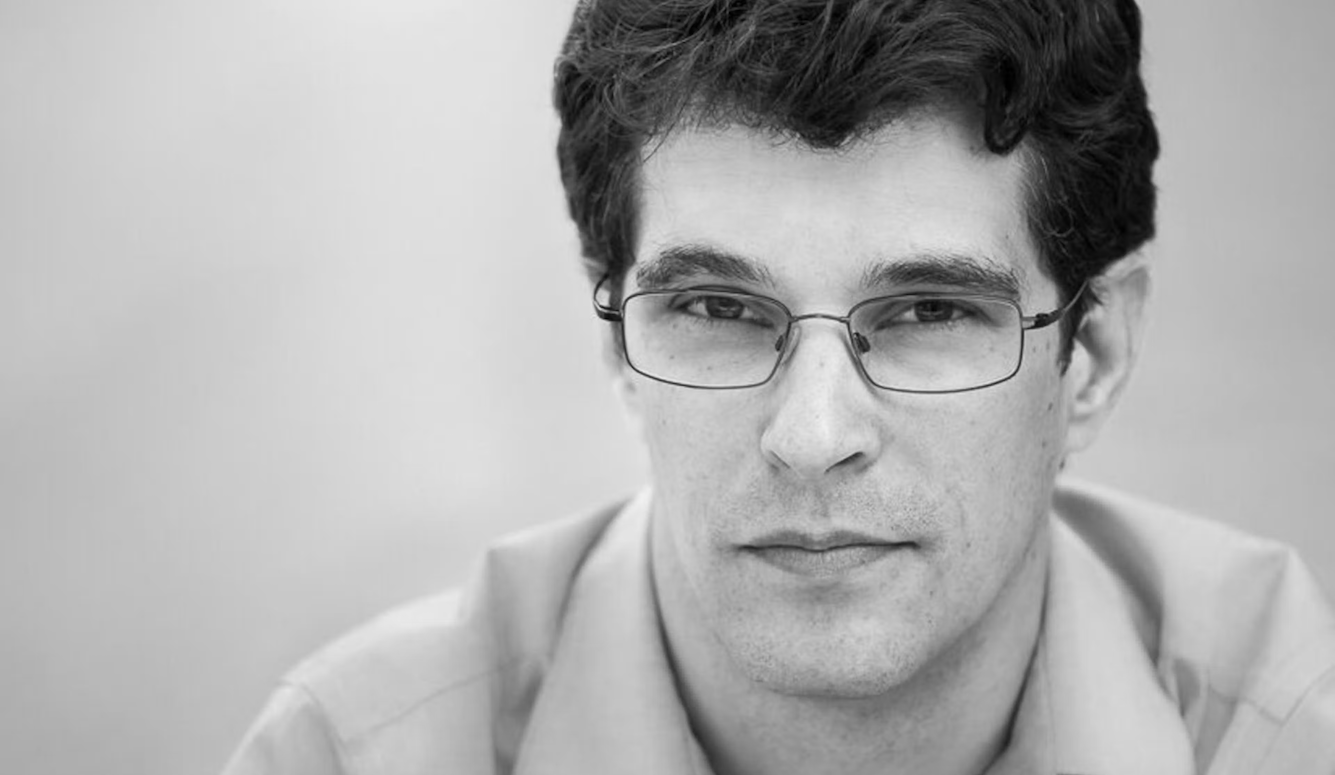
Omer Bartov, a prominent historian at Brown University, was born to a solidly left-wing Zionist family in Kibbutz ‘Ein Hahoresh, south of Haifa, in 1954. (By chance, I was also born in ‘Ein Hahoresh, six years earlier; also by chance, both of us did our IDF service in the Nahal (Infantry) Corps and both at some point were wounded. And both of us did our PhDs in Oxbridge in European history).
Omer’s father, Hanoch Bartov, was born in Palestine in 1926 to Polish Jewish immigrants and joined the Haganah, the Jewish community’s militia, at the age of 13. During the Second World War Hanoch served in the British Army in Europe. In 1948 he fought with the Haganah/IDF and was wounded in Jerusalem. After the war he turned into a full-time writer and journalist, publishing nine novels and a variety of other works, including a two-volume biography of the IDF’s chief of general staff in the 1973 Yom Kippur/October War, David (“Dado”) Elazar. Hanoch won the Israel Prize for literature in 2010 and died in 2016 (he once told an interviewer that he refused to die before getting the Israel Prize, Israel’s highest award).
Omer Bartov dedicated Israel: What Went Wrong? to the memory of his father, whom he called “the Last Zionist.” Omer writes that his father had “insisted with growing vehemence that Benjamin Netanyahu was the great destroyer of Zionism.” But Hanoch, I am sure, would not have approved of this hyper-critical take on Israel’s history, as he had not approved of his son’s emigration to the US in 1988–1989. (Omer devotes a terse sentence to the matter—Hanoch was “never quite reconciled with my departure from Israel.”) Traditionally, Zionists referred to emigration from Palestine/Israel as yerida (a descent), as opposed to immigration to the Holy Land, aliya (an ascent). Yerida carried a tinge of betrayal, though today emigrating from Israel—and tens of thousands have left the country these past three years under the impact of the war—generally carries no emotional-judgmental baggage. But I have often found Israelis who long ago moved to America spouting criticism of Israel with great vehemence, perhaps in retroactive “justification” of their yerida.
Omer Bartov is a historian of the Holocaust and the travails of Eastern-Central Europe before, during and immediately after the Second World War. His path-breaking books on the German Army’s participation in the murder of Eastern Europe’s Jews (and millions of Slavs)—Hitler’s Army: Soldiers, Nazis, and War in the Third Reich (1992) and The Eastern Front, 1941–45: German Troops and the Barbarisation of Warfare (2001)—radically changed accepted wisdom about the Wehrmacht’s role in the Holocaust. But he has never produced scholarship on Zionist-Israeli history.
There are two basic ways of viewing the Zionist enterprise and its current condition: As a crime/mistake from origin, a colonialist venture designed to dispossess an indigenous people, inevitably by fire and sword, or, alternatively, as an absurd venture—planting a European polity in the midst of the tumultuous Arab and Muslim worlds—which could not but fail after successive wars and amid rivers of blood (like the medieval Crusader polities, which lasted a bare two hundred years). Or: Zionism was a noble cause and effort to provide the world’s most oppressed people with a safe and creative haven that might turn into a “light unto the Gentiles”—but which at some point took a “wrong” turn that blighted the enterprise and condemns it to an untimely demise.
The title of Bartov’s book, and much of its content, trends to the second alternative, that an essentially virtuous and logical project had, at some point, gone off the rails, gone profoundly and possibly irreversibly “wrong.”
But here and there Bartov also tends to the first bifurcated alternative—that Zionism was a crime or mistake from the first, an historically “wrong” turn ab initio. Already in his “Introduction” he writes: “Some would argue that what we watched with shock and horror [i.e., the 2023–2025 war in Gaza] was the inevitable consequence of Zionist settler colonialism set in motion in the late nineteenth century. In part, that is true … [In retrospect] the unfolding of events can be seen as inevitable.” Later he argues that Netanyahu’s expansionist policies “despite some crucial differences … [have] much in common with Zionist policies dating all the way back to the pre-state [i.e., pre-1948] period.”
Many readers will come away from reading this short book believing that is what Bartov really thinks even though he never says so in so many words. They will surely note his repeated use of the highly charged term “settler colonialism,” a description of Zionism highlighted by the crowds of know-nothing American and European students who mobbed streets and campuses after 7 October in support of Hamas’s assault on southern Israel.
 Paul Berman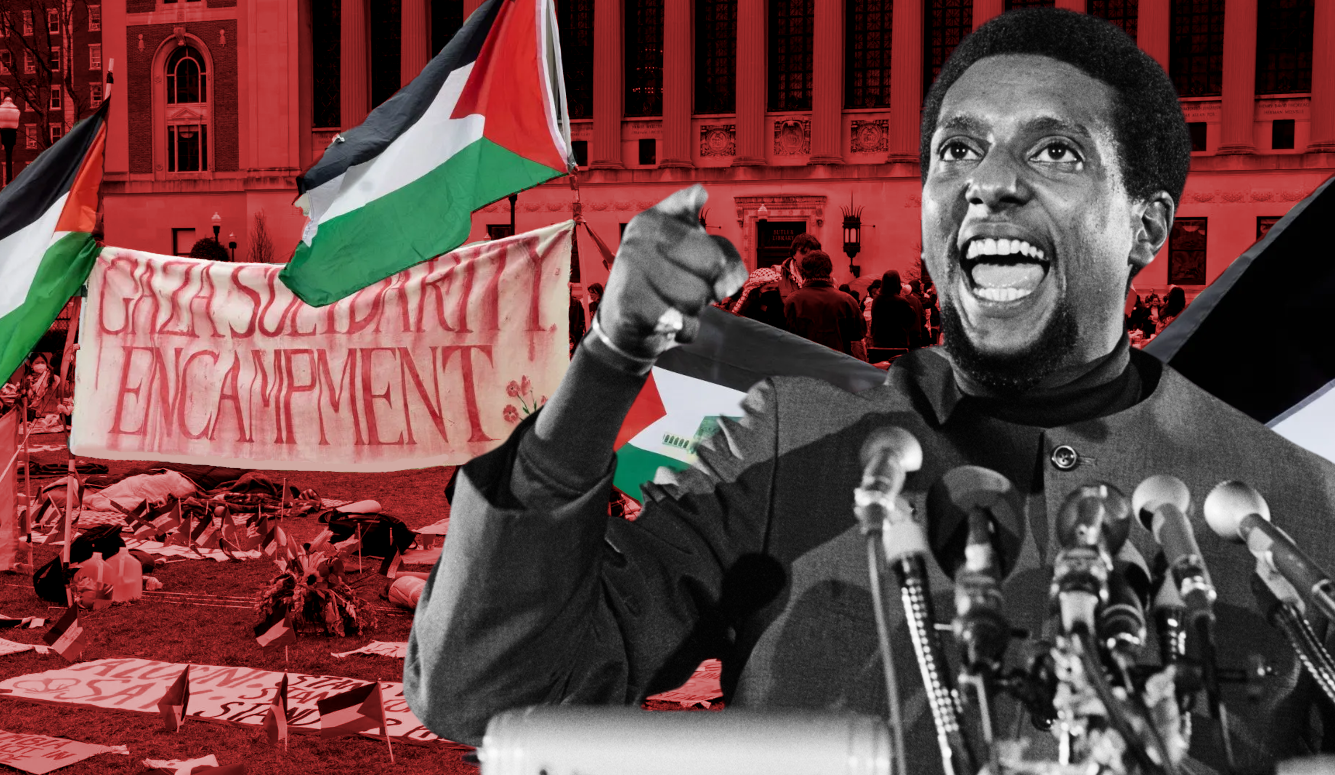
But let’s return to the book’s title (and much of its content) that implies that Bartov prefers the second alternative, that somewhere along the line Zionism, originally a sane and noble cause, had gone badly “wrong.”
Let me quickly say that, regarding Israel’s current “wrongness,” I unfortunately agree with Bartov. Israel has definitely—if not as yet definitively—gone “wrong”; Israeli society has grown progressively more religious, indeed messianic, right-wing, violent and callous, and unhinged.
National “wrong turns” traditionally are the result of long-term historical processes—political, demographic, economic and ideological—often compounded by a specific personal factor, such as the assumption of power by a mad or warped leader (vide Hitler or Stalin). And this, indeed, has been the case with Israel—very negative political and demographic trends compounded these past two decades by a government led and characterised by a corrupt and incompetent (albeit well-spoken) prime minister driven by personal more than national interests (Netanyahu is currently on trial on multiple corruption charges and, breaking all the rules, seeks to avoid spending his last days in prison, a very real possibility if convicted).
Benny Morris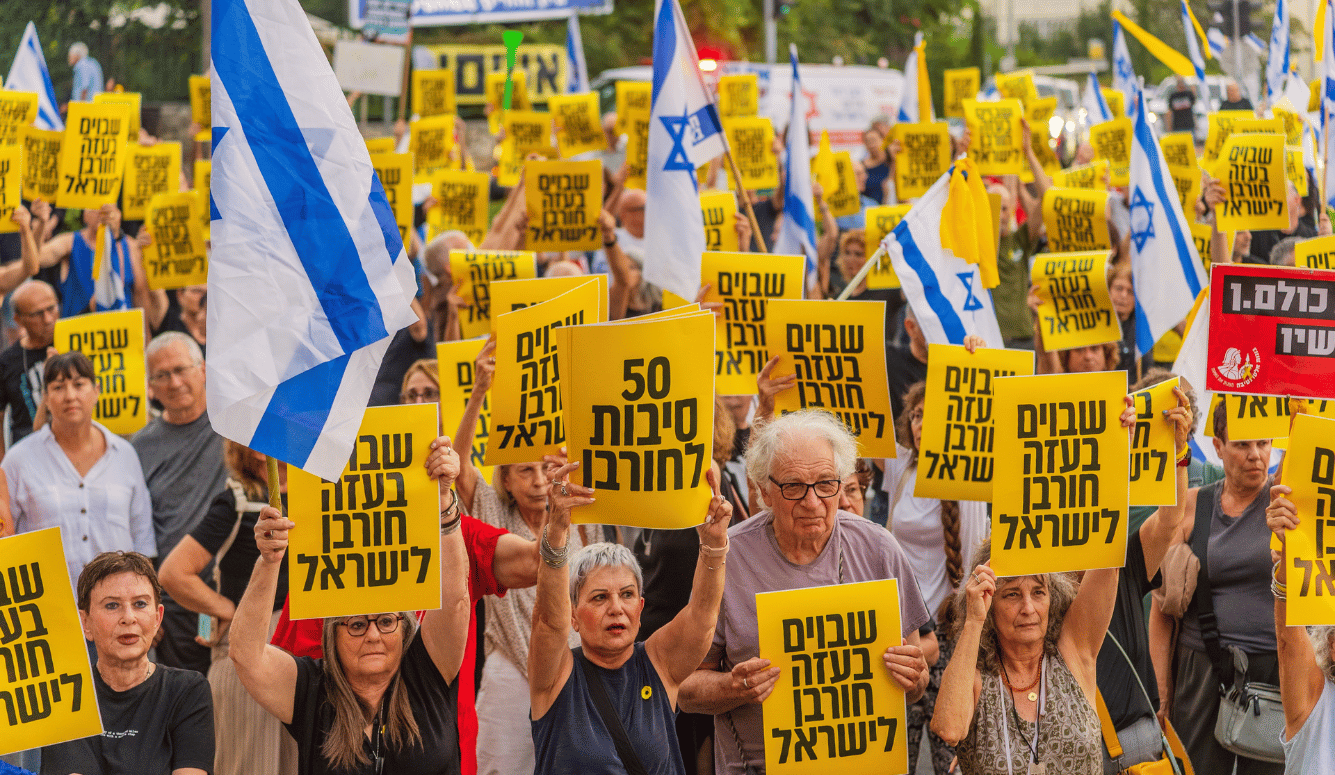
Unlike Bartov, most thinking Israelis will point to 1967—the Six-Day War and the start of the Israeli occupation of the Arab-populated West Bank, Gaza Strip and East Jerusalem—as the point at which the country began veering radically off track. That occupation, now characterised by full-blown apartheid features, bred a growing, increasingly violent, messianic-expansionist movement and gradually corrupted Israel itself. As well, this eroded the Jewish state’s legitimacy in the eyes of the international community, a development that came home to roost dramatically in the months after 7 October, 2023, when Israel, the victim of that day’s horrific Islamist onslaught (1,200 Israelis, mostly civilians, murdered, many raped, and 251 taken hostage), was almost instantly decried by many in the West as the aggressor.
Bartov, of course, touches on 1967 and the occupation as contributors to Zionism’s unfolding demise. But in effect, he focuses, in no fewer than fifty pages, on what he brands as the main cause: Israel’s lack of a constitution. For decades after 1948 Israel’s leaders and lawmakers struggled but failed to hammer out a constitution. They failed mainly because the country’s secular and religious parties could not iron out their differences over matters of church and state. According to Bartov, this prolonged absence of a constitution meant that no hard and fast assurances of basic rights to all citizens, Jewish and Arab, men and women, religious and secular, were (and are) in place, protecting, for instance, the Arab minority—21 per cent of Israel’s citizens—against discrimination and subaltern status.
Bartov’s argument is absurd on two counts. Count one, Israel’s Declaration (or “Scroll”) of Independence, from 14 May 1948, “ensure[d] complete equality of social and political rights to all its citizens irrespective of religion, race or sex.” Indeed, the Declaration—admittedly with questionable sincerity—even appealed to the country’s Arab inhabitants (in the midst of a war they had launched!) “to preserve peace and participate in the upbuilding of the State on the basis of full and equal citizenship and due representation in all…institutions.” Moreover, over the decades, the Israeli parliament, the Knesset, legislated a fistful of “Basic Laws” that theoretically buttressed the assurances proffered by the Declaration of Independence.
And count two, no constitution can assure basic rights if an authoritarian (or even a democratically-elected) government seeks to go its own way and discriminate and oppress. A case in point is the successive Soviet Russian constitutions which, while couched in enlightened language, failed to protect the country’s citizenry from oppression, mass incarceration, and mass murder by its government. Leaders and governments can and do discard constitutional promises at will, and the mere existence of a constitution would not necessarily have protected Israel’s Arabs or those in the occupied territories, or gender equality, or assured a policy of non-belligerency vis-à-vis its neighbours.
So Bartov argues that in the absence of a constitution Israel fairly quickly consolidated Jewish “supremacy” at the expense of Arab rights and the “Jewish nature” of the state at the expense of full-blown democracy. (Incidentally, as Bartov points out, the words “democracy” and “democratic” did not feature in the Declaration of Independence or in subsequent Israeli legislation before 1992).
Bartov pushes his arguments and descriptions to extremes not merited by history.
But Bartov pushes his arguments and descriptions to extremes not merited by history. For instance, he takes Israel to task for severely limiting the rights of its Arab citizens and imposing “military government” over them in the eighteen years following the 1948 War—while knowing that there was a real, reasonable fear that they might subvert and sabotage the emergent state that they had just tried to destroy. (Let me quickly add that Israel unjustly and unwisely exploited this military governance to confiscate land belonging to its Arab citizens and sway their voting “preferences” in successive general elections). But somehow Bartov leaves out the facts that under this military government, while Israel and its Arab neighbours were not at peace, the country’s Arab minority enjoyed basic rights such as the vote, and in 1966, at the end of those eighteen years, Israel removed the military government and its Arab citizens henceforward enjoyed full equality before the law.
But this is history (to which I will soon return). Bartov’s book actually focuses on the here and now or at least one segment of it, the IDF-Hamas war around and in the Gaza Strip during 2023–2025 and the attendant charge that Israel committed “genocide.” (Let me quickly add that Bartov completely fails to engage with the very real, hard fact that the war, which unfortunately is far from over, is an Islamist-initiated war geared to Israel’s destruction. This was what Yahya Sinwar, the Hamas leader who orchestrated 7 October, intended and this is what his fellow Islamists, Lebanon’s Hezbollah, Yemen’s Houthis, Iraqi Shi’ite militiamen and, above all, the Islamic Republic of Iran, who joined the assault, were and are engaged in. Bartov’s blindness regarding the nature and ambit of the war is one of the book’s major flaws. Of course, this narrowness of focus serves Bartov’s purpose, which is to pillory Israel, but it makes for poor historiography).
Bartov’s restricted focus, on Palestine, is not merely geographic. It also relates to the protagonists. His beef is with the Zionists and Israel; he fails to acknowledge or describe the agency of the other side in all that has transpired in the region since 1882, when the Zionists began to settle in Palestine. For Bartov, absurdly, the Arabs play no role in Zionism’s bad turn. In fact, in Israel: What Went Wrong? the Arabs are not really present. There is no Palestinian Arab terrorism bedevilling the Zionist enterprise almost since birth; there are no Palestinian pogroms (1920, 1921, 1929, 1936–1939); no Palestinian or other Arab-initiated wars (1948, 1967, 1973); no constant Palestinian rejection of the successive compromises tabled by international actors and/or the Zionists/Israel (the two-state proposals of the Peel Commission (1937) and of the UN General Assembly (1947); the peace settlements proposed by Israeli Premier Ehud Barak and US President Bill Clinton (2000), and by Prime Minister Ehud Olmert (2007–2008)); and the Palestinians’ rejection of Jewish sovereignty in any inch of Palestine starting with Nazi collaborator Haj Amin al Husseini and ending with Hamas and Islamic Jihad. Nowhere does Bartov explain that this rejectionism, repeatedly exploding in massive bloodshed, gradually drove Zionists and Israelis to despair, eroded the Israelis’ willingness to compromise, and, ultimately, generated the current Jewish extremism.
Benny Morris
Thus, a two-state solution, the only solution that can offer a modicum of justice to the two peoples, is off the table—because successive Palestinian leaderships have rejected it; because most Israelis today reject it; and because Israel’s vast West Bank settlement enterprise renders the idea unworkable. (Bartov would no doubt argue that for a relatively brief moment, in the 1990s, the main Palestinian political faction, the Fatah, led by Yasser Arafat, accepted the two-state solution. But, in fact, when it came down to the wire in July and December 2000, Arafat issued a resounding “no,” and his successor, Mahmoud Abbas, the current Palestinian National Authority and Fatah leader, echoed that “no” eight years later. Unfortunately, these leaders reflected what most Palestinians, perhaps 99 percent of them, felt and continue to feel—that Zionism and Israel are illegitimate. Chaim Weizmann, the head of the World Zionist Organisation during the pre-state decades, described the Zionist-Arab conflict as a clash between two “rights” and many Israelis still see it that way; but the Palestinians have never done so).
In the odd sentence or paragraph, as if ticking boxes, Bartov allows his readers a glimpse of Palestinian agency—as when he (very pithily) mentions the 7 October Hamas assault; he even at one point defines it as “a war crime and crime against humanity.” But he always takes care—and not with equal brevity—to intersperse subversive qualifiers, undercutting Palestinian criminality. For instance, he defines as “false” the Israeli charge that the Hamas had “decapitated babies” on 7 October. (In truth, I don’t know if they did or didn’t—but then neither does Bartov. Given the chaos of 7 October and the following days, the Israeli authorities tended to burials and forsook autopsies and detailed forensics.) Elsewhere Bartov even seems to call into question the “rapes and other sexual crimes” committed by Hamas and the Gazans who entered southern Israel in their wake, and he questions the allegation that the two abducted Bibas children and their mother were killed by their captors and not in an Israeli bombing.
The same authorial mindset is apparent in his treatment of the anti-Israel student protests on the American campuses. He writes: “It must be stressed that the vast majority … have not condoned the crimes of Hamas but rather condemned the ongoing massive destruction of Gaza by the IDF.” (Of course, he is technically right—they didn’t condone Hamas’s “crimes” because they never viewed their actions as “crimes”).
At another point, belittling the antisemitism and violence towards Jewish students displayed on the campuses, Bartov simply dismisses the culprits as “boisterous.” (He sure has a way with words). But does “boisterous” really cover what was on show in the demonstrations, sit-ins and campus take-overs of 2023–2024? Does “boisterousness” cover the barely veiled calls for Israel’s destruction (“Palestine from the river to the sea”), placards juxtaposing swastikas and Stars of David, and intimidation of Jewish students and lecturers?
Yuki Zeman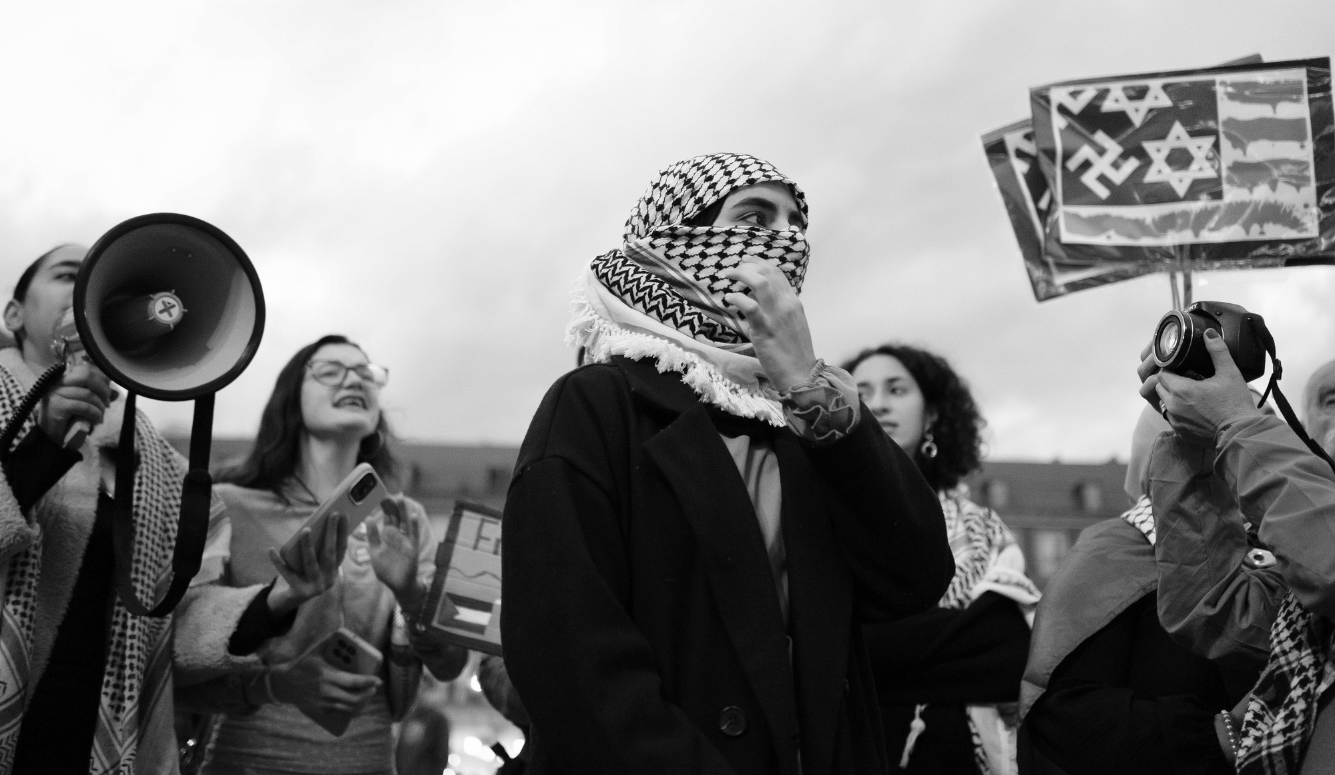
And, of course, Bartov defends America’s and Europe’s Muslims. He flatly denies that “the current rise in antisemitism is coming primarily from immigrants, especially from Arab and Muslim countries.” Rather, he says, antisemitism comes traditionally from the Right. But is this the whole truth? How about 19th and 20th century Marxist and Soviet antisemitism?
Anyway, Bartov implicitly denies the existence of Muslim antisemitism. But a passing look at the Quran would open his eyes. In fact, the Quran has been the wellspring of Muslim antisemitism since the religion’s emergence in Hijaz in the 7th century. In that sacred text the Jews are referred to as “apes and pigs (Quran 5:60)” and “murderers of prophets (Quran 3:21 or 3:112).” And unlike the Catholic Church’s 20th century rethinking of its attitude to “the Jews,” no such reformation has taken place in Islam. Rather the contrary, the Muslim Arab world has seen a doubling down in antisemitic professions.
Bartov pretends to be completely unaware of the rampancy of antisemitism in that world. And I’m not referring only to Hamas’s foundational charter of 1988—still the organisation’s constitution—where “the Jews” are charged with instigating the French and Russian revolutions and the First and Second World Wars (and establishing the United Nations!). The charter is a truly genocidal document, one passage even calling upon “trees and stones” behind which Jews are hiding to summon pursuing Muslims (in the person of “Abdullah,” the servant of Allah) to come and kill them.
For an anecdotal taste of the antisemitism at the heart of the Muslim Arab mind, nothing can be bettered than a passage in Ayaan Hirsi Ali’s autobiography, Infidel, where she describes a scene from the Hijazi segment of her childhood. She watches Saudi women hanging out the laundry—and cursing “the Jews” under their breath. But these women had never seen a Jew, as no Jews had lived in that crucible of Islam since Muhammad and his swordsmen slaughtered the neighbouring Jewish tribesmen and took their women and children as slaves, concubines and “wives.” (But, yes, the Muslim campus demonstrators and the Christian students they roped in and bamboozled also partook of a very real hatred of Israel based on what they saw on TV screens depicting very real Palestinian suffering in Gaza and the West Bank these past five or six decades).
Bartov has devoted much of his activity as a public intellectual these past months—and much of Israel: What Went Wrong?—to charging Israel with “genocide” in Gaza, describing Israel’s war-making, its leaders and Israelis in general as “genocidal.” Those words dot almost every page of this book, a constant reminder of Bartov’s message.
In fact, Palestinian spokesmen have been charging Israel with “genocide” for decades, usually after Israeli reprisals following Palestinian terrorist attacks. In the past no one in the West took them seriously. Now, however, after the 2023–2025 IDF counter-offensive in Gaza, in which some 70,000 Gazans died, many do—and to no small degree because Bartov and others like him appear to provide a stamp of authority.
Bartov evolved as an historian of Nazi Germany, and that, grotesquely, is the prism through which he views Zionism and Israel. Today he leads the (small) pack of Holocaust historians who describe Israel and its Jews as genocidaires.
Susie Linfield
In What Went Wrong? Bartov stresses that Israel has a Holocaust “syndrome.” And this is true. Israelis from a young age grow up in the shadow of the Holocaust. But this is not merely a product of Zionist manipulation, as Bartov would have it. Palestine’s and Israel’s Jews since 1945 have genuinely feared that the surrounding Muslims would do to them, if given half the chance, what was done to Europe’s Jews. Real Arab (and Iranian) threats and war-making have continuously reinforced this fear, as did 7 October.
Bartov dismisses this fear—he calls it the “again and again syndrome”—as an “internalised, irrational, and misleading terror … always lurking behind the corner.” In my view this dismissal itself is foolish, irrational and counter-historical. Bartov may believe that repeatedly stating a wish to destroy the Jewish state is meaningless (“they don’t really mean it”) or deny that such destruction would necessarily entail mass murder. And, of course, it is easier to give voice to such thinking sitting in a Cambridge café, surrounded by Gentile (and Jewish) academics who are detached from Middle Eastern realities (which have recently included the Iranian regime’s slaughter of 30,000–40,000 fellow Muslims and citizens in order to hold onto power).
Somehow Bartov finds it easier to imagine his fellow Jews indulging in genocide. Indeed, under the impact of his study of Nazi Germany, already decades ago he hinted that such indulgence was on the cards. In the book’s Introduction he relates that back in the late 1980s, against the backdrop of the First Intifada, he sent a letter to Israel’s then defence minister, Yitzhak Rabin, saying that, “based on my research on the indoctrination of the armed forces of Nazi Germany,” the IDF appeared to be “heading down a similarly slippery slope [i.e., towards genocide].” His fear or prediction was based on Rabin’s public statement at the time calling on IDF soldiers to break “the legs and arms” of Palestinian stone-throwers.
Of course, breaking some bones was not really what happened in the Holocaust and Rabin angrily responded, Bartov tells us: “How dare you compare the IDF to the Wehrmacht?” And Rabin, of course, was right. The IDF during the First Intifada behaved nothing like the German army during the Second World War (whatever Palestinian propagandists were feeding Western journalists at the time).
But this is only one of many comparisons between Israel and Nazi Germany that stud Bartov’s book—all apparently designed to buttress the charge that Israel was busy committing genocide in 2023–2025, as the Germans had done in the 1940s.
He begins by noting “remarkable similarities” between Israel’s campaign in Gaza and the German campaign against the Herero tribes in south-west Africa in 1904, perhaps the 20th century’s first genocide.
Then he compares the Nazi effort to create “a German ‘living space’ from which the Jews would be removed” to the Nakba, the Arab name for the disaster that befell the Palestinians in 1948, in which some 700,000 became refugees. The comparison is absurd on a number of counts. Yes, the Nazis wanted to get rid of their Jews. But this had nothing to do with “living space.” The German effort to achieve lebensraum was of course directed against Russians and Ukrainians. The Jews, on the other hand, were removed—and killed—because they were Jews (and, perhaps on the fringe, to enable the confiscation of their property). The Germans in 1939–1941 already possessed a large state—and, in invading Russia, simply sought more territory at the expense of their neighbours.
But, pursuing this false comparison, Bartov argues that the uprooting of the Palestinians was “the culmination of colonial views of Palestine as an empty space where ‘landless Jews’ could regain their roots, resulting in the displacement of the indigenous Palestinian population by displaced Jews from Europe.” This is untrue. Displacement of Palestine’s Arabs was not part of Zionist ideology or policy (though there were Zionist leaders who espoused “transfer”) and Arabs were not actually turned into refugees before they attacked the Yishuv in 1947–1948. And, as Bartov knows (see his praise, in What Went Wrong?, of my work on the subject), the displacement that occurred during that war was largely dictated by tactical, local decisions in the war-making and not grounded in over-arching policy decisions or ends—which is why at war’s end more than 150,000 Arabs—a full fifth of Israel’s citizenry—remained in situ (even though they had tried to abort the emergence of the Jewish state).
Benny Morris
Elsewhere, Bartov points out that during the height of the fighting in Gaza, Netanyahu, following President Trump’s lead, began promoting the idea of a “voluntary transfer” of Gaza’s inhabitants to neighbouring Arab countries. (And it is likely that Netanyahu was the one who planted this idea, like other, later ideas, in Trump’s mind).
But Netanyahu quickly abandoned the idea as Egypt and Jordan, and most other countries, made crystal clear their refusal to take in Palestinian refugees, while many Gazans opposed expatriation (in part, no doubt, under Hamas threat). So the idea and policy of “voluntary transfer” (or expulsion) never gained traction. But Bartov is quick to point out that expatriation was what the Nazis in 1939–1940 had had in mind for the Jews before realising that it was unworkable—which is when they adopted the more radical “final solution” to the Jewish problem.
Elsewhere in the book, to firm up the Israel-Nazi Germany comparison (and to reinforce the “genocide” accusation), Bartov likens the normality back in Israel and the lack of empathy for the plight of Gaza’s Palestinians during 2023–2025 to the portrayal of the Auschwitz commandant Rudolf Höss’s household in the recent movie The Zone of Interest (which I recommend), where complete disinterest reigned regarding the goings on in the next-door camp, despite the occasional screams and prevailing smells.
What happened during the IDF counter-offensive in Gaza’s streets—it was a war—was so unlike “genocide” that even a casual reader of genocide literature, say about the Holocaust or the Turkish Muslim massacre of Asia Minor’s Christian communities during 1894–1924, could not avoid noticing the stark differences.
Andrew Fox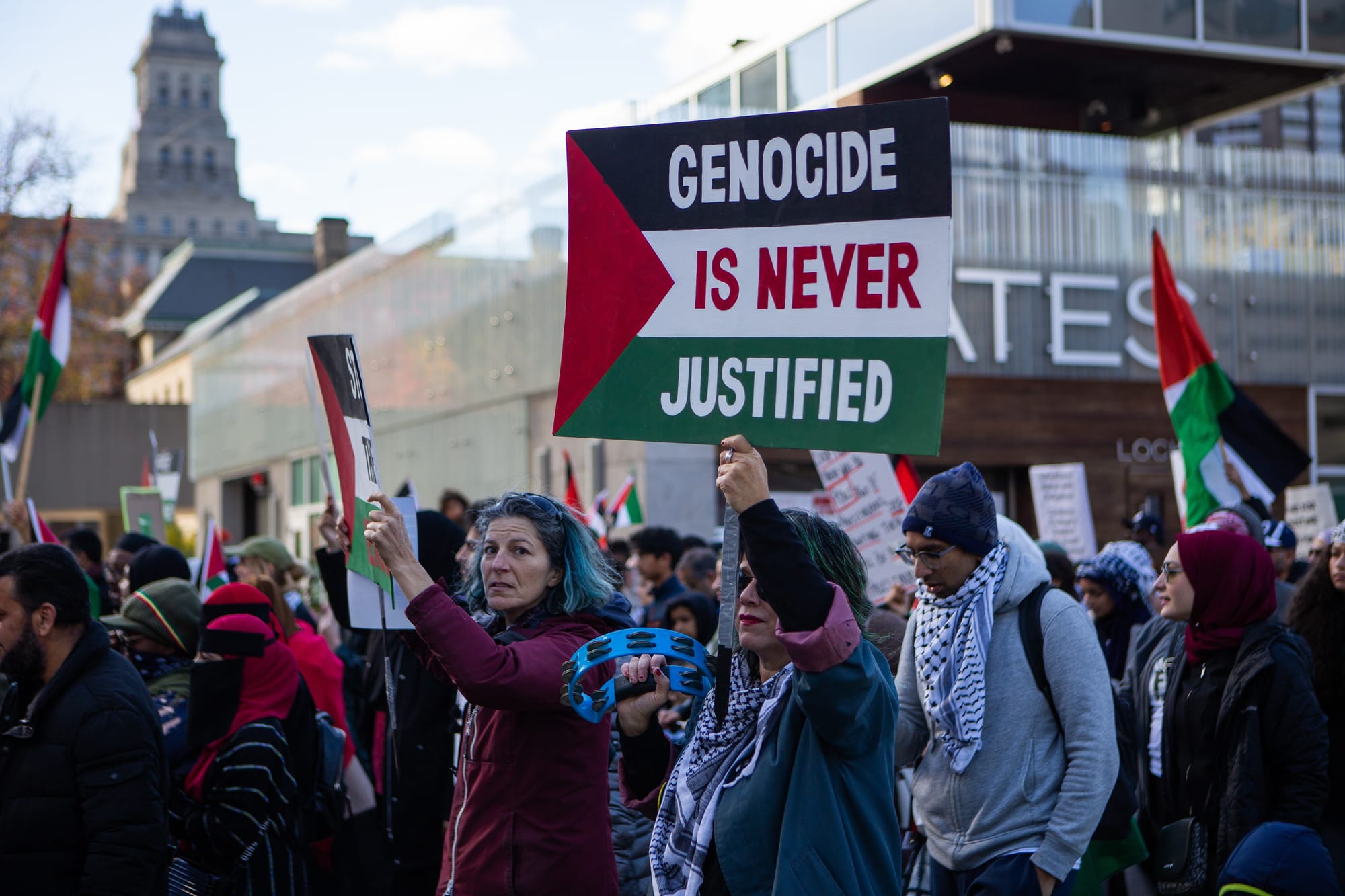
After the Hamas assault of 7 October, the Netanyahu government, quite reasonably, resolved to destroy Hamas (and free the hostages). The cabinet did not decide to "kill Gaza's inhabitants," and no such order was ever issued—not by the cabinet, the IDF General Staff, or the divisional and brigade commanders—nor did one make its way down the chains of command. (Had such an order been issued, dissenting Israeli conscripts and reservists would have revealed it in the media soon enough.)
But destroying Hamas proved extremely difficult (and Hamas, though much weakened, is still standing). There was the fear of hitting the hostages and there was the vast tunnel system constructed by Hamas deep under the Gaza Strip’s buildings, where Islamist fighters hid. But many were embedded among the two-million-strong civilian population—in effect, the fighters’ families—in apartment buildings and public structures, including schools, hospitals, mosques and universities. Israeli troops were routinely cautioned to avoid harming civilians, and no testimony has emerged to date of units being ordered to carry out massacres—or of massacres occurring.
Rather the opposite occurred—in complete contrast with anything that happened in actual genocides. During the IDF campaign, advancing Israeli ground forces and the Israel Air Force routinely warned civilians to clear out of neighbourhoods and even specific buildings about to be targeted and, indeed, masses of civilians were driven—usually southward—away from targeted areas. But in the bombings and shellings, buildings were hit and thousands of civilians died alongside Hamas and Islamic Jihad fighters embedded among them. Without doubt, many of the advancing troops and the IAF pilots were impelled not just by orders but, after 7 October, by a desire for revenge, and less care was taken to avoid causing collateral casualties than in previous clashes with the Islamists. Buildings were shelled and bombed to avoid ambush by Islamist fighters and IEDs.
To be sure, here and there Israeli troops committed war crimes and likely killed civilians deliberately, and there is overwhelming evidence of persistent abuse, including beatings and torture, of detainees arrested during the fighting. But annihilation of the population was never the objective—which is what “genocide” actually means. True, in the days after 7 October there were Israeli public figures and commentators who used genocidal language (which Bartov quotes at length). And there was a policy of destroying much of Gaza’s public and residential infrastructure, probably ultimately geared to persuading the inhabitants to leave the Strip. But genocide wasn’t government policy or intention in launching the counter-offensive.
It is also worth noting that Bartov, like most of Israel’s critics, nowhere suggests what Israel should have done after 1,200 of its citizens were murdered and 251 taken hostage, the biggest massacre of Jews since the Holocaust, as Israeli spokesmen repeatedly said. But what alternative did Israel actually have and how would other states have reacted to such a mass murder of their citizens? Complain to the United Nations? No Israeli government would have reacted differently. And, in launching 7 October, Sinwar knew this—in a recently revealed memorandum when planning the massacre, he speculated that Israel might even react by dropping an atomic bomb on Gaza. He clearly foresaw that Israel would exact a great toll among Gaza’s civilians and banked on this, expecting that this would undermine Israel’s standing in the world. (And, to boot, he believed, like all good Muslims, that the prospective “martyrs” would find welcome and repose in heaven).
If I am not mistaken, Bartov fails to mention that, during the war, Hamas barred Gaza’s civilian population from seeking shelter in the tunnel system. One Hamas spokesman later said that it was up to the UN or Israel to provide Gaza’s civilians with shelters.
As Bartov well knows, actual genocides pan out differently. In the Holocaust, Germans and their helpers across Europe raided houses and districts, rounded up Jews, shot some on the spot and herded the rest into cattle cars, imprisoned them in ghettoes where they died of disease and hunger, or ferried them directly to woods and camps where they were shot or gassed, man, woman and child. Similarly, the Muslim Turks who murdered up to a million Armenians in 1915–16 in Asia Minor and the Syrian and Iraqi deserts did not warn their intended victims to flee. They rounded them up, shot dead the able-bodied males, and sent the women, children and elderly on death marches into the mountains and deserts, where most died. The minority who somehow made it to the banks of the Euphrates were murdered in a second round of massacres. And during 1914–1924, the Muslim Turks massacred hundreds of thousands of Assyrians and hundreds of thousands of Asia Minor Greeks—Greek historians speak of a million—in the same fashion, as related by me and Dror Ze’evi in our book The Thirty-Year Genocide (Harvard University Press, 2019). That, not what happened in Gaza, is what genocide looks like.
Was the Allied bombing of Germany during the Second World War, in which some 400,000 civilians died—and German soldiers were not embedded among them—a “genocide”? I don’t think so, and I assume neither does Bartov. This is the closest parallel I can think of.
This said, Bartov, of course, is right on a related matter—the Holocaust and the Nakba were linked in a number of crucial ways. The Holocaust propelled hundreds of thousands of (surviving) European Jews to Palestine, the only place that would give them haven (despite protracted, violent Palestinian efforts to force Britain to bar their entry into the country); and the horrors of the Holocaust prompted the (guilt-ridden) western democracies to support Jewish statehood (albeit alongside Palestine Arab statehood). In 1948, many Holocaust survivors participated in the Haganah/IDF fight against the aggressing Palestinians and invading Arab states’ armies—and without doubt, the memory of the recent Holocaust motivated Israel’s troops to overcome their assailants and the Zionist leadership to strive to quickly establish the state that would provide the Jews with the protection they had sorely lacked in Europe.
And, of course, the Arabs by and large supported a German victory during the Second World War and the Palestinians’ antisemitic leader, Haj Amin al Husseini, spent the war years in Berlin calling in radio broadcasts to the Middle East to slaughter the Jews, and then led his people into 1948. So, in various senses, the Holocaust and the Nakba were linked. But Bartov’s simplistic take—“one tragedy generating and perpetuating another”—is somewhat off the mark.
But, of course, the Holocaust is only part of the backdrop to 1948 and the following decades. More pertinent is the Palestinian rejection of all proposed compromises before 1948 and their assault against the Yishuv in November 1947–May 1948, the assault that ushered in the Nakba. It wasn’t Jewish Holocaust survivors or their relatives in Palestine who unleashed the hostilities that ended in Arab societal collapse and refugeedom. Nonetheless, after losing, the Palestinians went on to blame all, especially the Jews—as they still do today—for their misfortunes.
Benny MorrisSubsequently, Bartov says, “Israel’s adamant refusal to share the land” was “at the core of the violence.” This is at best a half-truth. True, Israel’s right-wing parties, dominant in government since 1977, refused to share the land with the Palestinians. But Labour’s Rabin won office in 1992 and Labour’s Barak won office in 1999 and Kadima’s Ehud Olmert, a breakaway from the Likud, won office in 2006—and, backed by a succession of US presidents, they all advanced a peace agenda; indeed, Barak and Olmert resurrected the two-state solution and unfurled detailed peace plans. And the Palestinians consistently rejected them. Bartov’s attribution of complete guilt for the perpetuation of the conflict to the Israelis is a blatant distortion of history.
Bartov’s attribution of complete guilt for the perpetuation of the conflict to the Israelis is a blatant distortion of history.
Late in the book Bartov describes a post-7 October visit to Israel and a meeting with Israeli students. He says he came away shocked. “They had not only internalised a particular view that had become commonplace in Israel—namely that the razing of Gaza … was a legitimate response … but had also developed a way of thinking that I observed many years ago when studying the conduct, worldview, and self-perception of German army soldiers in WWII [again, the comparison to the Nazis!] … Hamas as human animals—and of the wider [Gaza] population as less than human … Thousands of children were killed? It’s the enemy’s fault … If Hamas carries out a massacre in a kibbutz, they are Nazis. If we drop two-thousand-pound bombs on refugee shelters and kill hundreds of civilians, it’s Hamas’s fault for hiding under or close to these shelters … The way people’s eyes glazed over whenever I mentioned the suffering of Palestinian civilians … was deeply unsettling.” (I wonder whether Bartov’s eyes “glazed over” when he was told of the suffering of Hamas’s victims, many of them tortured and raped. But, of course, he has a point about the progressive Israeli dehumanisation of the Palestinians—but he ignores the coin’s other face, the parallel dehumanisation of the Israelis by the Palestinians).
Bartov’s descriptions of various episodes in the conflict are speckled with distortions and marred by tendentiousness; this is not a book scholars will excavate for facts. For instance, Bartov repeatedly states that the Zionist forces “expelled” the Palestinian population from the territory that became the State of Israel—when, in fact, most simply fled from the actual or potential battlefields (and some were ordered or advised to leave—as in Haifa on 22 April 1948—by their own leaders). The most that can be said is that the Israeli government refused to allow the refugees to return to their homes and lands after the war, not exactly the same thing.
The decades of British rule were characterised, Bartov tells us, by the “familiar processes of a settler colonial takeover of land and resources from the indigenous Palestinian population.” The American, South African, and Australian “settler-colonial” paradigms, to which he is alluding, featured brutal armed conquest and confiscation of indigenous lands. In Ottoman and British Mandate Palestine, the Jews acquired lands from very willing Arab sellers—nothing before 1948 was conquered. And the country had, and has, no “resources” to speak of.
But the sad truth is that Israeli internal demographic and political trends and the constant Islamist violence and genocidal threats have derailed the Zionist project, transforming it from a positive, moral enterprise to something teetering on the edge of an abyss. I wouldn’t go so far as to say, as in Bartov’s peroration, that Israel today is “bloody-minded … [and] paranoid” and is now “heading down the path of theocracy and apocalypse.” I would advise waiting a bit before making a definitive judgment. Let’s see what sort of government the Israeli general elections, scheduled for 27 October, wash up and whether they will alter the current downward spiral.
But one thing is already clear: Bartov’s book, and his journalistic “Israelis are genocidaires” campaign that preceded it, have, objectively speaking, assisted the Islamist terrorists in their effort to destroy the Jewish state. This is something he will have to live with.
Quillette invites thoughtful responses to its essays.
Selected responses are published once per week as part of a curated Letters to the Editor feature. If selected, letters appear under the contributor’s real name and may be edited for clarity and length.
To submit a letter for consideration, please email [email protected].
Keep reading
The Genetics of Crime and Punishment
Jerry Kaplan on AI Doomers
Payback Time for Steven Galloway