Psychology
The Last Acceptable Prejudice
Ugly people are like everyone else, except we don’t like them as much.
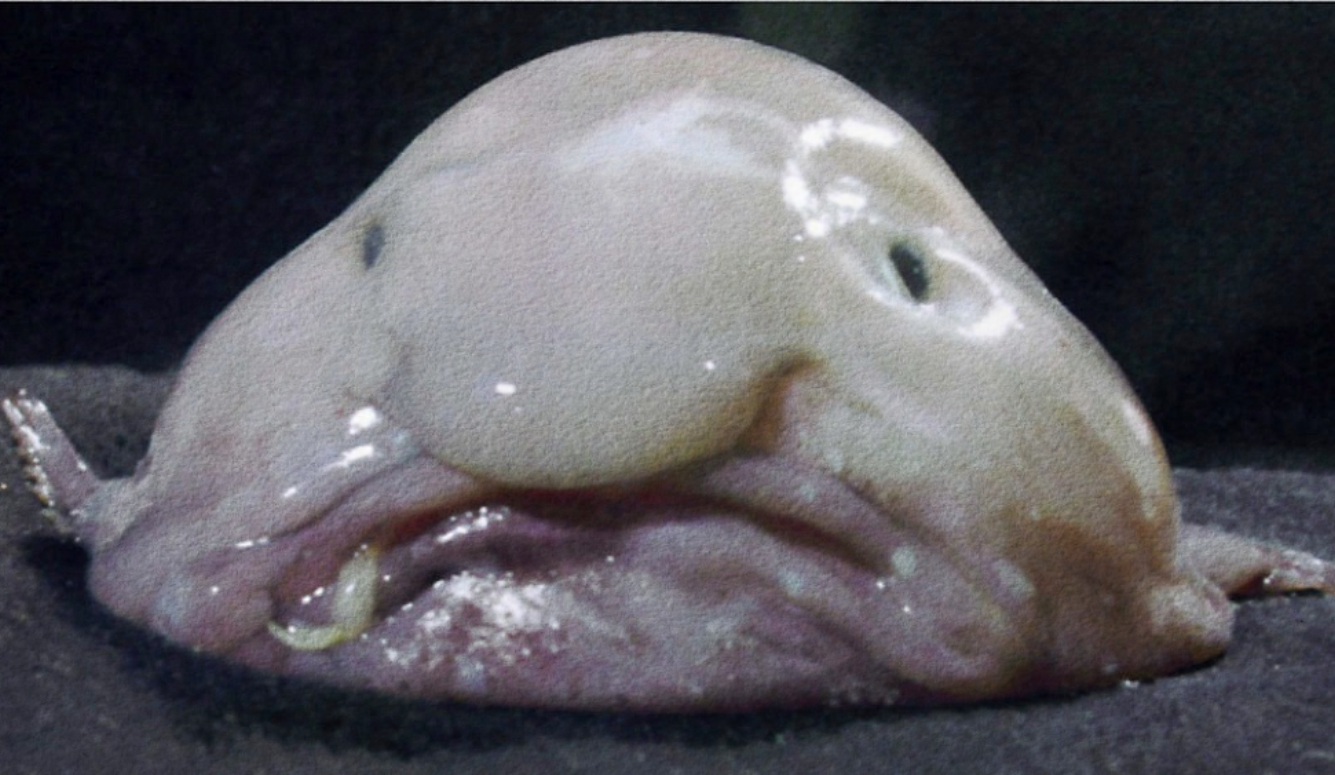
When we see someone beautiful, it doesn’t feel like we’re making a judgment. It feels like we’re recognising a fact. We experience ugliness the same way. Like mouldy bread or the shape of a rock, it just is. We might react with disgust, or we might look past the person as though they were a potted plant. None of it feels like a choice. But what seems like a mere observation becomes far less innocent when it turns into a judgment about who someone is and starts to shape how we treat them. This is how one of the most damaging forms of discrimination in America hides in plain sight, barely registering as a preference, let alone a prejudice.
Over the past few decades, an ever-expanding list of group identities has come to dominate conversations about fairness and discrimination. We have elevated race, ethnicity, sex, religion, sexual orientation, gender identity, disability, nationality, immigration status, neurodivergence, indigenous status, and sometimes class to something approaching the sacred. Yet for all this concern with social justice, we remain stunningly blind to an ancient bias rooted in sexual selection: the bias in favour of people we find attractive.
The advantages of beauty go well beyond sex. Good-looking people are seen as more intelligent, competent, likeable, and trustworthy. They’re more likely to be chosen as friends, more likely to be hired, and paid more once they are. In one experiment, equally qualified job applicants with attractive photographs received 36 percent more callbacks than unattractive applicants. A large American study found that the earnings gap between people judged attractive and unattractive frequently exceeded the Black–White earnings gap. Attractive defendants receive shorter prison sentences. And in an experiment with 34 physicians, the odds of missing kidney or bladder stones on an X-ray were nearly four times higher when the patient’s photograph was unattractive. Once you start looking, you see the injustice everywhere.
But while other disadvantaged groups can turn shared identities into sources of belonging, pride, and even status, ugliness offers none of these consolations. Almost nobody wants to admit to being ugly. How do you fight discrimination when even identifying its victims feels like an act of discrimination?

The Reverse Halo Effect
To see how effortlessly we turn judgments about appearance into judgments about character, I showed the nine faces above to high-school seniors and asked which person would be least likely to return a lost wallet. None of them asked why I thought they could tell, and just over half (38 of 73) chose the person in the centre. Of the 56 students who also rated attractiveness, about seven in ten (39) picked that same face as the least attractive (full results).
The instinct to treat ugly people as less trustworthy runs so deep we hardly notice it. Think of Tolkien’s beautiful elves and repulsive orcs, or Cinderella and her ugly stepsisters. Guess which ones are evil. Storytellers have been saving us time for centuries, telling us whom to root for before anyone has done anything.
The bias starts early and continues through adulthood. In a study of Jamaican children who had known each other for years, the more attractive ones were more likely to be chosen as friends. Teachers like good-looking kids more, too. A meta-analysis found that attractive students were rated higher on intelligence, academic potential, grades, and social skills. These advantages accumulate: attractive adults are more likely to be promoted, more likely to receive loans, and likely to pay lower interest rates on them. In a study of Florida men convicted of first-degree murder, those whose faces were rated as less trustworthy were more likely to be sentenced to death than to life in prison.

In another study, unattractive defendants convicted of misdemeanours received fines up to four times as large as attractive defendants. The economists Daniel Hamermesh and Jeff Biddle found that below-average-looking workers earned about 5 to 10 percent less than average-looking workers, even after accounting for other demographic and labour-market characteristics. Over a lifetime, that penalty can add up to nearly a quarter of a million dollars.
Your face can even affect how quickly you’re seen in an emergency room. In a study of 183 emergency-room patients, facial appearance predicted the triage priority nurses assigned them, with patients whose faces looked more “trustworthy” receiving higher priority. Is all of this discrimination against the ugly or favouritism towards the beautiful? Almost certainly both, although many studies suggest that the penalty for being unattractive is larger than the premium for being attractive.
These biases affect anyone who has a face. And unlike discrimination based on race or sex, discrimination based on looks is almost entirely legal. No federal law bans it. Michigan and New York City cover height and weight in their civil rights laws, but only a handful of places, including Washington, D.C., and Madison, Wisconsin, ban discrimination based on appearance itself. Everywhere else in America, an employer can discriminate against ugly people and never have to explain anything.
The studies above compare attractive people with unattractive people, but they can’t show what happens when the same person changes. Everyone eventually experiences the slow erosion of attractiveness that comes with age. It is much rarer to watch someone move in the other direction. Rapid weight loss, however, offers a chance to see the same person become more attractive and to watch how people treat them. My sister lost sixty pounds after starting a GLP-1 and was stunned by the difference. People were nicer to her. Strangers smiled more, held doors, and offered help. Waiters who had never offered her dessert now did, a neighbour invited her to join a tennis club, and the people at WeightWatchers finally stopped making her wear the piggy mask. My sister hadn’t become smarter, funnier, kinder, or more competent. She had just become thinner, and in America, at least, thinner means better-looking.
How much of what we call ageism, classism, and discrimination against fat people simply masks our aversion to ugliness? The categories clearly overlap, and age and weight are often important components of attractiveness. In an experiment in Spain, overweight men got 25 percent fewer job callbacks, but the gap shrank to almost nothing once researchers compared men who looked equally attractive. Money can also offset some of the penalties of being unattractive. Rich people can get prescriptions for weight-loss drugs, reverse signs of ageing with plastic surgery, fix their teeth, buy nice clothes, and pay other people to do their chores, which leaves more time to exercise, sleep, play tennis or polo, and do whatever else rich people do while someone else mows the lawn. Whether we call it ageism, classism, fat shaming, or simply discrimination against ugly people, an instinct for choosing mates and allies has turned into a verdict on who deserves what.
I Thought I Was a Seven
The first time I remember caring about looks was when I was ten. I had a crush on Stephanie Kraft, the prettiest girl in fifth grade. At recess one day, she called me “vulgar.” I had to look it up, and part of me still wonders whether she really meant ugly. So if I was going to write about ugly people, I figured I should find out whether she was right. In my twenties, I thought of myself as a seven, or maybe an eight on a good day. By 57, I imagined I’d probably slipped to a six, although if I’d aged particularly well, I hoped I might still be a seven.
I paid 100 strangers through Prolific, an online platform for research participants, to rate photographs of me at 35, 45, and 57 on a scale from one to ten. The average was 4.97 at 35, fell to 4.63 at 45, and for some reason rose slightly to 4.87 at 57 (full results are here). I peaked just below a five.
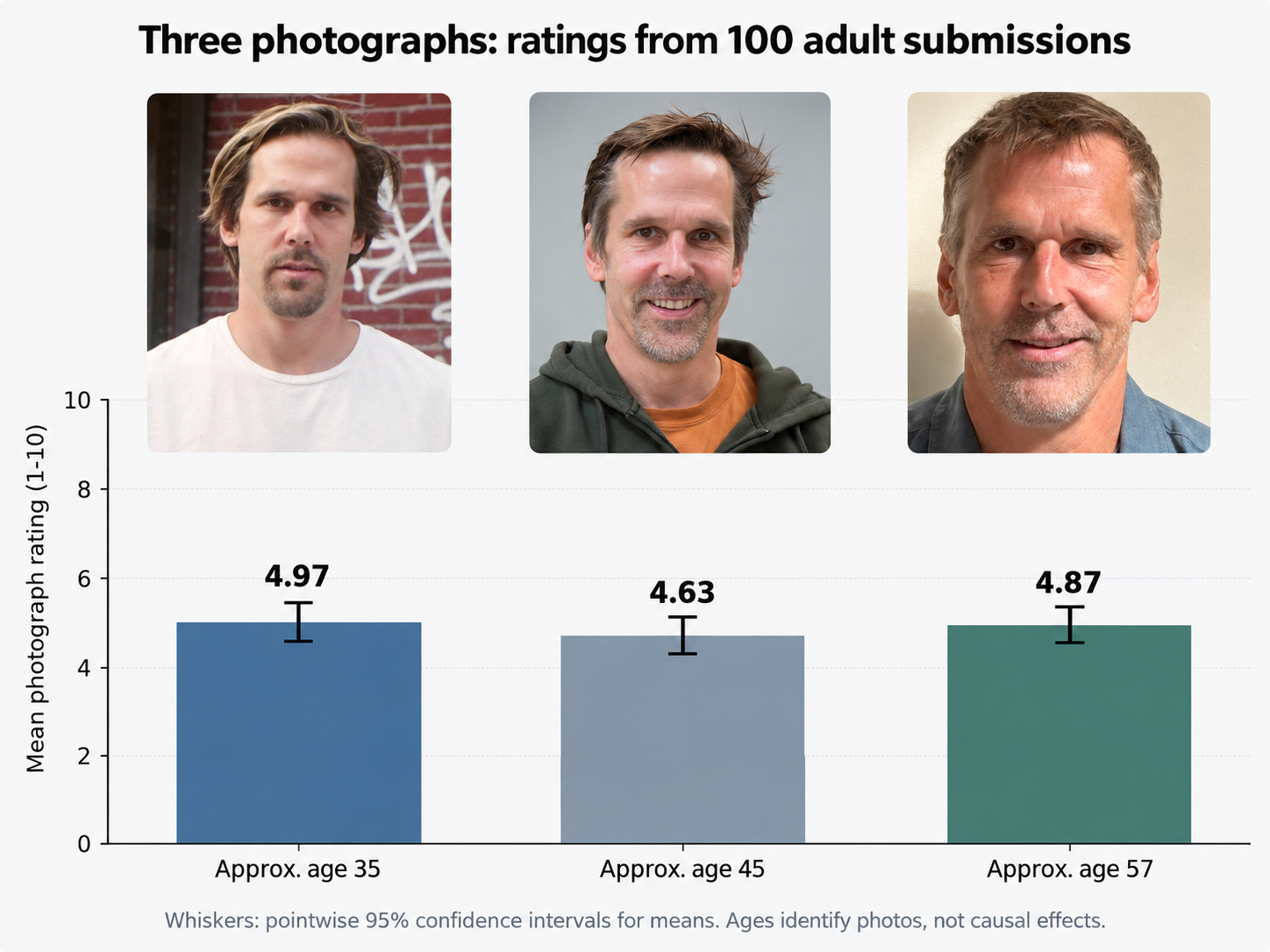
I was stunned. All three scores were below 5.5, the midpoint of a ten-point scale. Like a good self-deceiving ape,1 I immediately started looking for excuses. I hadn’t uploaded good photographs. I don’t photograph well. The raters, especially the men, were probably jealous and spiteful. And who cared what the men thought, anyway? The women, I was sure, thought I was good-looking.
One by one, most of these rationalisations turned out to be bullshit. I may not have spent hours searching for the most flattering photographs, but I certainly didn’t choose them at random. On most days, I’m pretty sure I look worse than I do in these pictures. And the men were actually more generous than the women, giving me an average of 5.05 compared with 4.36.
The one rationalisation I can legitimately cling to is that our standards are calibrated by the faces we see. If the faces on our screens are disproportionately attractive or digitally perfected, real ones like mine may start to look ugly. In one experiment, men who had just watched Charlie’s Angels rated an average-looking woman as less attractive. So the mathematical midpoint of a ten-point scale is not necessarily the average rating that ordinary, unenhanced faces receive. In the Chicago Face Database, 93 percent of ordinary male faces were rated below the scale’s midpoint. Scoring below 5.5 does not, by itself, prove that I am below average. I’m probably about average. Still, it’s hard to argue that I was ever a seven. Poor me. But what about the people who could never have mistaken themselves for a seven?
You certainly won’t find them in Hollywood, where ugliness usually means beautiful people playing dress-up. Charlize Theron won an Oscar for playing Aileen Wuornos in Monster after gaining thirty pounds, bleaching her eyebrows, wearing prosthetic teeth, and having makeup artists give her blotchy skin. Between takes, Theron took out the teeth and was beautiful again. Apparently, finding an ugly actress is harder than making a beautiful one look ugly. At other times, ugliness is treated as a failure to dress well. America Ferrera (see picture) needed only braces, thick glasses, and bad clothes to become Ugly Betty. Hollywood rarely shows us a truly ugly person. It shows us a beautiful person who isn’t trying hard enough.
Although almost no one on screen looks ordinary, we rarely notice. In movies and TV shows, the waitresses, janitors, insurance salesmen, and criminals all happen to look like movie stars. The comedian Jim Gaffigan joked that when Halle Berry played a poverty-stricken woman in Monster’s Ball, he spent the whole movie wondering why she didn’t just become a model.
Elite culture celebrates diversity like a Benetton ad, in which every identity is represented by a beautiful face. Most differences can be embraced without placing one kind of person above another. Attractiveness, however, is a ranking, and someone has to be at the bottom. Hollywood gets around this by turning ugliness into the “before” picture on Intervention and keeping ugly people offscreen. Movies, television, and advertising did not create our ancient preference for beauty. They just fed it back to us so many times that extraordinary attractiveness began to look normal, and ordinary faces like mine began to look ugly.
 Robert Lynch

Beauty Is Not in the Eye of the Beholder
The cliché that beauty is in the eye of the beholder is mostly wrong. Newborns just a few days old look longer at attractive faces than at unattractive ones, and a 2000 meta-analysis found strong agreement about who is and isn’t attractive, both within cultures and across them. David Buss’s landmark study of mate preferences across 37 cultures found that physical attractiveness mattered in every one of them. A much larger 2007 survey of more than 218,000 people in 53 nations found that overall good looks ranked fifth and facial attractiveness sixth, behind intelligence, humour, honesty, and kindness. Actual behaviour confirms that looks matter. A meta-analysis of 97 studies found that physical attractiveness predicted romantic interest equally well for men and women, and about four times as strongly as earning prospects. In real life, good-looking people tend to pair with other good-looking people. This may be why it feels surprising when one member of a couple is much better looking than the other. It seems as if something is off.
So why do apes like us care so much about what another ape’s face looks like? When a preference appears in babies, shows up across cultures, and has analogues in other species, biologists start looking for evolutionary explanations. In species ranging from mammals to birds and fish, animals choose mates based on how they look, and what they find attractive is frequently a proxy for health, fertility, and youth.
Age is probably the clearest case. Women’s attractiveness peaks in their twenties, declines through their thirties, and then falls more sharply in their forties and fifties. This transition can be especially jarring for women who were used to being attractive. A friend of my wife’s said that sometime in her mid-forties, she noticed that men no longer looked at her. They looked through her, as if she were part of the furniture. Men get older and uglier too, but more slowly. Male attractiveness can stay relatively stable through the forties before dropping more sharply in the fifties. At 57, I’m well into the downhill part of the curve, but most days I don’t really feel it. Every so often, however, the spell breaks, I catch an unexpected glimpse of myself in a mirror, and I think: Who is that old fucker?
The age-attractiveness curves for men and women look suspiciously like their respective fertility curves. This makes perfect evolutionary sense, since women’s fertility peaks earlier and declines more rapidly than men’s. In short, what feels like beauty or ugliness is an evolved response to cues of reproductive potential.
Other markers of attractiveness are less obvious than age. Body shape, facial averageness, symmetry, skin quality, and sex-typical features (more feminine features in women and more masculine ones in men) have all been proposed as signals of health or reproductive value. Composite faces blended from many individuals are rated as more attractive than the individual faces they were made from. Preferences for body weight vary more across cultures, but weight matters too. In wealthy societies, lower body fat is judged more attractive, probably because it conveys information about age, health, and social status.
Symmetry is of particular interest to evolutionary biologists because it is thought to measure developmental stability: the ability to produce the same outcome on both sides of the body. Why should that matter? The two sides of our bodies develop according to essentially the same genetic instructions, but disease, poor nutrition, parasites, and other stresses can disrupt the process. The idea is that someone who maintained symmetry through development was good at withstanding those challenges and may be better equipped for future ones. For fifteen years, I worked with Robert Trivers on the Jamaican Symmetry Project, where we measured tiny left-right differences (known as fluctuating asymmetry) in children’s knees, ankles, wrists, ears, and eyes as they grew into adults. How much those differences tell us about underlying biological quality or genes is disputed, but the tendency to find symmetrical faces more attractive is well established.
Exactly which traits humans find attractive, and what those traits actually tell us about health or reproductive value, is often contested. But the larger pattern is impossible to dismiss. People largely agree about what’s beautiful, and these shared preferences are constrained by biology and shaped by our evolutionary history.
This doesn’t mean that standards of beauty are identical everywhere or that individuals don’t differ in what they find attractive. Culture, ecology, wealth, and experience all play a role, and we are remarkably adept at finding the people available to us attractive, especially when the alternative is admitting that we simply can’t do any better. Still, our deeply ingrained, nearly automatic responses to beauty are too powerful to reason away. That is what makes the bias so hard to acknowledge, let alone fight. We might be able to teach people that racial discrimination is wrong, but we can’t teach them not to see beauty. That our preference for beauty evolved as a proxy for youth, fertility, and health explains why it exists. It tells us nothing about how people should be treated.
The Club Nobody Wants to Join
We have names for racism, sexism, ageism, ableism, classism, antisemitism, homophobia, transphobia, xenophobia, fatphobia, and an ever-growing catalogue of other biases. We march against them, study them, pass laws against them, and teach children to spot them. Discrimination against ugly people has a name, too: “lookism.” But almost nobody has heard of it. For every scholarly work that mentions lookism in its title or abstract, more than 400 mention racism, and in books published since 2010, the ratio is over 1,000 to one.2
Where’s the movement for ugly people? There’s no National Association for Unattractive People, no Ugly Lives Matter, no mandatory or even voluntary HR training on how to overcome contempt for your ugly coworkers. Why does almost every other disadvantaged group have advocates and organisations, while ugly people have almost none?3
One problem is that ugliness exists along a continuum, which makes it hard to identify as a distinct category. Where, exactly, does someone stop being average and start being ugly? This is a problem for apes like us, who instinctively divide the world into neat categories. In a famous psychology experiment, Henri Tajfel and A. L. Wilkes showed that dividing a continuous range into categories exaggerated the perceived differences between them.
Race provides a striking example. In the United States, the one-drop rule historically imposed a rigid boundary between Black and White Americans. (Barack Obama, whose mother was White, is almost universally regarded as Black.) In Brazil, racial classifications have traditionally been more fluid, reflecting gradations in skin colour and appearance. These differences matter for collective action. One study found that race was a much stronger predictor of participation in political demonstrations in the United States than in Brazil. Attractiveness poses an even greater challenge to collective action. The psychologists Jennifer Rennels and Judith Langlois found that although children showed strong biases in favour of attractive people, they were far less likely to categorise people by attractiveness than by race or sex.
But even if we could agree on who belongs to the group, there’s a far bigger problem. Nobody wants to identify as ugly. People can take pride in being Black, Jewish, gay, or disabled, and find solidarity with others who share those identities. Economic class presents some of the same difficulties as attractiveness, because poverty and wealth also exist along a continuum. But even people near the bottom of the income ladder can take pride in being working-class or belonging to a union. Being ugly is never a source of pride or status. To organise, you have to convince people to accept a label that is an insult. It’s painful to apply it to yourself and cruel to apply it to others. An ugly people’s movement faces Groucho Marx’s problem: nobody wants to join a club that would have them as a member.
The problem also affects who is likely to join the cause. Someone who advocates for racial equality or immigrant rights isn’t automatically assumed to belong to the group they’re defending. But defend ugly people, and others may assume you have a personal stake. Brad Pitt could probably pull it off, but the rest of us might be accused of protesting a bit too much. Allying yourself with groups that cultural elites have anointed as victims can confer social prestige, moral authority, and even professional rewards. Defending ugly people offers none of this. It’s hard to gain status when the stigma is contagious. In one experiment, job applicants were rated more negatively when they sat next to an overweight woman than when they sat next to an average-weight one.
And the closer we are to the bottom of a hierarchy, the more important it becomes to distinguish ourselves from those just below us. Economists call this “last-place aversion”: people are so determined to avoid the bottom rung that they oppose helping those immediately beneath them. One study found that workers earning just above the minimum wage were the most likely to oppose raising it. The same thing might happen with attractiveness. I might not see a three as an ally or a fellow victim of discrimination. I’m just relieved that I’m still a four.
Ugly people are like everyone else, except we don’t like them as much. At best, they’re invisible. At worst, they’re not. We can’t choose not to notice who’s attractive, and most of us wouldn’t want to even if we could. Nobody has to find everyone attractive. Noticing isn’t the problem. The problem starts when we treat beauty or ugliness as evidence of intelligence, honesty, competence, or someone’s worth as a human being.
None of this means we need another victim group or an Ugly Lives Matter movement. Few people are in the mood for more slogans, yard signs, corporate values statements, and yet another event in the victimhood Olympics. Besides, almost everyone judges others by their looks, ugly people included. We’re all both judge and defendant, and although some of us face much harsher verdicts, there’s no separate group of oppressors to organise against. There’s just us.
Ugliness breaks the simplistic categories we’ve built for thinking about discrimination, because it runs through all of them. There are ugly men and ugly women, ugly Black people and ugly White people, ugly rich people and ugly poor people, ugly gay people and ugly straight people, ugly Republicans and ugly Democrats. Perhaps the most important lesson ugly people can teach us is that if we keep adding group identities, we’ll eventually end up with a category of one. We will rediscover the simple truth that although everyone belongs to many groups, no one can be reduced to any of them. You can list every identity someone has and still not know whether they’ll return your wallet.
Nobody chooses the face they’re born with, but the world starts rewarding or punishing them for it long before they’ve done anything to deserve either. We are social-climbing apes, and when victimhood offers status, we instinctively compete for it. The best evidence that being ugly is a real disadvantage may be that nobody fights to claim it. It’s a lonely thing to be ugly. There are lots of us. The trouble is finding anyone willing to admit it.
Notes
1. In experiments, people were more likely to recognise attractively enhanced versions of their own faces as themselves.
2. Counts retrieved on November 2, 2026. Scholarly works: OpenAlex, works with the word in the title or abstract. Books: Google Books Ngram Viewer, English corpus, 2010–2022: “racism” appeared about 1,240 times as often as “lookism.”
3. One exception is the incel subculture, in which some men organise around their perceived unattractiveness and romantic rejection. But it is not a broad movement against appearance discrimination, and it is confined to the mating market.
Quillette invites thoughtful responses to its essays.
Selected responses are published once per week as part of a curated Letters to the Editor feature. If selected, letters appear under the contributor’s real name and may be edited for clarity and length.
To submit a letter for consideration, please email [email protected].