Cinema
Going the Distance: Rocky at Fifty
Rocky resonates across generations because Sylvester Stallone understood that life is the greatest opponent we’ll ever face.
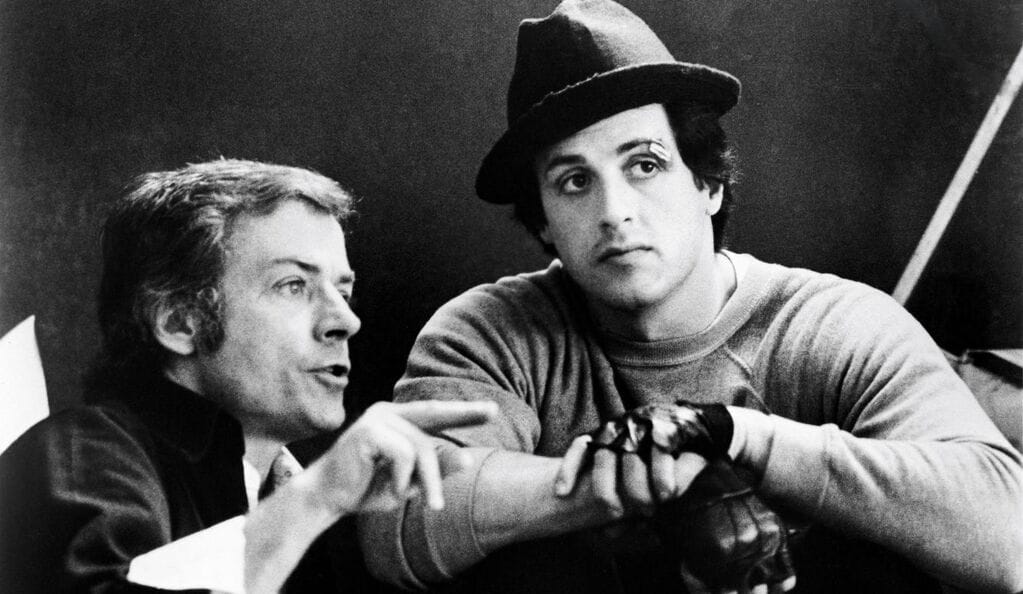
In January 1976, Sylvester Stallone was about to begin the journey that would make him one of the biggest movie stars in the world. He had spent years trying and failing to become a leading man, but he received the opportunity of a lifetime when United Artists took a chance on letting Stallone star in Rocky (1976), a film he wrote about a nobody boxer who receives a shot at the world championship. It’s an opportunity no young unknown actor or writer would receive today. As the filming commenced, Stallone lived out Rocky’s main theme both in front of and behind the camera: If someone received the opportunity of a lifetime, would they be ready to meet the moment? Stallone recalled twenty-five years later, “I walked out of that trailer the first time on those cold streets of Philadelphia, and I knew this was like the moment of truth and they said, ‘Sylvester you ready?’ I said, ‘No but Rocky is.’”
Before Rocky (1976), Sylvester Stallone was one of many actors who had big dreams of stardom that never came true. His first screen roles were as an uncredited extra in the Robert Redford sports drama Downhill Racer (1969) and M*A*S*H (1970), which amounted to one second of screen time. After seeing Easy Rider (1969), Stallone began writing screenplays in the hopes a studio would greenlight one and let him be the star. “Writing was the key; if I kept on writing, nothing could stop me,” Stallone told Playboy in a September 1978 interview.
Later in 1970, Stallone starred in his first leading role, but it wasn’t the big break he had in mind. He had just been evicted from his apartment in New York City and spent several days sleeping in a bus terminal. Stallone was desperate to make some money, any money. While reading “one of the trade papers,” he found that producers for a soft-core pornographic film were looking for a star. The film was The Party at Kitty and Stud’s (1970), and Stallone was paid $200 for two days of work, enough to get him off the streets.
Stallone continued to scrape by doing extra work, acting in off-Broadway plays and working a variety of jobs like cleaning cages at a zoo (which only lasted three weeks), working at a deli, and then as an usher at a movie theatre. Stallone watched every film he could while working at the theatre to improve his screenwriting, until he was fired for scalping tickets. By this point Stallone was in a relationship with Sasha Czack, an aspiring actress whom he married on December 28, 1974. Stallone also landed leading roles in the independent films No Place to Hide (1973; also released as Rebel) and The Lords of Flatbush (1974). However, like most independent films they languished in obscurity. After filming The Lords of Flatbush and realising their careers in New York City were going nowhere, Stallone and Czack took their bull mastiff Butkus and moved to Hollywood in the hopes they would find their dreams in the City of Angels. It wasn’t to be. “I moved in the Valley and things weren’t going very well there. As a matter of fact, I had to go out and try to sell my dog because it was either do that or he was just not going to be very well fed around the house,” Stallone said. Then on the evening of March 24, 1975, he went to a movie theatre to watch Muhammad Ali defend the world heavyweight title against Chuck Wepner. Ali was the 10 to 1 favourite against the underdog Wepner. Instead, something happened that gave Stallone an idea that changed his life forever.