Israel
How Wikipedia Rewrote Zionism
Since October 2023, four-fifths of the encyclopedia’s article on Zionism has been replaced, and the historians it cites—Benny Morris among them—are misrepresented.
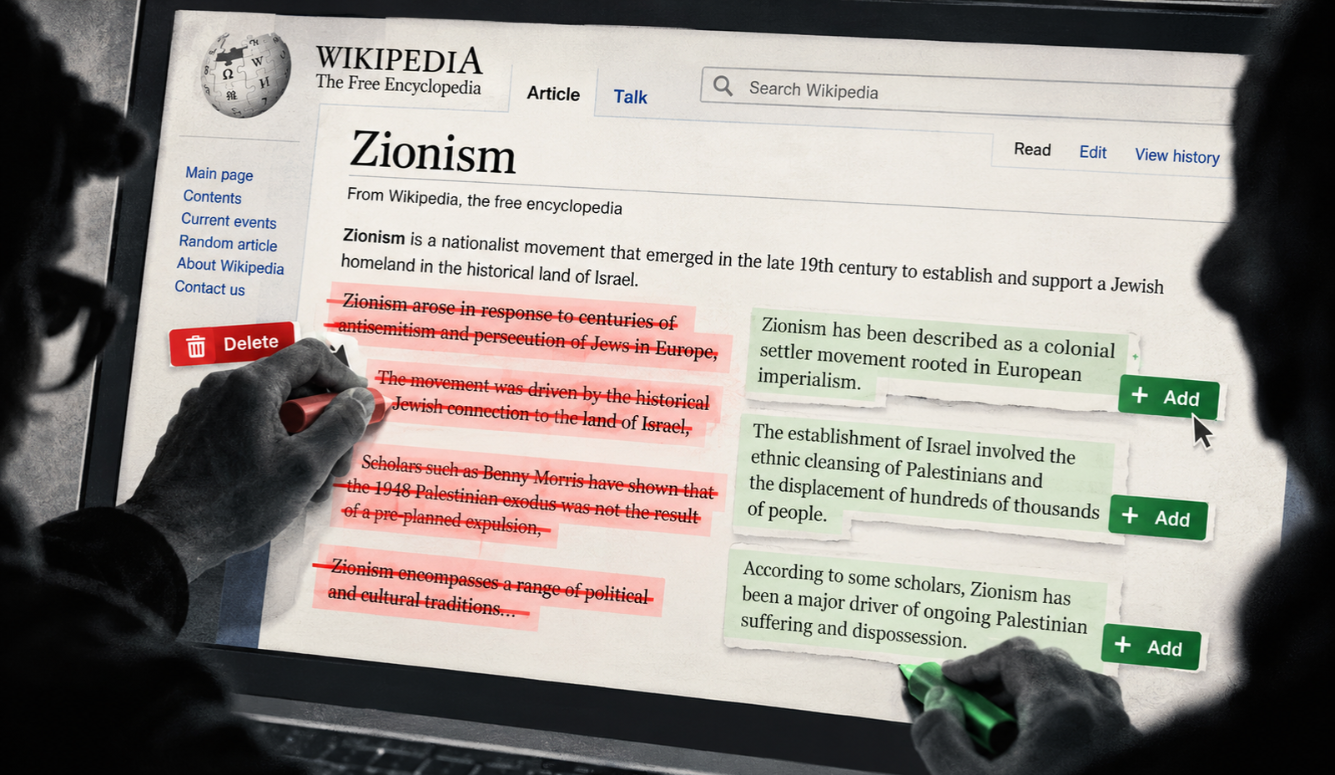

Before 7 October 2023, the English-language Wikipedia article on Zionism opened by describing a movement that emerged to “espouse support for the establishment of a homeland for the Jewish people in Palestine.” Since then, the opening has been reworded to say that this homeland was to be established “through colonization,” immediately followed by a new sweeping claim: “Zionists wanted to create a Jewish state in Palestine with as much land, as many Jews, and as few Palestinian Arabs as possible.” The sentence is backed by an unusually large bundle of 17 citations, drawn from historians including Benny Morris, Rashid Khalidi, Avi Shlaim and Ilan Pappé, and to the casual reader it looks like the settled verdict of scholarship. It is not. The editor who introduced it in August 2024 has since been banned from the entire Palestine-Israel topic area for non-neutral editing. Yet the sentence survives, and for a year Wikipedia formally barred its editors from even discussing whether to remove it.
That matters because Wikipedia is widely regarded as a generally reliable source of information, and its influence extends far beyond the millions of people who consult it directly: it has also been incorporated into many of the datasets used to train artificial intelligence systems, thereby shaping the information those systems subsequently reproduce. That reputation and reach rest in large part on one of Wikipedia’s foundational principles—presenting a “neutral point of view.” Wikipedia articles are supposed to summarise what reliable sources say without taking a position of their own. This principle is particularly important on controversial subjects, and few subjects are more contentious than Zionism and the Israeli-Palestinian conflict more broadly.
The rewrite
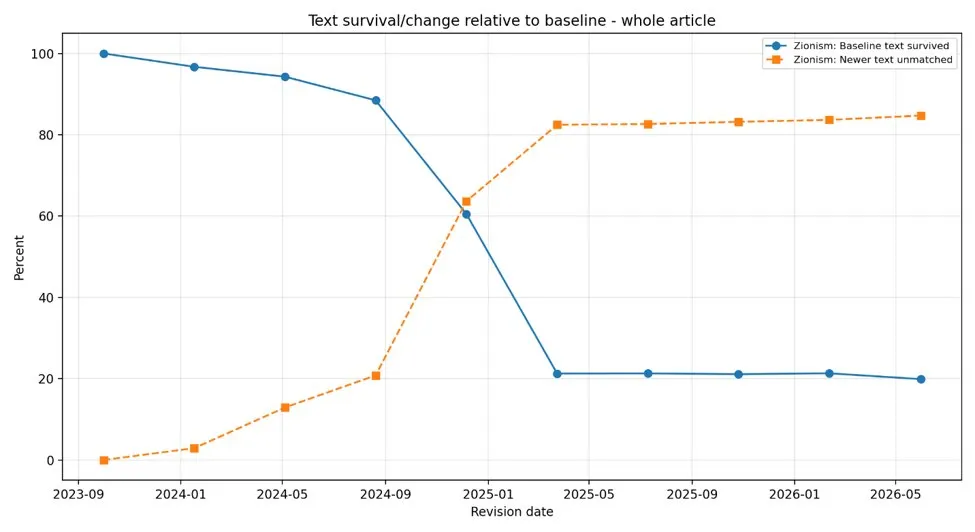
The sentence is only the most visible symptom of a much larger change. Over the past three years, Wikipedia’s coverage of this topic has undergone an extraordinary transformation, best exemplified by the Zionism article itself. I recently conducted a quantitative analysis of the article’s revision history and found that since 7 October 2023, about 80 percent of the article has been completely rewritten, and only about 20 percent of the pre-October 2023 text has survived.
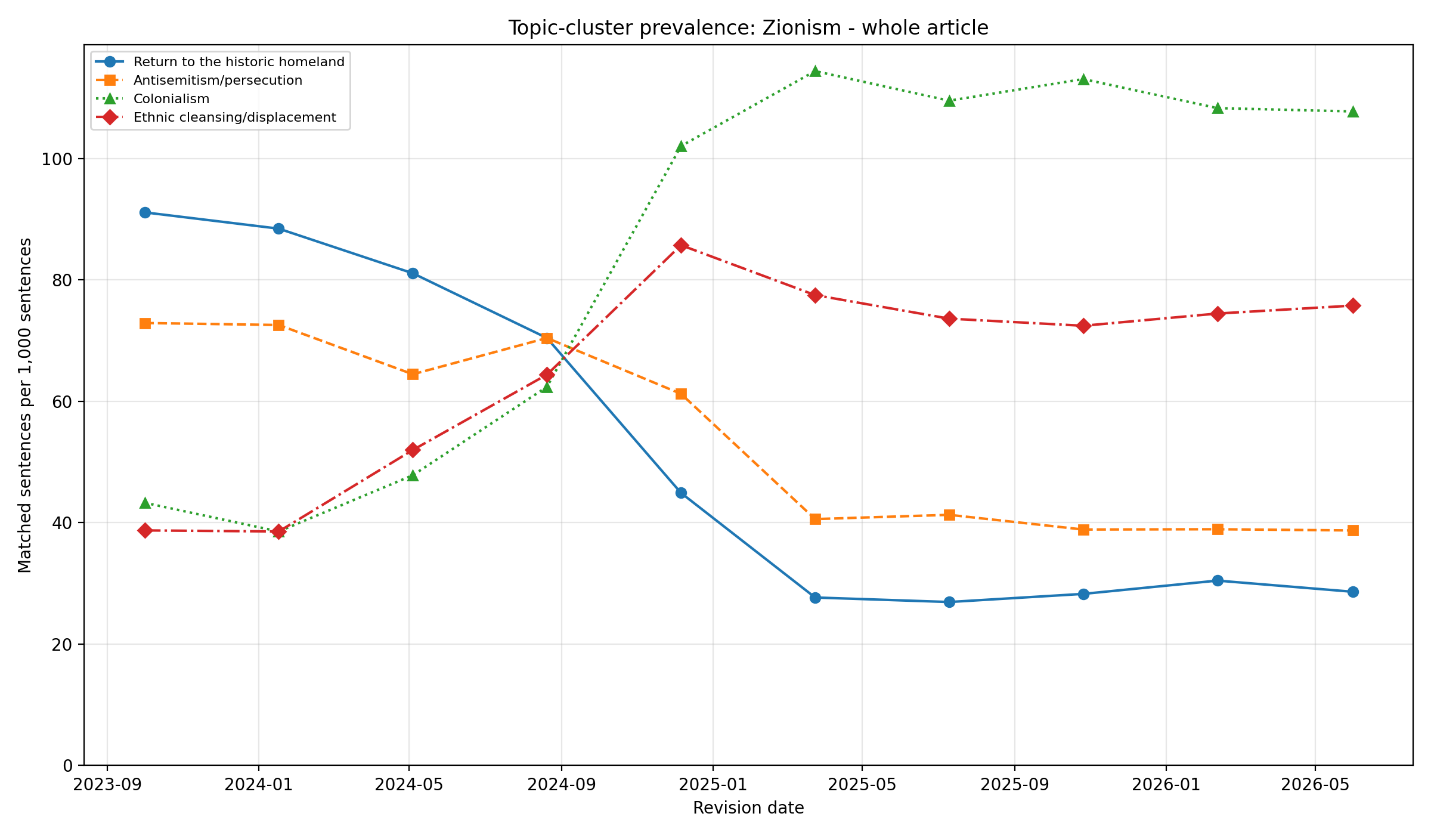
More importantly, this dramatic, measurable change reflected a fundamental shift in the topics emphasised by the article. For example, the volume of material associated with colonialism rose roughly two-and-a-half-fold, and coverage of ethnic cleansing roughly doubled. At the same time, discussion of antisemitism and persecution—the primary historical drivers of the Zionist movement—was cut approximately in half, while the return to the historic Jewish homeland went from the most prominent of the four topics to the least.
What makes this particularly unusual is the maturity of the article. By October 2023, it was already more than twenty years old, contained more than 27,000 words and represented the cumulative product of over 9,000 edits by nearly 3,000 different editors. While it is not unusual to see major rewrites of new articles or specialised pages in need of serious scholarly attention, this was an extensively sourced article that had been revised and expanded for two decades and already prominently featured critical perspectives, including interpretations of Zionism as a colonial project, discussion of Palestinian displacement, and competing accounts of the causes and conduct of the 1948 war.
Similarly, the scale of this rewriting cannot be explained by any recent fundamental shift in the underlying scholarship. For example, the most cited author in the article is Benny Morris, who published Righteous Victims in 1999, the substantially revised The Birth of the Palestinian Refugee Problem Revisited in 2004, and 1948: A History of the First Arab-Israeli War in 2008, drawing extensively on Israeli and Western archival material that had become available over the preceding decades. The same holds for the broader academic literature on the subject: the key works on which the article relies had all been published long before the page underwent its wholesale rewrite. In other words, there has been neither substantial new evidence nor a major historiographical shift since 7 October 2023 that could plausibly explain why four-fifths of a mature encyclopedic article suddenly needed to be replaced.
The explanation lies instead within Wikipedia itself—specifically, in the editorial choices determining which sources were foregrounded and how they were represented. An encyclopedic article is not supposed to reflect the political preferences of its editors, but to fairly represent serious scholarship on the subject. The post-October 2023 rewrite did exactly the opposite. Rather than neutrally presenting the actual range of views found among historians, the article moved towards a simplistic, partisan account, dominated by the perspective of Zionism’s political adversaries. Nor was the partisan editing limited to deciding which parts of the scholarship to foreground and which to push aside. It also repeatedly distorted what the scholarship actually said.
The most cited historian
Wikipedia’s use of Morris’s work shows the pattern particularly clearly. His archival research played a central role in reshaping the historiography of the Israeli-Palestinian conflict by foregrounding many previously neglected aspects of Jewish and Israeli conduct before and during the 1948 war that contributed to the creation of the Palestinian refugee problem, including expulsions, massacres, attacks on civilian communities and the destruction of villages. At the same time, he rejected the simplistic claim that the Palestinian exodus was the result of a pre-existing Zionist master plan to expel the country’s Arabs. As Cambridge University Press noted in its description of The Birth of the Palestinian Refugee Problem Revisited, Morris’s findings “undermined the conflicting Zionist and Arab interpretations”—the former that the Palestinians had left voluntarily, and the latter that their flight was the result of a pre-planned expulsion. His account instead presented a much more complex history that did not conform neatly to either political narrative. That complexity is precisely what the rewritten article strips away. To make sure I was reading Morris’s work correctly, I asked him to review my analysis at an early stage. He confirmed that I had accurately caught and explained the distortions of his scholarship described below, and later graciously agreed to review the full draft.
Keep reading
How Wikipedia Rewrote Zionism
The Wisdom of Charlemagne
Master of the Hunt


The Global Bellwether