Podcast
Australia Is Sick: Misha Saul on What Went Wrong
Investor Misha Saul joins Claire Lehmann to discuss Australia’s declining productivity, immigration policy, and the political choices shaping the country’s future.
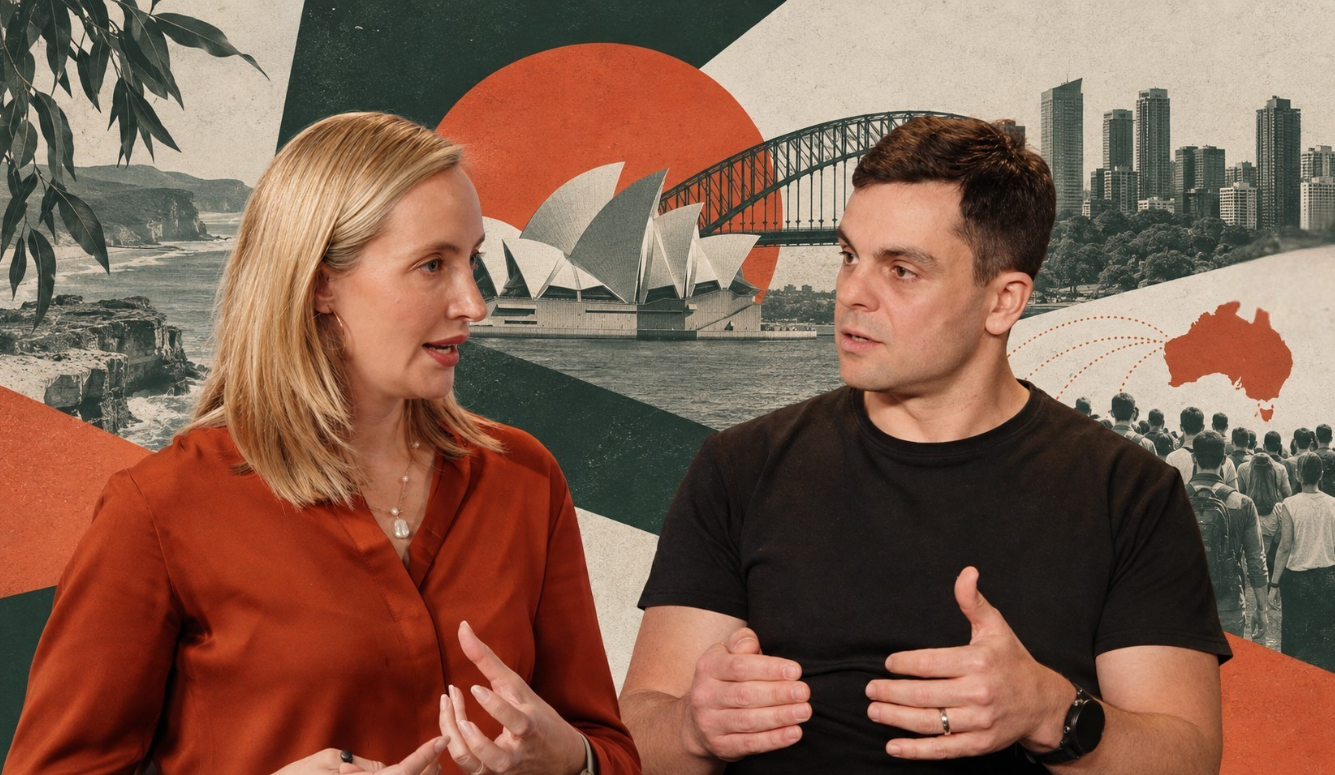

Today I’m joined by Misha Saul. Misha is an investor and entrepreneur here in Sydney, and he runs the Substack publication Kvetch. He recently wrote an essay that went viral, at least among my social network, called Australia is sick. It’s about the ways in which Australia’s political economy is dysfunctional and increasingly broken. I asked Misha to explain his views today on the Quillette Podcast.
Transcript
Editor's note: This transcript has been lightly edited for readability.
Claire Lehmann: Thanks for joining me, Misha. So Misha, you recently wrote an essay that really struck a nerve called Australia is sick. What prompted you to write this essay at this moment in time?
Misha Saul: Yeah. About a year prior to that—I’ll just back up a little—I wrote an essay called Ambitious Australia. And it asked, hey, why aren’t we reaching for so much more? When the British landed here in 1788, there wasn’t a great deal of technology and wealth. And over the next century Australians became the wealthiest people in the world per capita.
MS: And that was astonishing. And so my challenge to Australians, and to us, was: why aren’t we comparably ambitious? Why shouldn’t we reach for ten times the amount of wealth and of good things for our country? And so, I guess a year later, I was feeling more pessimistic. The specific catalyst was the recent tax proposals.
MS: And there’s a whole bunch of debate, which we won’t go into, around those tax proposals. But ultimately it’s a complex tax grab. And it was probably, in my view, the end of a series of own goals over the last two decades. And the question is less around this particular policy and more around what’s going on in this country. I saw in those tax changes structural challenges that are going on: the budget’s out of control, the spending’s out of control, and the government’s forced to tack to raising taxes. And so you get into this vicious cycle.
MS: And so I took a step back and said, hey, we have such great abundance in this nation—of mineral and resource wealth, and human capital and capability—and we’ve got unbelievable borders, and we have so much potential. But over the last two decades our political system has squandered it. It’s been a bipartisan issue. And I went into that. But that was the catalyst. It was frustration. My natural posture is real optimism about this country and what could be done. But I see it being squandered.
CL: And you make the point that a lot of decline can happen gradually. It’s insidious. If you look at cities or nations that have one per cent or two per cent difference in GDP growth, they wind up in very different places over a couple of decades. And we see that with a country like Argentina, which was once richer than France—and I don’t know what it’s comparable to today. But you’re right: Melbourne was once the richest city in the world. We can see that if we go and visit Melbourne, with the grand architecture from the 19th century. But look at Melbourne today.
CL: I think another commentator, Paul Kelly—he’s got a new book out—diagnoses three things that have gone wrong in this country. He identifies net zero policies, the NDIS, and a complicated labour system, our very complicated employment law system. And so each one on its own could be a surmountable challenge. But when you throw all three together, it’s like—how do we get out of this?
CL: And I share your pessimism after the last budget. It was quite shocking to me that these attacks on business, reducing the capital gains discount on businesses—it was shocking to me that that would even be considered as a policy change, let alone adopted by the government and then legislated. So do you think the decline has happened in the last ten years, just under Anthony Albanese’s government, or do you think it goes back further?
MS: Yeah. I don’t think Albanese has helped. I think it’s been a government focused on ideological issues. I think the general posture of the government is: hey, there’s this pie, let’s claw it more to our constituencies, rather than how do we rule for everyone. But a lot of these issues—and the three issues you identified are bang on—are certainly not something that’s happened in the last five years. The NDIS has been a disaster a decade in the making. Our employment law complexity issues are a century in the making. Net zero is certainly a disaster over the last fifteen years.
MS: I wrote in the piece that I remember the Kevin07 campaign. And there’s a lot mixed in there—the Howard government had been in government for a long time, people were tired of it, and it was WorkChoices, all this kind of stuff. And there was a sense of renewal and optimism. And in that moment there was certainly a global optimism around what can be done about climate change. And I’m sympathetic to that kind of vibe. But it was so misplaced coming from Australia. This global issue is not to be solved from Canberra. Australia’s just not in a position to do that. And so net zero effectively incurs all the costs and none of the benefits for this country. And that’s what’s happened.
MS: And I haven’t read Paul Kelly’s book, but I assume that’s what it’s all about. I start with the Howard years, partly because it’s a bit venerated on the right, and I think that’s a good place to start. I think the Paul Keating and the Hawke years were clearly generative in terms of reform, famously so. And so I think it was appropriate to start with Howard. Howard introduced the GST, he did gun reform laws, he had a crack at WorkChoices—although it doesn’t feel like, at the time, that was a simplification. It was just another complex set of rules replacing some other complex set of rules.
MS: But I point towards his immigration policy, and abdicating visa approvals and visa rules to universities, making them responsible. And that disgorged universities over the last two decades, and we lost control over the borders.
CL: And you’ve written about the role of universities in our immigration system quite a couple of times, haven’t you?
MS: Yeah. I just think it’s probably come up a few times, where some of the bureaucrats and administrators involved at the time have been quite vocal around what they’re doing. And it clearly starts around the Howard years, which is a bit counterintuitive. And that’s been a problem for universities, because suddenly they became highly incentivised to just maximise the number of international students, because that’s more profitable. And that’s bad for them, that’s bad for the student experience, that’s bad for a whole bunch of immigration issues.
MS: I think immigration’s obviously super salient today in the political environment, and that was one of the key drivers. And I think if we just step back on immigration—my posture has typically been that the very high immigration Australia’s been experiencing the last few years is not like rain, that it just happens and you suffer it. My posture has been: we should be regaining control and agency of our borders. And actually, if we want more immigration, there are a whole bunch of decent arguments for what that can look like and the right policy setting for that. But equally, if we want zero immigration, that’s perfectly acceptable. We are in a position to choose. We have ocean borders, and we should choose the people who come to this country and the circumstances in which they come.
CL: What would be an ideal immigration policy for Australia now, do you think?
MS: Yeah, I think these are complex questions. I’m pro-winning for this country, and I think that can have a bunch of flavours. I do think there’s a bit of a bait and switch with immigration policies. One of my very first essays that I wrote, six or seven years ago, and that I shared publicly, was around the time of the Hong Kong protests—so this was 2019 or so. China was kind of swallowing Hong Kong. And I thought, my goodness, what an opportunity: to invite a million or two million Hongkongers and build a new Hong Kong in Australia.
MS: And they shared the same high court till the 1970s, English speakers, very low crime, highly educated, wealthy, and so on. This would be a prize. And that would sound insane to the Pauline Hanson-flavoured kind of voters today.
MS: But their criticism of me, or of that essay—which would be correct, I think—is that, hey, you might want a great new city, but actually they’ll just be funnelled into Melbourne and Sydney, and would just strain the existing infrastructure, and be funnelled through universities or whatever. Which is kind of what’s happened in practice.
CL: Yeah. I think one of the problems with talking about immigration is that it devolves into this black and white issue, where you’re either pro or you’re against. And most people are pro-immigration, because most of us come from immigrant families. What the concern is, particularly with the rise of One Nation, is just the volume, the scale of immigration over the last few years, particularly since COVID. And if you look at the graphs, the explosion of arrivals has been quite astonishing.
CL: I think it has slowed down just a little bit in the last twelve months. I think there might be some moves around tightening up some of the pathways for students—particularly those going to the colleges, not even the universities, but the other education institutions.
CL: So I think it’s important to separate out the fact that many people are pro-immigration, pro-skilled immigration, and that historically our immigration policies have been quite successful. We do attract some high quality people. But the system as it is has become dysfunctional. We have all of these temporary migrants in the country, we’ve got all of these people coming in through family pathways, and it’s not having the economic benefit that it’s supposed to have. So we hear all of the time that high immigration leads to high growth, but we’re not experiencing that growth. So it makes people question what’s going on.
MS: Yeah, I think a lot of the economic arguments are fake. I think a lot of it’s driven by university profiteering and a business lobby that basically wants cheaper labour. And so I think that distorts a lot of our political economy. I’m an immigrant. I came to this country when I was little. I don’t have an impulsive knee-jerk—
CL: So you weren’t born here?
MS: No, I was born overseas and my family was born overseas. I grew up speaking not English at home, and the like. So I’m not compulsively anti-immigration somehow. But I think that also gives me the distance from Australia to look at the longer arc of Australian history. I’m a big Anglophile. I’m a deep appreciator of Australia, and of the deep Britishness of Australia that’s been forgotten and maligned. And so I guess I come to it with a broader view as to what’s possible.
MS: I think it’s okay if Australia decided, hey, we should have zero immigration today. There’s no rule of God that says “thou shalt invite anyone to this country.” We can do whatever we want. And if we wanted to say, hey, we should only have British immigrants, that’s okay. And if we say we should build a new city with Hongkonger immigrants—the main thing I think we want as a nation is agency and control. I think we’ve lost a sense of control.
MS: And we don’t know what we’re building towards. There’s no sense of, hey, why do we have half a million people coming to this country again? Why have we brought in a population the size of Adelaide over the last few years? Where are they going? And maybe it’s a timing thing, maybe it’s a volume thing. But what is the purpose and the vision for this country?
MS: And I’m not the person to answer those questions. I’m just posing some of them. As a society we can be more explicit and figure out: actually, what are we solving for? And we do in fact have agency and control, and we can decrease or increase the level of immigration.
CL: What about the argument that Jim Chalmers has made, that there are jobs that Australians won’t do? And he’s referring to jobs in the aged care sector, which is a growing sector. There are a lot of unpleasant jobs in health and aged care where industries are crying out for workers, where they’re struggling to find locals to do them. Is there an argument then for importing labour?
MS: Yeah, I mean, I think the policy settings on this have been schizophrenic, and I’ll give a few answers. I think we can look at a lot of models around the world. An extreme model of that is something like the Gulf Arab states, where seventy, eighty per cent of the population is foreign-born. There’s never a path to citizenship. They come in voluntarily, they’re paid better than they would have otherwise, they send remittances, and eventually they leave, and there’s no path. And there’s this very explicit trade-off.
MS: You’ve got other mixed versions of that where, maybe in America, you have all these illegals and they perform a lot of this work, and there’s no real official path to citizenship, but maybe it occasions an amnesty and they become citizens. There’s a broadly felt ethos that, hey, coming to this country, no matter where you’re from, what you do, we’re the same. You’re going to become Australian, you can share in the Australian dream of a nice backyard and a home.
MS: And so we’ve got the schizophrenic approach where, hey, we want a bunch of people here to do jobs we don’t want to do, and they’re degrading, maybe, and all this kind of stuff. But also, hey, you’re just one of us, don’t worry about it, and you can share in the Australian dream. And I think there’s a tension there which is unresolved. And we can choose, if we wanted, to do something closer to a Gulf Arab model, if we wanted to just solve for the labour thing.
MS: But immigration is not just about labour for us. It’s also a cultural question, and a question around what it means to be a citizen, and the like. And so again, I don’t have a great answer there. I’d point to the fact that a lot of these arguments are fake in the sense that the availability of cheap labour prevents investing in technology and capital equipment to solve a lot of issues. Now, I don’t know if that’s the case in, say, aged care. But you’ve seen that in things like car washes, where a lot more of it’s manual and human-washed now, rather than machine-washed, because suddenly there’s this availability of labour. And so I think there are these fake arguments—anti-productivity, anti-technology, anti-investment arguments, or downstream effects rather, that come about from that.
CL: Yeah, you could make the counter-argument that cheap labour—and when we’ve referred to cheap labour, temporary migrants are often paid less than local Australians, and because they’re in a precarious position it’s difficult for them to complain about their pay and conditions and so on. Temporary migrants are willing to be paid less, which is able to prop up zombie firms, or even zombie industries, which should really be going bust. Is that what you mean by it’s a fake argument—that if you remove the crutch of cheap labour, then either these companies will go bust, or they’ll invest in machines and so on?
MS: Yeah. Again, the car wash argument was one made by a senior government official recently. He himself noticed, hey, actually, I’ve noticed that my car wash used to be machine, now it’s people. And I thought it was amazing that someone involved in immigration decision-making made that observation. Because that’s a real argument.
MS: And yeah, I think it’s an empirical question of where that applies and where it doesn’t. I don’t have a firm view. But I think the economic arguments often don’t actually hold water. And if you ask people why have we had three or four hundred thousand people come in last year, often they’ll say, hey, it’s out of our control. It’s a university thing, or it’s because of the temporary visas, or student visas. And so the key question comes down to: we should be explicit around our choices here.
MS: We can have a target of net zero immigration if we want to. That’s perfectly moral and legitimate. Or if we want to be striving for something more, we can make the case. Or less—we can make the case. But right now, people have all sorts of reasons for it, and then you examine them closely and they don’t quite hold water, and so it all turns to mush.
CL: Yeah. And you make the case that the Liberal Party has been captured by the Business Council. Is it the Business Council that is pushing for big Australia?
MS: I mean, it was a little bit glib. I think it’s partly business, but it’s broader business interests who just want cheap labour, is the short answer.
CL: In Australia we have big corporate incumbents, we have oligopolies, we have these huge companies that push out the competition and can dictate terms in their market.
MS: This has been a two-hundred-year thing in Australia, and it’s common across countries. This is a really old argument and an old thing. But obviously, if you’re investing in this country, if you’re a business, if you’re a massive corporation in this country, you want the population to go up, more people to buy things. And that’s totally legitimate. That’s not a bad thing. And you want more labour at lower prices, basically. And again, that’s perfectly legitimate, frankly.
MS: But zooming out—why did I make that point? I made that point because, when I look at both parties: why has One Nation suddenly rocketed? Because for so long they ignored people’s preferences around immigration, mainly. And why do they ignore them? Because they were a blind spot for their constituencies. And for the Liberals, it was the business community. And for Labor, it’s a mix of unions and the inner-city professional class and university class and public servants and the like. And so those constituencies turned a blind eye to this immigration thing because it wasn’t in their interest.
MS: And so the broader point—because immigration was only a very small part of the essay—the crux of the essay really was about our political economy, and the broken incentives across the board in our politics, and the concern that actually it’s really hard now to unwind things like the NDIS. Because are you really going to claw back fifty billion dollars from voters now? How are we going to do that? That’s really hard. I don’t know how to do that.
MS: And you could point to a range of policies—even the immigration thing. The Libs felt, I guess, they couldn’t reduce the immigration that was out of control. They haven’t addressed that issue, and that was clearly so salient for their voter base, because it was against other special interests that supported them. And so I guess if you go through the major parties, go through what interests drive them, you get to a pessimistic place. Because if you accept that we’ve had a lost decade in this country, then how are we going to reverse those, or how are we going to generate the reform needed, around net zero or the NDIS or employment law—which you mentioned earlier, which I think are super interesting and salient points—actually it’s really hard.
MS: What is the constituency to do that? And who are the politicians who are going to do that? Because where are their incentives? And the pessimistic take is that their incentives are broken, and they’re not aligned to fixing those issues, which means that we are at real risk of continuing to bungle and drift.
CL: Do you see an outcome like the UK for Australia?
MS: Yeah, I love that it’s just shorthand for disaster. And I totally agree. The UK is basically shorthand for catastrophe. And that’s absolutely the downside case over a ten-year view. And over a hundred-year view, Argentina’s the downside case.
CL: Yeah.
MS: Venezuela used to be in a much better place as well. And Venezuela, similarly—high human capital, resource abundance, really close to the largest economy in the world. These countries should be way richer, and their political economies are broken. And so the risk for us is that we’re not going to be in great poverty next week. But the risk for us is that we do drift and get worse over time.
MS: So look, are we on the path to the UK? There are a bunch of UK-specific derangements, and we have our own path. But, as you said at the start, these things are a bit like the frog in boiling water. It’s the half a per cent reduction in growth, one per cent reduction in growth. That’s the thing that kills you over time.
CL: But it seems to me like all rich countries are having similar problems, with the obvious exception of the United States. But they have their own problems. They might be having GDP growth, but they have serious other issues that we’re familiar with. So if all rich countries are having this problem, then perhaps there’s something—maybe the ageing population is just a wicked problem that we haven’t figured out how to fix yet. Maybe we will. But maybe the low-hanging fruit has been picked when it comes to progress and economic growth, and we’ve just hit a wall.
MS: I think that’s the strongest argument against my essay. I had a bunch of comments saying, hey, you could say the same for the UK, say the same for Canada. And so I don’t know if it’s all rich countries. Certainly all Anglophone countries do seem to be on some sort of similar trajectory. I think the US ex-AI would be a really dire path as well.
MS: I’ve got an essay in my head, I was writing notes on it, incomplete—why are Anglophone countries going through this? And why is the US different? And I think there are a bunch of reasons, but one reason I think is probably underrated is American federalism. You can have a totally broken political economy and political class in places like California and New York, and Texas would just go, great, come here—and solar skyrockets, and gas. And Montana’s like, hey, we want to be the AI hub, or whatever. And so you’ve got competition amongst the states in the US. And here we don’t really have that. We used to have that more, and now it’s way more centralised.
MS: Another is something as hard as Silicon Valley, which is a sample of one. That doesn’t exist anywhere else in the world. And an AI boom—there’s a trillion dollars of CapEx spent last year in the US — that is extraordinary, and we’re certainly going to be beneficiaries of that. But it’s hard to replicate that. That’s a moment-in-time thing. And without that, the US would look a lot more dire.
MS: But look, I agree. I think there are a range of issues in this moment in world history around fertility, around population ageing and so on, which are kind of independent of any particular policy setting.
CL: Yeah. I recently had a chat with Louise Perry, who’s moved here to Australia—
MS: Huge fan of hers.
CL: —who moved to Australia from the UK. And it made me feel a lot more optimistic about Australia, because obviously she’s made the tough decision to bring her family out here, and it’s not a trivial thing. And so she was explaining to me all of the things that Australia is doing that are a lot better than the UK. And there are things I’d never heard of before, such as private schools in the UK are taxed more, whereas here independent schools are provided funding from the government.
CL: So, little things like that. And I talk to some parents at my kids’ school who have lived overseas, and they all talk about how safe Sydney is, how you can let your kids catch public transport, you can let them walk home. You can’t do that in a place like London, you can’t do that in other major cities. And Sydney is a big city. And so you can just let your kids roam around on public transport. So we’re doing a lot of things right.
MS: Look, I think Sydney’s the greatest city. I’m a huge fan. I don’t want to sound like I’m down on it. I’m obviously pessimistic in some respects, but spring has just come to Sydney and you have to think it’s the only city loved by God, this place. It is just glorious.
MS: I let my nine-year-old catch the train from school sometimes. He wears a kippah and he’s fine. And one of the other mothers thinks I’m mad for doing that. But I feel perfectly comfortable. It’s Sydney. To be fair, this mother I’m talking about, she lost her brother and her kids were shot at at Bondi, so I can understand her reticence. But nevertheless, I love Australia, I love Sydney, I love Sydneysiders. It is safe. We have done a lot of things right in this country.
MS: And I guess that’s where my starting position was: hey, we could be doing even more. And we have so much embedded potential. That’s my starting position. And my disappointment is around our political economy, the incentives for our politicians and our political class. And I don’t come with a great answer. I hope someone comes along who is super charismatic and inspiring and does a lot of the hard changes that need to be had.
MS: But yeah, I agree. We’ve got a long history of brain-draining the UK, and of Brits coming to Australia and becoming the best version of themselves. That’s essentially—if you have to say one story about Australia, that’s the story. British people coming here and being the best version of themselves. That’s the story of Australia. And it’s glorious. Free-range Anglos: just add sun, just add food and water and fresh air—
CL: And space.
MS: Absolutely. And they grew taller and more tanned and more glorious. And I hope we continue that tradition. I mean, Louise Perry coming here is a perfect example, where she’s the best Britain has to offer, a wonderful addition to this country. And I hope we do more of that, selfishly. So I think she’s right that we have a great culture and we’re doing a lot of things right. And we’ve been doing a lot of things wrong, and we could be doing a lot of things much better.
CL: Yeah, no, I completely agree. So what are you optimistic about in Australia? We’ve gone through how beautiful Sydney is, but is there anything in the political economy that is working? You write in your essay that One Nation are a bunch of nincompoops. So you’re not optimistic about—
MS: Yeah, maybe that was harsh. Look, I wrote another essay a while ago, like six months or something, called Australian foment, where it was like: hey, something’s brewing on the political right in Australia, something’s going to happen. There’s a lot of deep dissatisfaction, there’s a massive opportunity, someone’s going to take it. And One Nation came and took it. And good for them.
MS: I think Australians are sick of how broken immigration is, and One Nation are all about that. And Pauline Hanson’s been talking about that for twenty years, and good on her for saying what Australians want, frankly. And so I don’t want to condescend to her, and to our nation, and what they’re up to. And I think they’re often right. I think their challenge is just attracting talent and building the muscle for governance and competence, which we haven’t seen evidence of yet.
CL: Malcolm Roberts is an incompetent.
MS: And some of the people involved in that party—that’s what I was referring to. There’s a bunch of folks there where you look at it and you go, this is not the best Australia has to offer. And if they can increasingly attract the best Australia has to offer, great. It’s easy for a dude with a blog to say, hey, they’re all a bunch of idiots. And so that was probably glib, and I had a crack at everyone, to be fair. But look, I think that’s what I meant specifically by One Nation being nincompoops. I think they haven’t proved they can be serious. But I wish them well, I guess.
CL: Do you think their explosion in popularity will have an impact on the Liberal Party, and potentially the Labor Party, that is positive—in the sense that they address some of these concerns that haven’t been addressed for so long?
MS: Yeah, look, I don’t know what those parties are going to do. You can see in some of their announcements and retractions that they’re trying to figure out their response to One Nation. Look, in other countries—I think it was in Denmark, for example—the right were totally muted, because the left just adopted the anti-immigration stance. And it’s like, get rid of right-wing politics with this one weird trick.
CL: I know that’s how the Labor Party was sort of invented in Australia—anti-immigration. It was a party that grew out of the union movement, but the union movement itself was about protecting the wages of native workers against people who were coming from China to the goldfields in Victoria. And there were anti-immigration protests held by unionists up in Queensland, the shearers and so on.
MS: Yeah, the White Australia policy.
CL: So they were very explicitly for protecting the wages of local workers. And that’s how we got the Labor Party.
MS: It goes even deeper. That was an incredibly generative moment in Australian history. That was how the states federated. Britain started demanding, hey, you’ve got to open up your borders to these people and those people, and we’re signing treaties with Japan. And, you know, what about the Indians? They’re part of the Commonwealth. And the Australian states are like: no, actually, we are going to federate. And we’re going to do our thing.
MS: And so the single most politically generative moment in Australian history was a function of an anti-immigration stance, basically. Or of being particular about retaining Australian Britishness and whiteness. And that’s kind of forgotten.
MS: It was funny—there was something weird in the water at the time. Because one of the results of the shearers’ strike in Queensland that you referred to, in the 1890s, was a bloke who basically said, hey, this stuff’s too much, Australia’s not white or socialist enough for me. And so he got two hundred families together and sailed to Paraguay to set up an Australian colony in Paraguay, which totally dissolved very quickly. And it was a failure. But I’m not saying he was right. I’m saying it was incredibly generative. It was a time of nation-building.
CL: There’s—
MS: That’s exactly right. And so not just the Labor Party absolutely was born to protect local workers and local wages against foreign workers—but the whole nation really was formed around a closed posture, if you like.
CL: And do you think your status, or your identity as a migrant yourself, gives you more confidence in making these pronouncements? Because it’s difficult for someone like me—I’m fifth-generation Australian, and I don’t feel as strongly as you do, but I would be very nervous making those statements.
MS: Which statement? What I just said made you nervous? That Australia was born under those circumstances? Because I’m not saying it was right or wrong. I’m stating a fact.
CL: Yeah, no, it’s not a statement of history. It’s, I suppose, the idea that we can just be closed off. We can shut our borders and not take in—
MS: Maybe. For me, I don’t identify as an immigrant, I identify as an Australian. I grew up here. This is my home, and my family’s here, and I love this country. I do feel culturally—just to zoom out again—we were a really British country until roughly the seventies. I don’t remember the exact year, but the Australian passport was only introduced in something like 1965, or something like that. Australians just ran on a British passport.
MS: It was a really British country. It was like 98 per cent British prior to World War II. And then Britain changed its posture, moved towards Europe, and we suddenly had to figure things out for ourselves. And so then we had a swivel: hey, are we an Asian country? Turned on the taps for immigration. And we start to change. And I think Australians are uncomfortable—I think you’re alluding to Australians being uncomfortable about how British that history is.
CL: I love British culture. I’m an Anglophile as well. Whenever I visit England I feel so at home—which is interesting. When I go and visit Ireland, it feels weird to me. I feel much more at home in Britain.
MS: That’s because you’re a real Brit. You don’t know about those Irish.
CL: But it was Paul Keating who wanted to pivot towards Asia—in particular, explicitly pivot towards Asia.
MS: Yeah. Again, I think we can try things, and so I don’t hold that against him, so to speak. But there are still people of that generation who think of ourselves as an Asian country or something, which is totally ridiculous. We’re not. But to your question—most Australians are descended from British people, and our culture and our institutions and our language are all very much descended from the British. And I think there’s nothing wrong with that, A. And B, I don’t think there should be anything controversial or spicy about saying, hey, we should just control our borders, and we can choose who comes to this country and who doesn’t.
MS: That’s all I’m saying. You asked before what my ideal immigration take is—I don’t really have a firm view. I think the key thing is: we should not just let it happen to us. We can take control.
CL: Yeah, I think that’s reasonable. There should at least be some democratic voice. And for so long the policy has been technocratic, with not much input from voters. And I think now we’re seeing that voters are disgruntled.
MS: Well, someone should make the case. If we want certain migrants—let’s take the UK as a really bizarre example, where Brexit was a function of British discomfort with all these Polish people coming in—plumbers and nurses and the like—and they turned the tap off with Brexit, and then they increased the immigration rate from the subcontinent. And did that solve the issue? And what was the impact on people, and what was the vision or the view for that? It’s led to all sorts of controversies and other discomforts.
MS: And so I think for us—I live near Chatswood. It’s a really Chinese migrant kind of area, probably one of the most in this country, and it’s great. And I think it’s just about: what kind of country do we want to be? And accordingly, who we let into this country partly determines that.
CL: Yeah. And you recognise that human capital is such a huge part of what makes a country great. And if we can attract the best and the brightest from places like Hong Kong, potentially Taiwan and Britain, we will be a superpower.
MS: Yeah. I don’t know why we don’t do something—I mean, you can tell people aren’t serious about the skilled thing, because we don’t just auction off a certain amount. We could just do something like: fix a number, say a hundred thousand, fifty thousand, two hundred thousand, pick the number, and say we’ll just let this go to the highest bidders, whether it’s corporations or people.
CL: Yeah.
MS: That’s not really how it worked. I think it was used in a weird way. It’s a separate issue. But I think you could simplify and make it explicitly to that end, and you basically solve it. And you go, okay, well, if someone’s willing to pay a million dollars for this person, or two hundred thousand dollars for this person, then it’s pretty good for this country, probably.
MS: There could be other systems. I’m not saying that’s the only way. But you could devise a simple, clear mechanism to signal we’re going to take the highest quality people into this country, or the highest valued people. Or we don’t do that, and we have this pretend mechanism where we’re going to skill them up through universities. And so we don’t really skill anyone up, and we dilute the quality of our universities, and it all kind of—
CL: Rents just go through the roof.
MS: Yeah, strain our infrastructure and our housing, and it all just breaks. And so the story you’re often told is just not the reality that happens. And so it’s hard to clear that all away and simplify it to solve certain ends, because ultimately you’re trying to meet different interest groups and wrestle with trade-offs.
CL: I mentioned before that it’s possible that we’ve picked all of the low-hanging fruit when it comes to economic progress. But there is some low-hanging fruit in Australia—the obvious one being nuclear energy, lifting the ban on nuclear energy. What would we do if we could get our act together? What would Australia do in the immediate future, if we could just stop this malaise that we’re currently in?
MS: Yeah. I mean, we could just not ban stuff. So, to your point, the big argument with nuclear—it’s totally safe and it’s a great source of energy. The question is whether it’s economically feasible. And I haven’t done the maths. But just unban it and we’ll see. That’s the thing. And if it doesn’t happen, okay. That’s okay if it doesn’t happen.
CL: The companies would wear it—
MS: That’s right. Let people be allowed to invest in it, if they want to. Or gas — New South Wales and Victoria are sitting on some of the biggest gas fields in the world, and it’s effectively banned. And so that’s very low-hanging fruit, pretty climate-friendly, pretty energy efficient, and it’s banned. Just stop banning stuff is the starting position, I think.
MS: In my Ambitious Australia essay, I proposed on employment law—one of the three you mentioned earlier—it should just be on a page. Employment law. Choose a minimum. It could be higher. I’m not saying lower than minimum wage. Just choose a minimum. Say people are mandated X days off, or whatever. And that’s it. It’s unclear to me why we have volumes and volumes of workplace regulations.
CL: Six thousand pages.
MS: It doesn’t make any sense. No one understands it, and it’s totally unnecessary. And the reason is because historically every industry had to fight for certain rights and wages. And the way the corpus of laws has grown is industry by industry over many decades. And that’s fine, and that’s legitimate, and a lot of that was good stuff. But we don’t need to be in that world anymore. We can dramatically simplify.
MS: Maybe the tax code does need to be super complex, because there are all these edge cases, but we could dramatically simplify that. So I don’t think the low-hanging fruit has been picked. I think there’s a ton of stuff we could just unban, or simplify. I think the question is one around political incentives. And again, the political economy: laws tend to only ratchet one way. They tend to get more complex, not less. And they tend to just accumulate. And so I think that’s the nature of not just our society, but of all societies. And I think we need a catalyst to clean house a little bit.
MS: I am obviously very optimistic around the AI boom. I think businesses in this country, and the way people do things, will change dramatically for the better over the next decade and beyond. I’m maximally excited by that. So that’s not driven by Australia obviously, it’s driven from offshore, and we can squander the fruits of that yet. We can figure out ways to ban things or whatever. But I’m really optimistic that businesses can do things in totally new ways over a multi-decade view, and basically increase productivity and increase wealth—if we don’t squander that opportunity.
CL: Well, I’m going to stop you on that optimistic note, Misha. It’s been an absolute pleasure talking to you, and getting your frank views on the state of the nation. Where can we find your work, if we’re interested—your writing work?
MS: Look, I’ve got a blog called Kvetch. So, basically by the name, it’s just where I go to whinge a little bit, or [indistinct]. So that’s just k-v-e-t-c-h dot A-U. That’s it.
CL: Very well written pieces on there.
MS: I appreciate that.
CL: Brilliant. And it’s on Substack, so people can subscribe, and people can become paying subscribers if they wish.
MS: Everything’s free on the site. I’ve never paywalled anything.
CL: But if people want to patronise, they can. Thanks for joining me, and thanks for writing the essay, Australia is sick. I think it’s a bit doomerish, but I also think that it’s time we woke up to some of these realities, because they’re not going to get better unless people take back control and exercise some agency. So I appreciate you doing what you do.
MS: Thanks, Claire. Thank you for having me. I really admire all you do here.
CL: Thanks.
Quillette invites thoughtful responses to its essays.
Selected responses are published once per week as part of a curated Letters to the Editor feature. If selected, letters appear under the contributor’s real name and may be edited for clarity and length.
To submit a letter for consideration, please email [email protected].
Keep reading
The Genetics of Crime and Punishment


Jerry Kaplan on AI Doomers
Payback Time for Steven Galloway