Music
Parallel Kingdom
Nick Cave’s beautiful and tragic music brings redemptive catharsis to a grief-stricken city.
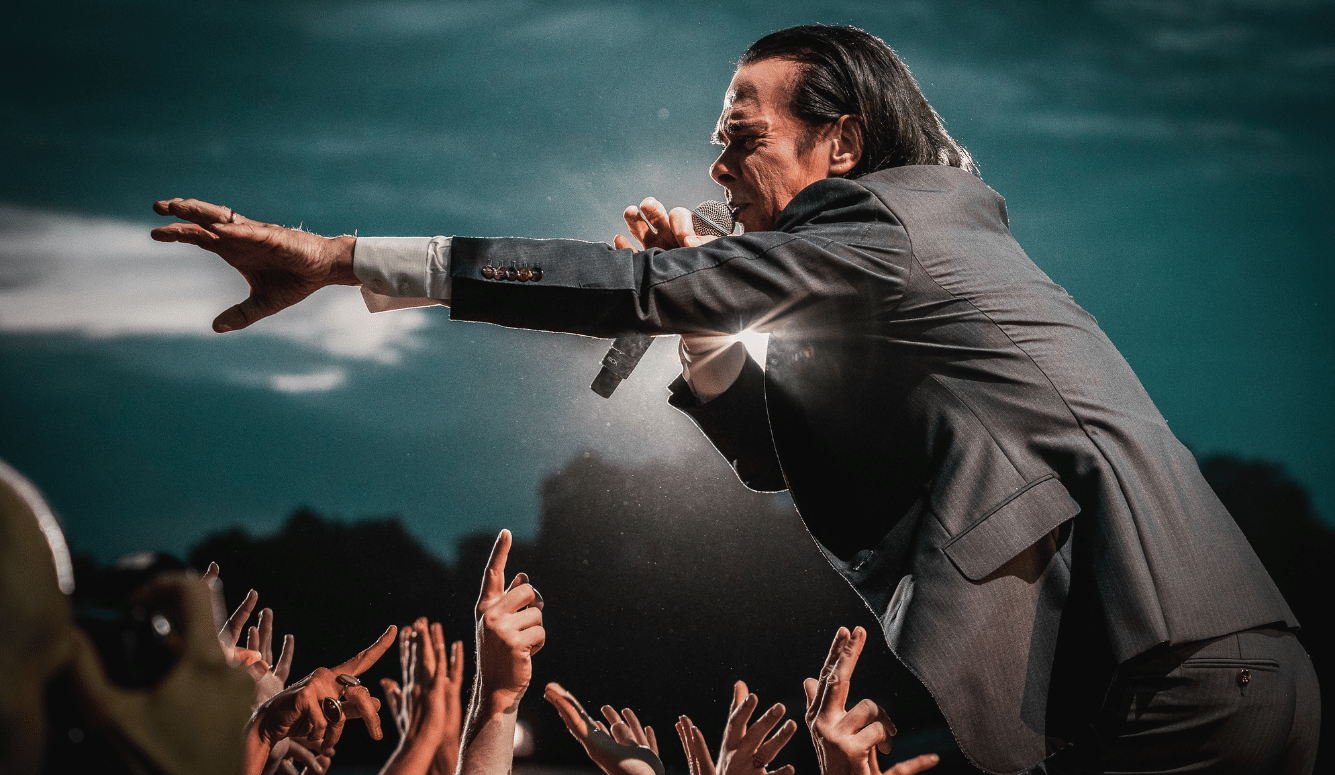
Review of Nick Cave and the Bad Seeds, playing at The Domain, Sydney (23 and 24 January 2026).
Bats migrate across the twilight. A fingernail moon hangs between city buildings. Nick Cave and the Bad Seeds emerge from the parkland of The Domain below singing “O Children.” Each night, Cave’s introduction changes. At first, he talks about how the song has followed him around, its meaning shifting over the years. On the second night, Cave’s introduction is rawer: he extolls the beauty of Sydney and warns people “not to fuck it up” for those that follow us. “Maybe that’s all the song really means,” he says, with a shrug.
Located directly across from the Art Gallery of New South Wales, The Domain is picturesque. Church bells ring out from nearby St Mary’s Cathedral, triggering a premature cheer for what sounds like the start to “Red Right Hand.” I felt as if I were inside a Brueghel painting—perhaps an Antipodean, reverse version of “The Hunters in the Snow,” all summer air, silver skies, and gentle optimism. Brueghel’s work depicts exhausted hunters returning empty-handed to their icy northern European home. It’s usually interpreted as a portrait of failure and fragility—but there’s also a hint of relief in the idea that they have just made it back okay. The truth lies somewhere in between those moods. We live in a world of uneasy balances and now and then, we are reminded of this.
The Domain was set up in the best way I’d ever seen. A flat green field had been turned into a vibrant fair, where 10,000 people each night sprawled between food wagons, picnic tables, two small grandstands, and a wheelchair-friendly platform, with a high stage and video screens that accommodated views from just about anywhere. So, what did our returning musical hunters bring to this village? And what did the village do for them?
Nick Cave and the Bad Seeds played two huge Friday and Saturday concerts here across a long weekend that culminated in Australia Day on Monday 26 January. It had been barely more than a month since the antisemitic terrorist attack at Bondi Beach on 14 December. A muted Christmas and New Year had come and gone, followed by a National Day of Mourning on 22 January. In the aftermath of all this, there was an atmosphere of both serenity and vulnerability at The Domain: an unmistakeable yearning for a gathering that would be positive, perhaps even healing.

When the Bad Seeds began, there was a huge tide of applause for Cave’s “Sunday Morning Coming Down” song, “Frogs.” It was followed by “Wild God” and soon we were on our way into another world—hyper-alive and eerily embodied—accompanying him in spirit as he walks his wife home from church in the rain while “the frogs are jumping in the gutters” before he sang his hallucinogenic and humourously self-referential story about an old man who “flew through the city like a prehistoric bird.”
Cave’s images of life and love continued to flow in a realm where the everyday and the magical were intertwined. This storybook energy was enhanced by flashes of lyrics from the Wild God album on the video screens in enormous caps: YOU’RE BEAUTIFUL, BRING YOUR SPIRIT DOWN, MINE.
And yet there had been a shift from the theatrical visions and cinematic soundscapes of the recordings into something earthier and more human in this live context. Classics like “From Her to Eternity” and “Tupelo” are, of course, furiously Grand Guignol, ominously disturbed, Biblical. They highlighted a theme of Cave’s earlier work: a cross-weave between his passions for psychotic storytelling and for out-of-kilter nature, an archetypal being tuned into the wrong world. Forty years on, they’re still pretty thrilling.
Many critics have defined Cave’s shift from the 1980s to the 90s as a move from the Old to the New Testament: religiously influenced and first murderously and emotionally sacrilegious then mercy-seeking. Given Cave’s problems with heroin addiction during those decades, these songs might track a journey from despair to redemption. With the album Push the Sky Away (2013), Cave confirmed a movement from stormy daemon and aspiring angel into that greatest of goals, the quest to become a decent human being: I was; I am; I will be. Maybe that’s where the real magic is, with the move from myth to man.
Now and again, Cave broke his amused stage patter to directly engage the audience. On the first night, he did a mock double-take when he hit the stage and looked out at everyone: “What happened to you all?” When he announced “another very old, old song,” he wryly referred to it as a work from “my middle period.”


Photos of the concert by the author.
Both shows revealed Cave’s multi-generational appeal: the audiences contained everything from punk-worn grandparents (coming out of the black and into the grey) through to swathes of teenagers sporting freshly-bought Bad Seeds merch (the pink T-shirts featuring Cave’s torso from the cover of 1994’s Let Love In sold like hotcakes). About a third of the setlist was drawn from the last century; the rest from this one, with the Wild God album helping the night’s offerings cohere. It’s remarkable that songs from such different eras can fit together so seamlessly. But there’s a shared otherworldliness in them; most of his newer songs feature parallel realms overlapping and becoming visible to one another. “Jubilee Street” worked as a fulcrum between past and present, carried by that persistent awareness of an otherness at work in the world as Cave told the red-light story of a girl named Bee from a client’s perspective, prostitution and death ending in a memorial rapture.
The material from this century was markedly different to what had come before, closer to the metaphysical, though not lacking in flashes of heavy aggression. For example, there was “White Elephant,” a threatening track (“with my elephant gun I’ll shoot you all for free”), which takes off into what might be seen as a delusional gospel ecstasy, its angry narrator either redeemed or intoxicated by his faith. The Bad Seeds felt like an entirely new group—despite the fact that the recent members had already been road-tested and despite the presence of long-time loyalists like percussionist-drummer Jim Sclavunos and Warren Ellis, Cave’s creative collaborator, on violin, keyboards, synth, and some loud, bastard amalgamation of mandolin and guitar.

It’s hard to put a finger on what it was that gave this impression of newness. It was not just the relatively fresh musicians on stage, especially Colin Greenwood with his buoyant, fluid bass playing (“we gave him a pass out to play with Radiohead but now he is back where he belongs”). Nor was it strictly to do with the increasing role of the four “backing” singers who these days are foreground presences, one male and three female: T.J. Cole, Janet Ramus, Wendi Rose, and Miça Townsend. Black-suited and silver gowned, the vocal foursome channelled an imaginary baby Elvis with a Moses-like intensity in “Tupelo”; then loped along in sync with Cave during the menace of “White Elephant” before Ramus walked down to the piano for an encore duet, her voice equal parts roar and smoke, on “Henry Lee.” If the vocalists felt a bit too churchy in the past there’s more soul music secularity now: a tad less religion, a touch more crazy, spooky heart.
Warren Ellis seemed shyer despite moments of showmanship like throwing kisses to the audience and shouting out an incantational round of “my people.” But just when he appeared to be unusually subdued, he unleashed tormented blazes off his violin and guitar. It was as if some untapped inner self kept opening up and drawing us into the heat and electricity that can run like lava out of the songs and from Ellis’s own Merlin stage presence.
George Vjestica (whose last name means “witch” in Croatian) stung with his lead guitar work in “From Her to Eternity” before offering an acoustic cowboy strum in “Mercy Seat” that would do Sergio Leone proud. Larry Mullins, on drums, announced each song with unmistakable power and a theatrical awareness of the lyrics; Jim Sclavunos’s percussion and rhythmic conversations with Mullins included a dose of nervy madness on the vibraphone during “From Her to Eternity.” The crowd went wild when he applied a hammer to his tubular bells for the chiming start to “Red Right Hand” and when he pummelled his way through “Papa Won’t Leave You Henry.”
Carly Paradis contributed keyboards while Cave banged away periodically at the piano before busying himself with fits of gothic Jerry Lee Lewis-style madness and preacherman fun front of stage. In Melbourne, Paradis even added some whistling during “O Wow, O Wow (How Wonderful She Is),” Cave’s loving tribute to his past creative partner, Anita Lane. Back in Canada, where she lives, Paradis is so good at whistling, Cave told us, that there’s a native bird that hears her call and comes flying to her like a familiar.
If the old Bad Seeds were heavier and dirtier, starker and darker, a snake perpetually uncoiling, this Mach.2026 version is brighter, lighter, but no less powerful. Because Paradis stood so close to the vocal quartet, I was very aware of how female the line-up is, in stark contrast with previous all-male incarnations. Maybe it’s this feminine energy that is the most changed quality, even though Cave has always exuded a yin to the yang in his songwriting, which enhances its submerged genderfluid quality.
The old favourites tended to be the most fully rocking: during burners like “Mercy Seat” and “Papa Won’t Leave You Henry,” the 68-year-old Cave leaped outrageously high beneath the stars. It was an amazingly physical performance—especially on the incandescent second evening. Older, darker songs leaned more into narration and purgation: demented entertainments, mind movies. Unlike those horror stories and guttural blues, the newer songs glimmered with more hopeful emotions.
The loss of Cave’s sons, Arthur and Jethro, has brought a mystical suffering into the music, a quality that is especially clear on stellar albums like Skeleton Tree and Ghosteen. Loss and hope are everywhere, underlined by a pulsing will to live. Certain songs were spiritual in unexpected, tear-inducing ways: “O Children,” “Bright Horses,” “Joy,” and “Skeleton Tree” created an almost unbearable feeling of intimacy with the singer’s grief as a large video screen highlighted Cave’s face fading into total blackness during “I Need You,” while he recited “just breathe, just breathe, just breathe.”
Thanks to the spectacular environment at The Domain, I found myself gazing skyward along with Cave or looking out at the surrounding trees during the more introspective songs. As a wild wind surged around us through a sea of leaves, it created a feeling of connection, a sense of ethereal presences flowing by as “Joy” played on. At such moments, it felt as if a second audience were around us, as if the music had connected us with some other world.
“Into My Arms” closed out each night after a towering two-and-half-hour performance. It is quite different from Cave’s other “mid-period” songs in the live set. He performed it alone at the piano, urging the audience to sing along with him. To be with everyone as they joined in was a very humbling experience—all of us knowing the words about a god who is not “interventionist,” yet paying tribute to something intrinsically holy in a ragged choir of thousands.
We can’t escape futility and pain in our lives, but we can share our struggles and maybe lighten the load—and even shine together on nights like these. The trees of The Domain shook once again in a strong wind as the show came to a close and the audience walked homewards beneath their dark green crowns, feeling that there had been something there with us along the way.
Quillette invites thoughtful responses to its essays.
Selected responses are published once per week as part of a curated Letters to the Editor feature. If selected, letters appear under the contributor’s real name and may be edited for clarity and length.
To submit a letter for consideration, please email [email protected].