Deeply Problematic
The Tragedy of Murdered Indigenous Women is Real. So How Did Activists Turn It Into a Punch Line?
Leah Gazan’s use of the absurd term ‘MMIWG2SLGBTQQIA+’ to describe female Indigenous homicide victims is a case study in progressive linguistic self-sabotage.
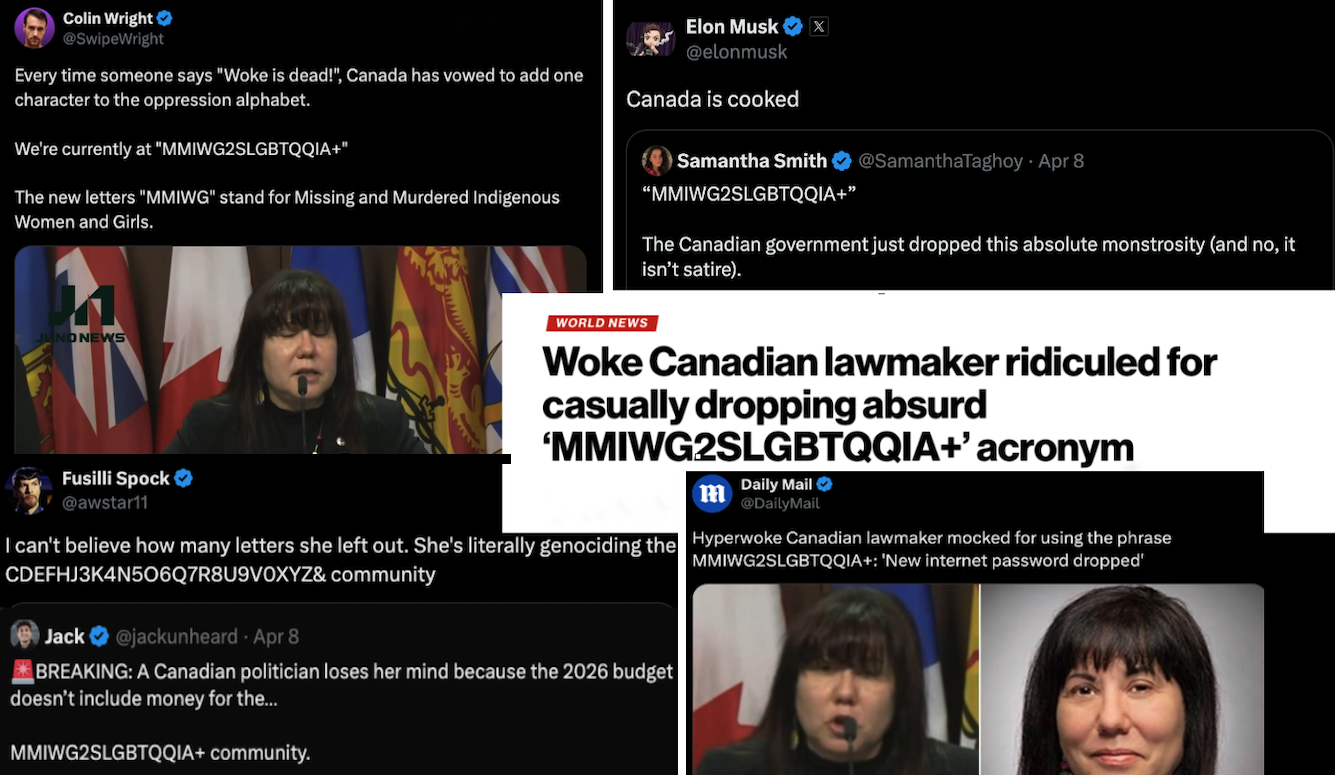

The worst serial killer in Canadian history was a British Columbia pig farmer named Robert Pickton. During the 1990s, he preyed on impoverished women from Vancouver’s Downtown Eastside—primarily sex workers whom he lured to his farm in the suburban municipality of Port Coquitlam. In 2007, he was convicted of the murder of six women and sent to prison (he died after being stabbed by a fellow inmate two years ago). But DNA from 33 other presumed victims was found on his farm, and Pickton himself claims to have killed 49 women. While the death toll is indeterminate, we know that many of the victims, possibly the majority, were from First Nations communities—members of that tragically expansive category that would later be called Missing and Murdered Indigenous Women and Girls, or MMIWG.
It later emerged that police had missed multiple opportunities to bring Pickton to justice over the years. In 1997, five years before bodies were discovered on his farm, a woman named Wendy Lynn Eistetter reported that she’d escaped the property after being handcuffed and stabbed. One of Pickton’s employees reported that he’d found personal effects that belonged to women who’d gone missing. Even when police executed a search warrant of the farm in February 2002, they went there looking for illegal guns, not bodies. It was only sixteen days later that he was charged with murder, following a more systematic search by a joint RCMP-Vancouver Police Department task force.
It is indisputable that racism and classism help explain why Pickton wasn’t brought to justice sooner. Throughout the 1990s, rumours were widespread that a Jack the Ripper-type monster was stalking the Downtown Eastside. Had Pickton been preying on middle-class soccer moms, his murder spree would have been front-page news across the country, and authorities would have spared no effort or expense to find him. Protecting Indigenous sex-trade workers, on the other hand, wasn’t seen as a priority.
In 2015, the government of then-Prime Minister Justin Trudeau announced the creation of a public inquiry into the issue—known as the National Inquiry into Missing and Murdered Indigenous Women and Girls—noting that Indigenous women were significantly more likely to be murder victims than their non-Indigenous counterparts. Its mandate was to “look at all underlying causes of violence against Indigenous women and girls including systemic issues.” While Pickton’s crimes were unusually horrific, Canadians learned, his victims represented just a small fraction of the approximately 1,200 Indigenous women who’d been murdered or gone missing over the previous three decades.
Unfortunately, that inquiry became something of a farce. This was due in part to the managerial incompetence of its leaders; as well as infighting among staff, some of whom complained that certain victim demographics were being ignored for political reasons. When the Inquiry published its report, Canadians were treated to a turgid 1,200-page ideological manifesto that was primarily concerned with abstract denunciations of “colonialism and colonial ideologies.”
Indeed, the word “colonial” (or its variants) appeared 379 times in that document. Vast tracts of the report read like automated summaries of postgraduate reading lists, complete with shout-outs to intersectionality, Frantz Fanon, and Critical Race Theory. The most prominent claim to emerge was that the problem of murdered and missing Indigenous women amounts to a full-blown “genocide.” There was even a separate 46-page sub-report dedicated (unsuccessfully) to justifying that word’s usage.
And yet for all the report’s heft, its authors never got around to any systematic analysis of who was killing Indigenous women, possibly because the answer turned out to be off-message: A Statistics Canada analysis of court outcomes in homicides of Indigenous women and girls, from 2009 to 2021, determined that “most Indigenous women and girls were killed by someone [whom] they knew (81%), including an intimate partner (35%), acquaintance (24%), or family member (22%).”
What’s more—and this was the disclosure that really made many Canadians wonder why we’d spent CA$53 million on the Inquiry—it turned out that in 86 percent of known cases, the person accused of the homicide was also Indigenous.
Keep reading
Robert Lynch on Status, Humour and the Apes We Pretend Not to Be | Quillette Cetera Episode 74
The Radicalisation of Tucker Carlson
A Pop Fiction Master and Monster

Australia’s Coming Censorship Machine

Anatomy of a Book Promotion