Videos
Bertrand Russell’s Cancellation and the Ongoing Battle Over Campus Speech
How religious conservatives cancelled philosopher Bertrand Russell in 1940, sparking academic freedom debates that echo today.

Written by James Huffman, read by William Laing.
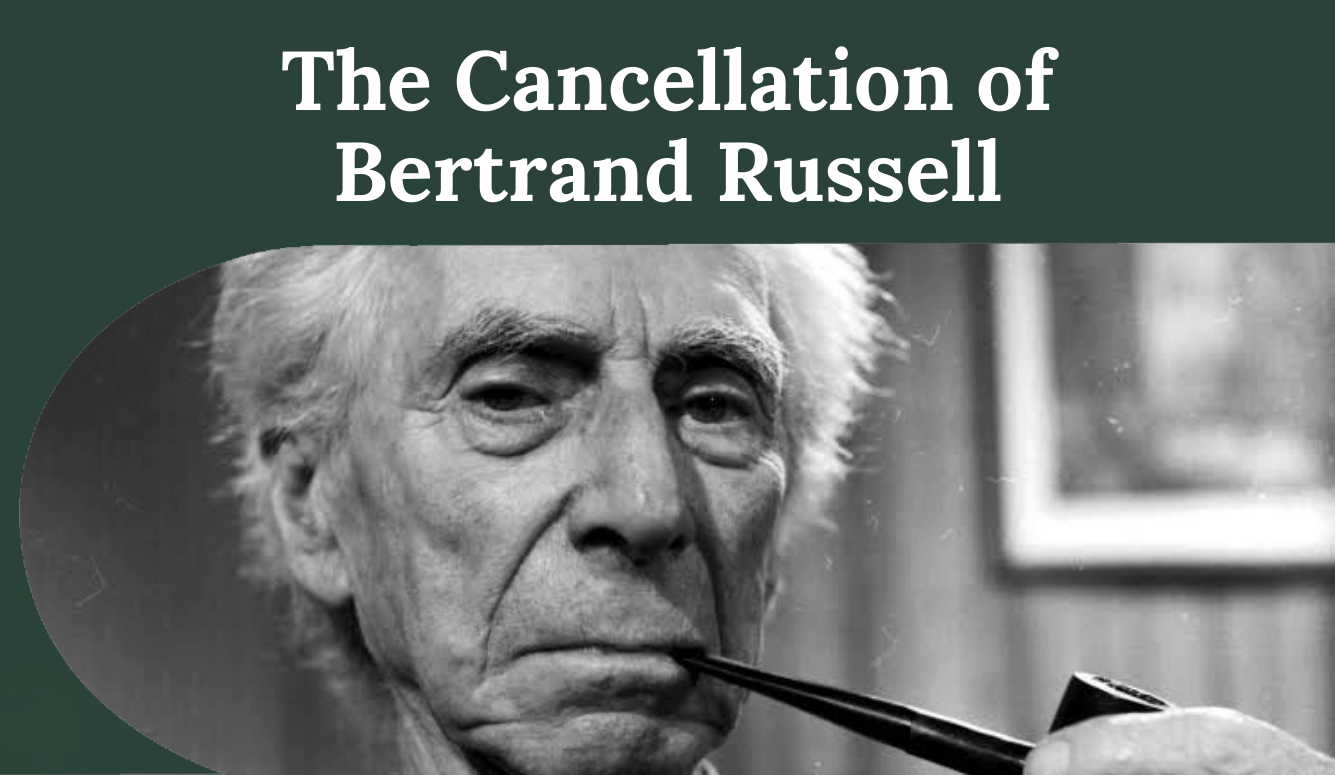
In 1940, Bertrand Russell was appointed Professor of Philosophy at the College of the City of New York. Within weeks, a New York judge voided the appointment, declaring that Russell’s writings on religion, sexuality, and marriage rendered him morally unfit to teach. The ruling followed a campaign led by religious conservatives and political actors who portrayed Russell as a threat to public morals.
This video essay revisits the episode in detail: the lawsuit brought by a private citizen, the inflammatory court brief branding Russell “lecherous” and “bereft of moral fiber,” and Justice John E. McGeehan’s decision to revoke the appointment without hearing evidence for the defence. It also examines the principled but ultimately unsuccessful efforts to appeal the ruling, as well as the broad coalition of academics who defended Russell on grounds of free speech and institutional autonomy.
Eight decades later, the issues raised by the Russell case remain unsettled. The boundaries of academic freedom—and the pressures exerted by prevailing moral orthodoxies—continue to shape public life.
Chapters
00:00 Bertrand Russell’s appointment and judicial revocation
01:37 Early life, pacifism, imprisonment, and intellectual development
02:32 Atheism, Why I Am Not a Christian, Marriage and Morals, and public scandal
03:54 Religious opposition and the taxpayer lawsuit
04:50 Justice McGeehan’s ruling and the “chair of indecency”
06:28 Appeals, mayoral intervention, and Russell’s refusal to withdraw
08:03 Academic solidarity and defence of free expression
09:53 Media reaction, further challenges, and contemporary parallels
Transcript
View full transcript
Bertrand Russell is well known as a philosopher and mathematician. But few know that during his lifetime, he was cancelled—to use the contemporary term—by the New York judiciary and by mid-twentieth-century religious conservatives. Both those conservatives today who seek to ban books and regulate curricula and those progressives who wish to censor everyone who disagrees with them would do well to reflect on the Bertrand Russell case. In February 1940, Russell was appointed Professor of Philosophy at the College of the City of New York by unanimous vote of the Board of Higher Education of New York City. He was assigned to teach three courses: logic and its relation to science, mathematics, and philosophy; problems in the foundations of mathematics; and relations of the pure to applied sciences and the reciprocal influence of metaphysics and scientific theories. But within scarcely a month, Justice John E. McGeehan of the New York Supreme Court ordered the Board to revoke Russell’s appointment, ruling that the appointment “adversely affects public health, safety, and morals” and would “aid, abet, or encourage conduct tending to a violation of penal law.” A year later, philosopher and educational reformer John Dewey noted that, although the Russell case was closed, “the issue underlying it is no more settled than the Dred Scott case settled the slavery issue.” Eight decades later, the issues raised by the Russell case—the rights to free speech and academic freedom—have still not been settled. Russell was born into a prominent aristocratic family in 1872, in the Welsh village of Trellech. He studied first mathematics and later philosophy at Cambridge University. In June 1916, he was fined for writing a pamphlet outlining his pacifist views and in February 1918, he was sentenced to six months’ imprisonment under the Defence of the Realm Act for publicly lecturing in favor of peace with Germany. These activities also led him to be dismissed from his fellowship at Trinity College, though he was reinstated the following year. While in prison, Russell wrote Introduction to Mathematical Philosophy and began work on The Analysis of Mind. In the face of Soviet and Nazi atrocities, Russell’s pacifism became more moderate. But he remained broadly anti-war and was sympathetic to many liberal causes of the day. He was also dismissive of religion, describing himself as both an agnostic and an atheist. In March 1927, he gave a talk titled “Why I Am Not a Christian,” which he later published in essay form. His political and religious views alone would probably have been sufficient to raise the ire of New York’s conservatives—but he had also written a book challenging Victorian notions of morality regarding sex and marriage: Marriage and Morals. His personal sexual history was also somewhat scandalous: by 1940, Russell had been married three times and there were widespread rumors of multiple extramarital affairs. By the time Russell was appointed in New York, he was among the world’s leading intellectuals. He had lectured at Oxford, Harvard, the Universities of Peking, Uppsala, Copenhagen, and Barcelona, and at the Sorbonne. He had held positions at the London School of Economics, the University of Chicago, and the University of California at Los Angeles. He had authored dozens of books and received awards from the Royal Society, Columbia University, the London Mathematical Society, and the Reale Accademia dei Lincei. But his pacifism, atheism, and allegedly libertine sexual views made his presence at the college offensive to some. When Russell’s appointment was announced, the Episcopal bishop William T. Manning told the press that the philosopher was “a recognized propagandist against religion and morality … who specifically defends adultery.” Charles Tuttle, a member of the Board of Higher Education, attempted to persuade the Board to revoke the appointment. A Brooklyn taxpayer, Jean Kay, filed a lawsuit asking the New York Supreme Court to vacate Russell’s appointment on the grounds that he was a foreigner and an advocate of sexual immorality who posed a threat to young women. Kay was represented by Joseph Goldstein, a former city magistrate. Goldstein’s brief described Russell as “lecherous, salacious, libidinous, lustful, venerous, erotomaniac, aphrodisiac, irreverent, narrow-minded, untruthful, and bereft of moral fiber.” The brief asserted that Russell was not a philosopher in the accepted meaning of the word but rather a sophist who employed “cunning contrivances” and “quibbling” to advance fallacious arguments. What Russell described as philosophy, Goldstein argued, was “just cheap, tawdry, worn out, patched up fetishes and propositions.” Justice McGeehan, who had previously attempted to remove a portrait of Martin Luther from a courthouse mural, declared that if Russell’s books sustained the allegations, he would give the appellate courts “something to think about.” Without hearing testimony from any defense witnesses and without reviewing evidence beyond excerpts from Russell’s writings, McGeehan ruled that the philosopher’s work ran contrary to “the laws of nature and nature’s God.” In addition to ruling that Russell’s appointment would adversely affect public health, safety, and morals, McGeehan concluded that the Board of Higher Education could not appoint a foreigner to a teaching post in New York, nor could anyone be appointed without first passing a competitive examination. Numerous non-Americans already taught at New York’s colleges, and none had been required to take such an exam. McGeehan further concluded that the Board had effectively established a “chair of indecency” while revealing “moral standards lower than common decency requires.” “Academic freedom,” he declared, “is freedom to do good, not freedom to teach evil.” The Board of Higher Education voted by a narrow majority to appeal the decision. Mayor Fiorello La Guardia attempted to render the controversy moot by proposing to cut the funding for Russell’s position, even though he lacked the authority to do so. The mayor’s corporation counsel declined to pursue an appeal, fearing that religious and moral controversies would overshadow the legal principles at stake. Nonetheless, the Board sought permission to appeal. McGeehan denied the motion, and the Appellate Division dismissed the appeal. Russell had not been made a party to the original lawsuit. Through his lawyer, Osmond K. Fraenkel of the American Civil Liberties Union, Russell petitioned to intervene. These petitions were denied. The New York Times editorial board suggested that Russell should have withdrawn from the appointment once its harmful effects became evident. Russell replied that to do so would have been cowardly and selfish, since principles of toleration and free speech were at stake. The ruling, he argued, created a precedent for driving from public office individuals whose opinions, race, or nationality were deemed repugnant. Most of Russell’s academic colleagues defended him. Leading mathematicians, including Albert Einstein, Oswald Veblen, Harlow Shapley, and Edward Kasner, came to his support, as did prominent philosophers such as Ashley Montagu, Curt John Ducasse, Sidney Hook, Ralph Perry, John Randall, Morris Cohen, and Arthur Lovejoy. College presidents across the United States expressed alarm at the decision and its implications for faculty independence. Professional associations likewise protested the threat to academic freedom. Support also came from outside the academy. Columnist Dorothy Thompson described Russell as a “twentieth-century Socrates” and characterized the affair as an attempt to destroy the professional life of a distinguished scholar for expressing unpopular opinions. Yet Russell’s supporters were no match for his antagonists. Additional efforts were made to challenge his appointments elsewhere, including at the University of California at Los Angeles and at Harvard. Though those efforts ultimately failed, the New York ruling stood. The judge’s order rescinding Bertrand Russell’s appointment was a travesty. Today, many professors continue to face censorship or cancellation for departing from prevailing orthodoxies. Then, it was unorthodox opinions about sexuality and war that provoked outrage. Today, it is often unorthodox views about race and gender. In the decades since the Russell case, the ideal of unfettered pursuit of truth has remained contested. The episode stands as a warning. We neglect its lessons at our own peril.Further Reading
Read the original Quillette essay:
The Cancellation of Bertrand Russell by James Huffman
Explore related topics:
If you found this video essay useful, subscribe to the Quillette YouTube channel and browse our video archive.
Keep reading
Communism’s Obsolescence
To Meet a Chatbot

Searching for Structure

Strange Bedfellows

The Axis of Renewal