economics
Fixing Central Bank Politicisation
Trump’s assault on the Federal Reserve demands a structural solution: rules-based monetary policy that protects central bank independence whilst delivering better economic results.
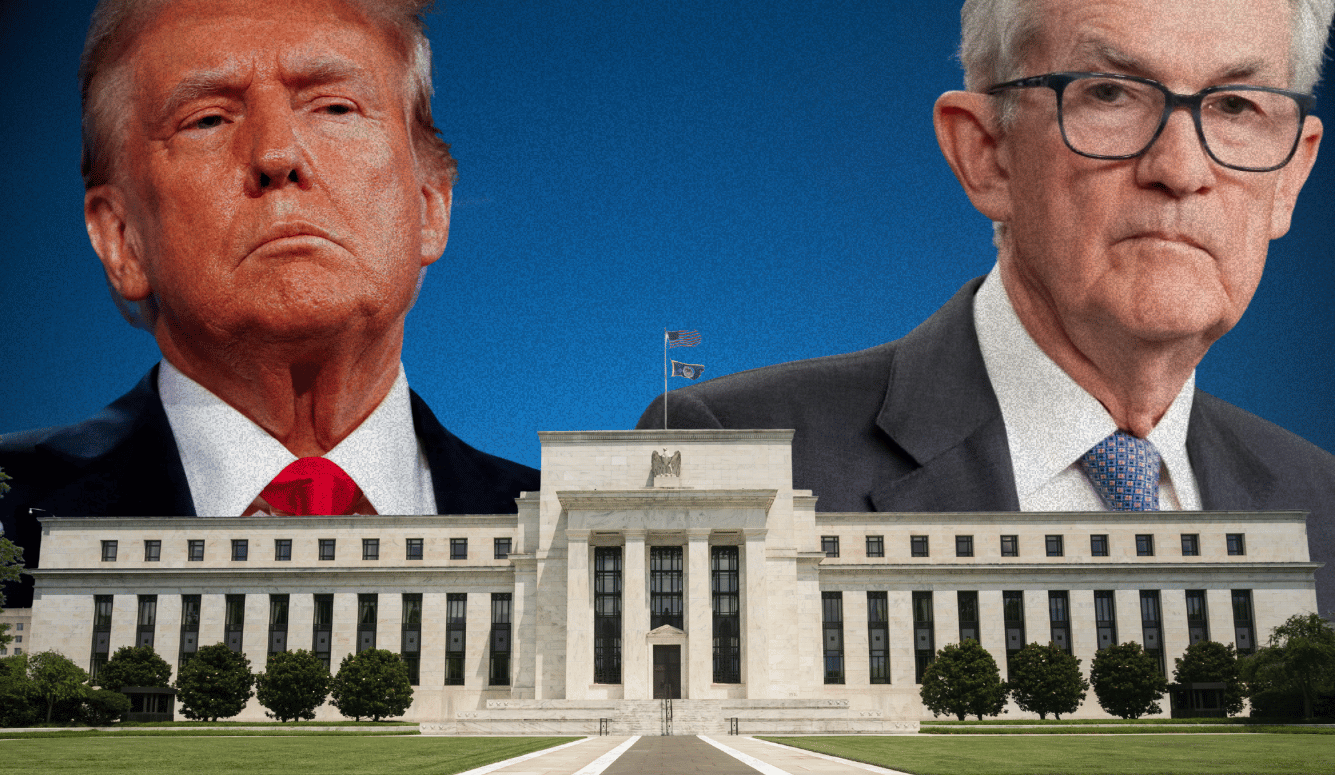
Central banks are soft targets for politicians looking to pass the blame for poor economic outcomes. Monetary policy is complicated. Most people cannot trace the chain of causation back from a bad inflation or unemployment report to some action taken by bureaucrats at the Federal Reserve, but the Fed is an easy target because it is explicitly tasked with maintaining stable prices and maximum employment. The truth is that most of the business cycle is determined by factors outside the Fed’s control, and while monetary policy can and does affect this cycle, it cannot (and should not be used in an effort to) overcome all other market forces.
Still, blaming the Fed and its chair Jerome Powell seems to be a favourite hobby of the current US political administration. Last year saw Trump and other members of his circle hurl juvenile insults at Powell. They tried to forcibly oust Fed governor Lisa Cook. Trump controversially appointed Stephen Miran to the Fed board. Miran became the first person ever to keep his job at the White House (albeit via unpaid leave of absence) while also serving at the independent central bank. Now comes news of a federal investigation into Jerome Powell over his testimony to Congress on the renovation costs of the Fed headquarters.
To be clear, I am not a fan of central banking. The Fed has a bad track record and has made many recent mistakes, from labelling inflation “transitory” to financing the US government’s reckless borrowing bill. But I acknowledge that we are far from having a privatised monetary system, despite the numerous benefits such a system would bring. If we must have a central bank, it had better be independent of the whims of the executive branch. This does not mean that there should be no oversight of the Fed; on the contrary, a well-functioning central bank must be accountable to the public through elected members of Congress. In the context of monetary policy, independence simply means keeping an arm’s length between interest rate decisions and the desires of the executive branch.
Chair Powell himself claimed, in an unprecedented video response to the announcement of the criminal investigation, that it was a pretext for executive interference with monetary policy. Numerous politicians, Republicans included, agree with Powell. I am not a lawyer, so I cannot judge the case on its legal merits, but for the purposes of this article, I will assume this is another attempt by the executive to strong-arm the Fed and will offer thoughts on the future of monetary policy accordingly.
I recently wrote about the potential economic fallout from the federal investigation against Powell. To summarise, business as usual is the most likely outcome. Fed members will offer economic rationales for their rate decisions instead of political ones, and both Main Street and Wall Street will believe them. This is no credit to the Fed; rather, it reflects the strong tendency of the US economy to revert to the status quo. However, the odds of the status quo holding will reduce with each successive political attack, until some unknown threshold is crossed.
At that point, our key macroeconomic measures, such as inflation, may or may not stay on trend; that will depend on people’s faith in the Fed’s ability or desire to maintain stability. Case studies of similar scenarios elsewhere provide no encouragement. A current example: in 2021 and 2022, President Erdoğan of Turkey pressured his central bank into lowering rates, despite soaring inflation. The inflation rate in Turkey peaked at over 85 percent in late 2022 and remained elevated, exceeding 50 percent for much of 2022–24.

Suffice to say, political interference is bad. President Trump and members of his administration should stop pressuring the Fed and leave it to conduct monetary policy independently. But these kinds of attacks are not unique. The Fed’s 1951 accord with the Treasury birthed the “independence” of the central bank. Since then, multiple presidents have pressured multiple Fed chairs to ease monetary conditions, hoping that the resulting short-term boost to output would help them electorally. The most famous example is Nixon pressuring Arthur Burns, to disastrous effect: the Fed under Burns eased up on rates in the early part of the 1970s, when US inflation was already elevated—around five percent. In fact, this phenomenon is so common that it is taught as a case study to budding macroeconomists in graduate school. It is termed “inflationary bias” because a central bank that caves to political pressure and tries to boost output by lowering interest rates in times of elevated inflation invariably fails to do so and manages only to raise the inflation rate.
The Fed is not blameless in this mess. Nearly 75 years have passed since the 1951 accord, and the Fed still does not have a reliable system for dealing with political interference. The current system within the Fed is too discretionary, too much of a black box, and it relies too heavily on the goodwill of politicians. If the system stays the way it is, it will be only a matter of time until Trump or a future president successfully manages to stage a repeat of the Nixon/Burns fiasco and consumers around the world pay the price—literally.
The best way for the Fed to proceed is to adopt a rules-based monetary policy, which would not only provide better cover against political interference but also lead to improved monetary policy performance.
First, the basics. The primary tool of monetary policy is the federal funds rate (FFR)—the overnight rate at which banks lend reserves to each other. The Fed does not directly control the FFR; rather, it announces a target for the FFR. It then changes the rates that it does control, or it buys and sells government bonds until the FFR meets its target. (The ways the Fed influences the FFR are fraught with risk and require fixing, but that is beyond the scope of this conversation.) Since the FFR represents the cost to a commercial bank of acquiring funds, it will in turn affect its choice to lend out money into the broader economy. The lower the FFR, the more money a bank will lend. In turn, cash is more readily available, thus amplifying demand for goods and services, which boosts output but also raises prices. Raising the FFR has the inverse effect. The former is called monetary easing, the latter monetary tightening.
The key decision for central bankers is to choose the ideal value for the FFR target. Too high or too low, and there could be economic disruptions. The choice of this target is left to the twelve members of the Federal Open Market Committee (FOMC), who meet multiple times a year to update the rate target and proffer the reasons for their views, usually citing current or forecasted values of economic indicators such as inflation or unemployment. But ultimately, these decisions have no structural basis. Too often, FOMC meetings feel like sessions to read tea leaves rather than the workings of a system rooted in sound economics.
The solution? Less allowance for discretion, and a mandated adherence to objective policymaking. That’s what rules-based monetary policy is designed to implement.
Under such a system, Congress mandates that the FOMC publish a rule rather than a specific target value for the FFR. The rule is a mathematical formula that connects the FFR to macroeconomic variables, for example, inflation, output, unemployment, or financial conditions. This formula is then used to mechanically update the FFR target, and the FOMC conducts operations as usual to bring the FFR in line with the target. The FOMC is free to pick any rule it likes, but once that choice is made, it is required to follow it. The rule may be updated, but only at infrequent intervals, such as at the Fed’s five-yearly framework reviews. Deviations from the rule are allowed only under exigent circumstances (think Covid-style economic shutdowns), provided the FOMC defends such deviations in front of Congress.
Such a system insulates the FOMC from political pressure, not because it stops politicians from attacking the Fed (nothing can stop that), but because it assures markets that rate decisions are apolitical. Since the rule is set in stone, short-term political pressure cannot force the Fed to lower rates. This is in addition to the market benefits that rules provide by offering less uncertainty regarding the likely future trajectory of interest rates. Of course, this system is not foolproof—no system that relies heavily on central planning can be. But it will be a significant step up from the way the Fed currently conducts monetary policy.
Readers may be concerned that forcing the Fed to follow a rule may be too restrictive, going too far to shield the Fed from political interference at the cost of its ability to stabilise the economy. The fact is, rules-based monetary policy improves economic outcomes. Academics dating at least as far back as Milton Friedman have advocated for the Fed to adopt rules, primarily owing to their positive economic effects. This is because no one person (or small group of central bankers) has enough information to accurately diagnose a complex economic system. As a result, when they attempt to fine-tune economic outcomes, the resulting macroeconomic performance is usually worse. If, instead, central bankers were to follow rules, their informational burden would be significantly reduced, and they would provide predictability and clarity to markets and not cause serious economic disruptions due to a “tea leaves” decision by the FOMC.
In fact, the Fed often takes credit for the Great Moderation—the period from the mid-1980s to the mid-2000s characterised by low, stable inflation and unemployment. Fed officials have claimed that these economic successes were, at least in part, due to good monetary policy decisions. However, unsurprisingly, this was also the period when the Fed’s interest rate decisions could be mapped closely to popular academic monetary policy rules.
Within policy advocacy circles, many experts agree that rules would lead to better outcomes. And this is not a partisan issue. For instance, Jason Furman, chief economic advisor to President Obama, has advocated for a rules-based regime similar to what I described above. Yet congressional legislation to force such a system on the Fed was introduced by Bill Huizenga, a Republican.
Most disagreements in policy circles centre on which specific rule the Fed should follow. While that is a worthwhile debate, most rules respond to a similar set of macroeconomic variables, and their prescriptions rarely differ drastically from one another. And all of them are better than pure Fed discretion. For example, virtually all common rules advocated that the Fed raise rates much sooner than it did to combat post-Covid inflation. If the Fed had listened, inflation may not have risen as high or become as entrenched as it did.
At the least, these debates should play second fiddle to forcing a rules-based regime on the Fed. Plenty was at stake already when such debates were aimed only at ensuring the independent Fed had the best academic support for its policy decisions. Much more is at stake now that the executive branch is actively trying to dictate monetary policy. I hope that this latest assault on central bank independence is the final straw and that it brings together policy experts and politicians from across the aisle to legislate better practices for the Fed. Otherwise, with each successive assault, we will be left merely hoping that it is not the one that destroys the credibility of our monetary system.