Classics
Our Lost Classical Learning
The Western canon was not an unchanging set of texts, but an ongoing conversation that lasted thousands of years—enabling each generation to build on the intellectual heritage of the past.
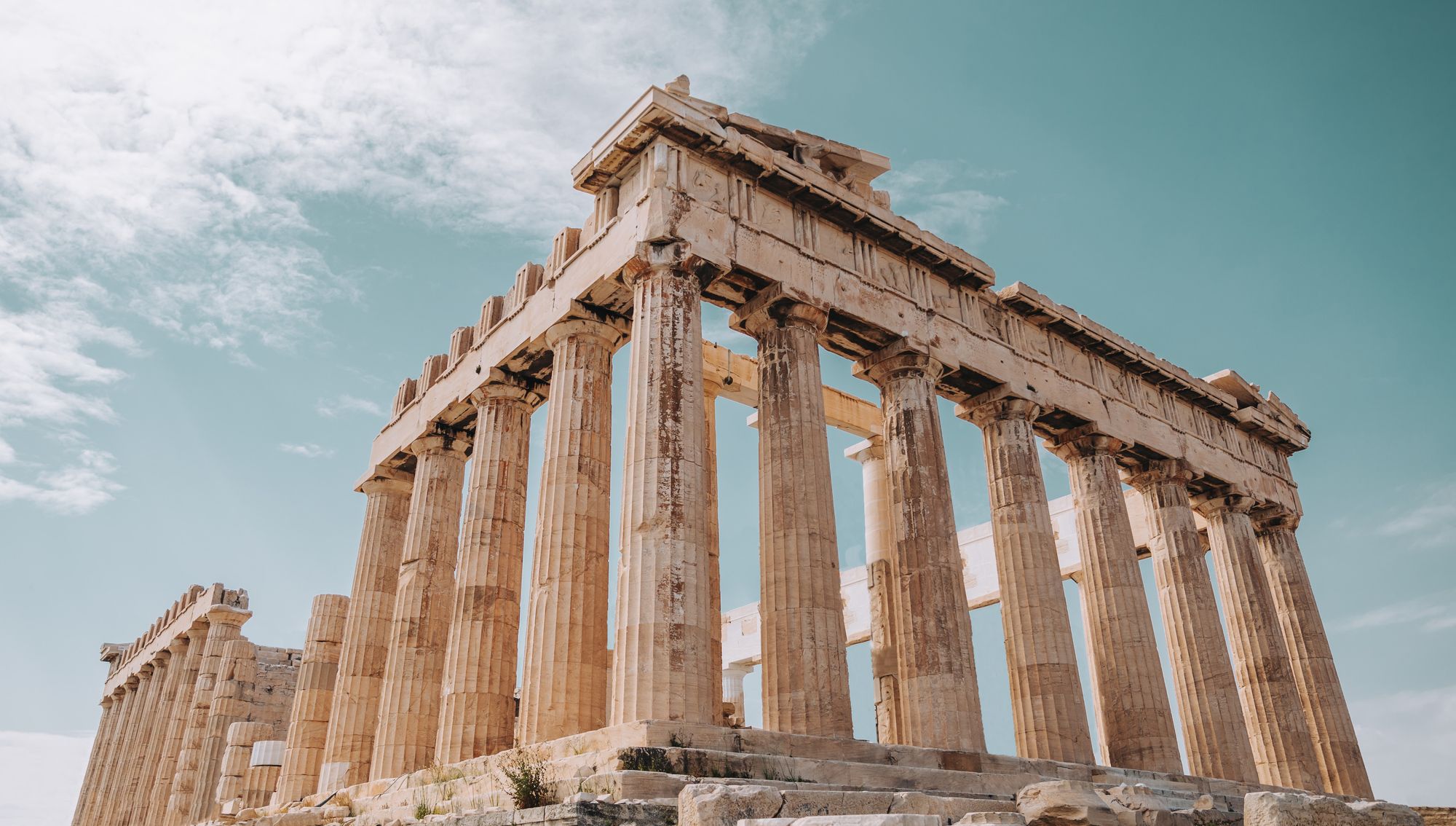

Ancient Athens was perhaps the first state in history in which substantial numbers of citizens were literate, and ideas were able to circulate freely. Literacy eroded the gulf between rulers and ruled and made possible the creation of a radically new kind of human society. For perhaps the first time, every free man could criticise and question officials and this was often portrayed as desirable and valuable. In literature at least, soldiers could even question their commanders—as Creon’s guards do in Sophocles’ Antigone. These freedoms extended to some playwrights and actors themselves. The anti-war comedies of Aristophanes were performed in the middle of the horrific Peloponnesian War.
Playwrights often endowed menial workers—shepherds, farmers, guards and messengers—with a common sense lacking in their rulers. As Victor Davis Hanson and John Heath put it,
In Greek plays, the hero is often the underdog, the trouble-maker, the one who criticises what everyone else blindly accepts. Ajax, Philocretes, Lysistrata, Electra, Prometheus, Antigone, he or she—and it was often a she—harshly condemned the leaders, the state, the people, and did so publicly on stage for everyone to see.
The Romans kept these Greek writings alive and added their own contributions to the growing canon.
As Rome’s thousand-year rule declined, and barbarians burned cities and libraries across Europe, Christian monks and Muslim scholars copied and circulated the classics. As Seb Falk has shown, even peasants would sometimes pool their resources to hire monks to teach them in teaching halls, some of which later became the first universities.
A classical education involved more than merely reading ancient texts: it meant learning to think critically and debate logically, in the way pioneered by the Greeks. Medieval scholars were trained in these skills, and the legal, political and scientific infrastructures of the West continue to assume such training. Obligations like jury duty and voting assume that ordinary citizens have an ability to assess logical arguments; science assumes the ability to test theories. It is no coincidence that much of our legal and scientific terminology comes from Greek and Latin.
 James Kierstead
The Western canon was not an unchanging set of texts, but an ongoing conversation that lasted thousands of years—enabling each generation to build on the intellectual heritage of the past. It gave people a set of cultural reference points: Homer, Socrates, Aristotle, Aquinas, Dante, Milton.
Even in the medieval period, Europe had a culture that valued reading, even before the invention of the printing press in 1436. The first books to be printed after the Bible were Greek and Roman classics, and schools soon sprung up to teach them. There were 34 schools in Gutenberg’s day, but by 1660, there were 444: one school every 12 miles, according to Neil Postman. That Greek and Roman history was familiar to such audiences is suggested by the confidence with which Shakespeare draws on it in plays like Coriolanus and Titus Andronicus.
By the eighteenth century, even in the backwater of rural Ireland, where Roman Catholics were prohibited from teaching, teachers formed underground networks to teach the classics, and children across Ireland secretly learned them. In his 1968 book The Hedge Schools of Ireland, P.J. Dowling repeats reports by eighteenth-century travellers of poor, ragged boys “well acquainted with the best Latin poets,” “good Latin Scholars” in the mountains of Kerry and wandering farmhands who “conversed for a considerable time in Latin.” Visiting Ireland in the 1840s, Johann Georg Kohl reported that even the poor farmers of Country Kerry knew their Latin.
In 1748, the Earl of Chesterfield wrote to his son that “classical knowledge, that is, Greek and Latin, is absolutely necessary for everybody … the word illiterate, in its common acceptation, means a man who is ignorant of these two languages.” While Chesterfield may have had a somewhat restricted understanding of the word “everybody” here, many people who knew no Latin or Greek would still have been familiar with the classics, through contemporary translations. Thanks to Alexander Pope’s English version, quip the satirists Thomas Burnet and George Duckett in 1715, “every country milkmaid may understand the Iliad as well as you or I.” While this is clearly hyperbole, in 1787, the Scottish poet Robert Burns reported meeting a gardener’s wife who “can repeat ... Pope’s ‘Homer’ from end to end.” In 1788, at the age of ten, William Hazlitt was reading Ovid and Eutropius.
During the Industrial Revolution, some working-class men and women organised clubs that provided not only lessons in reading and writing, but debating societies. According to historian Jonathan Rose, as many as a quarter of all male workers in Britain may have belonged to such clubs by the early 1800s, a number that may have risen as high as 80 percent by the end of the century. Some of these clubs produced their own periodicals focusing on classical authors like Livy, Homer, and Tacitus. These were publications both for and by working people and their pages were filled with articles and letters from coal miners, farmers, shepherds, and weavers.
David Livingstone, the famous African explorer, worked 14-hour days in a cotton mill from the age of ten. According to a nineteenth-century account of his life, he read the classics while at the machine and attended evening classes for four hours daily.
Some Welsh miners, who worked long hours doing dangerous work for low pay, put what few coins they had left over from their meagre earnings towards library memberships. These libraries were well stocked with Greek and Roman classics. According to Rose, at one typical library at Ynyshir, the average miner read 86 books a year.
Familiarity with the classics gives you access to a galaxy of cultural references, since, for a thousand years, paintings, speeches, poems, novels and sculptures were all created for a public familiar with Greek and Roman works. The famous depiction of George Washington in a Roman toga, for example, portrays him as Cincinnatus, the leader who stepped away from the temptation of lifelong power to return to his farm—thereby providing an important model for presidential term limits and for the peaceful transfer of power.
Keep reading

Anti-Catholic Social Panics, Then and Now
A Dishonest (and Dangerous) Nobel Laureate

Common People
How Genetics Rewrote History
Equal Pay, Unequal Work