Books
George Orwell, Henry Miller, and the 'Dirty-Handkerchief Side of Life'
Like Miller, Orwell didn’t just focus on the “dirty-handkerchief side of life”—he repeatedly confessed to the dirty-handkerchief side of his own personality.

I.
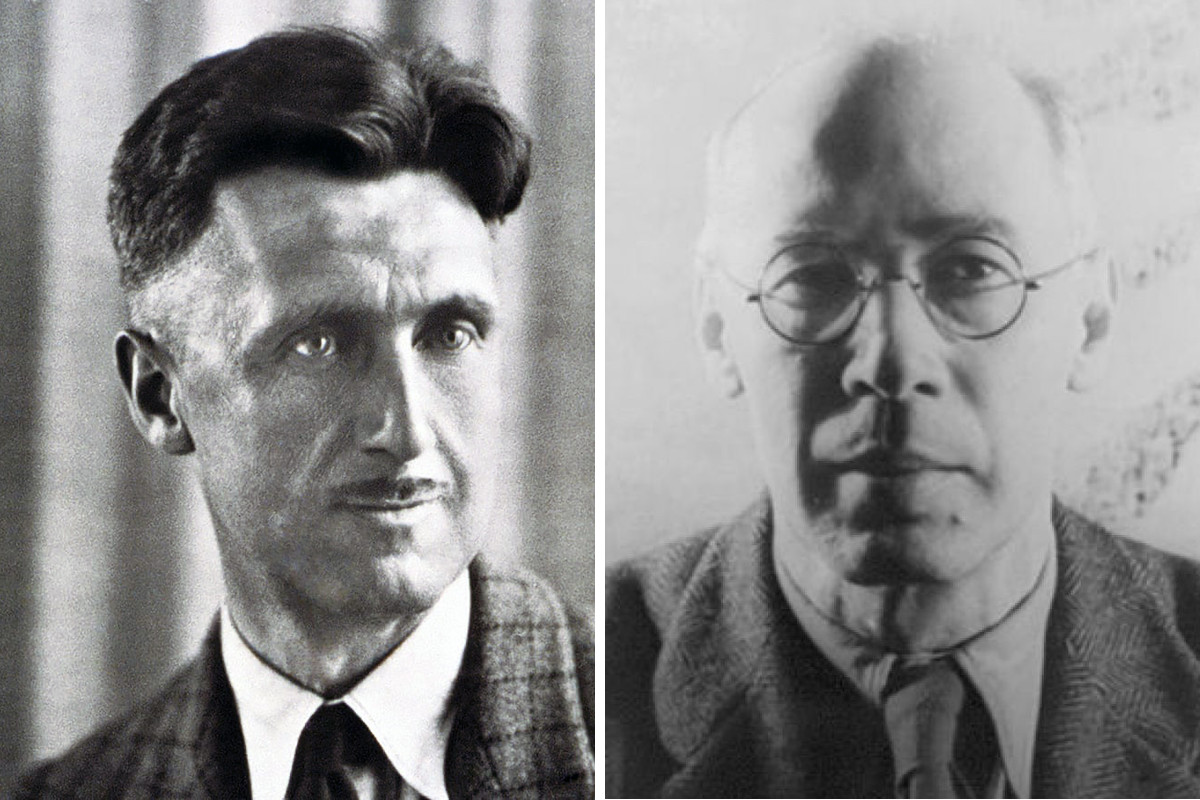
In December 1936, George Orwell was on his way to Spain to join the Republican side in the fight against fascism. On the way, he stopped in Paris where he met with Henry Miller in his Montparnasse studio. As D. J. Taylor notes in Orwell: The Life, Miller’s friend Alfred Perlès was present for the meeting, and he recalled an encounter that perfectly captured the seemingly antithetical worldviews of the two men.
Miller thought Orwell’s decision to fight in Spain was absurd—as Taylor puts it (summarizing Perlès’s account of Miller’s attitude): “Wasn’t he more use to the world alive than dead? Orwell replied ‘earnestly and humbly’ that in extraordinary times there could be no thought of avoiding self-sacrifice.” Miller then offered his corduroy jacket as a “contribution to the Republican war effort,” but he “tactfully refrained from adding that Orwell would have been welcome to the jacket even if he had been fighting for Franco.”
“Watching the two of them together,” Taylor writes, “Perlès was struck by the sharp contrast in personality and temperament, Miller with his ‘semi-oriental detachment,’ Orwell ‘tough, resilient and politically-minded, ever striving in his bid to improve the world.’” While Perlès’s recollection of the meeting makes it sound as if their disagreement about the Spanish Civil War wasn’t particularly disagreeable, Orwell remembered it differently. As he explained in his famous 1940 essay “Inside the Whale”:
I first met Miller at the end of 1936, when I was passing through Paris on my way to Spain. What most intrigued me about him was to find that he felt no interest in the Spanish war whatever. He merely told me in forcible terms that to go to Spain at that moment was the act of an idiot… my ideas about combating Fascism, defending democracy, etc., etc., were all boloney.
“Inside the Whale” is one of Orwell’s best-known essays. While it offers an extended analysis of Miller’s Tropic of Cancer, it’s much more than a review—it’s a study of how writers are influenced by the periods in which they live, as well as the role of literature in times of war and political upheaval. Orwell’s characteristic pessimism is on full display—he may have been “ever striving in his bid to improve the world,” but he didn’t have much confidence in the power of writing to make a difference in the early days of World War II.
“Another European war has broken out,” Orwell wrote near the end of the essay. “It will either last several years and tear Western civilization to pieces, or it will end inconclusively and prepare the way for yet another war which will do the job once and for all.” It’s clear that the ideas of 1984 were already taking root in his mind at this point—he argued that “almost certainly we are moving into an age of totalitarian dictatorships—an age in which freedom of thought will be at first a deadly sin and later on a meaningless abstraction.” He also observed that the “autonomous individual is going to be stamped out of existence,” which prefigured the famous line from 1984: “If you want a vision of the future, imagine a boot stamping on a human face—forever.”
What did the emerging era of war and totalitarianism mean for writers? “This is not a writer’s world,” Orwell wrote. “That does not mean that he cannot help to bring the new society into being, but he can take no part in the process as a writer. For as a writer he is a liberal, and what is happening is the destruction of liberalism.” While this was an eccentric view, Orwell arrived at it by assessing the dangers and difficulties of wartime writing. He was preoccupied with the idea that “no book is ever truly neutral,” as he put it in “Inside the Whale”—a point he also made in his essay about Charles Dickens when he famously observed that “All art is propaganda.” However, some works are more propagandistic than others.
To demonstrate this point, Orwell compared books written about World War I with books written about the Spanish Civil War: “The immediately striking thing about the Spanish war books… is their shocking dullness and badness. But what is more significant is that almost all of them, right-wing or left-wing, are written from a political angle, by cocksure partisans telling you what to think, whereas the books about the Great War were written by common soldiers or junior officers who did not even pretend to understand what the whole thing was about.”
The latter was “nearer to Miller’s attitude than the omniscience which is now fashionable.” Although he wasn’t writing about war, Miller didn’t try to tell his readers what to think. In Orwell’s view, with Tropic of Cancer, Miller produced a book that was as free of propaganda as any book could be.
II.
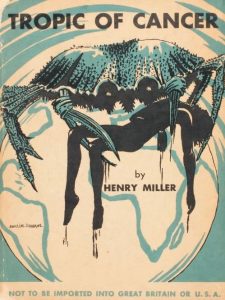
Tropic of Cancer was published by Obelisk Press in 1934, but it was banned in the United States until a 1964 Supreme Court decision ruled that it could legally be sold in the country (Grove Press started publishing it illegally in 1961). The book is an autobiographical account of Miller’s experiences in 1930s Paris—a chronicle of aimless sex- and booze-fueled expatriate life in the squalid undercarriage of the city.
Orwell describes Tropic of Cancer as a “story of bug-ridden rooms in workingmen’s hotels, of fights, drinking bouts, cheap brothels, Russian refugees, cadging, swindling and temporary jobs.” It immediately calls to mind the Paris-from-the-gutter perspective of Down and Out in Paris and London, in which Orwell recounts scrounging for his next meal or drink with a Russian émigré named Boris, the unsanitary horrors of a kitchen in an unidentified luxury hotel, and long hours of grinding work punctuated by periods of starvation and homelessness.
There are two major themes in Orwell’s analysis of Tropic of Cancer: first, that Miller makes the reader feel personally addressed because he’s willing to write honestly about universal human impulses and feelings that are rarely expressed: “It is as though you could hear a voice speaking to you, a friendly American voice, with no humbug in it, no moral purpose, merely an implicit assumption that we are all alike.” And second, that the book has no agenda beyond the transmutation of raw experience into prose—something Orwell regards as particularly strange in an “epoch of fear, tyranny and regimentation.”
After mentioning the end of Tropic of Cancer, in which Miller “simply sits down and watches the Seine flowing past, in a sort of mystical acceptance of the thing-as-it-is,” Orwell asks, “Only, what is he accepting?” His response again demonstrates the stark difference in outlook between the two men:
To say “I accept” in an age like our own is to say that you accept concentration camps, rubber truncheons, Hitler, Stalin, bombs, aeroplanes, tinned food, machine-guns, putsches, purges, slogans, Bedaux belts, gas-masks, submarines, spies, provocateurs, press-censorship, secret prisons, aspirins, Hollywood films and political murders.
Miller accepted the “ancient bone-heap of Europe, where every grain of soil has passed through innumerable human bodies,” and his response to Orwell’s decision to fight in Spain demonstrated that he was prepared to accept the bloodshed and destruction still to come. Orwell took a fascist bullet in the throat in Spain and knew people who had been tortured and imprisoned by Soviet agents, so it isn’t surprising that he didn’t share Miller’s indifference to Hitler, Stalin, and rubber truncheons. But it’s this very indifference that, according to Orwell, made Miller’s work more essentially true than any other novel written at the time.
Like the men in the trenches during World War I, Miller captured the visceral reality of life by dropping the “lies and simplifications” and “stylized, marionnette-like quality of ordinary fiction.” Instead, he filled his pages with the “recognizable experiences of human beings.” Orwell argued that Miller’s quietism was what allowed him to produce work that made the reader feel that he “knows all about me… he wrote this specially for me.” Orwell continued:
Precisely because, in one sense, he is passive to experience, Miller is able to get nearer to the ordinary man than is possible to more purposive writers. For the ordinary man is also passive. Within a narrow circle (home life, and perhaps the trade union or local politics) he feels himself master of his fate, but against major events he is as helpless as against the elements. So far from endeavoring to influence the future, he simply lies down and lets things happen to him.
While Orwell didn’t classify Miller as a “great author” in the same way as James Joyce (who he mentions by way of comparison several times), he was as unreserved in his praise for Tropic of Cancer as he was capable of being. He described Miller’s prose as “astonishing,” argued that some of the figures in the book were “handled with a feeling for character and a mastery of technique… unapproached in any at all recent novel,” and observed that “here in my opinion is the only imaginative prose-writer of the slightest value who has appeared among the English-speaking races for some years past.”
 Adam Wakeling
III.
In one of the most arresting sequences in Tropic of Cancer, Miller watches an acquaintance “dancing with a naked wench, a huge blonde with creases in her jowls” when “for a fraction of a second perhaps I experienced that utter clarity which the epileptic, it is said, is given to know… In this sort of hair-trigger eternity I felt that everything was justified, supremely justified; I felt the wars inside me that had left behind this pulp and wrack; I felt the crimes that were seething here to emerge tomorrow in blatant screamers; I felt the misery that was grinding itself out with pestle and mortar; the long dull misery that dribbles away in dirty handkerchiefs.”
Orwell emphasized Miller’s “preoccupation with indecency and with the dirty-handkerchief side of life… the truth is that life, ordinary everyday life, consists far more largely of horrors than writers of fiction usually care to admit.” It isn’t just the grimy and sordid realism of Tropic of Cancer that makes it such a revealing book—it’s Miller’s candor about his own nihilism, brutality, and selfishness.
“On the meridian of time,” Miller wrote, “there is no injustice: there is only the poetry of motion creating the illusion of truth and drama.” Instead of truth, drama, and justice, we generate “only ideas, pale, attenuated ideas which have to be fattened by slaughter; ideas which come forth like bile, like the guts of a pig when the carcass is ripped open.” These bleak and cynical convictions led Miller to an idea of his own: “I made up my mind that I would hold on to nothing, that I would expect nothing, that henceforth I would live as an animal, a beast of prey, a rover, a plunderer. Even if war were declared, and it were my lot to go, I would grab the bayonet and plunge it, plunge it up to the hilt.”
By comparison, consider a few lines from Orwell’s 1936 essay “Shooting an Elephant”: “With one part of my mind I thought of the British Raj as an unbreakable tyranny, as something clamped down, in saecula saeculorum, upon the will of prostrate peoples; with another part I thought that the greatest joy in the world would be to drive a bayonet into a Buddhist priest’s guts.” This is more than an emphasis on the “dirty-handkerchief side of life”—it’s an unblinking confrontation of the cruelty and ruthless indifference that are so clearly part of human nature.
The effect of Joyce’s Ulysses, according to Orwell, was to “break down, at any rate momentarily, the solitude in which the human being lives.” He saw this quality in Miller as well: “Read him for five pages, ten pages, and you feel the peculiar relief that comes not so much from understanding as from being understood.” Recall Orwell’s observation that Miller spoke to his readers with “no humbug… no moral purpose, merely an implicit assumption that we are all alike.” These two features of Miller’s writing—the lack of the distorting, humbug-generating influence of moral purpose and the refusal to lie about his own instincts and feelings, however despicable—accounted for Orwell’s argument that Tropic of Cancer was one of the most important novels written in years.
It may seem odd that Orwell—a man, of whom his friend Cyril Connolly once said, “could not blow his nose without moralizing on the state of the handkerchief industry”—would be so attracted to the work of a “non-political, non-moral, passive man.” But this isn’t as surprising as it seems—one of the main themes of Orwell’s work was how easily orthodoxy could corrupt thought. As Orwell put it in “The Prevention of Literature”: “To write in plain, vigorous language one has to think fearlessly, and if one thinks fearlessly one cannot be politically orthodox.” According to Orwell, Tropic of Cancer and Black Spring (a novel Miller published in 1936) gave readers “an idea of what can still be done, even at this late date, with English prose. In them, English is treated as a spoken language, but spoken without fear…”
Later in the essay, Orwell argued that “Good novels are not written by orthodoxy-sniffers, nor by people who are conscience-stricken about their own orthodoxy. Good novels are written by people who are not frightened.” He added the emphasis in both of those sentences for good reason—he was writing not just at a time of rampaging orthodoxies, but of pervasive fear of falling afoul of those orthodoxies.
IV.
“Literature as we know it,” Orwell wrote in “Inside the Whale,” “is an individual thing, demanding mental honesty and a minimum of censorship.” It’s the “product of the free mind, of the autonomous individual.” This is why Orwell argued that “a writer does well to keep out of politics. For any writer who accepts or partially accepts the discipline of a political party is sooner or later faced with the alternative: toe the line, or shut up.”
According to Orwell, “As early as 1934 or 1935 it was considered eccentric in literary circles not to be more or less ‘left,’ and in another year or two there had grown up a left-wing orthodoxy that made a certain set of opinions absolutely de rigueur on certain subjects.” In other words, many writers became communists, which meant they constantly had to decide whether to toe the line or shut up, depending on the circumstances: “Every time Stalin swaps partners,” Orwell wrote, “‘Marxism’ has to be hammered into a new shape… Every Communist is in fact liable at any moment to have to alter his most fundamental convictions, or leave the party. The unquestionable dogma of Monday may become the damnable heresy of Tuesday, and so on.”
Orwell also explained how communism replaced the patriotic and religious feelings that members of the English intelligentsia believed they had transcended: “All the loyalties and superstitions that the intellect had seemingly banished could come rushing back under the thinnest of disguises. Patriotism, religion, empire, military glory—all in one word, Russia. Father, king, leader, hero, savior—all in one word, Stalin.” Is it any wonder that Orwell, witnessing these endless intellectual and moral contortions, the shameless propaganda, and the constant stream of wartime lies and distortions, was drawn to a writer who didn’t regurgitate any orthodoxies or toe any lines? Miller gave his readers “no sermons, merely the subjective truth.”
Keep reading

What the Navigators Knew
Gemma Tognini on Australia’s Political Revolt

Rubio in Athens
How France Lost Control of Its Streets