Hezbollah
The Fall of Beirut
Calling Hezbollah merely a terror group is too simplistic, and nothing in Lebanon is ever simple or easy to explain.
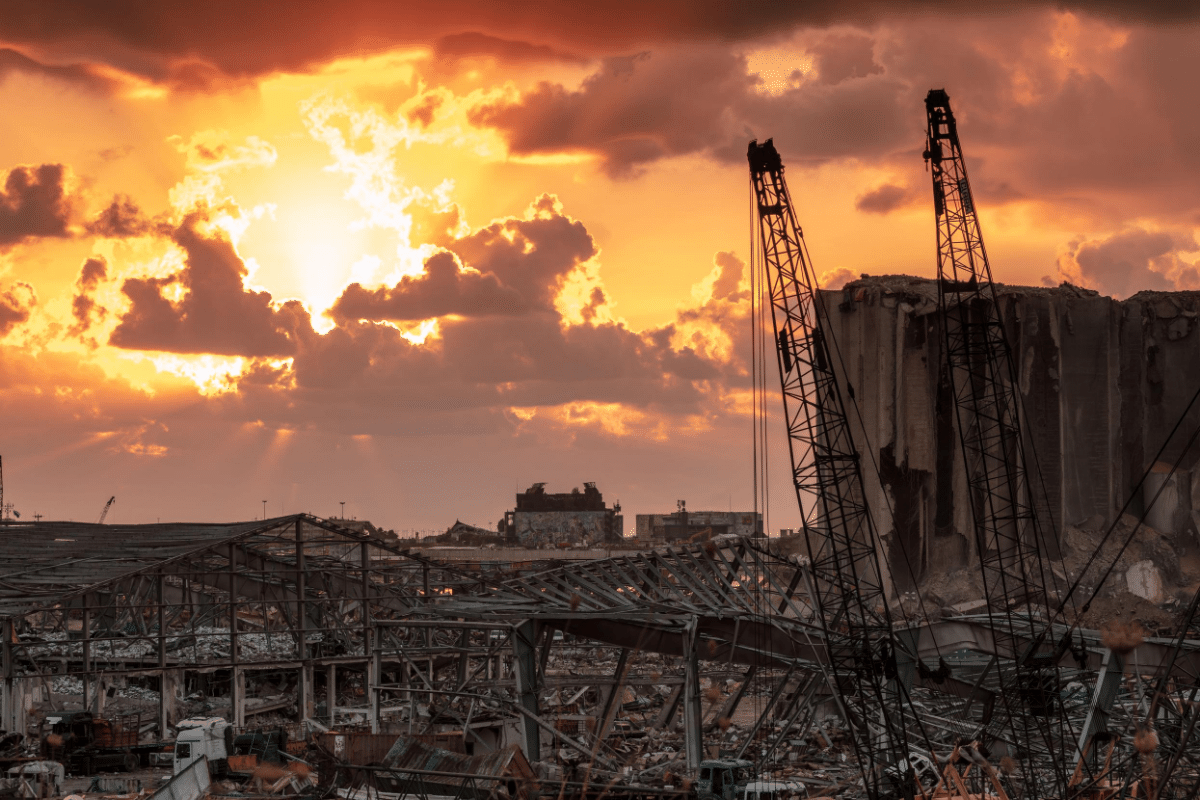

The effects of the explosion of nearly 3,000 tons of ammonium nitrate fertilizer in the port of Beirut, Lebanon on August 4th was not restricted to 170+ deaths and 3,000+ injuries. The explosion’s metaphorical shockwaves may prove to be the death knell of Lebanon’s domestic politics and economy. Both were already collapsing from extreme corruption even before COVID struck. Add an explosion that caused billions of dollars of damage to an already bankrupt country, and the result is a failed state in the making.
Lebanon is failing in no small part because the Shia terror group Hezbollah, which translates as “Army of God,” makes its home there. Hezbollah’s continued residency and effective Lebanese governance seem to be mutually exclusive propositions.
Except calling Hezbollah merely a terror group is too simplistic, and nothing in Lebanon is ever simple or easy to explain.
Hezbollah is responsible for countless murders, kidnappings, and terror attacks, including the 1983 suicide bombing of the US Marine barracks in Beirut that killed 241 Marines. But Hezbollah is also a charity operating in refugee camps. It’s a social service provider for Shia Lebanese, operating clinics, hospitals, and schools (which teach wildly anti-Semitic propaganda). It operates a satellite TV channel. It smuggles guns, sells drugs, and launders money. It has a finger in almost every pie in Lebanon, and influence in Syria, Iran, Iraq, the Northern Triangle countries of Central America (Guatemala, Honduras, El Salvador), and Venezuela. (Click to see the Washington Institute’s regularly updated interactive map of Hezbollah’s globe-spanning activities, and the actions taken to counter them.)
Beyond all that, Hezbollah is also a powerful paramilitary group with 30,000+ fighters, armed with tens of thousands of rockets, as well as precision munitions like guided ballistic missiles. Hezbollah fought Israel’s last incursion in Lebanon in 2006 to a standstill, and Hezbollah is often considered the winner of the clash, despite Israel’s access to the latest weapons tech.
Yet, like every other organization in Lebanon, Hezbollah is in very deep shit.
Lebanon’s current chaos is due to decades of previous chaos spawned of ongoing demographic and power shifts in the post-WWII era among Lebanon’s Maronite Christians, Sunni Muslims, Shia Muslims, and the Druze (a splinter Shia sect). The brutal Lebanese civil war fought by sectarian militias from 1975 to 1990 ended with a peace deal splitting political power along explicit sectarian lines. By law, the Shia nominate the Speaker of the Parliament, the Sunni get the Prime Minister’s Office, and the Christians select the Lebanese President. The sectarian structure of the government mandated by the peace deal effectively embedded political corruption into law. Each sect controls a piece of the Lebanese government and economy, and each has installed a patronage system dispensing favors and money to their upper echelons, with little of the wealth trickling down to the sects’ underclasses.
Hezbollah enjoyed a unique advantage at the end of the civil war. When all other sectarian militias were dissolved in 1991, Hezbollah, originally formed with Iran’s help to combat Israel’s 1982 incursion into southern Lebanon, remained intact.
Since then, Hezbollah has continued to accrue military and financial power. It received financial support from both Iran and Syria, and direct military support from Syria that included Syrian “boots on the ground” in Lebanon protecting Hezbollah’s flank. In early 2005, Hezbollah assassinated Lebanese Prime Minister Rafik Hariri, a staunch advocate for withdrawal of Syrian influence from Lebanon. The assassination ironically triggered a public backlash that forced Syrian troops to withdraw from Lebanon.
Hezbollah’s power is unquestionably harmful to Lebanon’s prospects for stability and prosperity. That said, the economic Armageddon brought on by rampant corruption is by no means just the fault of Hezbollah. It may be the most ravenous porker at the public trough, but there are plenty of Christians and Sunni Muslim elites eating their fill, too.
 Benny Morris
The meltdown before the explosion
On August 17th, 2020, the non-partisan Foundation for Defense of Democracies (FDD) hosted a symposium, “Lebanon’s Compounding Crises: Corruption, Destruction, and an Economy on the Brink of Collapse.” One panel member, economist Jim Rickards, explained why no past economic bailout can serve as a playbook for Lebanon now.
It doesn’t work in Lebanon. And the reason it doesn’t work is because there is nothing left. This country has been picked clean, looted. The mechanism was in effect a Ponzi. When I say Ponzi, I’m not trying to trivialize it. It was just a multi-decade, multibillion, almost a hundred billion-dollar Ponzi but the dynamics of that were pretty much the same. Keep taking in new money to pay off the old obligations as long as the new money keeps coming in, you can keep it going indefinitely if no one sort of blows the whistle on that. But it got to the point where not only did the new money dry up, by the way that money is largely coming from the Lebanese diaspora… Hard currency, dollars and euros, deposited in the banks… Meanwhile, the banks are being looted by the elites, by their own management, by the central bank, by the government. But they keep telling the depositors, “Hey, it’s all good. Your money’s good.” Turns out, it wasn’t; that collapsed. So, beginning, about two years ago, but accelerating through last fall, the diaspora money dried up, basically the word was out, “Hey, they’ll never pay you back. And so, stop sending your money.” And they did. And then once the money stopped coming in, the whole system collapsed.
(For those interested in a deep dive on Lebanon’s shattered economy, on August 4th, 2020, the same day of the massive explosion, Rickards released a detailed monograph about it, Lebanon in Crisis.)
This, then, was the state of affairs that triggered the protests that started in October 2019. Since then, Lebanon has suffered dual additional blows of a COVID outbreak it lacked resources and effective governance to cope with, topped by the massive August 4th explosion that inflicted an additional estimated $15 billion worth of property damage in a country that doesn’t have two nickels to rub together.
While this cannot all be laid at the feet of Hezbollah, much of it can. It has more organization, influence, and guns than any other outfit in Lebanon, and that includes the Lebanese Army. The United States’ Department of Defense has invested around $2 billion trying to build up the army in recent years to help stabilize Lebanon and fight off Sunni militant groups like ISIS and Jabhat al Nusra. The army has had some success on those fronts, but is helpless to stop the decades-long looting of the banks or to rein in Hezbollah in any way.
Tony Badran, a research fellow at FDD, where he focuses on Lebanon, Hezbollah and Syria, explained why the army is mostly impotent during the “Compounding Crises” symposium.
The sociopolitical thing that we call the Lebanese state, it’s not. It’s just a consortium of sectarian families and their loyalists that they represent in what they call the government. And that’s it. And the LAF (Lebanese Armed Forces) is responsive to that consortium. It doesn’t act beyond it. It doesn’t act against it. That’s why it only acts against (Sunni) jihadis because the jihadis have no place in the political consortium of Lebanon. They’re easy to go after. Whereas with the smallest actor within the political consortium, if you tell the LAF, “Go after that,” they can’t do it. The LAF is predicated on paralysis, which is why the whole policy is completely flawed and a waste of US taxpayer money.
Public outrage meets brutal reality
Public dissatisfaction with all the political elites in the wake of the explosion has reached new heights. Much if not most of that anger is directed at Hezbollah, as is evident from the recent public hanging-in-effigy of Hezbollah leader Hassan Nasrallah, a previously unthinkable form of protest (if only because of Hezbollah’s ruthlessness).
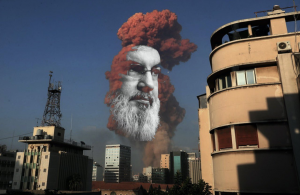
This unattributed image of Nasrallah looming over the bomb blast that recently surfaced on Twitter is of a piece with the public furor.
Despite the public fury, it is hard to see how anyone could pry Hezbollah’s hands from the levers of power and influence in Lebanon.
Former CIA case officer Bob Baer closely tracked Hezbollah (Baer’s book, See No Evil, loosely formed the basis for the Middle East political thriller, Syriana). Baer said in a phone interview, “Hezbollah controls the airport, the security services. Nothing happens there unless you get their permission. They could take total control of Beirut and throw all the Sunnis and Christians out if they wanted. They don’t, only because it’s not in their interest. For that matter, they could be setting off bombs in the US tomorrow if they wanted to.”
Senior fellow at the Atlantic Council, Nicholas Blanford, a leading scholar of Hezbollah and Lebanon, largely confirmed Baer’s take. Reached while he was still sweeping up the glass in his Beirut apartment from windows shattered by the August 4th explosion, Blanford concurred that despite Hezbollah’s culpability in Lebanon’s woes, and the public fury directed against it, there seems no clear path to lessen its grip. This leaves no clear path to creating a functional Lebanese government.
There are no real “politics” in Lebanon—its political mafias that work together to ensure they maintain control. The international community screams at the government to enact reforms, transparency, accountability, reduced sectarian control. It’s done nothing at all, despite accelerating decline. If it (Lebanon’s government) had enacted reform, then lending agencies would help with economic woes.
The international community had pledged $11.5 billion two-and-a-half years ago. The government was also in talks with the IMF that went nowhere. It doesn’t want reforms. It would lose its grip on the levers of power and patronage networks.
Given Hezbollah’s multiplicity of motives and roles, one could easily assume its participation in the looting of the Lebanese economy was motivated by sheer greed. While that undoubtedly plays a part, Blanford still sees the organisation as continuing to be driven by its founding values.
Hezbollah is not in power just for sake of power but to preserve their ‘resistance’ [against Israel] agenda. Their priority is maintaining their military capabilities.
When the Syrians left in 05 after the assassination of [PM Rafik] Hariri, Hezbollah had to work more actively and joined the government. They built cross-sect alliances with Christians and President Michael Aoun. But a backlash is now in the offing, and the opposition has washed its hands of dealing with the resigned government. The attitude towards Hezbollah is: You broke it, you own it.
But Hezbollah has money problems. And the US has gone after Hezbollah’s Achilles heel.
The US has been going after Hezbollah’s finances in a hit-or-miss way, sometimes turning a blind eye when politically convenient, as both Republican and Democratic administrations have done in last decade. Still, the US has also landed some major body blows against Hezbollah’s money machine. In 2011, the US sanctioned a Canadian/Lebanese bank that was estimated to launder $200 million a month for Hezbollah. In 2019 and 2020, the US named and sanctioned a slew of individuals involved in drug trafficking and money laundering for Hezbollah from South America to Lebanon, further squeezing the group. Most significantly, the US’s sanctions on Iran, Hezbollah’s chief military and financial sponsor, have put Iran under such financial hardships it can no longer spare much cash for its favorite foreign adventure.
Keep reading

What the Navigators Knew
Gemma Tognini on Australia’s Political Revolt

Rubio in Athens
How France Lost Control of Its Streets