Free Speech
Femen's Inna Shevchenko — Fear of Causing Offence Has Cost Many Innocent Lives
Femen founder Inna Shevchenko argues that the Western taboo on criticising religion — especially Islam — has directly enabled atrocities that frank discussion might have prevented.
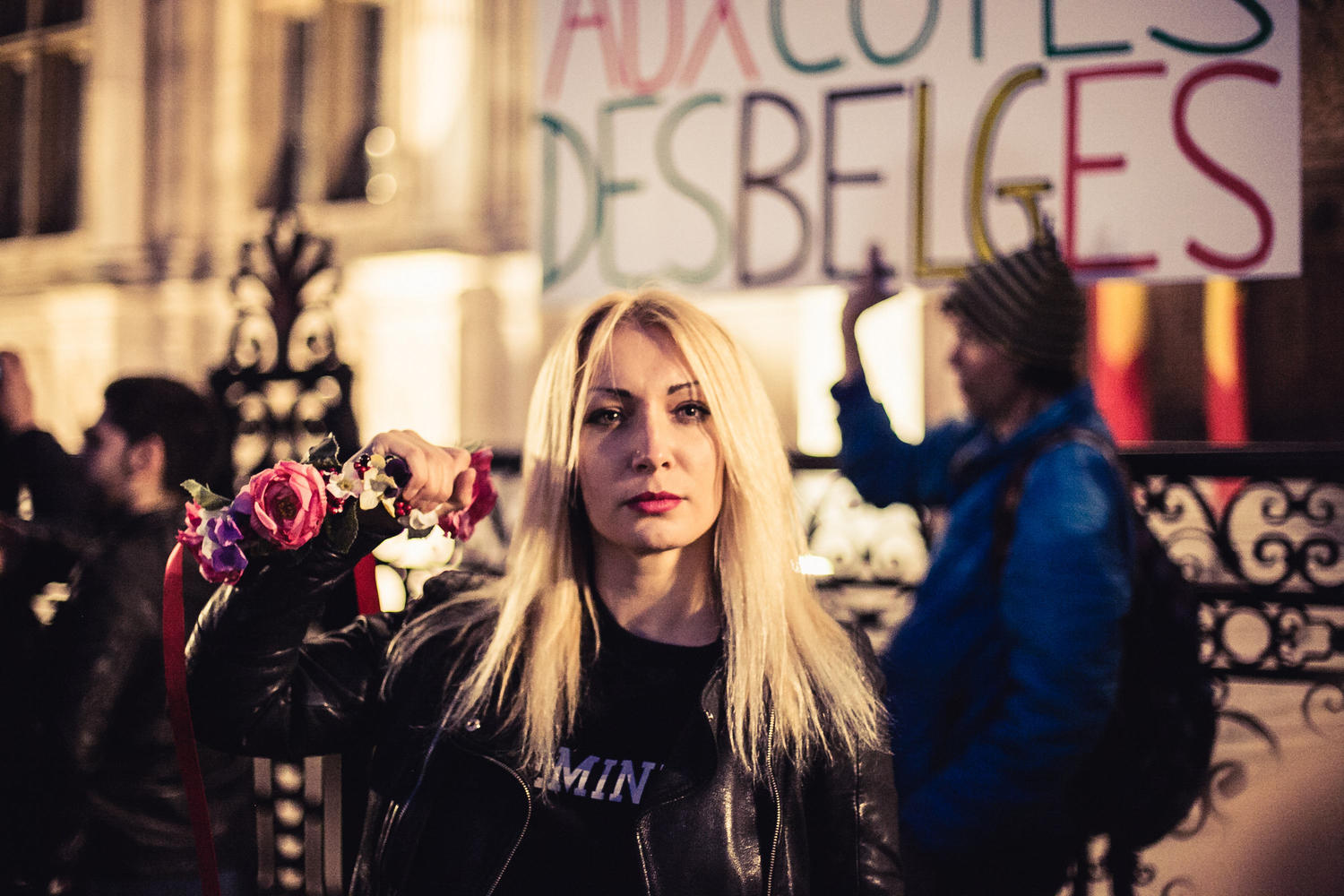

Editor’s note: As we enter 2018, brave women are protesting Islamic modesty culture and laws in Iran. Jeffrey Tayler has documented women’s protests against modesty culture in Europe for years. What follows is an interview conducted by Tayler with Femen’s leader, Inna Shevchenko, in 2017.
A female activist has just sawed down a giant Christian cross on the central square of the capital city of Ukraine, in protest against the prison sentence meted out to Pussy Riot band members for the “punk prayer” they had performed in a Moscow cathedral earlier that year. What fate awaits her when she flees, personally threatened by her country’s president for her audacious deed, to France, the self-proclaimed “homeland of human rights?” Upon her arrival in Paris, do orchestras greet her with rousing renditions of La Marseillaise? Do accolades of support pour in from the French media? Does she settle, finally, into secure environs, certain, for the first time in her young but politically active life, that she can pursue unhindered her feminist struggle for human rights and the propagation of atheism? And, in the country that enshrines laïcité (secularism) in Article 1 of its constitution, does she find her staunchly godless views lauded?
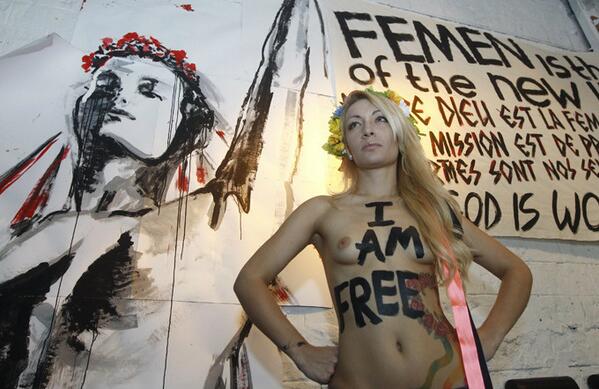
Quite the contrary! The now twenty-seven-year-old Inna Shevchenko, the leader of the international topless protest movement Femen, had, in August 2012, barely taken up residence in the attic of France’s historic Théâtre du Lavoir (which would become Femen’s headquarters), when she found herself and her activists under threat. True, she had inaugurated Femen’s arrival with a topless march in the Lavoir’s predominantly Muslim neighborhood. (Their slogan: NUDITY IS FREEDOM! Was this “culturally insensitive” to Muslims?) True, her activists had demonstrated, topless, against the burka in front of the Eiffel Tower. (Slogans: BETTER NAKED THAN BURKA! And MUSLIM WOMEN LET’S GET NAKED! Was this “Islamophobic”?)
And yes, she and Femen, the self-described “shock troops of feminism” and “watch-bitches of democracy,” were loudly decrying the spread of political Islam in France at a time when French Muslims were widely viewed as an oppressed minority. But Shevchenko expected liberals to back her group’s remonstrations against political Islam and Islam’s suppression of women’s rights.
They did not, by and large.
Physical violence soon followed, when, in November 2012, Femen, shouting IN GAY WE TRUST! disrupted an anti-gay-marriage march led by the far right, who beat them up in response. (Shevchenko lost a tooth, and she and her fellow activists were badly bloodied.) French liberals, however, rallied to support Femen’s defense of single-sex marriage, and the raunchy satirical magazine Charlie Hebdo adopted her (and Femen) and featured them often, even letting Shevchenko, by then a political refugee, co-edit an edition. The prominent French journalist Caroline Fourest shot a documentary about Femen for French television, focusing on Shevchenko in particular. For Shevchenko, among the left, things were beginning – just beginning — to look up.
But for France’s growing and increasingly restive far right she quickly became a hated figure, and death threats against her began multiplying. When the French government, in the summer of 2013, chose an image inspired by Shevchenko for its famed “Marianne” postage stamp, the controversy, as well as the danger, surrounding her seemed to peak; a week later a mysterious fire broke out in her room at the Lavoir, incinerating her few belongings. (Shevchenko was elsewhere at the time; the police have not pronounced on the origin of the blaze.) And when three Femen activists demonstrated against the incarceration of their first Tunisian activist, Amina Sboui, and landed in prison in Tunis, Femen embroiled France in a diplomatic crisis, exacerbated by their launching a topless attack (slogans: TOPLESS JIHAD! and WOMEN’S SPRING IS COMING!) on Tunisia’s President Moncef Marzouki while he was visiting Paris. This, after having burned the black flag of Salafism in front of the Grand Mosque of Paris, with ARAB WOMEN AGAINST ISLAMISTS and FUCK YOUR MORALS! the slogans painted on their bare chests.
Now times have changed. Islamist attacks have since wrought havoc across Europe and show no sign of abating. Many of Shevchenko’s friends at Charlie Hebdo were assassinated by Islamists in January 2015; and a month later, while she was speaking on stage, an Islamist gunman opened fire at a free speech conference in Copenhagen. (She escaped unhurt.) France now labors through its third year under a state of emergency. The country’s security forces continue to track terrorists and thwart attacks, but at times, as in Nice during the summer of 2016, fail spectacularly.
Reality has discredited those who maintained that Islam and terrorism have nothing to do with each other. This has granted fresh legitimacy to Shevchenko and Femen. On November 14th of 2017, France’s Comité Laïcité République (Committee for Secularism of the Republic) awarded Shevchenko its annual Prix de la Laïcité (Prize for Secularism). Standing before the crowd in Paris’ lavish Hôtel de Ville (City Hall), Shevchenko explained that she was more accustomed to being “arrested, attacked, and accused” than to receiving such honors, and shared her laurels with other Femen activists she invited on stage.
I spoke with Shevchenko one day recently by Skype. She is now pursuing a master’s degree in political science at a Paris university. Her voice sounded upbeat, though, she said, “far right nationalists” have called her winning the prize for secularism a “terrible crime.” Yet she took this in stride. “The far right uses laïcité only against Muslims, not against Catholicism. It’s just a tool to express their xenophobia.” (Femen has also demonstrated against the Catholic Church, across Europe and in front of the Vatican itself — repeatedly.)
Femen, she tells me, now runs itself, essentially, which leaves her time to write. “My work as Femen director is mostly done; the movement progresses on its own, following the philosophy we laid out for it.” Earlier in 2017, she and coauthor (and fellow Femen comrade) Pauline Hillier published Anatomie de l’oppression, a damning treatise, going female body part by body part, about how religion (and not just Islam) violates women’s rights and conspires to keep women under foot. “Monotheistic religions are waging a world-wide war against women,” she says. “It’s not a matter of specific countries.” She was surprised by the book’s reception. A times, at book-signing events, the faithful would show up to voice approval for pointing out “calmly and rationally what needs to change in their religion.”
“Even Muslim women?” I ask.
“No,” replies Shevchenko. “They continue to try to disprove what we say. Some of them call themselves ‘Muslim feminists.’ But it’s harmful to women rights look at them through the prism of religion.” Elsewhere she has called the idea of a Muslim feminist “oxymoronic.”
I first met Shevchenko in 2012, just after she arrived in Paris, and had seen the toll, physical and emotional, her activism took on her since then. I ask how she feels now, after so many years of risky street activism.
“I feel beaten up, as if yanked in all directions.” This, she says, started even before she reached France, when she was, in 2011, kidnapped by the KGB in Belarus for demonstrating against the Lukashenko regime. Apart from suffering a beating during Femen’s disruption of the anti-gay-marriage march, she had also been badly bruised by Italian police after Femen’s 2012 action against Prime Minister Silvio Berlusconi, repeatedly threatened with death by Islamists, and traumatized by the loss of many close friends at Charlie Hebdo. Then, of course, she almost fell victim to the Copenhagen attack in 2015.
 Pamela Paresky
The tension in Shevchenko’s life never really disappears. She has to keep an eye out when walking down the street or taking taxis, and, despite attempting to hide her widely recognizable face under dark glasses, has found herself recognized and threatened in the Paris metro. But bystanders have intervened to protect her. “The situation with terrorism has made people feel more responsible,” she says, “and they know they have to defend their rights and liberties. . . . They come up to me and say I may not agree with everything you do, but please continue, we need what you’re doing.” All in all, she adds, “I feel like a completely alive human being, having come three times close to death.”
“How do you deal with the stress”
“I take a philosophical approach. I ask myself, is it better to give in to fear or to master it? Well, I won’t let fear prevent me from expressing myself. I see fear winning out in European elections, so I feel a special obligation not to give in to fear.” She pauses. “I sometimes ask myself why a 27-year-old should have gone through so much. The answer is terrible: that it’s because I was defending my rights.”
Yet her direct interactions with the public have at times proved humorous. “I once had a man come up to me and say, ‘it’s cool that you’re so against the system!’ I said, ‘what? It’s the system that’s anti-me!’ The problem is with society, not with me! After all, all I’m doing is protesting or writing or speaking about my views – nothing more.”
When it comes to Islam’s relation to terrorism and women’s rights, the betrayal by many so-called liberals has really stung her. “So many on the left – in English they’re called regressive leftists, but here we call them Islamogauchistes — have ceded to manipulations by Islamists. For these leftists, “communautairisme” – ethnic identity politics, roughly, a negation of the French ideal of égalité – “has become like a new faith.” She takes a deep breath. “When you see so many who should be supporting you give in to manipulation by your enemy, you just despair. There’s this argument out there that to criticize Islam is considered racist. This is toxic for public debate. I don’t have any problem with being called an Islamophobe. I am indeed a religio-phobe. It’s not a crime to be afraid of religion. To be afraid of religion as a woman is normal.”
She categorizes the regressive left’s stance on Islam as “insulting toward the Muslim community. It suggests that all believers are a homogenous group of people. Because of the regressive left’s outcry and hysteria, moderate Muslims like Maajid Nawaz and ex-Muslims like Sarah Haider and Ayaan Hirsi Ali have to struggle to be heard.”
How does she feel when regressive leftists tell her that her stance on Islam is “offensive?”
“It’s a sign that someone is trying to deprive me of my right to free speech and impose censorship on me. It’s a sign that they’ve given up their own right to freedom of expression because of a wish for comfort and a fear of being called racist. They’ve given up the common fight and gone over to the side of the Islamists. But the right to free speech is the most precious right, the foundation for all other freedoms.”
Shevchenko tells me that she believes fervently in the right to blasphemy because “blasphemy is a celebration of free speech. It’s a raw form of free speech, yes, but it shows that any ideas and values can be challenged.”
How does Shevchenko respond to those who defend retrograde, misogynistic practices because they derive from a particular culture, with culture now presumed sacrosanct by so many on the left.
“There’s this argument on the left that if it’s someone’s culture, the debate is closed and you must shut up. So if you criticize female genital mutilation or child brides or headscarves, they will say that’s my culture and it’s offensive to argue about it, it can’t be discussed. Well, that sort of talk is offensive to me. Progress means recognizing more and more rights for people. There are many cultures that are violent or discriminatory, and they should be called such and changed. How can we progress or move forward if we aren’t able to give up medieval ideas?”
Keep reading
The Oldest Tradition in Art
The Tobacco Wars

Omer Bartov: What Went Wrong?
The Patriarchal Mind Virus
The Modern Mythology of AI