European History
The Wisdom of Charlemagne
In a new book about the Carolingian Empire, historian James T. Palmer argues that its founder was more than just a brutal warlord. He was also ‘a savant with a large library and a taste for the obscure.’


One day, so one story went, two Irish scholars turned up at a market near the northern coast of Gaul. Their own land was rich with books and willing students. However, they had heard that the educational scene among the Franks was more tepid. At the market, as people ambled to and fro between stalls, the Irishmen called out that they had wisdom for sale. The Franks, they reckoned, were Philistines who knew the price of everything and the value of nothing, people who would never embrace learning unless they thought it was a commodity.
The shoppers were unmoved by the stunt. Word of the scholars nevertheless reached the king. Impressed, he invited them into his presence and was delighted to discover that, for their wisdom, they wanted nothing more than somewhere to live and sustenance so that they could continue their teaching. The Irishmen got their wish, and the king proved himself more sophisticated than his people.
The story, written in the late ninth century, showed that one of the Carolingians’ greatest conquests was of the imagination. As the body count rose, the redemption of Charlemagne—also known as Charles the Great—lay in his piety and love of learning. It was not merely window dressing. If the ultimate goal was to lead the faithful to a good hearing on Judgment Day—and people did keep telling him that this was his mission—kings needed to ensure that people’s standards of morality, action, and speech were appropriate. They needed books and education. They needed to be understood as part of history and indeed where history was heading in the grand scheme of things. Real power lay in using force and wisdom together, and we need to understand that dynamic if we are to understand the Carolingians.
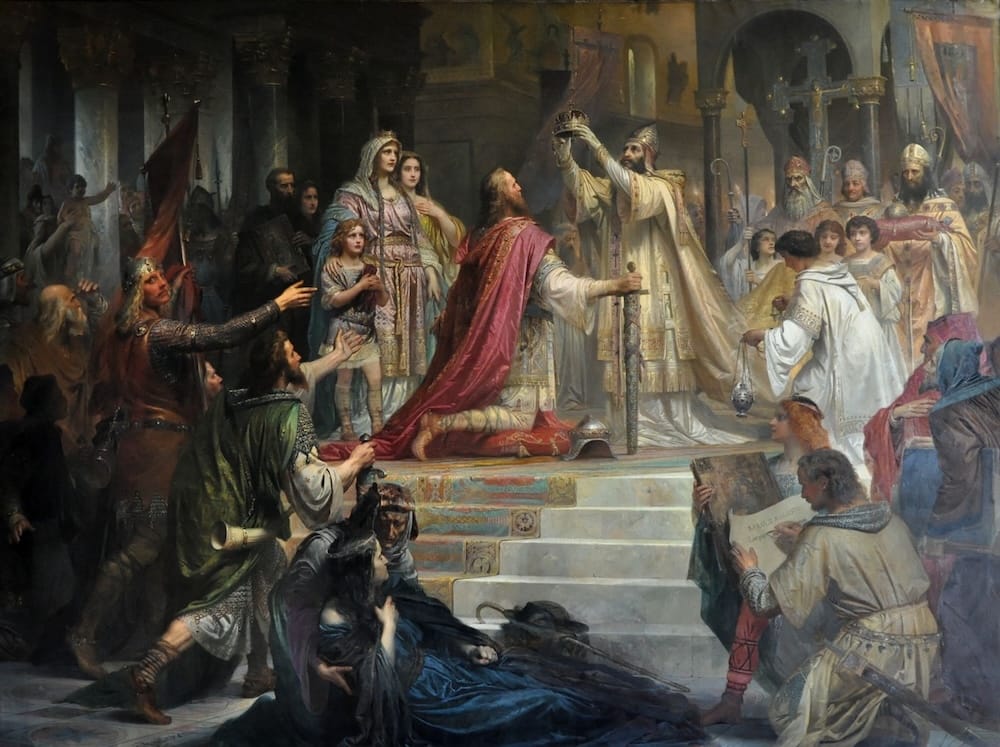
Contrary to what many people imagine about the early Middle Ages, there was a belief that people should have knowledge and critical-thinking skills, if only so that they wouldn’t be easily led astray. Ignorance fostered error. But to achieve new standards required libraries and teachers to rival the perceived golden ages of Greece and Rome. If it was not what we might call a full “renaissance” because of its limitations in scope and ambition, then it was certainly a wide-ranging cultural and religious project of “renewal” or “correction,” to employ terms used around the time. After years of war, Charles began to consider dedicating more of his energy and resources to this new project.
This was not what we might call a full ‘renaissance’ because of its limitations in scope. But it was certainly a wide-ranging cultural and religious project of renewal.
There certainly was a growing sense of urgency to address educational standards. In a letter to an abbot of Fulda in Germany around the time of the 786 AD Thuringian revolt, Charles lamented how poor the quality of writing in the kingdom seemed to be. Worse still, he wrote, “We began to fear that, just as skill in writing was deficient, so also wisdom for understanding the Holy Scriptures might perchance be deficient.” If one could not accurately express one’s faith, had one truly understood it?
A couple of years later, in 789, the king began to outline an ambitious solution in a document known as the General Admonition, which was to be preached to his followers. He positioned himself as a figure akin to King Josiah of Judah in the Old Testament, a ruler who had taken a hard line on religious discipline and purity.
The General Admonition conservatively reaffirmed commitment to core points of Church canon law and demanded various actions to be taken to support their observance, including the setting up of more schools. Charles also attacked vigilantism, “unlawful marriages,” and bearing false witness, in a scattergun attack on undisciplined Frankish behaviour. It was time for everyone, in the Church and outside it, to take responsibility and to do better. It was time for a correction.
Yet maybe there was room for a little fun along the way. In a sketch of Charles’s intellectual life contained in his biography, the Life of Charlemagne (Vita Karoli Magni), his courtier Einhard portrayed the king as a dedicated and enthusiastic student. He had hired the brightest and the best from around Europe to hang out at court, to teach him and his family, to amuse and edify them with poetic riddles and treatises on learning and morality.
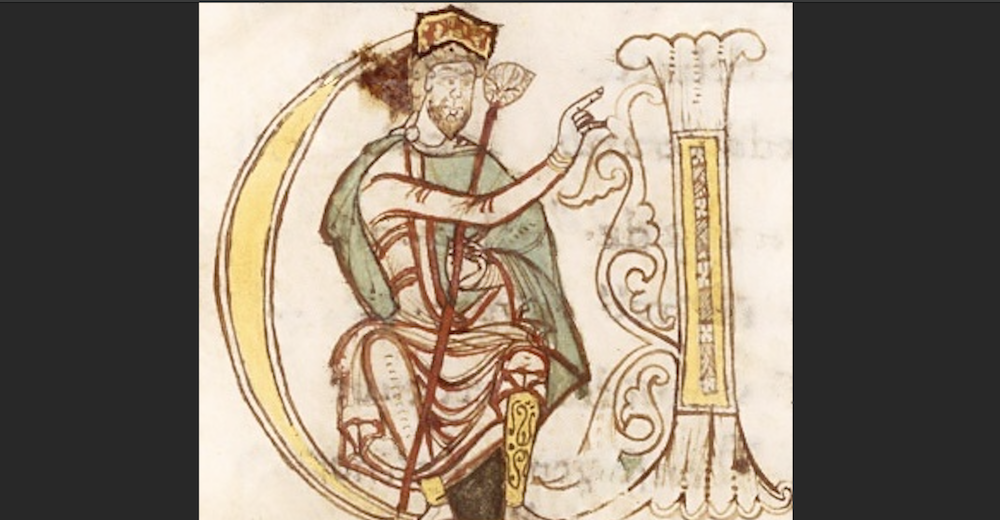
Einhard claimed that Charles struggled with writing and foreign languages, which has allowed some historians to portray him as a typical barbarian: willing to learn but ultimately out of his depth when faced with actual high culture. However, Einhard’s Charles was a literary creation infused with the flawed characters contained in the classic moralising histories of the old emperors of Rome.
The true Charles was certainly more complex. He was not just the brutal war leader he had proved to be so far; he was now also a savant with a large library and a taste for the obscure. The cultural rebirth the king sought was going to go beyond dour ecclesiastical discipline. The question was how far.
The state of learning in the eighth century was probably not as bad as many people have assumed—including some people at the time. Charles’s complaint to the abbot of Fulda came at a point when multiple fractures in Latin culture had long been inevitable. Latin-speaking communities in the pre-Carolingian world had already noticed that, seven hundred years after the heyday of Cicero and Virgil, quotidian speech had firmly departed from the written norms of ancient times. Languages are like that: It is not as if modern English is much like Chaucer’s, modern French like Chrétien de Troyes’s, or modern German like that in the epic Nibelungenlied.
 Charlotte Allen
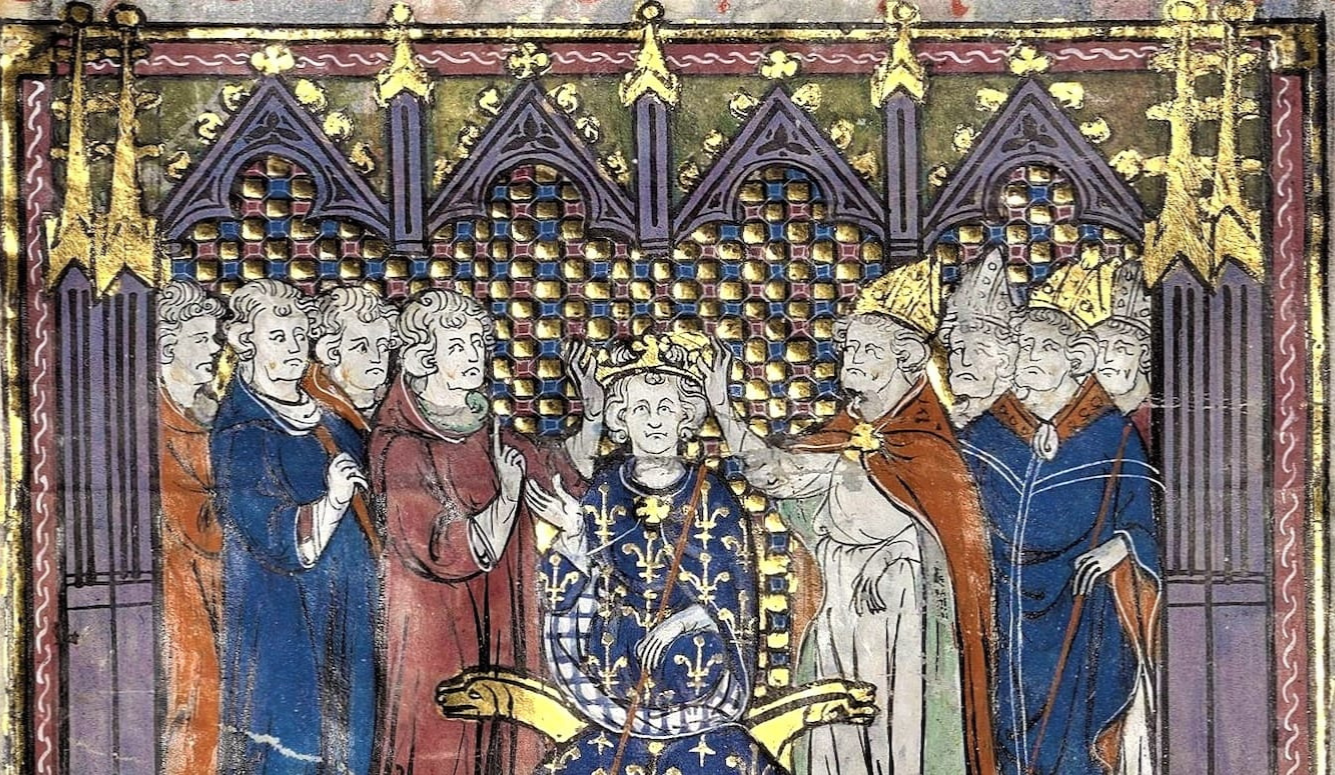
In fact, by the ninth century, Latin was already starting to separate into the dialects that gave us Italian, French, Spanish, and other Romance languages. It hadn’t “degenerated” through barbarism; it had splintered and evolved. But of course, that’s easier to recognise with hindsight. In the meantime, as it is across all the nations that share languages with nations elsewhere, many peoples felt separated by a supposedly common language.
To complicate matters, interest in Germanic languages and culture was booming for the first time. Einhard, despite drawing on Latin classics, claimed that Charles was a leading figure in the change because he delighted in hearing or reading heroic Germanic verse. Although we don’t know what was in his collection, it doubtless revolved around the kind of strong kings and dashing deeds familiar from Old English works such as Beowulf and Widsith.
Charles attempted to rename the months and winds with new Germanic words, although none caught on, probably as most were banal (for example, January was to be “Wintermonth”). The king also made a point of wearing traditional Frankish clothing rather than Roman: shirts and trousers, not tunics. There is little sense of any of this in the sources beyond Einhard’s sketch, so it is likely an exaggerated caricature by an author who, unlike Charles, grew up across the Rhine in the forested retreats of Germany.
Exaggerated or not, the king certainly spent a lot of time in the North during his reign. And here he would have found more and more people who were at a distance from the Latin world and struggling to master the language from books alone. The bigger the kingdom became, the harder it was to maintain any linguistic unity.
An awkward issue was that most groundbreaking ancient learning had been pursued in Greek rather than Latin anyway. The best astronomers, such as Ptolemy, traditionally came from Alexandria, where the clear skies were perfect for star watching. The fundamentals of many mathematical topics were laid out in ancient Greek treatises. Most medicine derived from the work of Hippocrates of Cos or Galen, and even theorists in Latin-speaking areas tended to work in Greek if they wanted to obtain any kind of status. Translations often existed to assist those in the West who didn’t speak much Greek, but it was assumed that anyone truly capable would become bilingual.
This was fine until the fifth and sixth centuries, when, little by little, political, economic, and cultural drift eroded East-West communication across the Roman Empire. Knowledge of Greek persisted in many Western Mediterranean areas and occasional pockets further north—notably around the curious libraries of Ireland—but it certainly waned overall. Access to Greek books seems to have become rarer and rarer.
Access to all kinds of books, in fact, seems to have been a challenge. However, it is unfair to blame this on indifference or hostility towards learning in the years since the “Fall of Rome.” For a start, linguistic and cultural shifts made it progressively harder for audiences to fully understand old books, much as modern audiences often struggle with centuries-old prose. And no less so than now, old books tended to fall apart if used too much or be ditched if not used enough. Because many consisted of fragile papyrus scrolls, which decay quickly in the damper climates of Europe, few were ever going to last long—even before wars and revolutions changed or destroyed the libraries that preserved books.
Only a couple hundred manuscripts survive from the Merovingian period (450 AD to 751 AD) as a result of such circumstances. By the time Charles was born, it had become standard to use more robust parchment (treated animal skin). Unsurprisingly, many more manuscripts from that time and afterwards have survived. That is an important reason that the so-called “dark ages” seemed to retreat under the Carolingians.
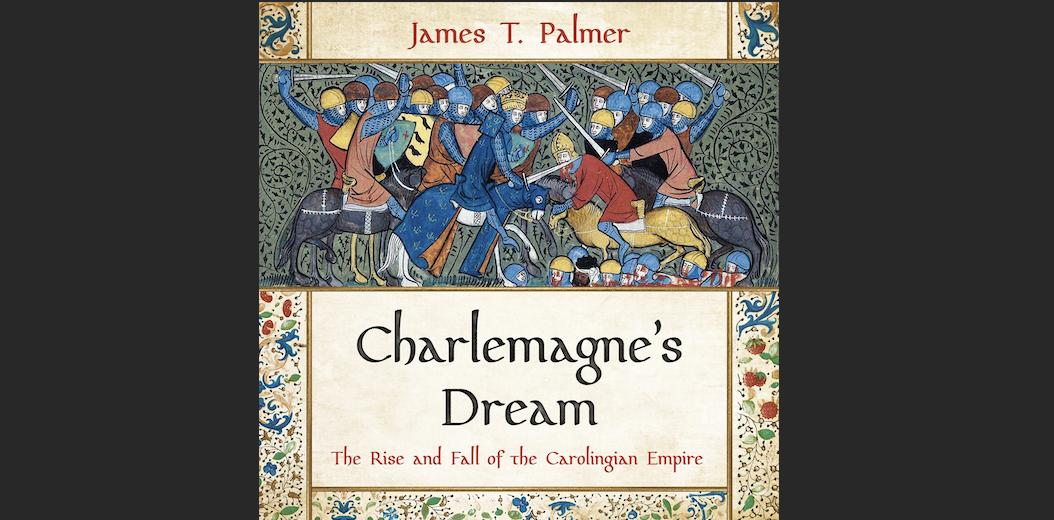
Excerpted, with permission, from Charlemagne’s Dream: The Rise and Fall of the Carolingian Empire by James T. Palmer. Copyright © 2026 by James T. Palmer. Available from Basic Books, an imprint of Hachette Book Group, Inc.
Quillette invites thoughtful responses to its essays.
Selected responses are published once per week as part of a curated Letters to the Editor feature. If selected, letters appear under the contributor’s real name and may be edited for clarity and length.
To submit a letter for consideration, please email [email protected].
Keep reading
The Wisdom of Charlemagne
Master of the Hunt


The Global Bellwether


Addicted to Transition