Podcast
The ‘Sex Recession’ is Real
Quillette podcast host Jonathan Kay talks to Debra Soh, author of ‘Sextinction: The Decline of Sex and the Future of Intimacy,’ about neuroscience, hypergamy, elephant seals, politicised sex research, the perils of polyamory, and the sex-repellent scourge of 'phubbing.'


This week marks a special occasion for me because my guest is the person who helped me start my career in podcasting almost a decade ago.
I’m guessing a lot of you don’t know this, but before I came to Quillette, I spent a few years co-hosting a Canadian show called WrongSpeak, which turned out to be a sort of early training ground for the kind of classically liberal and science-based material I ended up covering here at Quillette.
Watch the interview here.
That podcast was put together by a Montreal-based producer named Dan Delmar, who paired me up with a then up-and-coming Toronto-based PhD neuroscientist and sex researcher named Debra Soh.
 Debra Soh (Author) Format: Hardcover
Following those early podcast adventures, I went on to join Quillette, and Debra went on to journalistic fame as a columnist and author.
Just a few months ago, Simon & Schuster published her second book, titled, Sextinction: The Decline of Sex and the Future of Intimacy, which is the subject of today’s episode.
As you’ll hear, Debra isn’t arguing that our society has become too sex-negative. Just the opposite: We are now bombarded with sexualised messages and services on the internet, and propagandised with so called “sex-positive” messaging from kink-obsessed academics and activists.
But in the process, the very idea of sex has become commoditised and stripped of its connection to real human intimacy. Which is what most people really want—even if they don’t think that’s what they want when they’re swiping mindlessly through dating profiles on hook-up apps.
In many ways, in fact, Sextinction isn’t really a book about sex. It’s a book about the sense of alienation caused by the mismatch between our brain’s sexual wiring and the nature of modern society. The fact that many people aren’t having sex—or at least, aren’t having emotionally satisfying sex lives—can be seen as a symptom of that larger issue.
For instance, it’s great that women are now earning more money and dominating university campuses. But as a result of their skyrocketing fortunes, many women have fewer opportunities to date men who match them in earning power.
Vincent Harinam
This is a tendency that grates against the natural female preference for what’s known as “hypergamy”—i.e. the evolutionarily learned female preference for mates who have superior earning power, which in turn, can be invested in resources for any potential offspring.
So when Debra looks around downtown Toronto, she sees lots of women with great jobs and nice apartments, but very limited dating prospects.
Meanwhile, the few men who do have the steady job and sex appeal that women tend to be looking for are enjoying what’s essentially a seller’s market, playing the field in a world of perpetual adolescence. There’s no “sextinction” for that small group of people, but they’re in the minority.
Along the way, we’ll also talk about the perils of BDSM, sex dolls, politicised quote-unquote “sex-positive” research, something called “phubbing,” and polyamory.
And on that latter score, I’ve got to apologise for an error I made in the interview you’re about to hear.
At one point, about halfway in, you’re going to hear me talk about quote-unquote “longhorning,” which I describe as the practice whereby a woman in a polyamorous relationship uses clever tactics to push out all the other women hooking up with her man—so that she ends up in what is essentially a monogamous relationship with her formerly polygamous mate.
In other words, it means getting rid of the competition.
Urban Dictionary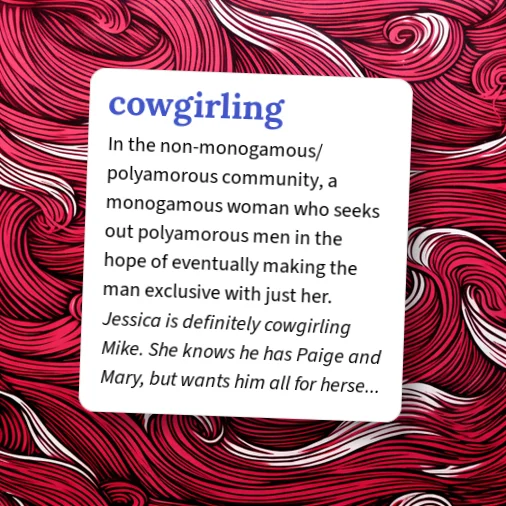
Which is a real thing in the polyam community, apparently—except it’s not called “longhorning.” I don’t know where my brain got that term, but apparently, I made it up.
The real term in polyam culture for this kind of practice is “cowgirling”—the metaphor being that the successful woman is a kind of rodeo star who uses a lasso to incapacitate all her rivals, and get the guy all to herself.
Again, it’s called cowgirling, not longhorning.
In fairness to me, I guess both words have a kind of rodeo-cowboy-culture connotation, so maybe my confusion has some reasonable basis. But still, I hate getting things wrong in these interviews.
And so on behalf of Quillette, let me say that I deeply regret the error. And I would like to extend my sincere apologies to both cowgirls and to their haplessly dumped victims.
With that out of the way, please enjoy my interview with my former WrongSpeak co-host Debra Soh, author of the 2026 Simon & Schuster book, Sextinction: The Decline of Sex and the Future of Intimacy.
Transcript
Keep reading
A Clockwork Filmmaker


The Insight Trap

Cornell and Consent

Robert Lynch on Status, Humour and the Apes We Pretend Not to Be | Quillette Cetera Episode 74