Art & Culture
Disaster Cinema
The making of John Boorman's misbegotten sequel to ‘The Exorcist’ and our fascination with creative failure.
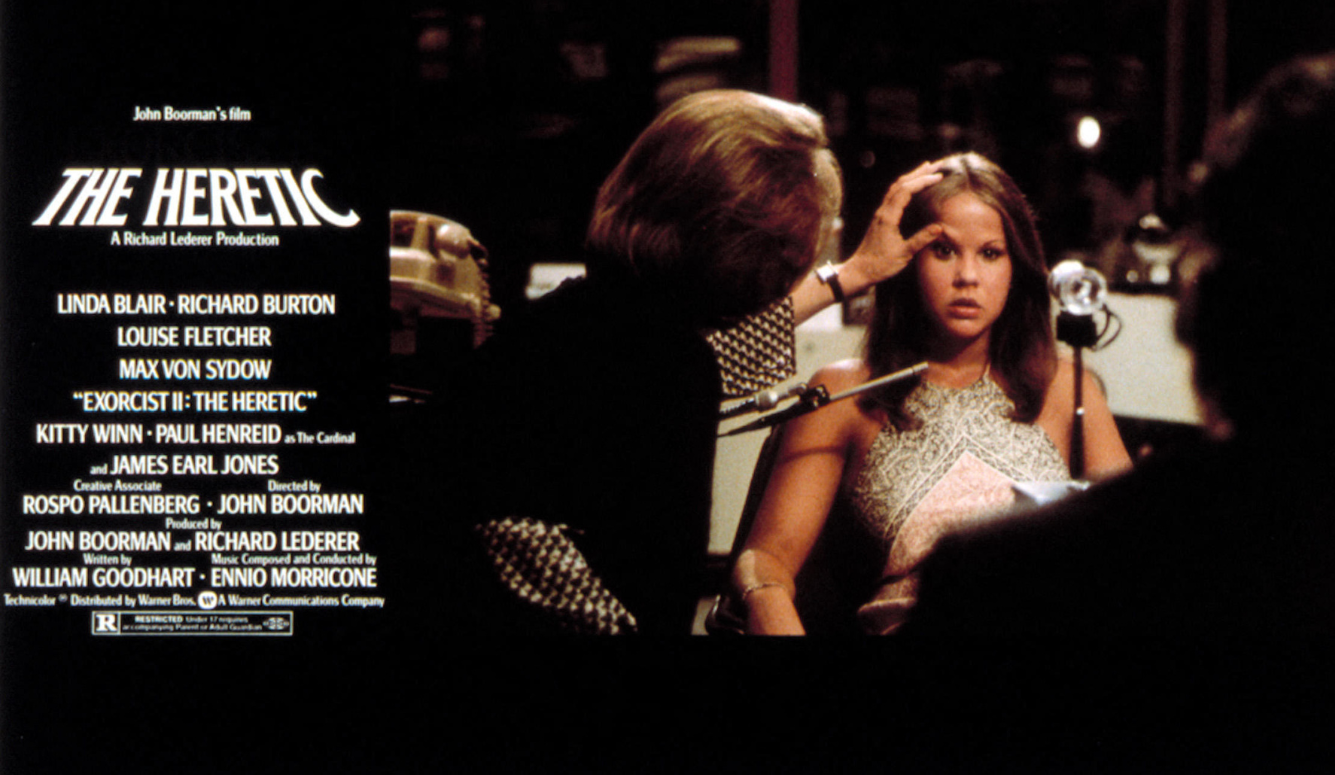
David Kittredge’s 2025 documentary Boorman and the Devil is a very good film about a very bad film, John Boorman’s 1977 feature Exorcist II: The Heretic. Boorman insisted that his film was not a sequel but a “riposte” to the 1973 William Peter Blatty/William Friedkin classic, and Kittredge’s examination of the source is so good that it encouraged me to revisit the source. Was The Heretic really as bad as I remembered? It was.
By now, the books, documentaries, and podcasts that dissect the cadaver of a dead-on-arrival motion picture comprise something of a distinct subgenre in the film-on-film checklist of cinema that feeds upon itself. I refer here only to the case studies of epic boondoggles and misbegotten monstrosities—not the run-of-the-mill box-office fizzle or creative misfire, but clinical autopsies of a truly catastrophic film-wreck, critically reviled and commercially stillborn; a flop for the ages, the very title of which remains a mortifying embarrassment to all involved. These are disaster films in which another film is the featured disaster.
Emphatically not fitting this category are documentaries like Les Blank’s Burden of Dreams (1982), which chronicles Werner Herzog’s Sisyphean struggle making Fitzcarraldo (1982), or Eleanor Coppola’s Hearts of Darkness: A Filmmaker’s Apocalypse (1991) about the travails endured while shooting Francis Ford Coppola’s Apocalypse Now (1979). These films explore the creation of a flawed masterpiece, not an abject failure. Even a bomb-by-reputation like Joseph L. Mankiewicz’s Cleopatra (1963)—recently given the forensic treatment by Ben Mankiewicz’s TCM podcast The Plot Thickens—is redeemed by the cinematic splendour of its spectacle: the dazzling set design, the cast of thousands in period costume, and Elizabeth Taylor at the peak of her beauty. Also, Cleopatra turned a profit when the TV rights were sold in 1966 for US$5 million.
Hollywood history has always had its share of troubled productions—Gloria Swanson’s Queen Kelly (1929), Darryl Zanuck’s Wilson (1944), and David O. Selznick’s Duel in the Sun (1946)—but the genius of the system and the penny pinchers in the front office usually kept budgets and artistic hubris from spiralling too far out of control. Only with the collapse of the studio system did the lack of adult supervision open up spaces to squander vast fortunes and tarnish reputations. In Fiasco: A History of Hollywood’s Iconic Flops, published in 2006, entertainment reporter James Robert Parish examined fifteen films, beginning in 1963 with Cleopatra before looking at Ishtar (1987), Last Action Hero (1993), and Waterworld (1995). But what distinguishes the films below, besides their loser status, is that they generated illuminating literary and cinematic offshoots, in the parasitical way that Tim Burton’s terrific biopic Ed Wood (1994) fed off the husk of Wood’s godawful B-movie Plan 9 from Outer Space (1957).
Perhaps the first instance of an extensive coroner’s report on a Hollywood bellyflop was Lillian Ross’s five-part New Yorker article titled “No. 1512—I: Throw the Little Old Lady Down the Stairs!” about John Huston’s adaptation of Stephen Crane’s 1895 novella The Red Badge of Courage. Ross was a staff writer at the New Yorker, and the cachet of that magazine combined with the egos of MGM producer Gottfried Reinhardt and writer-director Huston granted her unprecedented access to the inner workings of what was still the classical Hollywood studio system. During a period in which gossip columnists took dictation from studio ad-pub boys, Ross’s series (subsequently combined into a 1952 book titled Picture) offered a private tour of the factory floor (“from story conferences to preview”) to see how the sausage was made. “It is doubtful that ever before in the history of the motion picture industry has a journalist been accorded so detailed and unhampered an insight,” said Boxoffice at the time.
Ross was not starstruck. She pinpointed the bad decisions, named the names of those who made them, and covered her flank by recording her interviews. Over the objections of Reinhardt and Dore Schary, MGM vice president in charge of production, Huston insisted the leads be played by Audie Murphy, the most decorated soldier of World War II, and cartoonist Bill Mauldin, creator of the GI dogfaces “Willie and Joe” for the Stars and Stripes. Neither was a renowned thespian. Huston smelled a stinker even as the film was being edited, so he flew off to Africa to shoot The African Queen, leaving Reinhardt to supervise final cut and face the music. What the Hollywood Reporter called “the histrionic ineptitude of the two leading players and the onlooker’s indifference to the Civil War after having lived through a much greater and terrifying social dislocation” torpedoed the project. Ross gently stuck the knife in. Attending a screening in New York, she asked the theatre manager how business was. “Not socko,” he said.
Ross’s account dribbled out in the New Yorker starting in May 1952. Everyone in Hollywood scrambled for the latest issue and hated what they read. The “profile” was variously regarded around town as a “defile,” a “sneer-smear,” and even a “rape.” A Hollywood press agent threatened to break Ross’s arm. In the aftermath, Variety editor Abel Green remarked that “the same blow-by-blow labor pains would undoubtedly show up with equal disillusionment in such mundane industries as putting together a new hardware store or a piece of furniture,” but he knew that no one wanted to read a blow-by-blow account of carpentry gone wrong. The experience with Lillian Ross was traumatic enough for Hollywood filmmakers to close the door to pesky journalists for decades.