American History
Blood, Progress, and Amnesia
There is real value in Noah Rothman's century-spanning chronicle of left-wing terror, but it falls short in analysis.

A review of Blood and Progress: A Century of Left-Wing Violence in America by Noah Rothman; 368 pages; Center Street (May 2026)
The assassinations of conservative activist Charlie Kirk and insurance executive Brian Thompson, the murder of a Jewish couple outside the Capital Jewish Museum, the latest (as of this writing) attempt on the life of Donald Trump—these are some recent examples of serious violence in the name of left-wing causes. Others include the spate of bombing and shooting attacks against ICE facilities, and, going further back, the deadly and destructive riots of 2020.
Noah Rothman’s Blood and Progress: A Century of Left-Wing Violence in America aims to “confront its readers” with “the quickening tempo of left-led attacks and their political motives,” as well as with the ways in which such violence is often forgotten or justified.
Rothman opens the book with recent examples like the Kirk assassination, then goes back in time to consider waves of leftist violence since the early 20th century. It thus proceeds from the anarchists of the 1910s to the Marxian terrorists of the 1970s, on up through violent offshoots of the Black Lives Matter (BLM) and pro-Palestinian movements. Highlights include:
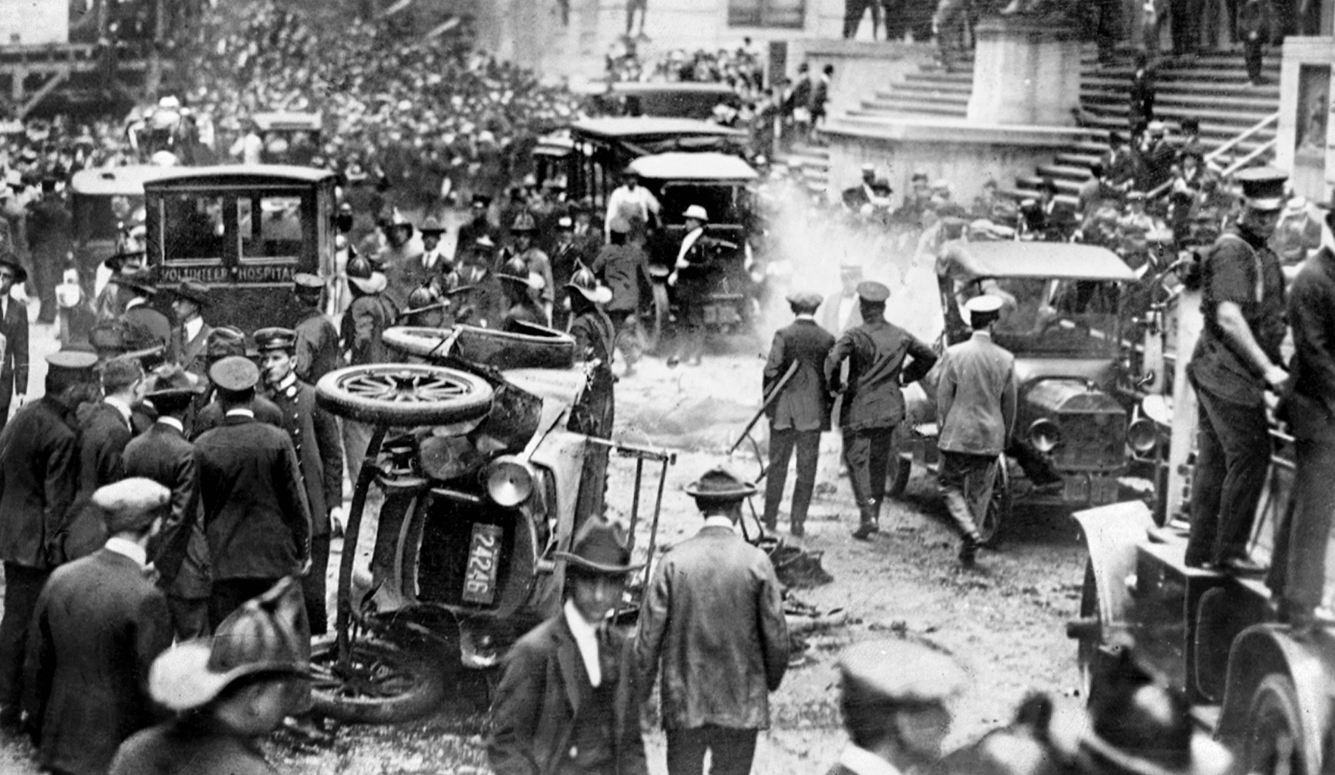
- At the turn of the 20th century, anarchists declared war on capitalism and government, believing themselves just a few killings away from Utopia. The result was a wave of arson and bombing, including a blast on Wall Street that killed 38 and wounded hundreds more. There was also the mass poisoning of hundreds of people at the Chicago University Club—an attack that very nearly wiped out most of America’s industrial leadership at a time when the country was just becoming an industrial power.
- The late 1960s and early 1970s saw a proliferation of Marxist terrorism. Radical groups included the Black Liberation Army, which funded its ambush killing of police officers with bank robberies. Weatherman also aimed to kill police with its bombing attacks, though after several failures it settled on blowing up empty rooms. FALN, a group of Marxist Puerto Rican separatists, were prolific bombers whose most deadly attack killed four and maimed many more.
- If Occupy Wall Street goes down in history as a mostly peaceful movement—aside from the looting and vandalism—it is because the authorities managed to stop attempts to burn down a port in Oakland and blow up a bridge in Ohio.
- Four years before BLM and Trump, we see the emergence of antiracism as a Schelling point for violent radicals in a bizarre 2012 incident where eighteen masked assailants assaulted diners and patrons at an Illinois restaurant because they thought that a group with white supremacist ties planned to meet there.
- But BLM and opposition to Trump were accelerants: Hence the assassination of five Dallas police officers at a BLM event in 2016 and the shooting of Republican congressman Steve Scalise and others at a congressional baseball practice in 2017. Then came 2020’s Summer of Love, which included the burning of businesses and police stations, and the strange spectacle of Seattle’s “Capitol Hill Autonomous Zone,” in which protesters established a breakaway republic free of police violence, only for it to quickly descend into a chaos of beating, shooting, and attempted rule by a local strongman.
- The radical left’s dramatic swing towards anti-Zionism and antisemitism following the October 7 Massacre in Israel. Activists celebrated the mass killing of Israeli civilians and smashed the windows of Jewish-owned businesses. An assailant attempted to burn down the home of Pennsylvania’s Jewish governor. The assassin who killed a Jewish couple in Washington, D.C., received legal charity from a group describing itself as the vanguard of the “Hamas Marxist Army.”
Along the way, Rothman detours for a chapter to discuss how the left constructs heroes and martyrs. Former terrorists like Bill Ayers become respectable professionals, and even convicted murderers like Assata Shakur are celebrated as good-hearted activists.
Also strewn throughout the book, most heavily in the opening chapter, is the observation that mainstream politicians, academics, and pundits downplay or even justify left-wing violence. “Even if you believe violence isn’t the answer, it is a solution,” wrote one academic in the wake of Kirk’s assassination, an event that in some quarters produced more strenuous condemnation of the victim than the killer. Similarly, Rothman quotes several politicians who seemed unable to condemn the Thompson assassination without adding a “but” that sympathised with the killer’s motives. And 2020’s BLM riots gave us open defences of burning and looting—the latter described by an author in an NPR interview as “a powerful tool to bring real, lasting change in society.”
Rothman’s final chapter turns to right-wing violence, from 1980s abortion clinic bombers to the 1995 Oklahoma City bombing to the January 6 riots at the Capitol. Liberals and leftists tell an incomplete story when they focus solely on violence from the right, but they’re certainly not making up the threat. The chapter’s title, “Contagion,” hints at Rothman’s view of extremism as a self-reinforcing phenomenon, with each side’s crazies inspiring one another.
So how are we to judge this book?
Keep reading
A Clockwork Filmmaker

The Insight Trap
Cornell and Consent
Robert Lynch on Status, Humour and the Apes We Pretend Not to Be | Quillette Cetera Episode 74