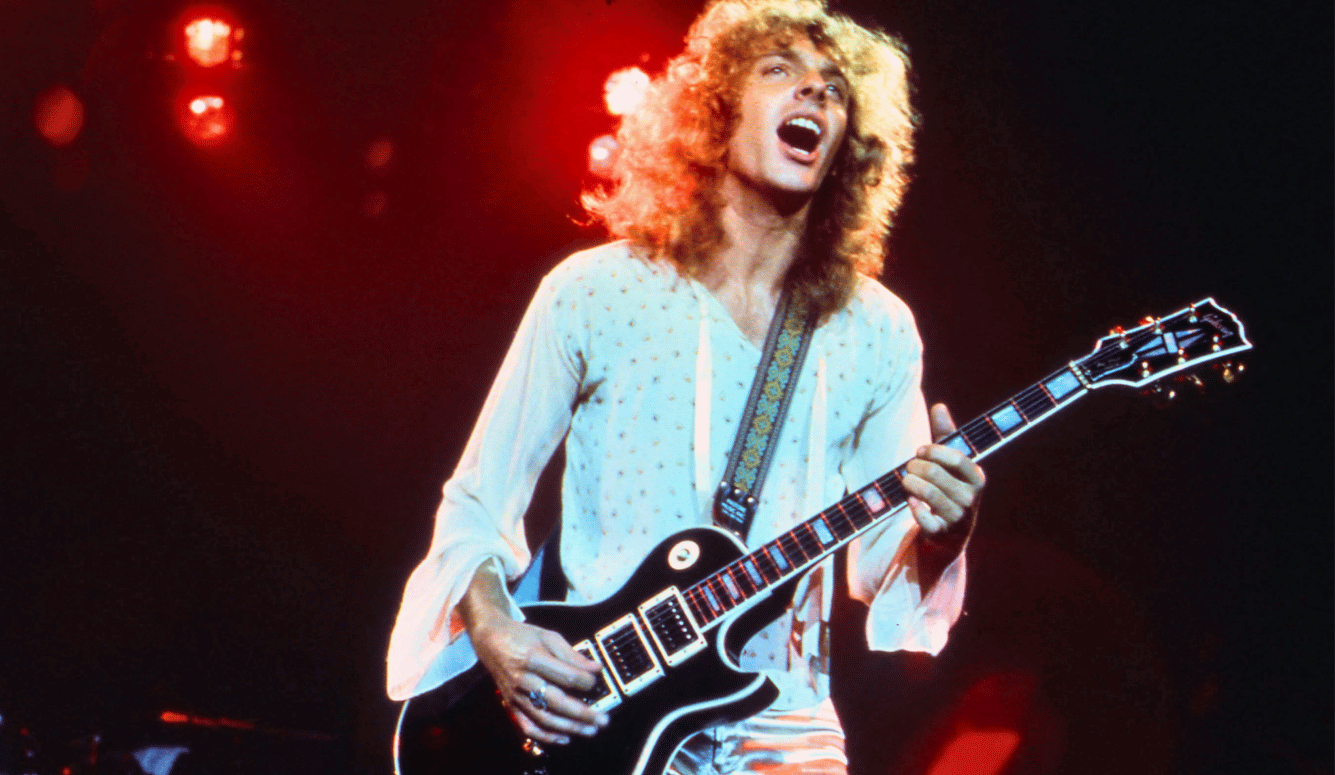

In 1976, Peter Frampton was a guitar player who was respected among his more popular peers despite having enjoyed no commercial success. He had only a small following in his native Britain and in a couple of American cities—and then with lightning speed, he became the biggest star on the planet. The live album Frampton Comes Alive! (1976) brought him fame and commercial success, but, as he was later to recall in his 2024 Rock and Roll Hall of Fame induction speech, “What goes up must come down. Looking back, my fall from grace was almost predetermined.”
In 1971, his band Humble Pie was on the verge of breaking into the American mainstream after finding early success in the United Kingdom. Humble Pie had been formed two years earlier by Frampton and Steve Marriott, the singer and lead guitar player with The Small Faces. Frampton met Marriott when his band The Herd opened for The Small Faces during the latter’s residency at The Marquee Club in London and the two young men bonded over the dissatisfaction they felt about their respective bands. Frampton resented the fact that the music press thought of The Herd as a teenybopper band, while Marriott felt that The Small Faces had run out of creative steam. While Small Faces were more established in the British rock scene than The Herd, they were far from the upper echelon of bands like Cream, The Who, and The Rolling Stones. Marriott recognised Frampton’s special talent right away and wanted him to join The Small Faces in the hopes of reinvigorating their sound, but the rest of the band refused, so instead, Marriott helped Frampton form a band of his own. Then Marriott left The Small Faces, dramatically announcing mid-concert, “I quit!,” and storming off stage. He called producer Glyn Johns with whom Frampton was staying at that time and Frampton agreed to let him join his new band, which they decided to call Humble Pie. The remaining members of The Small Faces renamed their band The Faces and recruited Rod Stewart and Ronnie Wood to replace Marriott on vocals and guitar.
They released Humble Pie’s debut album in August 1969 and a second album in November: a stunningly fast turnaround even for the late 1960s and early 1970s, when it was common for bands to release two albums in a year. Marriott and Frampton wanted to shed the posh British pop rock sound their previous bands were known for. Initially, Marriott envisioned sharing the role of frontman with Frampton and bassist Greg Ridley, but although he was barely over five feet tall—having been a very premature birth—Marriott possessed a larger-than-life personality. He quickly came to dominate the stage and would eventually determine the band’s musical direction.
By the time they released their third album, Humble Pie (1970), the band had abandoned their diverse mix of acoustic and electric blues influences in favour of the raw and raucous hard rock sound that Marriott preferred. Frampton’s sole contribution to the album was the number “Earth and Water Song,” whose mellow, folksy quality feels out of place sandwiched between the hard rock numbers “One Eyed Trouser Snake Rumba” and “I’m Ready,” a Willie Dixon cover. Frampton was an excellent hard rock guitarist, but this simply wasn’t his kind of music.
By 1971, Humble Pie was one of rock and roll’s rising star acts, touring the US with Grand Funk Railroad, who were at their peak in popularity. Grand Funk Railroad’s Mark Farner later described the band’s helicopter approaching the packed house of 55,000 people during Humble Pie’s performance at Shea Stadium: “The stadium was rocking, I mean visually rocking … bouncing up and down, and we could see it from the air.”
Humble Pie kept up the momentum with the release of their live album Performance: Rockin’ at the Fillmore (1971), recorded at the historic Fillmore East venue in New York City. The album was the band’s commercial breakthrough, peaking at #21 on the Billboard 200. But by this time, Frampton had already left the band. He and Marriott had very different musical ideas and Marriott, who was already one of rock and roll’s most notorious party animals, had become addicted to cocaine. “At one point, my songs were okay for Humble Pie, but now they weren’t,” Frampton later related. “Steve was an incredible teacher. I learnt so much from him. But it was almost a Mick and Keith love/hate thing between us. We thought … Fillmore was going to be our biggest record, and I figured that if I didn’t get out now, I’d be sucked in and it would be harder.” It turned out to be a good decision. Peter Frampton departed Humble Pie just as they broke through into stardom. The band scored another gold record with Smokin’ (1972), but then Marriott’s escalating drug benders began to take their toll. Their follow-up albums were substandard and they quickly faded from relevance.
In 1974, Peter Frampton acquired the talk box, a device that would define his sound from then on. He was introduced to the gadget by pedal steel guitar player Pete Drake while they were playing on George Harrison’s All Things Must Pass (1970). Drake came into the Abbey Road studios, Frampton later recalled: “He gets out this little box, sets it on the side of the pedal steel there, plugs it in, whatever, a pipe comes out, he sticks it in his mouth, and the pedal steel starts singing to me. It’s like I think I’ve died and gone to heaven, this is the sound, and it’s right in front of me.” This pivotal moment in rock history was captured on tape during the All Things Must Pass sessions with Harrison and Ringo Starr in the studio. Talk boxes were rare at the time and Frampton spent years searching for one of his own, until he finally acquired one from inventor Bob Heil, who had just begun to make his own version of the device.
Although his first three albums sold poorly, Frampton toured relentlessly, building up his popularity. When his fourth album, Frampton, was released in March of 1975, it cracked Billboard’s Top 40 albums, peaking at number 32. Meanwhile, fans in three of rock music’s most important markets recognised that Peter Frampton had something special. “San Francisco, and Detroit, and New York were ahead of everywhere else,” Frampton reported. “I could headline in those three places from the Frampton record.” Then his manager, Dee Anthony, who had previously managed Humble Pie and the A&M Records label, suggested he record a live album.
The album that would become Frampton Comes Alive! was recorded in 1975 at the Winterland Ballroom in San Francisco and the Marin County Civic Center in San Rafael, California. According to Frampton, all but five songs on the album were recorded at Winterland during the first headlining concert of his career. Frampton’s backing band had changed since his last tour: Bob Mayo on keyboards and bassist Stanley Sheldon were recruited mere weeks before Frampton hit the road. Drummer John Siomos was the only remaining member of the original backing band. Frampton said of the Winterland gig, “We had that show down. We came off stage and that’s where you usually go, ‘Wow, I wish we’d recorded that.’ And then we said, ‘Oh my God, we recorded this.’” When the band listened to the recordings from the production truck parked behind the stadium, they realised that they had just played the show of their lives. “[T]he energy that came from the tape just leapt out of the speakers,” Frampton later recalled. Frampton Comes Alive! was intended to be a single LP, but Jerry Moss, the President of A&M Records, offered to pay for a double album, which would include some acoustic numbers.
With just weeks to go till the release, the band hastily scheduled additional concerts at The Long Island Arena in Commack, New York, and State University of New York at Plattsburgh for the purpose of capturing Frampton’s acoustic songs. Eddie Kramer, who had been the engineer on Rockin’ the Fillmore and produced KISS’s Alive! (1975), which was rocketing up the charts at the time, was the engineer in the production truck for the Commack recording. “The intensity of the playing and the way the audience was reacting was just spectacular,” Kramer later recalled. “[T]he audience was so tuned in, it was magnificent. And Peter’s playing just soared.”
Fifty years after its release, Frampton Comes Alive! is a time capsule of what concert-going was like in the 1970s. Like KISS, The Who, and Bob Seger in the early years of their careers, Frampton was unable to harness the energy of his live performances in the studio. Frampton Comes Alive! showed record-buying audiences what they were missing. For example, the final track “Do You Feel Like We Do,” was first released on his debut album, Frampton’s Camel (1972). It was already nearly seven minutes long, but after Frampton acquired the talk box “Do You Feel Like We Do” was transformed into a fourteen-minute epic that he played as the finale for every concert. Mayo’s keyboard and Frampton’s guitar solos gave the song an energy it lacked in the studio. When Frampton asked the audience, “Do you feel like we do?” in a robotic voice, and soloed using the talk box, he gave listeners something they had never heard before. Aerosmith lead guitarist Joe Perry had used the talk box in the iconic intro to “Sweet Emotion,” and Bon Jovi’s Richie Sambora used it on their biggest hits, “Livin’ on a Prayer” and “It’s My Life,” but neither of them gelled with the gadget quite as perfectly as Frampton did.
“Wind of Change,” the sixth track on Frampton Comes Alive!, features a dangerous practice that was a regular occurrence at concerts in the ’70s: a concert-goer lets off a cherry bomb. The practice of lighting powerful firecrackers like M-80s or cherry bombs and throwing them into the air to create a cheap firework display dates back to the mid-’60s. One of the first uses of a cherry bomb at a concert was during a Beatles performance at the Mid-South Coliseum in Memphis, Tennessee, in 1966, when a group of teenagers threw one onstage. None of The Beatles were harmed, but for a moment they thought that one of them had been shot when the cherry bomb exploded. In 1977, Steven Tyler and Joe Perry of Aerosmith and Led Zeppelin guitarist Jimmy Page were all wounded by M-80s in separate incidents.
Frampton promoted the release of the album in radio interviews across the West Coast while the album was still being recorded and mixed. By the time Frampton Comes Alive! was released, these DJs were personally invested in seeing it succeed. The album’s release also coincided with the peak popularity of Album Oriented Rock (AOR). Lee Abrams, the DJ who pioneered the AOR concept and later co-founded XM Satellite Radio, has said that “Frampton Comes Alive! defined AOR during that period, which was anchored by being as commercial as possible without losing its progressive identity, and deeper tracks … The album had a wide range of styles and was tied together with great melodic songs and a minimum of indulgence, making it easy to program on a mass-appeal station.”
Frampton Comes Alive! was finally released on 15 January 1976 and debuted at #143 on Billboard 200 on 31 January. Peter Frampton knew the album was going to be a huge hit when the first three concerts of the promotional tour sold out Detroit’s Cobo Arena, a 12,000 seat venue that was the epicentre of rock and roll. The album raced up the charts in February when “Show Me the Way” was released as a single and the world heard Peter Frampton’s talk box for the first time. “Show me the Way” is a mellow acoustic song, electrified by the talk box, and it had crossover appeal on both pop radio and AOR stations. It peaked at #6 on the Billboard Hot 100. By March, the album Frampton Comes Alive! had reached #2 on the Billboard 200 and was certified gold for 500,000 copies sold. It stayed at the #2 position for the next five weeks. Then on 10 April 1976, it reached number one.
 Thomas Larson
Frampton posed shirtless on the 22 April 1976 cover of Rolling Stone magazine, turning him into an overnight sex symbol. “Throughout the year, as Rolling Stone, then more magazines, came out with me on the cover with my shirt off, at my shows the guys went to the back of the hall and the girlfriends came to the front,” he later recalled.
What made Frampton Comes Alive! such a record sales juggernaut was its crossover appeal. “Show Me the Way” and “Baby I Love Your Way” were hits on pop radio, which had a predominantly young female listenership and deep cuts like “Lines on My Face” and “Do You Feel Like We Do?” were in heavy rotation on Album Oriented Rock radio stations, which appealed to young males. A Peter Frampton concert was the perfect date night. Young couples could hold hands during “Baby I Love Your Way” and then they could rock out to “Do You Feel Like We Do”. “Do You Feel Like We Do” was such a hit on Album Oriented Rock radio that it was released as the album’s final single, in a seven-minute-long cut—unusually long for a pop single. It peaked at #10 and is one of the longest songs to ever become a top ten hit.
In 1977, at his manager Dee Anthony’s urging, Frampton released the follow-up album I’m In You while Frampton Comes Alive! was still in the charts. It sold better with the teen idol crowd than with rock fans. “I had a fifty-fifty male/female audience up until I’m In You was released,” Frampton commented, “now, I’m hated by the guys and loved by the women.”
In 1978, Peter Frampton, The Bee Gees, Aerosmith, Alice Cooper, and Earth, Wind, & Fire all starred in Sgt. Pepper’s Lonely Hearts Club Band, a musical based on the Beatles album of the same name. Frampton was reluctant to join the cast because of his reverence for the Fab Four, but agreed after the producer led him to believe that Paul McCartney would be participating. In fact, none of the Beatles starred in the film, which was a critical and box office disaster and damaged the standing of the bands involved, all of whom—except Earth, Wind & Fire—took a major hit to their careers.
In the summer of that same year, Frampton broke his arm and several ribs, and suffered a concussion following a car crash. Instead of convalescing, he went straight back into the studio to record Where I Should Be (1979). The album went gold and the single “I Can’t Stand It No More” reached #14 on the Billboard Hot 100, but this would be the last commercial success Frampton would enjoy. Frampton had been a teen idol but now he was about to turn thirty and his appeal to that demographic was fading. His melodic style was also beginning to seem increasingly dated with the emergence of new wave and the growing popularity of heavy metal.
Peter Frampton continued to release new albums throughout the 1980s, but he was firmly out of the spotlight. Then in 1986, Frampton received a call from his boyhood schoolmate David Bowie who asked him if he wanted to play guitar on the album that would become Never Let Me Down (1987). Frampton accepted the offer without hesitation, and also joined Bowie on the subsequent Glass Spider Tour, which reintroduced him to the public as a guitar player.
In 1991, Frampton approached Marriott, who had spent the past fifteen years playing small clubs and bars in the US and England. The few people who remembered Marriott knew him only as Peter Frampton’s washed-up old bandmate. But when Frampton and Marriott played together again, it sounded as if time had stood still, even though they hadn’t collaborated in almost twenty years. They wrote and recorded some songs in Los Angeles and even made plans to tour together. The prospect of two of rock’s greatest live performers reuniting attracted the attention of several big labels, but just as it looked like the duo would gain a new lease on life, Marriott backed out and returned to England. He died the very next day after he fell asleep smoking in bed. He was forty-four years old.
After Marriott’s death, Frampton went back on the road as a soloist. At this point, nostalgia for the 1970s was reaching fever pitch and Frampton became a popular touring act again. People have been flocking to his concerts in droves ever since—and not just old-timers who remembered him at his peak. Many decades after his heyday, a Peter Frampton concert was still the perfect date night.
Keep reading
Equal Pay, Unequal Work

The Genetics of Crime and Punishment
Jerry Kaplan on AI Doomers