Science / Tech
“Too Much Science in the Curriculum”
Tragicomic scenes from reparations-based medicine.

In April 2020, I published an essay in these pages investigating attempts to boost minority (specifically black) enrolment in America’s medical schools. These attempts consisted mostly of subtle bookkeeping gimmickry that under-counted grade point averages and Medical College Admission Test (MCAT) scores while giving greater weight to “non-cognitive skills.” A month after that essay appeared, in Minneapolis, a white cop knelt on a black man’s neck for nine minutes and sparked one of the greatest moral panics in modern American history.
 Steve Salerno
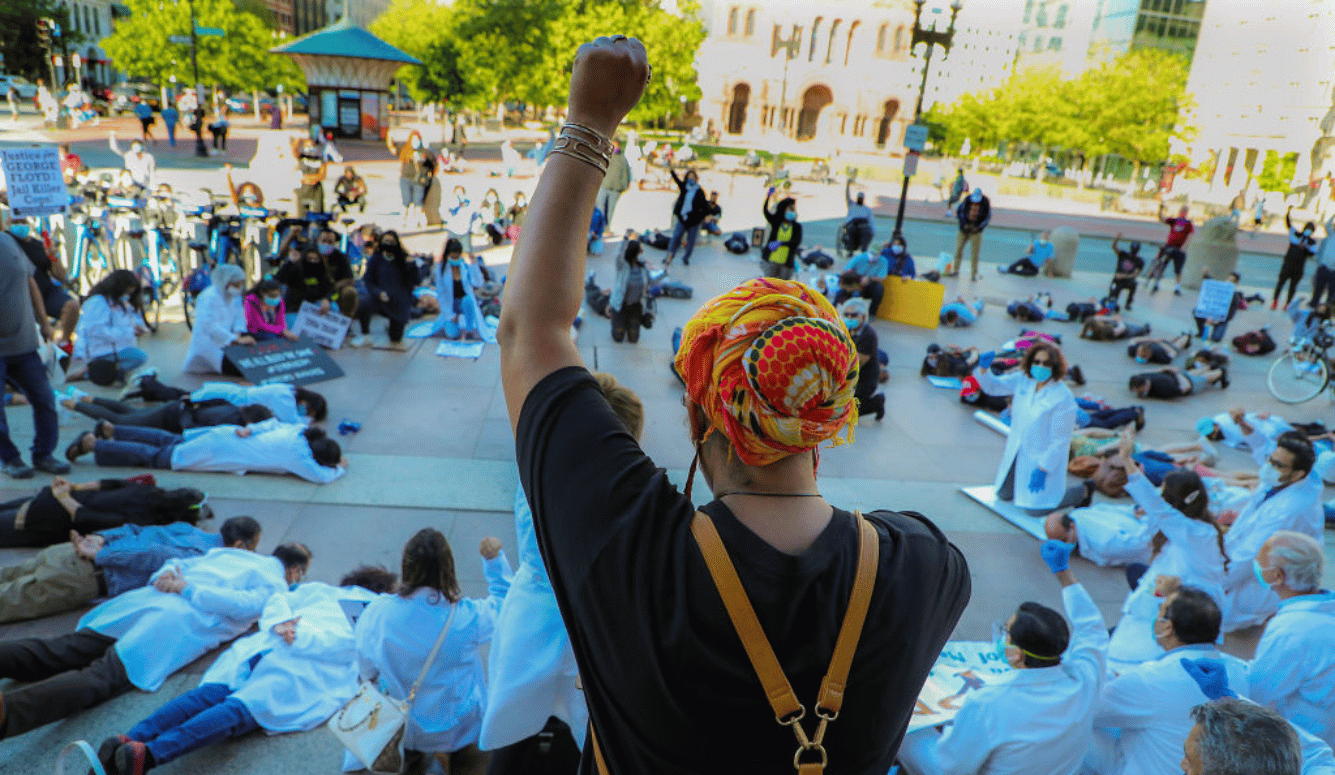
As “antiracist” efforts to “decolonise” medicine and catalyse “health justice” accelerated, what was once merely implied behind closed doors was now stridently declared before rolling cameras. Within days of George Floyd’s death, the American Medical Association (AMA) called on physicians to “dismantle white supremacy, racism, and other forms of exclusion and structured oppression.” The Association of American Medical Colleges (AAMC) demanded that its member schools incorporate bias training into technique classes.
New mandates were issued by the Liaison Committee on Medical Education (LCME), the profession’s accrediting body, while the Association of American Medical Colleges (AAMC) exerted influence over admissions through the MCAT—an exam that had already been broadened in 2015 to include sociology and other social-science content. An ad hoc group of young medical professionals calling themselves White Coats For Black Lives organised demonstrations on the campuses of American medical schools, and deans scrambled to implement curricular tweaks that addressed allegations of institutional racism. Ibram X. Kendi’s books suddenly appeared on med-school bookshelves alongside Gray’s Anatomy.
Admissions processes began to include “disadvantage essays,” in which students were encouraged to ruminate on formative factors that supposedly obstructed their path to medical school. Prospective faculty were compelled to compose DEI statements outlining their personal plans to combat racism and promote black progress. Photos of white males began disappearing from the hallways of august medical buildings, while instructional materials featuring too many white authority figures drew disdainful accusations of “whitewashing” and calls for more inclusive imagery. Search committees were also reconstituted to include more black faces. Policy manuals delicately noted that research faculty could confirm their dedication to the mission—and the school (and their careers)—by ensuring from the start that their work would contribute to racial equity.
That fall, UCLA’s David Geffen School of Medicine trotted out its “anti-racism roadmap” (since removed), which unveiled various strategies that paved the way for black and Hispanic applicants to gain admission before more qualified white or Asian students. Diversity manifestos (like this one) began appearing under the auspices of the AAMC, which urged the implementation of DEI policies. After-action reports revealed that most schools adopted the majority of the demands. Nearly ninety percent, including many in the top ten, admitted (and even boasted) that DEI was now embedded in their core values.
The social-justice juggernaut got results. Minority representation in med schools—which had dipped in California and even ebbed nationally after California’s landmark Prop 209 (banning affirmative action)—roared back to peak-AA levels and beyond. “Schools decided it was more important to have a racially diverse corps caring for patients than to identify the most capable individuals,” recalls Stanley Goldfarb, MD, former associate dean with the prestigious Perelman School of Medicine at Penn. “Achieving this involved a growing movement to eliminate traditional academic qualifications for entry.” In 2022, convinced that antiracism was becoming anti-medicine at Penn and pretty much everywhere else, Goldfarb established a nonprofit organisation called Do No Harm, the charter mission of which was “keeping identity politics out of medical education, research, and clinical practice.” Today, it claims 50,000 members in fourteen countries.
Apostasy like this prompted witch hunts. They came for Goldfarb at Penn, where fellow faculty members circulated petitions denouncing him as a racist and unsuccessfully seeking to strip him of his “emeritus” status. He was fired from his job as editor-in-chief of the nephrology section of medicine’s leading research portal, UpToDate. As he would subsequently write of that tumultuous period:
The Perelman School had just hired a vice dean for education who urged that we train medical students to be leaders in “social justice.” That set off alarm bells, since medical students are supposed to treat illnesses, not diagnose, much less cure, what ails society. Physicians simply have no agency to address these societal ills. My alarm turned to shock when the vice dean declared, “There’s way too much science in the curriculum,” a sentiment that was echoed when another colleague criticized me for not emphasizing climate change in the course of study.
Keep reading
The Genetics of Crime and Punishment
Jerry Kaplan on AI Doomers

Payback Time for Steven Galloway