Books
The Ballad of East and West
In a fascinating new book, historian Anthony Bale vividly reconstructs the brutal, fantastical, and sometimes deeply religious experiences of medieval travellers across Europe, the Middle East, and Asia.
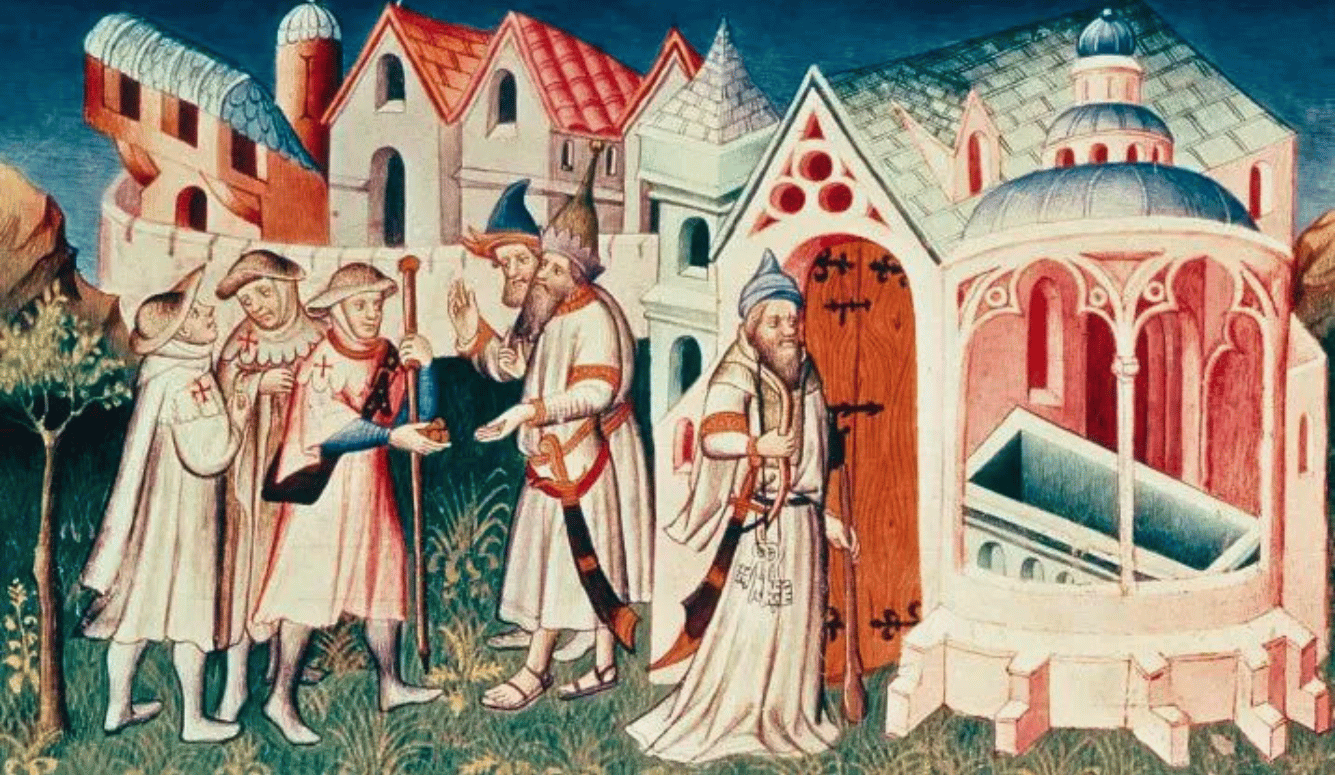

A Review of A Travel Guide to the Middle Ages: The World Through Medieval Eyes by Anthony Bale; 368 pages; W.W. Norton (April 2024)
Hormuz was never plain sailing. Marco Polo, who landed at the city-island in the strait in the 1270s, called the place “torrid” and “insalubrious,” although he noted the “spices, precious stones and pearls, silk and gold fabrics [and] elephants” that festooned its markets. A century later, European travellers were still describing Hormuz as a dangerous place. The Franciscan missionary Odoric of Pordenone reported that it had neither fresh water nor trees, and caused “men’s testicles to hang down to their legs as far as the knees.” In his new book, A Travel Guide to the Middle Ages, Cambridge University historian Anthony Bale notes that, for many, Hormuz’s “sweltering weather seemed to reflect a broader corruption.”
However, Hormuz figures more positively in some of the descriptions Bale cites. In the early 15th century, Ma Huan, a Chinese Muslim, journeyed as far as Jeddah on Arabia’s west coast. Of Hormuz, he observed that “the people of the country are all rich,” and religiously “reverent.” Its Muslim inhabitants were “refined and fair,” “stalwart and fine-looking” and its “physicians and diviners” were “decidedly superior to those of other places [perhaps he was thinking of China].” Those falling into poverty, he wrote, were given “clothes and food and capital” by their betters. Ma Huan, possibly guided by religious camaraderie, made no mention of misshapen bodies or other ills.
The combat-devastated Gaza Strip also figures (briefly) in Bale’s narrative. In the eyes of the late 15th century Italian Jewish traveler Meshulam of Volterra, Khan Yunis, the Strip’s second largest city (mostly rubble and tent encampments today), was a “fine and renowned place” that sported “fine fruit.” But it also had plenty of robbers, prone to targeting travellers.
The title and subtitle of Bale’s book are both somewhat misleading. It is not really about the medieval European mind or a guide to the Middle Ages. Instead, the author relates how travellers—mainly pilgrims seeking penance or salvation, missionaries, soldiers, diplomats, and businessmen from western Europe—visited sites in Europe and lands as far east as Indonesia in the late Middle Ages and early 1500s, and he describes who they were, why they traveled, and what they saw—or said they saw—and heard. But the book is finely written, engaging, deeply researched, and littered with anecdotes and informative observation.
Keep reading
Robert Lynch on Status, Humour and the Apes We Pretend Not to Be | Quillette Cetera Episode 74

The Radicalisation of Tucker Carlson

A Pop Fiction Master and Monster

Australia’s Coming Censorship Machine

Anatomy of a Book Promotion