Education
Criminal Research
European jurists should not seek to arbitrate controversial matters best settled by science.


I.
On 20 March 2026, Counsellor Pierre Thiriar in the Antwerp Court of Appeals published an opinion piece in which he describes the writings of American philosopher Nathan Cofnas as punishable under criminal law:
When [Cofnas] states that genetic variants influencing intelligence may be unevenly distributed across populations and that this can explain differences in cognitive performance, this constitutes not merely a neutral hypothesis, but the empirical basis for a hierarchical view of humanity.
Cofnas is currently a postdoctoral researcher at the department of philosophy and moral sciences at Ghent University, and his position was already threatened by petitions and protests. Now the most radioactive topic in biology has been called criminal by a judge. So is Thiriar right?
First, some terms. When scholars use the term “individual differences,” they are referring to one person being taller, brighter, wittier etc than another. The term “group differences” refers to variation in average height, smarts, wit etc between—for example, older/younger, male/female, black/white groups of people. Then there are causes of measured differences at the individual or the group level. That’s four different levels of analysis, and conflating or confusing them leads to slop.
Unlike wit or kindness, both of which are socially valued traits, it’s rare to hear intelligence mentioned without someone becoming excited—and not always in a good way. But intelligence research is a scientific golden child. It survived the replication crisis that cratered psychology, and intelligence has the most explanatory power of any single trait in the whole of the human behavioural sciences. It has scientifically well-known properties. It is measurable in ways that are neither culture-free nor significantly biased, and its distribution is roughly a bell-shaped curve with a fat centre and narrow tails. In a large city, you will run across a few people who can figure out how to build a thirty-storey building and a few who find it hard to interpret a subway map. But most of the people you encounter will fall somewhere in between.
We underestimate the range of healthy normal variation in intelligence because in work and play we tend to mingle with others who are similar to ourselves. People with low cognitive abilities (and no known pathologies) are often diagnosed as having learning disabilities. But while low cognitive ability does constitute an impediment to learning, it is part of the normal distribution, just as a person who solves protein structures is also part of the normal distribution. Lower cognitive ability is not necessarily evidence of a disorder.
As well as being measurable and varying among individuals, intelligence is linked with many important outcomes, including health, income, educational achievement, and even (albeit weakly) life expectancy. These links are found in thousands of large-scale studies. The top-line is that a person’s intelligence can be measured reasonably well, humans vary a lot, and someone who is lucky with their intelligence is liable to be lucky with other good outcomes. This is the observed (measured or phenotypic) level of analysis concerning individual differences in intelligence and what is associated with such differences (their correlates).
Next let’s consider the causes of the wide variation in intelligence. It is now uncontroversial that genes contribute to individual differences in intelligence. The magnitude of that contribution is not at issue here. It is not a fixed amount anyway. And there is compelling evidence from large-scale studies, particularly those led by Robert Plomin at King’s College London, that within the same sample, the genetic contribution to the differences in performance on tests of cognitive ability is low in early childhood and increases with age. Some studies converge on fifty percent heritability on average across a lifetime. It is worth noting that in early childhood, differences in family upbringing contribute substantially to cognitive-ability differences. This makes sense—a kid who benefits from engagement, stimulation, resources like books, regular bedtimes, and domestic stability gains advantages that manifest in the kind of performance that gets measured on IQ-type tests. But as children emerge from the larval stage of spotty adolescence into the silkier coats of young adulthood, the influence of upbringing on test scores diminishes—in many studies, to close to zero percent of the variance.
Our differences in intelligence arise from genetic and non-genetic causes. The term "environment" gives me hives; it has led to such misunderstanding. Intelligence is resilient. Intelligence can be depressed by head trauma, some illnesses, malnutrition, and severe neglect, but it is unharmed by the wide range of evolutionarily expected conditions. The non-genetic component of test-score variation includes measurement error, random (stochastic) biological processes, and non-systematic individual experience (such as a bad dose of measles in childhood, for example). Counter-intuitively, there is little evidence that differences between families (such as income, parenting-style, schooling) cause substantial intelligence differences in young adults. This level of analysis is about the causes (or aetiology) of individual differences.
Separately, we can examine test scores (the average, the range and so on) from groups—such as young and old, rich and poor, male and female, or groups based on ancestry (I am going to avoid the word “race” here since it is a trigger term, but ancestry is an adequate substitute). People do not fit into neat ancestral categories like eggs in a carton. Ancestry that expresses the biological reality of gene frequency clusters with fuzzy edges is operationalised on government forms as socially constructed categories. Visual cues alone often allow us to identify a person from Europe, Asia, Africa, and so on because our looks reflect our genetic population structure to some extent. Our self-reported ancestry correlates fairly well with genomically inferred ancestry clusters, but it does not correlate perfectly.
Which check box does a woman tick if her mother is Igbo Nigerian and her father is sixth-generation Welsh? This is not simply a measurement problem; it is ontological. Many of us do not fit neatly within a discrete ancestral cluster. We are a single species, and genes now flow among all of us. The conflation of clusters with categories is a mark of threadbare thinking because ancestries are not pure signal, they are noisy. But acknowledging this does not compel us to abandon the term. It can be useful.
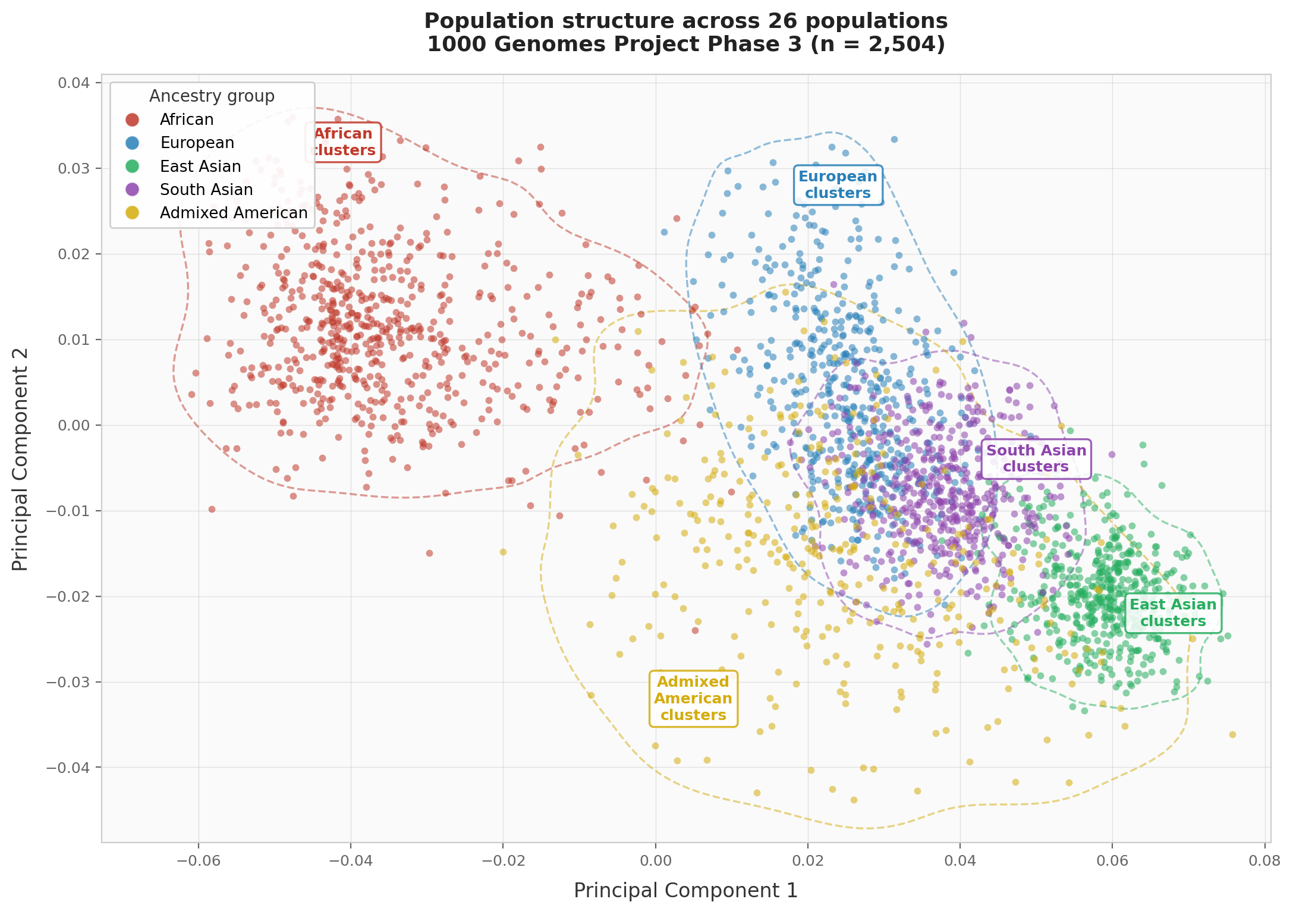
Our next level of analysis is measured differences in performance scores between ancestral groups, operationalised as government-form type categories. Many studies have probed this question. Some of them are execrable owing to poor sampling and weak methods, and some are good. What repeatedly emerges is that average (mean) test scores do vary between ancestries. But it is important to bear several points in mind when evaluating this literature. First, we have already said that there is ineluctable noise in the socially constructed government-form categories (our Igbo/Welsh example). Second, performance indicators are necessarily a snapshot in time. They report what was found, not what the future will find. Third, test scores are agnostic about causal factors. And fourth, the value reported is usually the average. Slay me, but I’m going to repeat that word a lot.
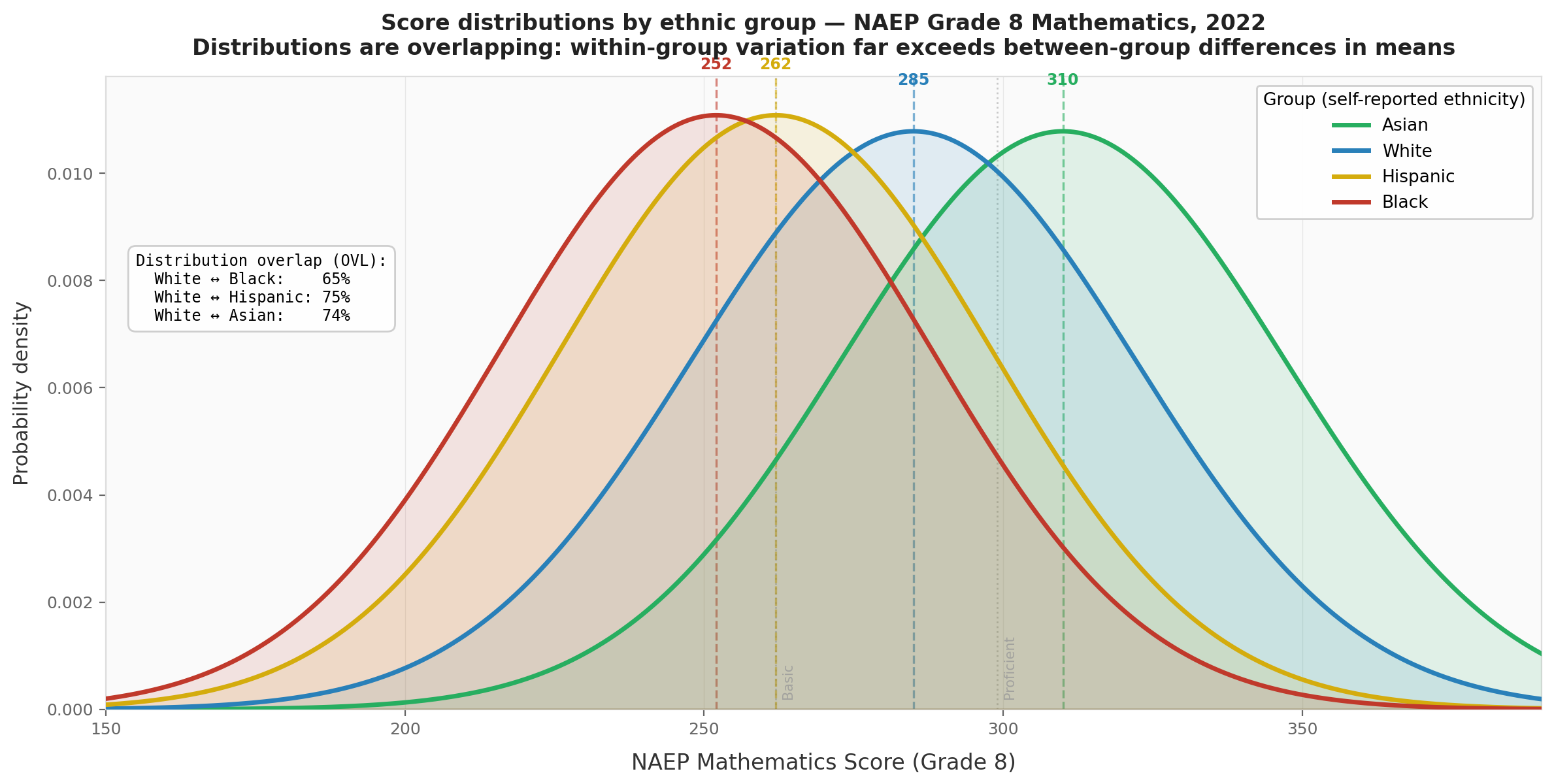
Around each ancestry test-score average there is a wide distribution of scores, and these distributions overlap substantially. So in every group, some individuals will exceed the average test score of the other groups. This should be familiar from our observations of other traits. Men are taller than women, on average, but some women are taller than the average man. You will have heard this before, and refreshingly for a much-bruited assertion, it is also true: “variation within a group far exceeds the variation between groups” in test scores.
II.
If we were Vulcans, we might say: “Okay, but what are the causes of the observed test-score differences between groups?” But we are not Vulcans, we are sensate carbon-based people, and many electrons have been spun resisting or promoting this question. This is the casus belli, the epic fury of population genetics. Why does an empirical question over which no Vulcan would lose any sleep cause such insomnia in earthlings? It seems to have given Pierre Thiriar, our Antwerp Court of Appeals justice, some unholy nightmares. But his anxieties are unlikely to be about the scientific methods or findings—in fact, Counsellor Thiriar doesn’t engage with them at all in his condemnation of Nathan Cofnas.
 Abhishek Saha
Instead, his concern is about the implications of those findings and their possible impact on people. This is why he calls Cofnas’s opinions criminal and invokes Articles 20 and 21 of a Belgian Act. The first of these articles concerns incitement to discrimination and the second concerns dissemination of ideas about racial superiority. The feared answer to the question “Do genes contribute to the currently observed average test-score gaps between ancestries?” is “Yes.” And it is defensible to be concerned. But it is also defensible to explore this most taboo of topics.
Let’s begin by dragging a common mistake into the sunlight, which Counsellor Thiriar may find relevant. It is widely assumed that it would be socially optimal if individual differences in intelligence were caused by variation between family upbringing (factors like schooling, diet, and parental income), since the external systematic environment is widely assumed to be easily malleable (unlike those pesky genes). But as we have seen, the impact of differences between families in rearing style and socio-economic status (excluding neglect and abuse) explains close to nothing in adult intelligence test scores. Short of an oppressive planned-economy or totalitarian regime, the environment is much less manipulable than genes anyway. And when environments are equalised, all remaining differences among individuals are necessarily genetic, measurement error, or stochastic. Genes are biddable by comparison. We will eventually find solutions to many single-gene and few-gene causes of severe intellectual disabilities. We won’t so easily find a cure for indifferent parenting, bad town-planning, and poor teaching.
So what harm would arise if genes were found to contribute to ancestries differing in test-score averages? There are several possibilities to consider in turn. Some of which fall under the general heading of “misunderstandings.”
The first type of misunderstanding concerns what a “yes” finding would mean. Probabilistic thinking does not come naturally to most of us, including journalists, bloggers, and people who post on Twitter. Such findings would invariably be presented in ways that invite confusion. Because group-level genetic findings will be reported as percentages and probabilities, the conditions for misreading are baked in from the start. There is even some relevant research on this. Gerd Gigerenzer’s work on how we think convincingly argues that we tend to reason better about probabilities when they’re presented as natural frequencies rather than percentages or probabilities—ie: “three in ten” rather than “thirty percent” or “p=0.3.” And Gigerenzer’s work shows that it’s not just us hoi polloi who trip up. Educated clinicians and other professionals fall down too.
Misunderstandings like these are likely to lead people to slip from group averages to individual predictions with discriminatory consequences such as “Oh, let’s just hire the Asian guy—he’ll be smart.” So Counsellor Thiriar is correct when he writes, “When one argues that it is rational and necessary to take racial differences into account in societal selection, one lowers the threshold for concrete discrimination on the grounds of so-called race.” But hiring, as with most forms of societal selection, should be done at the level of the individual, not the group, precisely because within-group variance swamps between-group variance.
Another risk of exploring this topic is that inflammatory falsehoods (“Group X is inferior)” will receive more airtime than nuanced truths (groups overlap and the averages differ). The correction to the misreading takes a long time to catch up with the more widely broadcast message. And in the meantime, some groyper decides they have “scientific justification” to bully a kid because he is black. It is reasonable to worry that findings about a genetic contribution to group differences would negatively impact people in lower-scoring groups in ways that findings about other traits do not. This is because intelligence is routinely conflated with moral worth, especially outside our own affiliative network.
Intelligence and height are both highly polygenic traits. But compare the casual remark “Those people are shorter than us” with “Those people are stupider than us.” Applied to ancestries, both statements are scientifically false, but only one is morally objectionable. And this is why Cofnas’s employment at Ghent University is in danger. Height is only weakly linked with outcomes we care about, but a disparaging remark about intelligence lands as a compressed claim about a bundle of life chances including health, employability, status, educability, potential, and so on. And in this way, it is widely confused with a person’s worth as a human being. Being cavalier about language is a form of narcissism that tracks an impoverished theory of mind.
III.
We are susceptible to conflating the value of intelligence and moral worth in ways that are context-dependent. Within circles of connection like children, family, friends, and colleagues, our affection for a person does not covary with their intelligence because we do not rank those close to us by their abilities. Our esteem and regard for people in our network track their character, shared history, relationship, and affection more than cognitive ability. We may praise a son’s precocity, but it doesn’t trump his brother’s endearing playfulness. We seem to be much more disposed to conflate moral worth with intelligence when we make judgments about people outside our circle. And this matters because our conflation of intelligence and moral worth is most likely to happen out of network, which is a proxy for “in other ancestries.”
Compounding these unhappy likelihoods are risks that genes are miscommunicated as deterministic and immutable, and that ancestry is mistaken for clear-cut biological categories. And this is part of Thiriar’s mistake. He is evidently haunted by the prospect of racial hierarchies, which he believes will follow naturally if we accept Cofnas’s claims about group differences. But this assumption really is woefully wrong. Empirical evidence is necessarily descriptive—it tells us what the world is like—in a series of (mostly) incremental approximations towards truth. Hierarchy, in the sense that concerns Thiriar, is a value term. Acknowledging that average differences exist in cognitive test scores between ancestries, and that these differences may be partly explained by genetics, does not imply a hierarchical view of human nature.
Although we are still figuring out what contribution genes make to the observed average differences in test scores among ancestries, we will learn the answer eventually. We cannot hide forever behind methodological challenges; they will be overcome in time. This is a highly specialised and technical area, and the question is not currently amenable to genome-wide association studies. We do not yet know which genes cause intelligence—we only know which genes are tagged (close by) the causal genes. Nevertheless, suggesting that directional selection on intelligence has acted uniformly across all populations is not a serious position. Our species walked, swam, and rowed out of Africa and over the globe, settling into hundreds of different ecologies, climates, and ways of life. The selection pressures bearing down on any given population—the problems it needed to solve to survive and reproduce—varied across time and place.
What deus ex machina would we invoke to imagine otherwise? That some phlogiston-like force has yoked together all selection pressures acting on all global populations over all time such that the average intelligence of all human populations is precisely the same? Even without natural selection, one would expect to find average genetic differences in polygenic traits between ancestries simply by genetic drift (the random divergence of gene variants that occurs whenever mating populations are somewhat separated).
The expectation of universal uniformity is such drivel it’s painful. Intelligence is a highly polygenic trait with a wide range of healthy viable expressions (unlike the number of heads, hearts, or spines, where an answer of more than one or less than one per person is usually fatal). From an evolutionary-theoretical standpoint, one should expect polygenic traits to have overlapping distributions with slightly different averages among peoples that have a long history of reduced gene flow.
As far as I know, there is no example of a highly polygenic trait that has the same observed average across ancestries. And where the genetic contribution to average differences between ancestries has been explored (height being the best example), the evolutionary prediction stands. Intelligence is, from the Vulcan standpoint, just another polygenic trait. Yes, we do treat it differently for social reasons, but we need both lenses, the Vulcan lens and the Earthling lens to see well and act better.
The motto of my home institution, the London School of Economics, is Rerum Cognoscere Causas (“To know the causes of things”). It is a concise and foundational statement of the presumption of scientific enquiry and a further reason why it is wrong to shut down socially sensitive research by direct or indirect means. It is better to pursue knowledge than to peddle what may turn out to be Noble Lies, because restricting scientific enquiry in deference to taboos risks unintended harms and the victims may not be obvious. And it is a category error to confuse human variation (in any trait, intelligence included) with value terms like superiority or inferiority.
There are very good reasons to avoid polarising polemics on a scientific topic of this sensitivity, and to discuss it with clarity, care, and accuracy. We should avoid tendentious statements in support of an allegedly greater cause (such as dismantling wokeness, which I find Cofnas inclined toward). But he is not guilty for acknowledging the existence of average test score differences between ancestries, nor for saying these differences may be partly explained by a genetic contribution. Only scientific evidence can be the arbiter of that.
In an earlier essay published on 9 March 2026, Thiriar writes:
[T]he difference between controversial science and pseudoscience is precisely that the former allows itself to be tested against empirical evidence and methodological rigor, whereas the latter often makes selective use of data to support pre-existing ideological conclusions.
It is hard to see how empirical evidence can be subjected to methodological rigour if it might be criminal to do so. We face two kinds of ill. One is suppression of science, the other is heedless, inaccurate, and demeaning communication. We can and should avoid both.
Giving the hard questions over to the mainstream is the best long-term strategy. Leaving it in the hands of those willing to be vilified is necessarily giving both the research and the communication to a restricted sample. That’s bad scientifically and it increases the likelihood of further polarisation. The reflexively suspicious will readily see a conspiracy (“they won’t tell the truth because they’re afraid”), while research will remain ceded to those who don’t care so much about communication. The mainstream majority will push back against misunderstandings and falsehoods. “Most of us” are probably the safest hands available for socially sensitive science.
The genetic part of the story is not anyway the most policy-relevant part of group-differences research, although it should help us to see the wrong-headedness of pursuing “proportional representation” as a primary goal. Our policies should instead focus on delivering whatever fosters flourishing: increased stability, reduced neglect and chaos.
The science points clearly: “take each person as they come.” We can avoid cowering and cringing if we confront falsehoods, communicate with force and clarity, and work to get past our intellectual and ideological tribal biases. The group is the wrong unit for selection, morally and methodologically. Whether the genetic contribution to ancestry differences in average IQ-type scores turns out to be zero or substantial, the person in front of you has exactly the same claim to be seen and treated as an individual. That is the most rigorous scientific approach we can take.
Quillette invites thoughtful responses to its essays.
Selected responses are published once per week as part of a curated Letters to the Editor feature. If selected, letters appear under the contributor’s real name and may be edited for clarity and length.
To submit a letter for consideration, please email [email protected].
Keep reading
Criminal Research
Getting Away With It

The Many Roots of Our Suffering: Reflections on Robert Trivers (1943–2026)

The First Post-Ideological Bedouin State

Trump, Tehran, and the China Calculus