Art and Culture
Out on the Wily, Windy Moors...
Emerald Fennell’s misbegotten adaptation of ‘Wuthering Heights’ destroys the very structure of Emily Brontë’s classic story.

I.
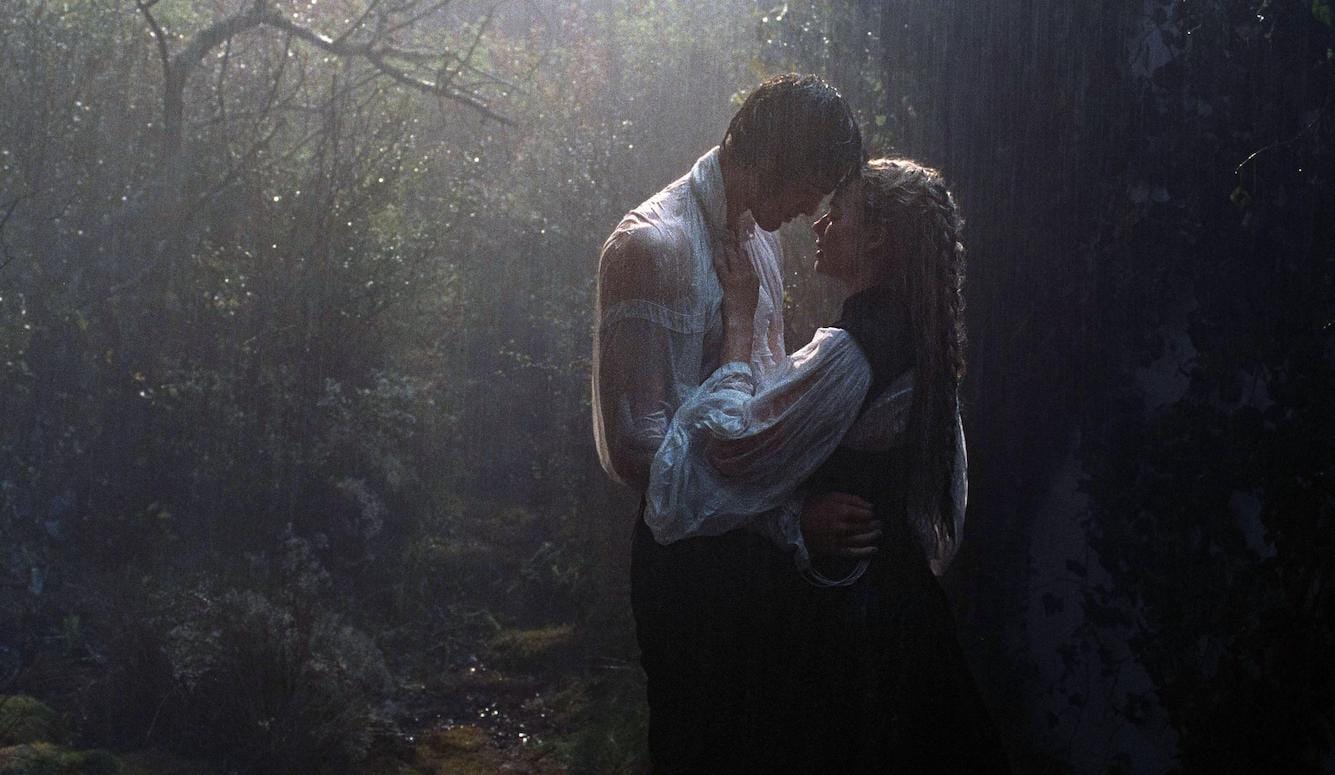
Dismal reviews notwithstanding, I hoped that “Wuthering Heights”—writer-director Emerald Fennell’s cinematic adaptation of Emily Brontë’s 1847 gothic novel—would at least be a deliciously enjoyable bodice-ripper. The trailer promised hunky, saturnine Jacob Elordi in his exquisitely tailored black frock-coat lustily bending over a billowing-gowned Margot Robbie, who swoons and melts in the throes of tragic passion. Oh, the desperate sprints across the Yorkshire moors to those secret trysts! The howling wind and the lashing rain! The yearning quasi-folk electropop of Charli xcx in the background (Charli may be forever tainted by her association with the hapless Kamala Harris, but she sure can sing). “Bring it on!” I thought. “Who cares that this two-hour-plus extravaganza obviously bears no resemblance to Brontë’s book? Isn’t that why Fennell enclosed the title of her movie in distancing quotation marks?” At the Brontë Women’s Writing Festival in Yorkshire last September, Fennell declared, “I wanted to make something that made me feel like I felt when I first read it [aged fourteen], which means that it’s an emotional response to something. It’s, like, primal, sexual.” She cast the sloe-eyed 6’5” Elordi as Heathcliff because, she said, he looked just like the illustration on the cover of the edition she read as a young girl.
Unfortunately, the movie does not deliver on the bodice-ripping deliciousness. Fennell evidently decided that, since Cathy and Heathcliff never consummate their affair in Brontë’s Victorian novel, she needed to remedy that deficiency by stuffing her film with a lot of softcore sex and innuendo (a hanged man with a massive erection, for example). So, Heathcliff and Cathy go at it incessantly. And since Cathy has married her rich neighbour, Edgar Linton (Shazad Latif), for his money, the coupling takes place in an array of furtive and impromptu venues: inside a carriage, on a tabletop, but usually in the great outdoors.
It’s all R-rated sex and the characters keep their clothes on (their passion is too urgent for undressing), but Fennell makes up for that by having Heathcliff do quite a bit of licking—of Cathy’s face mostly, but also of her fingers after he catches her masturbating on the moors (which have undoubtedly seen worse over the millennia). It also rains constantly, drenching the lovers mid-coitus—another “primal” touch added by Fennell. The results are often risible. I enjoyed a good laugh when Heathcliff and Cathy sneak up to a hayloft and peep through the floorboards at two lusty young servants engaging in a bit of BDSM with the horse tack. And a reviewer for the Hollywood Reporter remarked that a shot of a shirtless, sweating Heathcliff stacking hay bales was “so close to gay farmer porn I giggled.” Just in case we haven’t got the idea, Fennel lays the sexual symbolism on extra thick during a scene in which Cathy cracks raw eggs onto Heathcliff’s bedsheets, and another in which we watch Cathy knead wet dough in slow-motion like she’s giving an erotic massage.
But for most of the film’s running time, I was bored. After about an hour, I began to wonder when, how, and if all of this was going to end. Part of the problem is that for all their strenuous exertions, there’s no chemistry between Elordi and Robbie at all. Elordi is good-looking and swarthy enough, but he doesn’t have the hammy charisma of, say, Laurence Olivier in William Wyler’s 1939 adaptation. It doesn’t help that, for the first third of Fennell’s movie before he makes his fortune and cleans himself up into Hot Mr. Darcy, Heathcliff resembles a stringy-haired, bushy-bearded hobo (like Charles Manson, but a lot taller). Whenever he kissed Margot Robbie, much less licked her fingers, I recoiled on her behalf.
And Margot Robbie is comically miscast as Cathy. She’s a rare blonde bombshell who can also act, and she’s a standout in spunky, high-spirited roles like Mrs Wolf of Wall Street, Tonya Harding, Sharon Tate, and Barbie. But she can’t do tragic period heroines well. Furthermore, Robbie was 34 when “Wuthering Heights” was shot, which is much too old to play the part of Cathy. In the novel, Cathy develops her crush on Heathcliff when she is fifteen, and dies aged just nineteen. This is not necessarily fatal to the adaptation—Merle Oberon was 27 when the Wyler version was shot—except that Robbie had just given birth to her son when filming began, and her postpartum-thickened waistline and maternal pheromones make it hard to take her moor-romping seriously.
Nor is Robbie well-served by the movie’s much-praised but actually ugly and unflattering costumes—the handiwork of Jacqueline Durran (who also designed the costumes for Barbie). Nearly every one of Robbie’s frocks features a tight-waisted bodice that makes her look like an opera coloratura instead of a Yorkshire ingenue, and a neckline (if it can be called that) cut to emphasise her heaving cleavage (I don’t know whether it was push-up bras or nursing, but Robbie isn’t that busty). On the Wuthering Heights farm, she sports a revealing Oktoberfest dirndl outfit that looks like it was copied from the St. Pauli Girl label. Once she marries into the conspicuously consuming Lintons, there must be a hundred different costume changes. But it’s all more of the same, except with even bigger puffed sleeves and skirts so voluminous that when Robbie is running across the moors in long shot, she looks like a bowling ball. A crimson bowling ball specifically, since Durran apparently decided that Cathy’s sensuality required her to almost always be dressed in red. Red garments with their bloody connotations seem to be de rigueur these days for the tempestuous heroines of female-directed movies (cf. Hamnet).
There is no character development in Fennell’s film because there are hardly any characters. Fennell has ruthlessly stripped away most of the ones that Brontë created, including an entire second generation of Heathcliff’s and Cathy’s offspring (not by each other). She’s by no means the first Wuthering Heights adapter to lop off the novel’s second half; William Wyler did the same, as did many of those who followed him. After all, it’s not easy to make a movie version of a book work when the A-list female protagonist dies long before the story is over. But in Fennell’s version, the amputation means there’s hardly any story left at all.
One of the key characters she eliminates is Cathy’s older brother, Hindley. In Brontë’s novel and in Fennell’s movie, Heathcliff is a foundling of possible gypsy origin, picked off the streets by Cathy’s father, Mr. Earnshaw, during a trip to Liverpool. In the book, old man Earnshaw dotes on and spoils the sullen new family addition (some literary scholars have wondered whether Brontë meant him to be his illegitimate son). This rankles Hindley, Earnshaw’s lawful heir, and makes him spiteful. When Earnshaw dies and Hindley takes over Wuthering Heights, he reduces Heathcliff to stable-hand status while he squanders the family fortune on booze and gambling and neglects his wife, who dies of consumption soon after giving birth to their son, Hareton. Hindley also nearly kills little Hareton at one point by tossing him over a bannister because his crying annoys him.
Fennell tries to make up for getting rid of Hindley by grafting his dissolute and violent nature onto old Earnshaw himself (Martin Clunes). This not only removes the complex triangular relationship among the three quasi-siblings (prefiguring the Heathcliff–Catherine–Edgar love triangle), but it also turns Catherine’s doting dad into that favourite feminist cardboard villain: the toxic patriarch. In a drunken fit of pique over a missed celebration of his birthday, Earnshaw flogs Heathcliff with a horsewhip to within an inch of his life, leaving his back a mess of gaping welts and blood. (This particular topos—the abusive-drunkard father covering his son’s back with permanent scars from beatings—seems to be another current trend in female-directed films, cf. Hamnet again.) The only thing to be said about this is that it gives Clunes a chance to turn in the only interesting performance in the movie as he grins and sneers amid his towers of empty bottles. Cathy, meanwhile, offers Heathcliff sweet solace; she’s Little Nell with overactive hormones. Earnshaw’s alcoholism eventually kills him, and Cathy kicks his corpse in the head before donning one of her immense dresses for the funeral.
This makes for not much of a plot. Fennell softens the temperaments of Heathcliff and Cathy, who are both noxious pieces of work in Brontë’s novel despite their physical beauty. Brontë’s Heathcliff is surly but sober, in contrast to Hindley’s drunk, and he plots the revenge he plans to exact with care; Cathy flies into rages, pinches the servants when they annoy her, and is generally rude to everyone. Fennell preserves some of Heathcliff’s and Cathy’s antisocial traits, but she makes the couple more sinned against than sinning. Heathcliff runs off after overhearing Cathy declare that she would be “degraded” if she marries him, so she marries into the Lintons and moves into their manicured estate, Thrushcross Grange. In the book, the Lintons are landed hereditary gentry of refined tastes and manners, and Edgar is a handsome and kindly young fellow who has adored Cathy since both were children, even though she makes him put up with a lot. In Fennell’s film, the Lintons are nouveau-riche arrivistes and Edgar is a slightly chubby textile-capitalist who entertains to wasteful excess and decorates his stately home with garish vulgarity and a touch of fetishism (he has Cathy’s bedroom painted to match her skin, down to the freckles).
Heathcliff then returns clean-shaven and wealthy (even though we are told he is unable to read or write), and attired in his spiffy new Beau Brummel wardrobe plus a flirty little gold earring. He lords it at Wuthering Heights, which he has bought from old Earnshaw to pay off the latter’s gambling debts, and he and Cathy, now neighbours, commence their adulterous adventures on the moors. Heathcliff also marries Isabella (Alison Oliver), another of the few characters from the book whom Fennell retains. In the book, Isabella is Edgar’s virginal younger sister who becomes infatuated with Heathcliff. He persuades her to elope, and then he imprisons and physically and mentally mistreats her. She escapes and flees to London, where she bears their son, Linton, whom she keeps away from his father until she dies.
But in Fennell’s film, Isabella is a freak with a Roseanne Roseannadanna frizz. And she’s not Edgar’s sister but his “ward” and a figure of derision. At one point, Fennell even makes the poor girl the butt of a dirty joke involving a scrapbook (it went over the heads of the opening-day audience with whom I saw the movie, so I won’t rehearse it here). There’s some sadism in Isabella’s relationship with Heathcliff, all right, but it’s cosplay sadism (Fennell seems to have a thing for BDSM) right out of 21st-century kink-culture. “Do you want me to stop?” Heathcliff asks Isabella several times, in keeping with today’s rules of enthusiastically consensual bondage, before he puts her into a dog collar and leash while she pants and barks.
Eventually, Edgar catches on and bans Heathcliff from Thrushcross Grange. This happens in the book, too. But in the movie, Fennell has Nelly Dean rat out Heathcliff. Brontë’s Nelly is a stout, garrulous housekeeper and Yorkshire native who narrates the story of Cathy and Heathcliff (occasionally unreliably) to the novel’s narrator Mr. Lockwood. But in keeping with the current fashion for colourblind casting in period drama (cf. Bridgerton), Fennell’s Nelly is played by Vietnamese American actress Hong Chau and transformed into Cathy’s mendacious paid companion. Dour, drably dressed, uptight, and disapproving, Nelly is the Fu Manchu of the Heathcliff–Cathy relationship, doing everything underhanded she can to keep the lovers apart, including intercepting and destroying Heathcliff’s love letters (dictated to Isabella because he’s illiterate). This is hardly a flattering ethnic stereotype, but that’s the hazard of DEI casting.
Meanwhile Cathy falls pregnant—by Edgar, not Heathcliff—just as she does in the book. In the novel, she dies giving birth to her daughter, also named Cathy, who plays a key role as an avatar of her mother in the story’s second half. But in Fennell’s movie, there is no daughter and Cathy perishes from sepsis after the baby dies in her womb and she fails to miscarry (a possible homicide engineered by Nelly). Heathcliff rushes to her deathbed on horseback, but it’s too late, so he climbs into bed with her corpse to weep. And that’s it. We never learn what happens to any of these characters afterwards.
II.
It would be a waste of keystrokes to complain that Emerald Fennell’s film makes a hash of Emily Brontë’s creation. Or that its casting choices, plot points, settings, and costumes are often grotesquely anachronistic (the silliest item being the sunglasses Robbie wears during a picnic scene—evidently an homage to Sofia Coppola). That was never the point. The point, as Wall Street Journal columnist Louise Perry observes in her perceptive review, was to make a film that would “charm the modal millennial woman.” And Fennell has succeeded, if the box office takings are any indication. To date, “Wuthering Heights” has grossed more than US$192 million from its theatrical release alone on its US$80 million budget. It was the largest draw over its strategically chosen Valentine’s Day (or Galentine’s Day, since its audiences have been nearly 100 percent female) opening weekend.
And while I found Elordi and Robbie inert, Perry and her fellow Millennials did not. When Elordi appears as Heathcliff, rolling his eyes romantically and wearing his new black suit and gold earring, Perry reports there were “happy gasps” and even applause from her audience. In a review for the Australian, Nikki Gemmell announces, “I inhaled this latest iteration of Emily Bronte’s 1847 novel not with my heart (as with the 1939 Laurence Olivier/Merle Oberon version), nor with my head (the dour, overly earnest 2011 one), but with my groin.” And when Cathy dies and Heathcliff mourns over her dead body like Romeo over Juliet’s, many women reportedly shed tears as well. Perry admits to having done so, as does Susie Goldsbrough in the Times (“Fennell had me by the scruff of the neck”). Goldsbrough—who is the Times’s deputy literary editor!—even argues that Fennell improves on Brontë’s “flawed novel”:
The film is of course not faithful in all respects to Emily Brontë’s novel, which would anyhow be a weird standard to apply to any adaptation—the word itself implies change. The business of taking something born of one era and making it appeal to another inevitably involves change—how boring if it didn’t. Also, as any of the noble 10,000 who recently bought and hopefully read a copy could tell you, Wuthering Heights is not a book you want to be entirely faithful to. It’s a wild work of imaginative invention but it’s also ludicrous, repetitive and, for the final 200 pages, a slog. Fennell’s film, which like several adaptations before it has done away with the dreary second half, is largely better for its alterations.
The claim that Brontë’s story required radical adjustment to appeal to Millennials and Zoomers does nothing to flatter either generation. On the evidence of this particular film, Millennial and Gen-Z women just want to eat up bright colours, sumptuous costumes, luxury vistas of the getaway weekend variety (tiers of cream-puffs on the Thrushcross Grange tea table, for example), the kind of sex that involves long looks and yearning, and handsome guys whose masculinity doesn’t interfere with their own desire to be the centre of attention at all times. What they don’t care for, apparently, is any sort of complexity beyond the choice of one boyfriend or husband over another. They demand simplification. The next eighteen years of Heathcliff’s life after Cathy dies—or even what becomes of him—doesn’t interest them. This dismal attitude appears to confirm Aristotle’s contention that women are inferior versions of men, more emotion- and pleasure-driven than rational. But it is more likely a damning reflection of a culture that has dumbed down as it has feminised.
 Charlotte Allen
Emerald Fennell is clearly no dope; she went to Oxford during the mid-2000s, where she specialised in English literature. Her “Wuthering Heights” smells of the university English department, soaked in postmodernism and decolonisation and concern about what is and is not problematic from a feminist perspective. The theory that Nelly is the real villain of Wuthering Heights, for example, has been floating around academic literature for decades. And the theory that the novel is really about race and ethnicity is pure late-20th-century university-campus ideological reductionism—a combination of critical race theory and the Marxism-derived “New Historicism” precept that every work of art is a reflection of cultural anxiety about social and political conditions. It’s the academic mindset that has turned Jane Austen’s Mansfield Park into a novel about the slave trade. Every lecture and tutorial session Fennell attended at Oxford was likely permeated with sweeping and simplistic political assumptions like these, handed down from professors to grad-student assistants and thence inflicted on hapless undergraduates in the humanities. This is certainly the case at American universities, and there’s no indication that British institutions aren’t similarly infected.
Emerald Fennell seems to have a gift for soaking up academic fashions and then retailing them to college-degree-bearing young women. Before “Wuthering Heights”, she wrote and directed two feature films, both of which were also co-produced by Margot Robbie: Promising Young Woman in 2020 (for which Fennell won an Academy Award for Best Original Screenplay) and Saltburn in 2023. Promising Young Woman is a time capsule from the pre-2020 #BelieveWomen era, when feminists were preoccupied by the threat posed to young women by predatory rapists on campus while corrupt and incompetent college administrators turned a blind eye. After her friend is raped at a med-school party in front of a jeering mob, Fennell’s pious protagonist (Carey Mulligan) tracks down those involved to teach them each a lesson. The plot incorporates aspects of the Duke University lacrosse hoax in 2006 and the University of Virginia fraternity house hoax in 2013, but then perversely gerrymanders the argument to reproach anyone minded to doubt dubious claims of sexual assault.
Saltburn was a kind of practice run for Wuthering Heights, in which a nerdy, socially ambitious, and hungrily pansexual scholarship student at Oxford (Barry Keoghan) travels to the home of his wealthy classmate (Elordi, warming up for Heathcliff), and then proceeds to seduce and murder each of the latter’s repulsive family members in turn before making off with their palatial country estate. Evelyn Waugh’s ornately Catholic novel Brideshead Revisited was undoubtedly on Fennell’s Oxford reading list, but here it is reduced to a secular parable about class snobbery and aristocratic obsolescence. Saltburn introduces Fennell’s interest in bodily fluids but it also provides the story arc for her overhaul of Wuthering Heights. And it is this relentless simplification in the service of sexual sensationalism and ideological catechising that makes Fennell’s adaptation of Brontë such a depressing and dispiriting experience.
III.
I read Wuthering Heights for the first time when I was thirteen. It was a paperback with a nondescript cover, lent to me by Sister Ann Martine, the overworked nun in charge of seventh grade at my Catholic parochial school. She didn’t like me much (I was a smart-mouth), but she knew I needed something to keep me busy. I found the novel strange but also riveting. I knew next to nothing about sex, but I knew something about obsessive feelings from my unrequited crushes on two different boys. The book’s natural and human landscape was dark and terrifying, and Cathy’s and—especially—Heathcliff’s wilfulness frightened me, although I could see the blazing intensity that locked them together. “I am Heathcliff!” Cathy tells Nelly in the novel’s most famous piece of dialogue, curiously but characteristically omitted from Fennell’s film. “He’s always, always in my mind: not as a pleasure, any more than I am always a pleasure to myself, but as my own being.”
This relationship didn’t need sex because they were already burning together like a double star, deliberately inflicting misery on themselves and everyone else around them—especially their spouses. I was relieved when Cathy died; her daughter inherits her mother’s perverse will, but also her father’s sweetness and kindness. And in the second half of the book, she catalyses a kind of redemption in the next generation, as goodness grows out of the unforgiving turf of catastrophic evil, like the breeze-stirred grass and harebells that cover her mother’s grave in the summer. It was decades before I picked up Wuthering Heights again, but I never forgot the impression it made.
The alterations that Fennell has made to the text destroy the very structure of the story. Without Hindley, there is no bitter sibling rivalry to fire Heathcliff’s resentment and cruelty. After Hindley’s death, Heathcliff treats young Hareton as roughly as Hindley treated him, reducing him to servant status even though he is technically the legal owner of Wuthering Heights. And without a next generation—Hareton, Linton Heathcliff, and young Cathy, all of whom have bits and pieces of their parents in them—the story is sterile and simply ends without arriving at a proper conclusion. Fennell’s film is a grim (although probably unintended) metaphor for plunging birth rates and the increasing disinclination or inability of Millennial women to marry. With the exception of old Earnshaw, Fennell has torn away all the family ties that bind the characters to one another in spite of themselves, and she has excised the novel’s recurring motif of death and regeneration, which was powerful in an era in which not many people lived very long (its author included).
Despite its intricate Russian-doll narrative-within-a-narrative structure, Brontë’s Wuthering Heights is an economical read. Unlike Dickens and Thackeray, whose Bleak House and Vanity Fair came out around the same time, Brontë didn’t serialise her novel, so she felt no need to fashion subplots or large numbers of characters. She did, however, create a timeline for her novel’s action so precise that fans have been able to identify the months and years in which the incidents she narrates take place. (It is, in fact, a historical novel—all the events occur at least half a century before Brontë published it.) And that timeline is focused strictly on Heathcliff, who is almost exactly the same age as Cathy, but who lives for eighteen years after her death. It is a story of methodical vengeance—Heathcliff destroys the Earnshaw and Linton families and acquires their landholdings to punish them for humiliating him and separating him from the woman he loves and regarded as his possession. Since Fennell’s two previous movies both deal in revenge—a feminist against men and their female enablers in Promising Young Woman, and the poor against the privileged in Saltburn—it is odd that she discards Brontë’s central theme here in favour of repetitive scenes of spicy sexual intercourse that are absent from the novel.
Heathcliff plays a long game in Brontë’s novel, patiently manipulating the legal system of 18th-century England to accomplish his goals. The idea that he could be illiterate (as he is in Fennell’s adaptation) is absurd; legal historians have marvelled at how thoroughly Brontë, who grew up in a parsonage and had only a few years of girls’ school education, mastered the maze of laws governing inheritance, land titles, and marital property that prevailed at the time. If Fennell wanted to make a feminist movie, she might have focused on some of this. For example, when a woman married, all her personal property, including her cash income, automatically became her husband’s property under a legal doctrine known as coverture. This practice wasn’t abolished in England until 1882. Landed estates such as Thrushcross Grange were typically subject to entailments designed to ensure that they would pass on to male offspring only. Entailments weren’t abolished until 1925.
Those strictures could be altered if a father made out a written document providing for his daughter as part of her wedding settlement. But since Heathcliff talked Isabella into eloping (while her father was still alive), she is penniless and under his thumb. He grabs Wuthering Heights by making Hindley mortgage the property over to him in return for paying his gambling debts, then moves in and takes over as virtual owner. Hareton is supposed to inherit the place after Hindley dies, but Heathcliff tries to ensure that will never happen by refusing to let him learn how to read. Then Heathcliff goes to work on Thrushcross Grange. Isabella dies when her son Linton is twelve, and Heathcliff exercises his father’s rights and brings the boy to live with him.
A few years later, when Edgar is on his deathbed, Heathcliff lures young Cathy over to Wuthering Heights and forces her to marry his son. Edgar, knowing his end is near, summons the town lawyer to alter his will in favour of Cathy and her offspring, but Heathcliff waylays the lawyer and Edgar dies leaving his daughter nothing. Once her father’s cosseted pet, she’s now Heathcliff’s unpaid servant (or, more accurately, his slave). Linton is now the sole heir of Thrushcross Grange. Sickly since birth, he hasn’t long to live himself, so Heathcliff sticks the final nail into the Earnshaw-Linton coffin by forcing his son to will the property to him. Even during the 1700s, wills and marriages made under duress were invalid, but Cathy, a teenager without the money to take a case to court and watched day and night by Heathcliff, is helpless.
Heathcliff’s savagery is boundless. Several characters in the novel refer to him as “diabolical,” and he does seem to bear the mark and the manners of Satan. Early on, he hangs Isabella’s dog for the pleasure of waiting to see her discover the corpse. He despises and mistreats his own son because he’s a Linton, and he probably hastens his death by refusing to call a physician. But Heathcliff’s most cruel mental torment is reserved for young Cathy, who has her mother’s eyes, which he cannot abide in another. He shows up at Thrushcross Grange just after her father’s death to cart her back to his private prison, where she will toil without pay or hope for the future because “she owes me her services for her bread.” Young Cathy assumes she’ll be taking along her beloved pony, Minny, but Heathcliff’s chilling response is: “[Y]ou’ll need no ponies at Wuthering Heights; for what journeys you take, your own feet will serve you.”
Heathcliff smoulders with a dark and fearful energy that is more than just sexual magnetism. Yet he has his own pathos, because the only thing that he genuinely loved, and that loved him in return, is irretrievably gone. Young Cathy taunts him with this knowledge: “You are miserable, are you not? Lonely, like the devil, and envious like him? Nobody loves you—nobody will cry for you when you die!” Heathcliff can only beg for her mother’s ghost to haunt him—and it does, appearing on the moors and at his bedside, never giving him rest. He digs her out of her grave at the churchyard, and makes the sexton cut away a side of the coffin so his remains will intermingle with hers when he’s buried beside her. But he can’t have her, and it burns him out; she consumes him like a succubus. He stops eating and drinking and finally expires at the age of 38 in a kind of glittering-eyed ecstasy, as if dragged to his death by Cathy’s ghostly hand. Needless to say, Emerald Fennell, with her thoroughgoing ideological materialism, excised all of these demonic and supernatural elements—traces of a fading Christianity in a rapidly disbelieving 19th-century world—from her movie. She has recreated a gothic novel completely stripped of its gothic elements.
It is young Cathy who is an instrument of healing. She’s a version of her mother in her hauteur and hot temper, scorning both the coarse and illiterate Hareton and the whiny and sometimes nasty Linton during her early days at Wuthering Heights. But she comes to love both of her cousins with a selflessness and gentleness unknown to her mother, and she has the resilience to stand up to Heathcliff and outlive him. She showers the dying Linton with the only affection he has known since his own mother died. She teaches Hareton how to read and gives him books, and lo, he is not quite the lout that she first took him to be; in fact, when cleaned up, he’s quite the handsome and intelligent young man, so the inevitable follows after Heathcliff’s death.
Emily Brontë, who loved reading and animals but had a reputation for introversion and antisocial inclinations, seemed to work elements of herself into young Cathy. Brontë was a talented watercolorist, and she makes young Cathy an artist as well; reduced to destitution as unpaid kitchen help, she carves sculptures out of vegetable peelings and draws pictures on the windowpanes. Cathy and Hareton marry and move out of Wuthering Heights forever to live at Thrushcross Grange and presumably to raise yet another and possibly less haunted generation. That may be a pat happy ending, but they deserve it.
Viewers of Emerald Fennell’s overstuffed and over-obvious Millennial-centric “adaptation” deserve something, too. They deserve a film that reflects just a tiny bit of the richness, sophistication, and moral seriousness of Emily Brontë’s remarkable creation. And if they have to settle for a bodice-ripper instead, how about a genuinely sexy bodice-ripper?
Quillette invites thoughtful responses to its essays.
Selected responses are published once per week as part of a curated Letters to the Editor feature. If selected, letters appear under the contributor’s real name and may be edited for clarity and length.
To submit a letter for consideration, please email [email protected].
Keep reading


Doomscrolling into Adulthood

Podcast #331: The Ayatollahs’ Assassins
The Disgrace of Tariq Ramadan

Apocalypse ’92