Epstein Files
I Used to Beat Up Sex Offenders. Now I Question the Mob.
An ex-prisoner reflects on Jeffrey Epstein, the Epstein files, Prince Andrew, and the rise of online conspiracy theories.
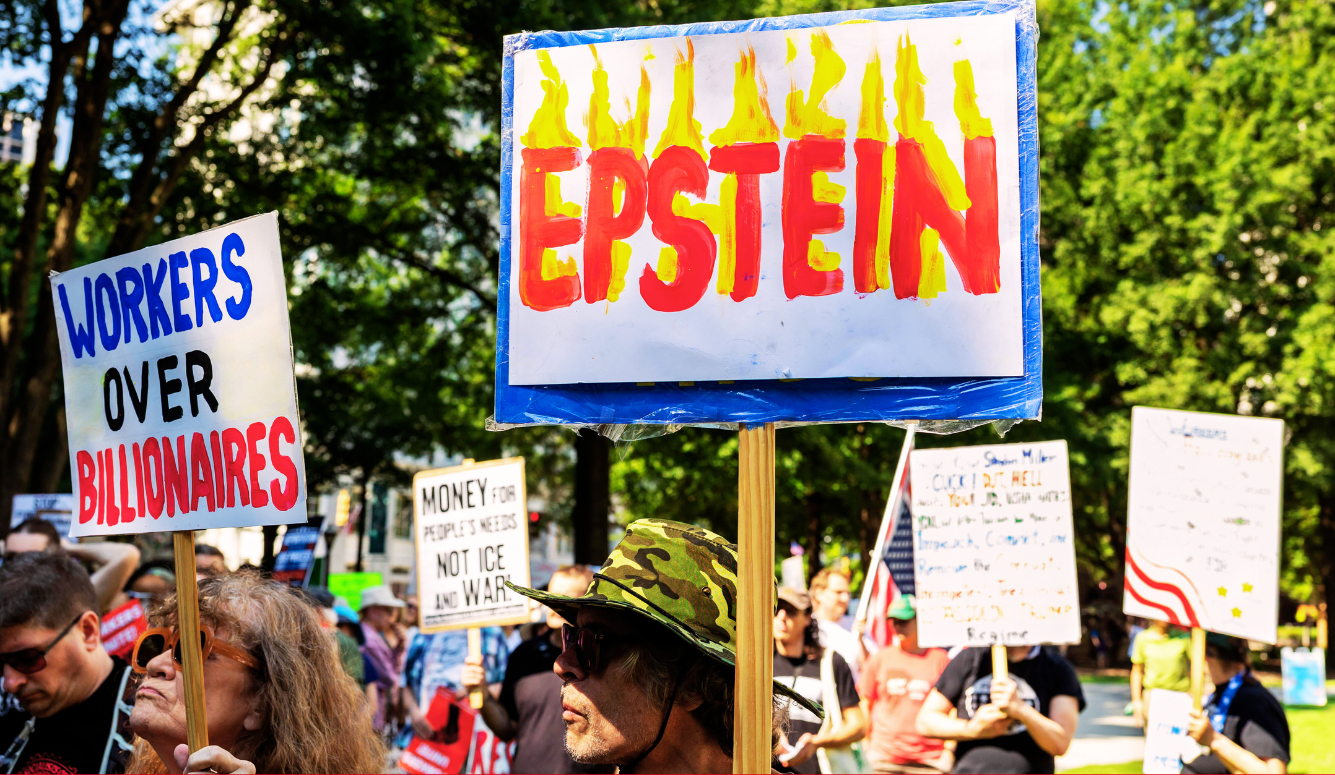

Paedophilia may not be the most serious of crimes—murder is surely more serious—but it is arguably the worst. Child abuse evokes a revulsion that other crimes do not. Having spent half my life in prison, I have had the opportunity to express this revulsion in ways keyboard warriors can only fantasise about. I used to beat nonces. But today, through the transformative power of the obsession with Jeffrey Epstein, a chunk of X has been calling me a “royalist paedo defender.”
Rarely has one name drawn together such a disparate coalition of the mentally fragile and hateful: Jew haters, politician haters, CIA haters, Russian haters, Trump haters, dentist haters, Democrat haters, Mossad haters, and anticapitalists. There is even the occasional reference to aliens. It’s a beautiful nexus of all those who hate, many of whom have found the flimsiest and most tangential reasons to connect their personal objects of animus to the case.
Epstein IS the very essence of the modern world. He IS the Modernity itself, the Enlightenment, the liberalism, the free market economy, Ayn Rand, AI, the Singularity, the Palantir, the Black Rock, Davos, Trilateral, the bioweapon, the harvesting of organs, the Covid.
— Alexander Dugin (@AGDugin) February 16, 2026
In the febrile atmosphere of a prison wing, uncovering sex cases can become a forensic accounting of the evidence—or a blatant witch hunt. A small, enclosed environment where the stakes are genuinely high can distort the social fabric sufficiently to justify the dumbest of claims. People with too little information and too much empty time can foment gross claims with only the most tenuous link to reality. I expect that in information-poor environments in which supposition and rumour fill in the vast gaps in actual knowledge.
But I expect better out here in society, especially in a society that carries the sum of human knowledge in the palm of its hand. There is rarely a compelling need to fill in the gaps with guesswork. We can simply consult Google.
Or not. The response to Epstein has been infinitely more revelatory than any actual information on the case. It has revealed not so much the rotten soul of a child abuser as the genuinely frightening imaginations of those responding to the news, the depths of hatred some can create within themselves based on remarkably little information—or even on none at all. In an instant, a large chunk of the world has decided that Epstein sexually abused prepubescents and bought and sold them to other powerful men, while occasionally pulling their teeth out and murdering them before dissolving the bodies in acid. It’s a fascinating tale, positively Grimm-ian.
As someone works in human rights, I’ve never seen anything like the Epstein files in my 15-year career
— Mohamad Safa (@mhdksafa) February 16, 2026
Raped
Cannibalized
Trafficked
Filmed
Terrorized
Tortured
Murdered
13, 14, 15 year children
ZERO arrests
I don't understand how we're not having a global revolution right now
But, like the tales of the Brothers Grimm, much of what is not only believed but insisted upon in the case of Epstein is pure fantasy. These claims don’t arise from alleged victims, who merely suggest that Epstein enjoyed sex with teens. Instead, they have sprung from the oddest of quarters: usually sane journalists, forensic-minded commentators, national politicians. It’s rare for one person to bring such a broad coalition of the stupid together in public.
BREAKING: 🇺🇸 🇮🇱 Thomas Massie just said what everyone is thinking but no other republican politician has the guts to say.
— ADAM (@AdameMedia) February 16, 2026
“This is the Epstein administration.” pic.twitter.com/Grt1BRYWfg
This raises so many questions. Why are some people so insistent that we are ruled by a class of paedophiles? Because let’s be very clear here: there is no evidence that Epstein had any interest in prepubescents. Yet it is now a cultural truth that Epstein was a paedophile, and anyone who questions that assertion can have only the worst of motives.
The need some have to traduce our whole political class is more understandable. We live in a time where contempt for our political masters is at a high. No one is immune from this cynicism. However, assuming our leaders are all a bit rubbish is a far cry from believing them all to be part of a giant child butchery enterprise.
The evidence supporting all this nonsense is remarkable mostly for its absence. At recent press events, a lot of attention has been given to people described as “survivors,” including Annie Farmer. As journalist Michael Tracey has pointed out: when Farmer testified at Ghislaine Maxwell’s 2021 trial, the judge told the jury that the contact she described did not count as “illegal sexual activity.” The jury was also told not to treat her testimony as proof that a crime had taken place.
FUN FACT: Annie Farmer received $1.5 million for claiming she was a "survivor" of "hand-holding." Literally. When she testified in the Maxwell trial, the judge was compelled to instruct jurors that she hadn't been subjected to any "illegal sexual activity" https://t.co/7TvfW9KhlJ https://t.co/PLVz0vLqC5
— Michael Tracey (@mtracey) February 6, 2026
Tracey has also raised questions about the credibility of another star-witness Virginia Roberts Giuffre, who claimed to have been trafficked to various powerful men, and raped by her own father, her father’s friend, and—most famously—by the lawyer Alan Dershowitz. None of these claims led to criminal charges, and the claim against Dershowitz was formally withdrawn (her claims were later described by her own lawyers as “fictionalised.”) Giuffre had all the time in the world to file a criminal complaint against Andrew Mountbatten-Windsor (the former Prince Andrew) in both America and the UK. She didn’t. Instead, she accepted a financial settlement, all the while declaring it wasn’t about the money.
 Michael Tracey
In any criminal case, shady witnesses are unwelcome. As the foundation on which to create a global conspiracy, these people are risible.
Every piece of information around Epstein is examined and judged through the worst possible lens. A rich man on an island has a dentist’s chair? Must be for pulling children’s teeth out (rather than for his own convenience in receiving dental treatment). Question that and you are now suspect. A man buys acid? Must be for dissolving the bodies of murdered children (rather than for use in his desalination plant).
These conspiracies are fuelled by others in their turn. There are those who believe in satanic rituals and think that “pizza” is a code word. Allowing conspiracy theorists access to the files has been a disaster, as they see only what they want to see.
The word "Pizza" is used over 900 times in Epstein's various emails.
— Jay Anderson (@TheProjectUnity) February 1, 2026
DO YOU UNDERSTAND? pic.twitter.com/Om9SGyBKlJ
This is exemplified by the calumny heaped upon both Andrew and the whole Royal Family. We know that Andrew met Giuffre. We know she sued him. We know there was a settlement. Some have seen the settlement as a sign of guilt but, as any lawyer will tell you, settlements are made every day for all kinds of reasons. We don’t even know that Andrew wanted to settle—perhaps he did so at the Queen’s behest. Given that this took place in her Jubilee year, she may have been especially keen to put an end to the story.
Andrew had nothing to gain from a settlement. It did not silence Giuffre, as her allegations were a matter of public record. Andrew’s reputation was shattered as a result of those allegations alone. I’m more inclined to think the Queen made a massive error in an online world she didn’t fully grasp—a world in which no story ever completely goes away. It is only by attributing evil motives to Andrew that any of this can be portrayed as part of a wicked plot.
No part of this entire saga encapsulates the bad-faith involved more clearly than the phrase “in the Epstein Files.” Epstein was an extremely rich and very sociable man. His contacts were broad. And yet the world is working on the assumption that having been in contact with Epstein itself implies culpability—though of what, no one seems sure. But clearly, the reasoning goes, such people probably did something bad. We need to fire them, hound them, prosecute them—for something, for anything.
As a cynic, I tend to assume that where there’s a fortune, there’s a crime. The wealthy often play fast and loose with the law. Having good lawyers and accountants helps. I wouldn’t be shocked if the arrests based on financial wrongdoing were on point. But the existence of a global child-abusing elite is one of those extraordinary claims that requires extraordinary evidence—or, indeed, any evidence at all.
Some of this rests on the idea that if you are friendly to a sex criminal then you must support and defend their crimes. As an ex-con (although I wasn’t convicted for a sex crime), I find this fascinating. Is merely knowing me an endorsement of my crime? If you are in my contacts list, do you support murder? This makes little sense. But we have an especially visceral reaction to sex crimes. Nothing less than utter condemnation is sufficient to signal our disgust. I take a contrary view. When you’ve spent half your life amongst those who have committed the most serious crimes, as I have, you soon realise that the crime is the least important part of a person. The wider world does not operate on this basis. That said, I don’t know anybody who has refused to deal with me on the basis of my crime.
We are in a panic. People are being hounded merely because they knew someone who knew someone. To resist this tidal wave of conspiratorial certainty is to go against the zeitgeist. And that is an uncomfortable prospect. But it is better than outsourcing justice to a howling mob. Much as I despair at the current state of the criminal justice system, it has one often overlooked benefit—it saves us from our own worst instincts.
Quillette invites thoughtful responses to its essays.
Selected responses are published once per week as part of a curated Letters to the Editor feature. If selected, letters appear under the contributor’s real name and may be edited for clarity and length.
To submit a letter for consideration, please email [email protected].
Keep reading
Foreign Power, Local Politics

Podcast #333: The Search for Truth

A Costly Misconception

Addressing the Academic Skew

Letters to the Editor