Academic Free Speech
Mobbed on Campus, Vindicated in Court
Four years after the University of Washington began investigating Stuart Reges for authoring a satirical ‘land acknowledgement,’ his First Amendment rights have been upheld by the Ninth Circuit.

Four years ago, I explained to Quillette readers why I am “Against Land Acknowledgements.” As most will know, these are sombre declarations testifying to the historical existence of Indigenous tribes that were once situated in this or that geographical region (and, in some cases, that may still have an ongoing demographic presence). Such statements have become fashionable in North America and Australasia, particularly among progressive-minded academics and local politicians.
At the University of Washington (UW), where I teach computer programming, we have a standardised version that runs as follows: “The University of Washington acknowledges the Coast Salish peoples of this land, the land which touches the shared waters of all tribes and bands within the Suquamish, Tulalip, and Muckleshoot nations.”
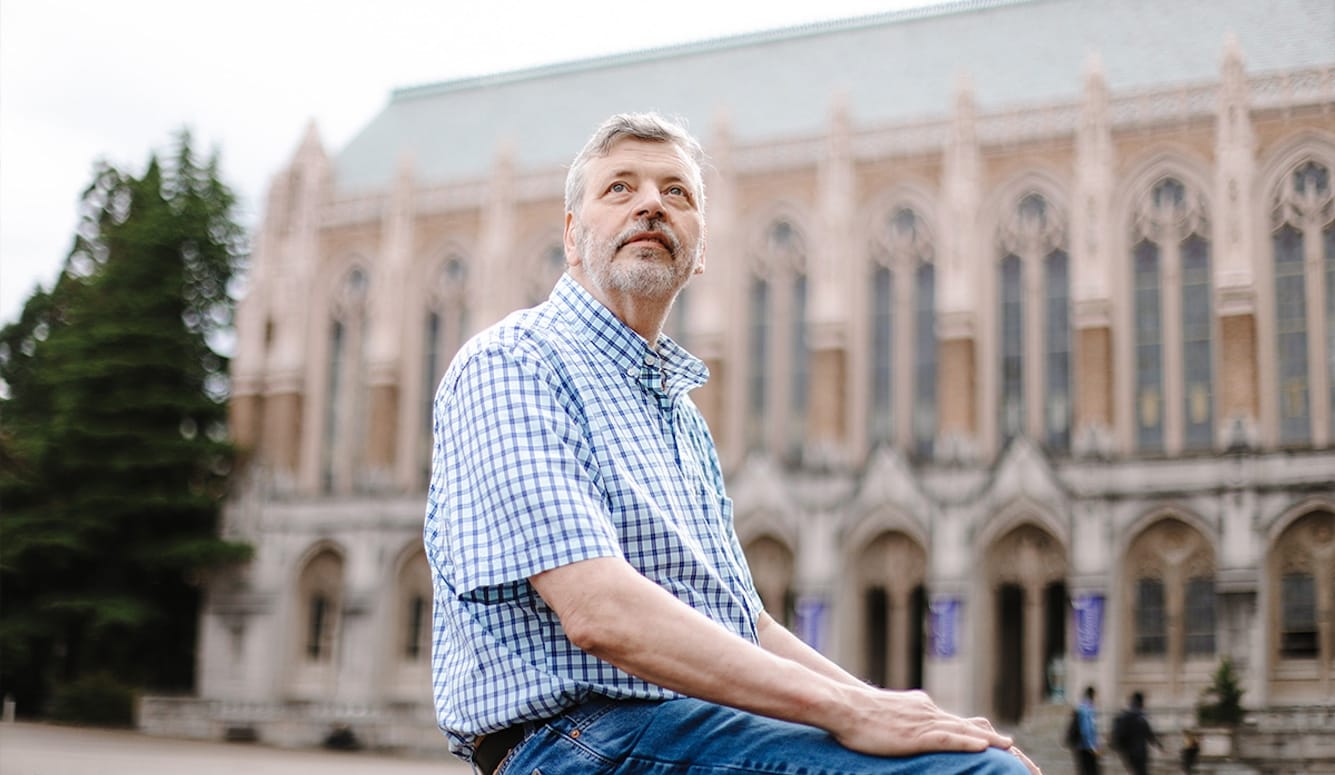
 Stuart Reges
According to explanatory text on the university’s web site, it took “several years” to craft this 31-word land acknowledgement—as input (apparently) had to be solicited from “tribal elders, elected tribal leaders, attendees of the annual UW Tribal Leadership Summit, the Affiliated Tribes of Northwest Indians, UW Native American Advisory Board and others across our community.”
The Office of Minority Affairs and Diversity notes that this model land acknowledgement should be “spoken by UW leadership”—which is to say, senior administrators—“during events to acknowledge that our campus sits on occupied land.”
But in 2019, things went further. The Paul G. Allen School of Computer Science and Engineering at UW, where I work, revised its Best Practices for Inclusive Teaching to recommend that all instructors add an Indigenous land acknowledgement to their course syllabi. The above-cited standardised UW land acknowledgement (which had been adopted four years earlier) was offered as an example to be followed. This was not a formal “prescription,” we were assured, but just an “idea” that would help us be “more effective teacher[s] and better role model[s].”
As I saw it—and still see it—land acknowledgments are a form of political speech, aimed (at least implicitly) at advancing the idea that a debt of some kind is owed to Indigenous groups. The word “occupied,” in particular, suggests that the presence of UW, its staff, and its students in this part of the world is morally illegitimate.
People are free to hold pro-Indigenous political views. But expressing them with ‘inclusive’ spoken-word rituals doesn’t change their political character—even if the claimed goal is to improve pedagogical ‘effectiveness.’
The use of such language also suggests that we all have some (ill-defined) duty to restore the land to (by the university’s description) “the original caretakers”; or at least channel the beliefs of Indigenous constituencies in making day-to-day land-use decisions.
People are, of course, free to hold such political views. But embedding them in “inclusive” spoken-word rituals doesn’t erase their political character—notwithstanding the disingenuous conceit that the objective is merely to improve our pedagogical “effectiveness.”
Toronto citizen recites Taxpayer Land Acknowledgment at City Hall 🤔 pic.twitter.com/eKDHBVt5Dq
— IntegrityTO (@integrity_to) January 21, 2026
Like others, I decided to strike a blow against such policies through satire—specifically, by including a parody version of a land acknowledgement on my course syllabus in January 2022. Instead of using the university’s version, I wrote:
I acknowledge that by the labor theory of property, the Coast Salish people can claim historical ownership of almost none of the land currently occupied by the University of Washington.
The “labor theory of property” originates with seventeenth-century English philosopher John Locke. In Two Treatises of Government, he argues that when one’s labour is mixed with shared land, the land loses its public character, because people own the products of their work. Or as Locke originally put it: “Whatsoever then he removes out of the state that nature hath provided, and left it in, he hath mixed his labour with, and joined to it something that is his own, and thereby makes it his property.”
For example, the land on which downtown Seattle sits was once an Indigenous village—which gives the tribes in question a claim of ownership according to this theory. But UW’s main campus was carved out of dense forest, and therefore would not qualify.
My land acknowledgement quickly became a hot topic within UW’s reddit community, with many social-justice-minded students expressing outrage. UW officials pronounced themselves “horrified,” censored my syllabus, and offered my students an alternate course section if they wanted a different instructor. The university then began an investigation, which could have led to the termination of my employment.
With the support of the Foundation for Individual Rights and Expression (FIRE), I filed a lawsuit in July 2022, arguing that these actions constituted a violation of my First Amendment rights. I also argued that the university was engaged in retaliation and viewpoint discrimination; that I was owed monetary compensation for the harm done to me; and that the university’s “Nondiscrimination and Affirmative Action” policy, known as Executive Order 31, was facially over-broad and unconstitutionally vague. (EO-31, which purported to “promot[e] an environment that is free of discrimination, harassment, and retaliation,” stipulated that UW could discipline “any conduct that is deemed unacceptable or inappropriate, regardless of whether the conduct rises to the level of unlawful discrimination, harassment, or retaliation” (my emphasis).
VICTORY! The U.S. Court of Appeals for the Ninth Circuit today delivered a decisive victory for the First Amendment rights of public university faculty in Reges v. Cauce. Reversing a federal district court’s opinion, the Ninth Circuit held University of Washington officials… pic.twitter.com/CYPCEsFKOU
— FIRE (@TheFIREorg) December 19, 2025
We lost at the district-court level. But in a split decision filed on 19 December, a three-judge panel of the Court of Appeals for the Ninth Circuit reversed the lower-court judgment. Circuit Judge Daniel Aaron Bress wrote:
A public university investigated, reprimanded, and threatened to discipline a professor for contentious statements he made in a class syllabus. The statements, which mocked the university’s model syllabus statement on an issue of public concern, caused offense in the university community. Yet debate and disagreement are hallmarks of higher education. Student discomfort with a professor’s views can prompt discussion and disapproval. But this discomfort is not grounds for the university retaliating against the professor. We hold that the university’s actions toward the professor violated his First Amendment rights. We reverse and remand for further proceedings.
Many people have asked me how I feel now that I’ve been vindicated. The obvious answer is that I am quite pleased. And I recommend that anyone interested in the issues I’ve raised read the entire decision (or the shorter summary of the case that I’ve posted online, along with an excerpt from the judgment). Of particular note, Judge Bress (who was joined by Judge Milan D. Smith) noted that
Keep reading

Doomscrolling into Adulthood

Podcast #331: The Ayatollahs’ Assassins
The Disgrace of Tariq Ramadan
Apocalypse ’92