biology
Survival of the Fitting
How a set of unglamorous enzymes quietly solved biology’s biggest problem: how to create and uphold a set of rules that make meaning from molecules.
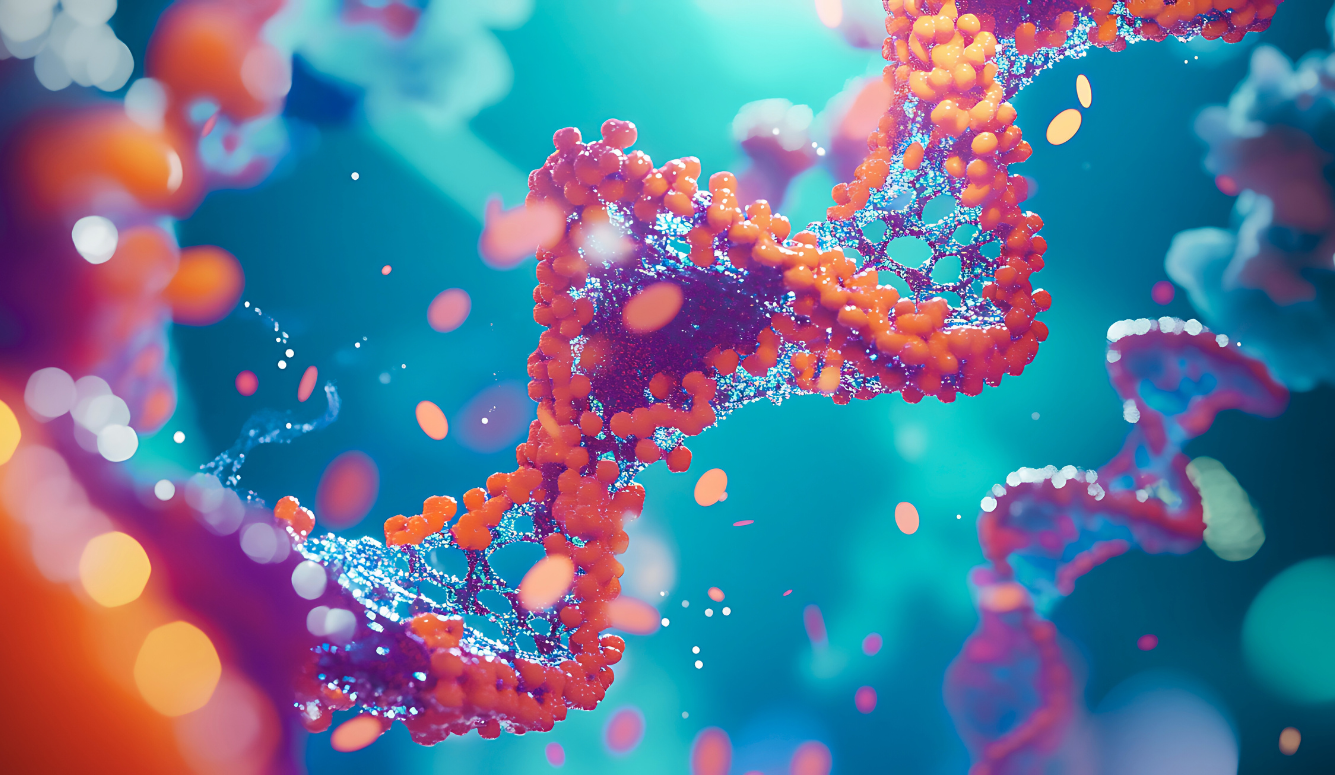

If you went searching for the origins of meaning, you would probably start with brains, languages, and culture. You would not start with twenty enzymes whose name looks like the result of a keyboard being sat on. Aminoacyl-tRNA synthetases—aaRSs, whose acronym is almost as unwieldy as their name—are widely regarded as the least glamorous molecules in biology. Students meet them once in a lecture and immediately move on with their lives.
Yet tucked into their protein folds is one of the deepest stories in biology. Long before organisms competed, before genomes condensed into chromosomes, this small community of molecules learned to coordinate. They did not evolve muscles or membranes. They evolved something stranger: a way of agreeing what patterns should mean.
Textbooks invite you to think of the genetic code as a neat chart—“AUG” means methionine, “UUU” means phenylalanine—as though the mapping were imprinted into the structure of matter. But a codon is simply a sequence of three nucleotides, a pattern. Nothing inherent in “AUG” connects it to methionine. On a comet or in a prebiotic pond, a triplet of bases has no meaning at all.
Meaning for codons appears only inside a working translation system, in which some entities reliably enforce patterns. In cells, those entities are aaRSs. An aaRS is the physical bridge that bonds a specific amino acid to its matching transfer RNA (tRNA). They do not think, but each of them enacts a rule. Together, they stabilise a correlation that matters. If DNA is a script, aaRSs are the actors.
In 1990, Gilbert Eriani and colleagues examined aaRSs and found a startling divide. The set of enzymes fall into two unrelated lineages—Class I and Class II—that grip tRNAs from opposite sides, attach amino acids to different atoms on the same sugar, and fold into utterly distinct structures.
Standard evolutionary logic says this should not exist. If two technologies solve the same problem, one typically becomes dominant and the other fades. Natural selection seldom preserves incompatible solutions and forces every descendant to maintain both.
Yet all life uses both classes of aaRSs. Both are essential. Neither can be lost. Why would the most delicate function in biology—the interpretation of the genetic code—be conducted by two incompatible toolkits, both locked into the very code they help interpret?
 Jack Lohmann
To answer that, we need to rewind to a world before genomes, when life was more like a chemical storm: RNA fragments, short peptides, crude catalysts. The chief danger was not competition but noise. If early translation mismatched amino acids too often, proteins would misfold, including those meant to enforce the rules. The system would quickly cross the “error threshold,” beyond which information cannot survive.
Over the last few decades, Charles Carter, Peter Wills, and colleagues have been carving modern aaRSs down to minimalist “urzymes”—tiny fragments retaining surprising activity. These skeletal enzymes can still activate amino acids and recognise tRNA-like molecules. Even more suggestively, short peptides encoded by opposite strands of the same proto-gene can produce Class I-like and Class II-like urzymes biased toward different amino acids: one toward bulky hydrophobics, the other toward smaller or polar ones.
Thus, a single piece of primordial genetic material could, in principle, yield two complementary translators. Each alone would be error-prone; together, they would reduce catastrophic mix-ups.
This suggests a new picture. No single molecule fixed codon meanings. A crude community—two mutually reinforcing proto-aaRS systems—collectively stabilised a mapping. As this configuration became more reliable, its products gradually refined the translation rules. Eventually, the translators were encoded in the very language they maintained, completing a self-referential loop.
In such a system, natural selection acts not on individual molecules but on the relationships among them. A mutation that speeds up one urzyme but increases amino-acid confusion could destabilise the whole network, pushing it toward the error cliff. A mutation that slows an urzyme but sharpens the communal mapping could strengthen the system.
What persists is not a particular protein sequence but a particular arrangement—a rule-set governing which amino acids correspond to which codons and with what level of accuracy. Any aaRS variant consistent with that arrangement is tolerated; others cannot be coherently expressed in the first place.
This arrangement is what I call the first society. Each enzyme performs a local, oblivious task. None “knows” the code. But together they uphold a rule-set none could sustain alone. The object of selection is the agreement itself—and, in modern cells, each component persists only by continued adherence to that agreement.
Biologists often resist social metaphors for molecules, wary of anthropomorphism. But “society” here means something minimal: a set of agents whose behaviours are constrained by shared rules, such that violating those rules destroys the group that sustains the agents.
Humans express this through laws, bees through pheromones, and microbial consortia through metabolic coupling. The aaRS system meets the same criterion. Its rules are not written in a constitution; they are enforced by the cost of mistranslation. Its members are not conscious; they are bound by chemistry and selection. But the essential feature remains: no enzyme can unilaterally change what a codon “means” without collapsing the system that makes that enzyme possible.
What is being preserved is not any one molecule but a historically created rule-set that shapes and constrains its participants. That is exactly what we call an institution. The genetic code, in this sense, is life’s oldest institution: a pattern of meaning stabilised by the catastrophic cost of altering it, renewed continuously by its practitioners, and obeyed even by its legislators.
Semioticians avoid defining meaning as a private feeling. Instead, they point to a triad: a sign, an object, and an interpreter. Meaning arises when a system reliably uses a sign to act with respect to something.
By that definition, a codon “means” an amino acid only when an interpreter treats it as such. In cells, the interpreter is the translation apparatus: tRNAs carrying patterns, ribosomes reading them, aaRSs attaching the correct amino acids. Thus, AUG functions as a “sign” of methionine because the system behaves accordingly.
While aaRSs do not understand, they do interpret in this minimal sense. They treat patterns as instructions. And because the blueprints for the interpreters are written in the same language, each act of interpretation is simultaneously an act of self-maintenance. Meaning enters the universe not with brains but with the first stable act of taking-as.
Viewed this way, the conservatism of the genetic code looks less like a frozen accident and more like the practice of a very old law. Mutations can rewrite anatomy, metabolism, behaviour, even ecosystems. But alter the code itself—change which codons signify which amino acids—and every protein is threatened, including those needed to apply the new rule. Translation seizes up. The institutional fabric tears.
That is why nearly all life uses essentially the same code. It is not universal by necessity but by entanglement. Once a communal agreement hardened enough to support complex translators and genomes, the cost of revising it skyrocketed: any attempted revolution would have to be carried out by tools built on the old order.
The exceptions prove the rule. In mitochondria and a few microbial lineages, codons have been reassigned, but always locally and cautiously. These are dialects, not revolutions. Even they must consolidate quickly or risk error catastrophe.
The genetic code is not a table. It is a law upheld by a molecular society that has renewed it for nearly four billion years—even as the law rebuilds the very enzymes that uphold it.
You and I are not merely members of human societies. We are the emergent consequences of a social order invented by molecules long before organisms existed.
Every thought you have depends on proteins that exist only because a tiny molecular community continues to honour its pact about the meaning of patterns. When those enzymes falter—when errors rise and misfolded proteins accumulate—we not only age but we also lose coherence. The continuity of meaning unravels from within.
The first society was molecular. It assembled a language before there were mouths and stabilised meaning before there were nervous systems. It discovered that survival’s deepest form was not solitary competition but shared interpretation.
That society is still at work in every cell of your body, carrying forward the oldest institution on Earth. The only reason these words make sense as you read them is that, somewhere deep inside you, an ancient agreement about what patterns mean is still actively being kept. Meaning, it seems, did not arrive late as a human speciality. It was the first thing life learned to make.
Keep reading
Trump, Tehran, and the China Calculus
Parallel Kingdom

Meanwhile, in Sudan

The Australian Way of Life
What Makes the West Western?
The State of Grace