Skip to content

Anthropology

The Sexual Paradise That Never Was

How Margaret Mead’s romanticised account of Samoan life became the founding myth of cultural determinism—and why it endures despite having been thoroughly debunked.
· 19 min read
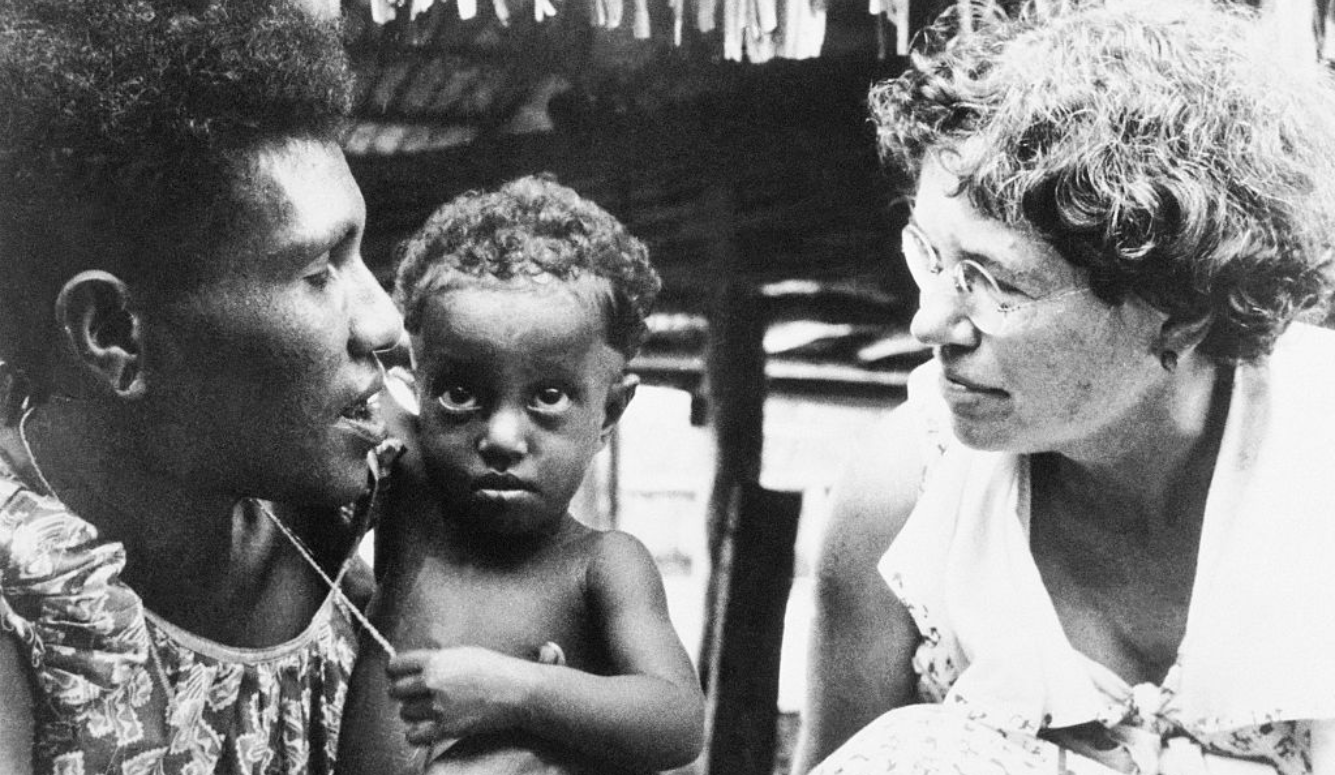
Margaret Mead, a white woman with short hair and glasses, speaks to a dark-skinned mother and child.
Anthropologist Margaret Mead with a Manus mother and child in 1953 during a visit to the Admiralty Islands. Getty

Exactly 100 years ago, in the southern hemisphere summer of 1925–26, a pioneering anthropological project was underway in the Pacific islands of Samoa. Margaret Mead, a 23-year-old graduate student fresh from New York, had begun fieldwork among a society whose culture and behaviour contrasted sharply with those of the United States. Her findings would inform one of the most influential—and most misguided—books of the twentieth century: Coming of Age in Samoa. An international bestseller, Mead’s vivid account of non-Western life and sexuality helped shape modern ideas about human nature, cementing the widespread belief that human behaviour is overwhelmingly determined by environment—by nurture and not nature.

Fifteen years later, in 1940, another young anthropologist arrived in Samoa—also destined for the history books, though this time as a challenger to Mead’s idyllic portrayal of a Pacific paradise. New Zealand-born Derek Freeman was initially convinced by Mead’s claim that culture trumped biology, but his own fieldwork gradually turned him into her fiercest critic. The ensuing Mead–Freeman controversy has become one of the most famous episodes in the seemingly never-ending nature-nurture debate.


Coming of Age in Samoa is an exuberant read. Take Mead’s account of “A Day in Samoa,” which starts at first light:

As the dawn begins to fall among the soft brown roofs and the slender palm trees stand out against a colourless, gleaming sea, lovers slip home from trysts beneath the palm trees or in the shadow of beached canoes, that the light may find each sleeper in his appointed place.

As the day progresses:

Girls stop to giggle over some young ne’er-do-well who escaped during the night from an angry father’s pursuit and to venture a shrewd guess that the daughter knew more about his presence than she told. The boy who is taunted by another, who has succeeded him in his sweetheart’s favour, grapples with his rival, his foot slipping in the wet sand.

And as evening draws in:

Half the village may go fishing by torchlight, and the curving reef will gleam with wavering lights and echo with shouts of triumph or disappointment, teasing words or cries of outraged modesty. Or a group of youths may dance for the pleasure of some visiting maiden. … Sometimes sleep will not descend upon the village until long past midnight; then at last [there is only] the whisper of lovers, as the village rests until dawn.

It is easy to see how Coming of Age in Samoa captivated readers in the industrial West. Such a vision of the “natural” human condition was not, of course, entirely new: it echoed Marx and Engels’ notion of egalitarian “primitive communism” and Rousseau’s romantic ideal of the “noble savage,” uncorrupted by civilisation. What set Mead apart, however, was her claim to have found scientific proof that such a way of life not only could exist but, in Samoa, actually did.

The scientific rationale for Mead’s research is laid out in the book’s introduction. Her focus was adolescence—the period in which, according to prevailing theory, “idealism flowered and rebellion against authority waxed strong … [and] difficulties and conflicts were absolutely inevitable.” She wished to test whether the troubled developmental stage was truly universal and whether the “conflict and distress” observed among teenagers in America was indeed inescapable. Since laboratory-based human experiments were impossible, Mead decided instead to conduct field-based observations “of human beings under different cultural conditions in some other part of the world,” ideally among one of the “primitive groups who have had thousands of years of historical development along completely different lines from our own.” She chose the Polynesian people of the Pacific Islands and “to concentrate upon the adolescent girl in Samoa.”

Mead spent just under nine months in Samoa. Although she had initially assumed she would need at least a year to learn Samoan properly, she spent only eight weeks studying the language on the main island of Tutuila before travelling to the outlying Manu‘a group to conduct her fieldwork. Basing herself at a medical dispensary run by the only Americans on the island of Ta‘ū, Mead “used her room at the back to meet with Samoan girls individually and in small groups as it … opened onto a village.” Preferring “the casual give-and-take of unstructured conversations” with the girls “away from their homes and peer groups,” she aimed to capture the everyday dynamics of adolescence in ways that formal interviews or public settings would not allow. This approach provided the rich detail central to her depiction of Samoan life in Coming of Age in Samoa.


Yet despite the untroubled tone of Coming of Age, this research period was anything but easy. Before journeying to Samoa, Mead had never been outside the United States—nor even stayed alone overnight in a hotel—and she found herself lonely, homesick, and frequently frustrated or embarrassed by the unfamiliar cultural practices and etiquette. Her health suffered too: neuritis in her arms, menstrual cramps, and numerous infections plagued her. Then, just seven weeks after her arrival on Ta’ū, a major typhoon struck, destroying homes and crops and disrupting normal routines as villagers focused on rebuilding.

On top of these physical and emotional strains, Mead also felt the weight of expectation, especially from her mentor Franz Boas, the influential “father of modern anthropology.” Mead was only the second American woman to conduct ethnography fieldwork overseas. If she failed, it might reflect badly not only on her but on “Papa Franz” and on the reputation of women anthropologists in general.

Then there were the significant methodological challenges she faced. Mead had received no formal training in fieldwork techniques nor were there established guidelines for the novel research she was doing. Mead therefore had to devise much of her methodology as she went along—for example, compensating for her short stay through a “cross-sectional approach” that compared girls of different ages instead of tracking individuals over time.

In spite of these difficulties, Mead had managed to interview and observe 68 girls from three villages on Ta‘ū by the time she completed her fieldwork in mid-April 1926. Although funding was available to  extend her stay, she had already been offered a curatorship role at the American Museum of Natural History—an opportunity too good to refuse. She left Samoa the following month.

Over the next few years, Mead produced three major works on her Pacific research. Her two technical academic pieces, however—The Adolescent Girl in Samoa (1927), a ground-breaking ethnographic study of adolescence; and Social Organization of Manu‘a (1930), a detailed monograph on kinship and political structures—were completely overshadowed by the runaway commercial success of Coming of Age in Samoa (1928). Published in the same year as Lady Chatterley’s Lover, D.H. Lawrence’s scandalously explicit novel of sex and infidelity, according to Sam Dresser, Mead’s account of uninhibited Samoan sexuality “caught the tide of changing sexual mores” in the industrialised West. Indeed, Mead’s public image and fame drew on her own unconventional openness about sex, her multiple marriages, and her relationships with both men and women. Yet while it was sex that initially drew readers to the book, its most significant arguments concerned cultural conditioning and human malleability.


The most immediate impact of Coming of Age in Samoa was that it bolstered Franz Boas’s belief in the primacy of culture over biology in influencing human behaviour. He argues in the foreword to the Mead’s book that her Pacific island evidence demonstrates “that much of what we ascribe to human nature is no more than a reaction to the restraints put upon us by our civilisation.” In this way, Mead’s work fed directly into the foundations of modern anthropology—and even though her dated approach (for example, her references to “primitive” peoples) might jar with today’s ‘decolonising’ mindset, the core focus on cultural determinism remains central to the discipline. 

But Coming of Age in Samoa also had an important influence outside academia. Mead aimed the book at American educators, social workers, and parents, using Samoan evidence to argue that supposedly fixed behaviours were really the product of culture. The “storm and stress” of adolescence, she claimed, was neither universal nor inevitable. Rejecting the detached tone of a scientist, she instead offered subjective guidance on avoiding the “turbulent manifestations” of growing up, urging her audience to use Samoan society as a mirror to “judge anew and perhaps fashion differently the education we give our children.” 

The implications of these claims went far beyond the classroom. If adolescence could be reshaped, then why not society itself? “[N]either race nor common humanity,” she writes, “can be held responsible for many of the forms which even such basic human emotions as love and fear and anger take under different social conditions.” This point is reinforced in a subsequent work on other ‘primitive’ peoples in New Guinea:

We are forced to conclude that human nature is almost unbelievably malleable … [and that] the differences between individuals . . . are almost entirely to be laid to differences in conditioning, especially during early childhood, and the form of this conditioning is culturally determined.

It is easy to see why the idea of a malleable human nature appealed to social reformers of the time—especially when the newly-formed Soviet Union seemed to promise a better society and new human nature. Mead, as Matt Ridley argues, had provided “definitive proof of the perfectibility of man.” If human behaviour was shaped by culture rather than biology, then social phenomena such as racism, sexism, and economic inequality were not natural facts of life. If human beings were malleable—perhaps even perfectible—such injustices could be remedied through public policy, social engineering, or revolutionary change. 


Mead’s ideas also chimed with emerging psychological and sociological theories that championed nurture over nature. Her focus on cultural conditioning aligned with the behaviourism of J.B. Watson and the social psychology of Erich Fromm—a close friend—who emphasised the crucial role of the cultural environment in shaping identity. Philosopher Bertrand Russell, an outspoken advocate of sexual freedom, also admired Mead’s work, citing her Samoan findings in his controversial Marriage and Morals, published a year after Coming of Age in Samoa. Mead’s influence was also felt strongly in feminist theory, since the evidence from Samoa seemed to demonstrate that gender roles were far from fixed: Betty Friedan devotes a chapter to Mead’s ideas in The Feminine Mystique (1963), a popular bestseller often credited with sparking the “second wave” of feminism. Tellingly, at the height of the free-love 1960s—nearly three decades after it first came out—Coming of Age in Samoa still sold over 100,000 copies.

The lively and accessible book turned Mead into a public figure. Her regular appearance in newspapers, on radio, and later on television made her one of the most recognisable intellectuals of the twentieth century. As a result, her ideas influenced popular discussions of adolescence, education, and personality, and her core belief—that behaviour is shaped above all by culture—bolstered faith in the possibility of social reform and seeped deeply into public consciousness. Her influence was acknowledged even by her critics: one conservative research institute ranks Coming of Age in Samoa first on its list of most socially pernicious books. As evolutionary biologist Robert Wright—himself a champion of the idea that there are many evolved constraints on human behaviour—puts it, “[i]t is hard to exaggerate the influence of Mead’s findings on twentieth-century thought.”

American anthropologist Margaret Mead with a tribal mask at the American Museum of Natural History, New York, 1930. Getty

Within anthropology itself—where Mead was often regarded more as a gifted populariser than a rigorous scholar—her empirical evidence for the primacy of culture was tacitly accepted rather than critically examined, Robert Strikwerda has argued. Thus more than half a century passed before her claims were directly and publicly challenged.

Derek Freeman was at first taken in by Coming of Age in Samoa’s beguiling effects. As a student in the 1930s, he fell under the book’s spell and, in 1940, eagerly seized the chance to conduct fieldwork in the islands. Like Mead, he was 23 when he arrived. Unlike his American predecessor, Freeman spent three years living in Samoa, mastering the language and culture, and even earning a chiefly title that showed his acceptance into village life. Yet although he began as “very much a cultural determinist,” his “credence in Mead’s findings complete,” his field experience gradually led him to question both Mead’s depiction of Samoan society and the broader culture-first assumptions of Boasian anthropology. His time in Samoa, however, was interrupted by military service towards the end of WW2, and he did not return until the mid-1960s. By this point he was an established anthropologist, with well-received ethnographic fieldwork in Sarawak, on the island of Borneo, under his belt.

In Borneo, Freeman had experienced both a mental breakdown and an intellectual epiphany, becoming convinced that Mead’s work had misled anthropology both by misrepresenting Samoa and by exaggerating the role of culture at the expense of biology. In 1964, he met Mead at a conference at the Australian National University and raised his concerns; both agreed to correspond further. By the next year, Freeman was back in Samoa carrying out research that only reinforced his conviction that Mead’s conclusions were flawed. He also suffered another mental breakdown during this time.

Nearly two decades passed—and Mead had died—before Freeman published his critique in 1983. Margaret Mead and Samoa: The Making and Unmaking of an Anthropological Myth was based, he writes in the foreword, “on observations that have extended, on and off, over some forty years, including six years spent in Samoa and even longer in the research libraries of Australia, New Zealand, England, and the United States.” He further underscores this contrast with Mead’s fleeting visit by emphasising that his investigations encompassed everything from direct testimony by Samoans—including some who had known Mead personally—to evidence from missionary, colonial, and police archives. He had also surveyed the history of anthropology and biology, focusing on the early twentieth century’s “frenetic nature–nurture controversy”—the intellectual foundation of Mead’s ideas.

At the centre of Freeman’s critique was Mead’s claim that Samoa provides a “negative instance”—a single example that appears to contradict a general rule or theory—of the supposed universality of adolescent turmoil. If even one society could be shown where adolescence was calm and conflict-free, Mead argued, this would demonstrate that teenage “storm and stress” was shaped by culture rather than biology. For Freeman, this was the logical cornerstone of her argument: if her portrayal of Samoan life was inaccurate, then her broader conclusions could not stand. Here he turned to philosopher Karl Popper (to whom his book is dedicated) and the concept of scientific falsification—testing theories against evidence in an attempt to disprove them. With this principle in mind, Freeman set out to assess Mead’s theory against the extensive evidence he had gathered.

This task occupies the bulk of Margaret Mead and Samoa. Across ten chapters—ranging well beyond “Adolescence” and “Childrearing” to include “Rank,” “Punishment,” “Cooperation and Competition,” “Aggressive Behaviour and Warfare,” “Religion: Pagan and Christian,” and “Sexual Mores and Behavior”—Freeman demonstrates that Mead’s depiction of Samoa was false. The breadth of his survey was deliberate: in his view, Mead had not merely misunderstood Samoan adolescence but had misrepresented the character of Samoan society as a whole.

According to Freeman, Mead had been obliged to portray wider Samoan life as free from conflict and tension in order to explain the “perfect adjustment” she claimed to observe in almost all of her adolescent informants. He quotes extensively from Coming of Age in Samoa to illustrate how Mead consciously constructed this image of a harmonious, easy-going society. “[T]he general casualness of the whole society”, Mead had declared, “makes growing up so easy”:

For Samoa is a place where no one plays for very high stakes, no one pays very heavy prices, no one suffers for his convictions, or fights to the death for special ends. Disagreements between parents and child are settled by the child’s moving across the street, between a man and his village by the man’s removal to the next village, between a husband and his wife’s seducer by a few fine mats. … No one is hurried along in life or punished harshly for slowness of development. Instead the gifted, the precocious, are held back, until the slowest among them have caught the pace. 

While this near-idyllic portrayal would have appealed strongly to Mead’s Western audience, it could not, in Freeman’s judgment, withstand empirical scrutiny. The evidence pointed firmly in the opposite direction: rigid social hierarchies, strict demands for deference and obedience, fierce competition for status, harsh punishments for children and the like were all abundantly evident in Samoan society.

rigid social hierarchies, strict demands for deference and obedience, fierce competition for status, harsh punishments for children and the like were all abundantly evident in Samoan society

Take aggression, for example. Freeman contrasts Mead’s depiction of the Samoans as “one of the most amiable, least contentious, and most peaceful peoples in the world” with what he calls “the rivalrous aggression that is so characteristic of Samoan society”—which included the fact that “adolescent girls are prone to rivalrous aggression, just as are adolescent boys.” He further points to the extensive recorded history of violence in the islands, noting that “the reputation of the Samoans as an unusually bellicose people” could be traced back to early European contact in the 18th century; by the mid-19th century, they were even described as “perhaps the most ferocious people to be met with in the South Seas.” In Freeman’s view, Mead had simply ignored the lengthy historical record—from explorers, missionaries, and other visitors—because it was at odds with the image she presented. 

Freeman stressed that his aim was not to disparage the Samoans but to counter what he saw as Mead’s romanticised portrait. As he explains:

I have necessarily had to discuss in some detail the darker side of Samoan life, which … [Mead] so ignored as to turn the complexly human Samoans into characterless nonentities. The Samoans … do indeed have a dark side to their lives, but this, I would emphasize, is something they share with all human societies. And, as with all human societies, they also have their shining virtues.

Turning to sexuality, Freeman contrasts Mead’s evocative vision of a free and permissive attitude to sex with extensive evidence to the contrary. In Mead’s telling, the Samoans, having “no conviction of sin,” had “the sunniest and easiest attitudes towards sex.” They regarded lovemaking as “the pastime par excellence … based on the general assumption that sex is play, permissible in all hetero- and homosexual expression, with any sort of variation as an artistic addition.” Romantic love does not occur in Samoa, she further claimed, while many of the emotions that “have afflicted mankind” had been eliminated—“perhaps jealousy most importantly of all.” The islanders’ relaxed attitude towards sex meant that “frigidity and psychic impotence do not occur.” Instead, the “exceptionally smooth sex adjustment of adult Samoans [was] preceded … by a period of free lovemaking and promiscuity before marriage by adolescents.”

Freeman provides a darker—but, he insists, more accurate—picture of Samoan sexual behaviour, replete with numerous anecdotal and recorded accounts of sexual repression, jealousy, and violence. Rape provides one of his starkest contrasts. Mead writes that “the idea of forceful rape or of any sexual act to which both participants do not give themselves freely is completely foreign to the Samoan mind.” According to Freeman, however, “[Mead’s] assertions are, once again, wholly misleading, for in fact the incidence of rape in Samoa, both surreptitious and forceful, is among the highest to be found anywhere in the world.” 

In Mead’s romanticised account of sexuality, Freeman saw not only a distortion of Samoan life but a reflection of the intellectual climate of the late 1920s. Coming of Age in Samoa, he suggests, appeared “at a time of sexual revolution [that] fitted in with and confirmed radical ideas of sexual freedom and promiscuity”—ideas bolstered by travellers’ tales from Soviet Russia, which was said to be, under the transformative influence of communism, “in advance of the rest of the world in its attitude towards sex.” Mead’s guilt-free Pacific paradise, with “no neurosis, no frigidity, no impotence,” offered further confirmation of these utopian fantasies.

For Freeman, the misrepresentation also stemmed in part from Mead’s credulity and ignorance of Samoan culture. “Mead, a liberated young American newly arrived from New York,” Freeman writes, “sought to extract from the adolescent girls” intimate details of their sex lives, oblivious to the fact that such questions were socially inappropriate. “And when she persisted in this unprecedented probing of a highly embarrassing topic, it is likely that these girls resorted … to regaling their inquisitor with counterfeit tales of casual love under the palm trees.” (Freeman later expanded the allegation that Mead’s principal informants “jokingly misled her about the sexual behavior of Samoan girls” in The Fateful Hoaxing of Margaret Mead.)


Yet the main reason Mead so gravely misrepresented Samoan sexuality—and, indeed, all the key aspects of Samoan life—was not ignorance but ideology, Freeman argues. Steeped in the Boasian rejection of biological explanations for human behaviour—itself a reaction against racist theories widespread in the early 20th century—Mead was already convinced that culture alone shaped human nature. Blinkered by this belief, Freeman argues, Mead simply saw what she wanted to see. Indeed, her errors went deeper than this: Mead, he suggests, went to Samoa not simply to investigate adolescent development but to find confirmation for the doctrine of extreme cultural determinism.

By the early 1920s, when Mead was in the midst of her studies, this doctrine dominated American anthropology. Nevertheless, it had never been empirically tested, even though Boas himself, as Freeman reports, acknowledged the “fundamental need for a scientific and detailed investigation of hereditary and environmental conditions.” By 1925, he had found the ideal candidate to carry this investigation out. “In Margaret Mead,” Freeman remarks wryly, “there was at hand a spirited young cultural determinist ideally suited to the project [Boas] had in mind.”

In Freeman’s reading, this was where ideology and naive inquiry became so disastrously intertwined. In Mead’s case, he writes, “there is the clearest evidence that it was her deeply convinced belief in the doctrine of extreme cultural determinism … that led her to construct an account of Samoa that appeared to substantiate this very doctrine.” He extends this criticism to Franz Boas, “the instigator and supervisor of Mead’s Samoan researches.” If Boas, Freeman argues, had checked “the readily available ethnographic literature on Samoa … he would have very quickly found accounts … of the Samoans that are markedly at variance with Mead’s picture of life”. By simply accepting “[without] a word of criticism” research that was so closely “in accord with his own cherished beliefs,” Boas failed in his basic scholarly duty.


When Freeman’s book finally appeared, it ignited a firestorm—one that is still raging  decades later amid the continuing nature vs. nurture debate. According to philosopher Peter Singer, Freeman was unfairly “pilloried by his fellow anthropologists,” who, as Matt Ridley puts it, “vilified [him] in every conceivable way except by refuting him.” This hostility seems to have been motivated less by scientific disagreement than by a need to protect a politically appealing view of human malleability. For sceptics of this blank slate view, therefore, the academic establishment’s reaction simply epitomises what Steven Pinker calls “the modern denial of human nature.”

Some of Mead’s defenders concede that she probably overgeneralised from a brief field study and narrow pool of informants to present Samoan life as more harmonious than it really was. But they suggest that Freeman swung too far the other way—treating Coming of Age in Samoa as almost an anthropological fraud and depicting the islands as excessively conflict-ridden. Some critics also point to Freeman’s shaky mental health and combative personality, implying that his biases may have warped his interpretation just as much as Mead’s distorted hers.

How the Science Wars Ruined the Mother of Anthropology
Both revered and despised for the image of humanity she presented to the world, and for her conclusions about the Samoan people, in particular.

They further note that Freeman focused almost entirely on Coming of Age in Samoa—a lively, popular book—while neglecting Mead’s more technical studies of Samoan society. His research, moreover, relied heavily on interviews with older men rather than adolescent girls, was conducted in Western rather than American Samoa, and mostly took place decades later, after profound social change. Were the two even studying the same society?


Mead’s Samoan informants are now all long gone—as too are Mead (who died in 1978) and Freeman (in 2001)—so what are we to make of all this? Certainly, Freeman appears to have achieved his main goal: falsifying Mead’s theory with a mass of contrary evidence. Mead’s grasp of the language and culture was too limited, and her fieldwork too brief to support the sweeping conclusions of Coming of Age in Samoa. Freeman’s portrayal of Samoa aligns with the wider ethnographic and historical record, whereas Mead’s is an anomaly that calls for explanation. Extraordinary claims require extraordinary evidence.

As for Freeman’s focus on Coming of Age in Samoa, this is beside the point: it was her bestselling book—and the arguments within it—that made her an international intellectual icon. For Freeman, this was the real issue. In the foreword to Margaret Mead and Samoa, he stresses that his concern is “with the scientific import of these actual researches and not with Margaret Mead personally.” The “vast popularity of Coming of Age in Samoa, the best-selling of all anthropological books” had profoundly shaped “the thinking of millions of people throughout the world”—and profoundly misled them.

Despite the furore his critique provoked, Freeman’s final conclusion is remarkably mild: “[T]he exclusion of either biological or cultural variables,” he writes, “is unwarranted; both nature and nurture are always involved.” The solution is synthesis—a recognition of “the radical importance of both the genetic and the cultural and their interaction.” The tragedy is that Coming of Age in Samoa, through its immense cultural impact, helped entrench an unscientific model of human malleability.

Yet the biology-denying, blank-slate model seems, if anything, more unshakeable than ever. A recent anthropology podcast has revisited the controversy. The presenters accept that Freeman’s account of Samoa is more accurate than Mead’s—but become uneasy when the discussion turns to his emphasis on biology. The host warns:

It can lead to some pretty questionable science—essentially the same kind of pseudoscientific racism that Boas and his circle had been combating in the 1920s. Views that helped propel eugenics and the notion of racial improvement and planned breeding that culminated in the lethal tenets of the Nazi regime and continue to reverberate today. Freeman himself might not have held those views, but it’s part of why his work drew so much attention. 

Pseudoscientific racism, eugenics, Nazi racial science—the contrast with the balanced nature–nurture synthesis Freeman actually proposed is staggering. 

Freeman himself, writing in the early 1980s, stated that “[t]he nature-nurture controversy … has now receded into history.” On this point, he was sadly very wrong. Only a few years earlier, in 1975, the publication of evolutionary biologist E.O. Wilson’s Sociobiology: The New Synthesis, had provoked the same sort of firestorm as Freeman’s own book on Mead. In this seminal text, Wilson proposes that the principles of sociobiology might also apply to evolved human psychology—a suggestion that provoked a furious reaction, including the accusation that such theories had “led to the establishment of gas chambers in Nazi Germany.” After Wilson’s death in 2021—long after his main ideas had all been vindicated—a Scientific American op-ed reflected on his “complicated legacy” of “racist” and “dangerous ideas on human behaviour.” This reflexive fear of biology is part of Mead’s legacy.

Sociobiology on Trial
Wilson wanted to apply Darwin to everything from ants to humans. In response, the media embarked on a crusade to discredit him.

Those who maintain Mead’s blank-slate beliefs often do so because they are enthralled by the image she created of a liberated, sexually untroubled society—and, more importantly, by the possibility that we might “judge anew and perhaps fashion differently” our own society. As Sam Dresser puts it, because the culture-first view implies that “human nature is ambiguous and malleable” it therefore “stands to reason we can always organize ourselves in more equitable, just, and dignified ways.” Accepting biological constraints threatens that dream. Thus even as Mead and Coming of Age in Samoa fade into history, it is the story she told, not the facts behind it, that endures.

Ironically, Mead’s own life undermines her central claim: her bold fieldwork, her rise in a male-dominated world, her formidable ambition and drive—even her bisexuality—suggest innate traits as much as cultural conditioning. But people are moved less by evidence than by narrative. A century on, Mead’s seductive myth still triumphs over Freeman’s prosaic reality—and continues to set the limits of what we are permitted to say about human nature.

Featured in Sections

headshot

Patrick Whittle

Patrick Whittle is a freelance writer with a PhD in philosophy. He writes about the social and political implications of modern biological science.