Videos
How Doctors Without Borders Became a Political Actor in Gaza
In recent years, large international NGOs have increasingly blurred the line between humanitarian work and political advocacy.
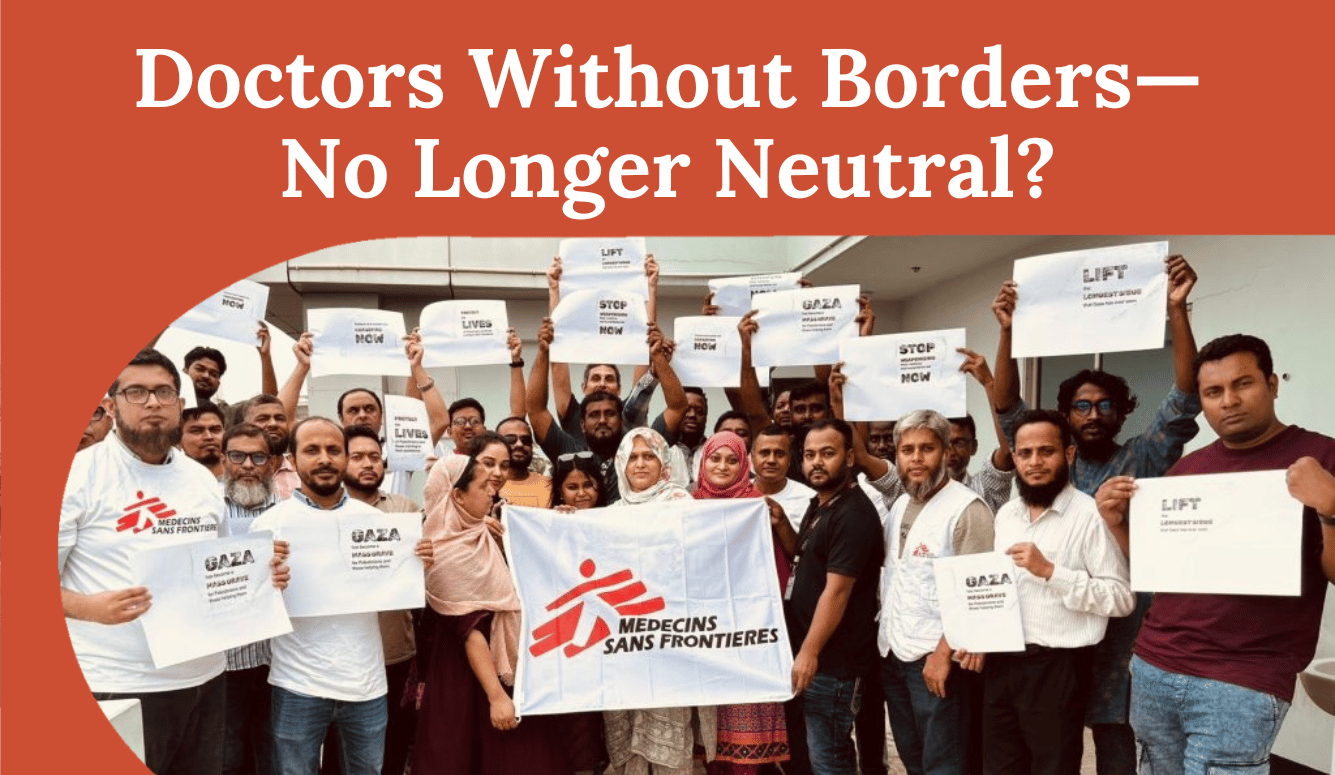

Video essay based on the work of Gerald M. Steinberg and E. Levenson and narrated by Zoe Booth.
For decades, Médecins Sans Frontières (MSF), also known as Doctors Without Borders, was regarded as one of the world’s most trusted humanitarian organisations. Its authority rested on a strict commitment to medical neutrality—the principle that humanitarian medicine must remain independent of political causes, even in war. Awarded the Nobel Peace Prize in 1999, MSF became synonymous with ethical restraint and institutional credibility.
That reputation is now under serious strain.
This video examines how MSF’s response to the war in Gaza reflects a marked departure from its long-standing principles. It analyses the organisation’s adoption of activist language, including public accusations of genocide against Israel, while remaining conspicuously silent on Hamas’s documented war crimes, including the October 7 massacre and the systematic use of civilian infrastructure for military purposes.
Central to this breakdown is the role of Ghassan Abu-Sittah, a British-Palestinian surgeon associated with MSF whose public claims following the al-Ahli Hospital explosion helped fuel global outrage based on allegations later shown to be false. Despite mounting evidence that the blast was caused by a misfired Palestinian rocket, MSF neither corrected the record nor reconsidered its reliance on Abu-Sittah as a neutral authority.
Drawing on the reporting and analysis of Gerald M. Steinberg and E. Levenson, this video explores how humanitarian legitimacy can be repurposed for political advocacy—and why the erosion of medical neutrality carries serious moral and institutional consequences.
Chapters
00:00 Doctors Without Borders, medical neutrality, and the rise of MSF’s global reputation
01:08 MSF’s genocide accusations against Israel and the adoption of political messaging
02:33 Ghassan Abu-Sittah, the al-Ahli Hospital explosion, and the spread of false narratives
06:10 Internal dissent within MSF and the shift from humanitarian relief to advocacy
08:12 Ethical consequences of silence on Hamas and the collapse of medical neutrality
Transcript
View full transcript
For decades, Médecins Sans Frontières—Doctors Without Borders—was treated almost like a secular saint in global affairs. Neutral, heroic, fearless. Its doctors operated on the front lines of civil wars, outbreaks, natural disasters. In 1999, it was awarded the Nobel Peace Prize, lauded for its medical ethics and unimpeachable neutrality. According to its own charter, MSF was supposed to rise above politics, guided only by the Hippocratic oath and humanitarian values. But as the dust begins to settle over Gaza and the conversation shifts toward reconstruction and accountability, one thing has become increasingly clear: MSF has abandoned the very principles that made it so revered. Instead of remaining a neutral provider of care, it has turned medicine into yet another theatre of ideological warfare—and has done so under the guise of humanitarianism. In recent months, MSF has allowed itself to become a loudspeaker for accusations of genocide—aimed squarely at the state of Israel. Earlier this year, the organisation unfurled a massive banner in Amsterdam, outside a Jewish publishing house, that read: “Gaza Genocide.” On its UK website, there's now an entire section titled “Gaza Genocide,” where Israel is accused of systematically destroying the conditions necessary for Palestinian life through forced displacement, annexation, and mass killing. Its international president, Dr. Javid Abdelmoneim, appeared at a civil-society tribunal in Istanbul and testified that MSF had witnessed Israel’s “deliberate mass harm to civilians,” its use of “food as a weapon,” and its destruction of Gaza’s healthcare system. He called these “key elements” in a genocide, couched in what he described as the historical context of occupation, colonisation, and blockade. At this point, MSF's messaging is barely distinguishable from that of activist NGOs or state-aligned propaganda outlets. And the most damning illustration of this shift comes in the form of one man: Ghassan Abu-Sittah. A British-Palestinian reconstructive surgeon, Abu-Sittah entered Gaza under MSF sponsorship just two days after the October 7th Hamas massacre in southern Israel—a massacre that killed at least 1,195 civilians and took 251 hostages. This was not his first time working in Gaza with MSF. He had been there during previous conflicts in 2018 and 2019. But this time, his mission wasn’t just medical. It was political. He spent six weeks working in various hospitals across Gaza—al-Shifa, al-Ahli Arab, al-Awda. And when an explosion occurred at al-Ahli Hospital on October 17th, Abu-Sittah immediately issued a statement through MSF, calling it “a massacre.” He appeared at a press conference surrounded by corpses and was presented to the global media as an impartial medical professional offering eyewitness testimony. His words travelled around the world. Headlines spoke of a devastating Israeli airstrike. Politicians condemned Israel. Protesters flooded the streets. But within days, it became clear that the explosion had not been caused by an Israeli bomb at all. Evidence from both Israel and the United States pointed to a misfired Palestinian rocket. Even the New York Times—along with Human Rights Watch—walked back their initial assumptions. HRW concluded that an Israeli air-dropped bomb was “highly unlikely.” But MSF never corrected the record. Abu-Sittah never retracted his statement. The narrative had done its work. After returning to London, MSF continued to platform him. He was interviewed by major media outlets, often introduced simply as “a surgeon who volunteered with MSF.” In these interviews, he repeated the accusation that the hospital strike marked the moment Israel’s war became a genocide. His credibility was artificially inflated by his association with MSF—an organisation that the public still believes stands for neutrality and humanitarianism. From there, things escalated. In December 2024, on Democracy Now!, Abu-Sittah accused Western medical institutions of “genocidal enablement.” He claimed the silence of groups like the American Medical Association amounted to complicity. In March 2025, at a “Divest for Palestine” event in London, he accused the UK, France, and Germany of forming an “axis of genocide.” At a University of London panel, his lecture was titled: The Biosphere of Genocide: Gaza’s Killing Machine. And yet, MSF continued to endorse him—until, eventually, the political cost became too great. The organisation quietly distanced itself, stopping its public promotion of his appearances. But by then, the damage was done. Still, Abu-Sittah found defenders within the MSF apparatus. Mohammad Salaymeh, a Palestinian Arab and MSF’s head of mission support, accused the NGO of silencing Palestinian voices. In a blog post, he lamented that Abu-Sittah’s “act of speaking out as a Palestinian” was deemed too political, and therefore not humanitarian. He argued that MSF exploits Palestinian labor, death, and experience to bolster its legitimacy, while excluding Palestinians from authorship and leadership. This is not an isolated claim. It reflects a larger belief among some MSF staff that the organisation should act as a conduit for Palestinian political expression. That is, not just treat the wounded—but serve as a platform for those who claim to speak for them. And that’s exactly what MSF has done. Abu-Sittah became a regular on the international speaking circuit. Harvard’s FXB Center for Health and Human Rights hosted him. So did the Carr Center and the Harvard Law School’s human rights program. He accused Israel of systematically targeting medical workers and destroying Gaza’s health infrastructure. He co-authored a piece in The Lancet titled Break the Selective Silence on the Genocide in Gaza, and issued an open letter demanding that healthcare and academic institutions publicly recognise what he called a genocide. His Twitter feed is even more explicit. In February 2024, he posted: Israel fears Palestinian children. They represent the Palestinian tomorrow and are therefore a mortal threat to the Zionist project. That is why Israel has intentionally targeted children in its genocidal war. Elsewhere, he described Israelis as “a nation of irredeemable monsters.” Eventually, even MSF had to admit that this kind of rhetoric was incompatible with the organisation’s public image. But that reckoning came far too late. And the problem isn’t just Abu-Sittah. It’s systemic. Former MSF secretary-general Alain Destexhe has been blunt. In a 2023 report titled MSF: An Accomplice of Hamas?, he warned that the organisation’s credibility had been co-opted. Since October 7th, Destexhe noted, MSF had not issued a single condemnation of Hamas. Not one. Not for the massacre of civilians, not for the abduction of hostages, not for the routine use of hospitals and schools as military bases—violations of humanitarian law that MSF is supposed to be especially attuned to. Even when given an opportunity—on international television—MSF representatives offered only muted regret about the fate of the hostages, with no condemnation of the war crimes committed by Hamas. As Destexhe put it: MSF's reputation gives it enormous influence. When its doctors speak, the world listens. But when that trust is abused—when medicine becomes a front for political messaging—the consequences are not just reputational. They are moral. The Al-Ahli Hospital explosion, and the disinformation campaign that followed, shows how MSF’s credibility has been exploited, how its silence on Hamas and its amplification of falsehoods about Israel have contributed to global outrage built on shaky foundations. And all under the halo of humanitarianism. At this point, MSF’s role in Gaza looks less like a neutral aid organisation and more like a PR firm with stethoscopes. The language of neutrality remains on their website, in their fundraising appeals, and in their press kits. But in practice, neutrality has been replaced by ideology. Medical ethics have been replaced by moral theatre. And for an organisation that built its name on impartiality, that trade-off is more than dishonest. It's dangerous. This video is based on the reporting and analysis of Gerald M. Steinberg and E. Levenson, whose Quillette essay examines how Médecins Sans Frontières has strayed from its founding principles of neutrality and medical ethics, increasingly operating as a political actor in the Israeli–Palestinian conflict. Steinberg, founder and president of NGO Monitor, and Levenson, a bioethicist and head of NGO Monitor’s research on medical NGOs, trace how MSF’s credibility has been co-opted to legitimize inflammatory claims—including the uncorrected falsehoods surrounding the al-Ahli Hospital explosion. Their full article is available at http://Quillette.com .Further Reading
Hamas and the Red Cross— Gerald M. Steinberg
Amnesty International's Controversial Ukraine Report Exposed — Gerald M. Steinberg
If you found this video essay useful, subscribe to the Quillette YouTube channel and browse our video archive.
Keep reading
Germany’s Cozy Catastrophe
AI and the Wiki Wars
Foreign Power, Local Politics
Podcast #333: The Search for Truth
A Costly Misconception