Podcast
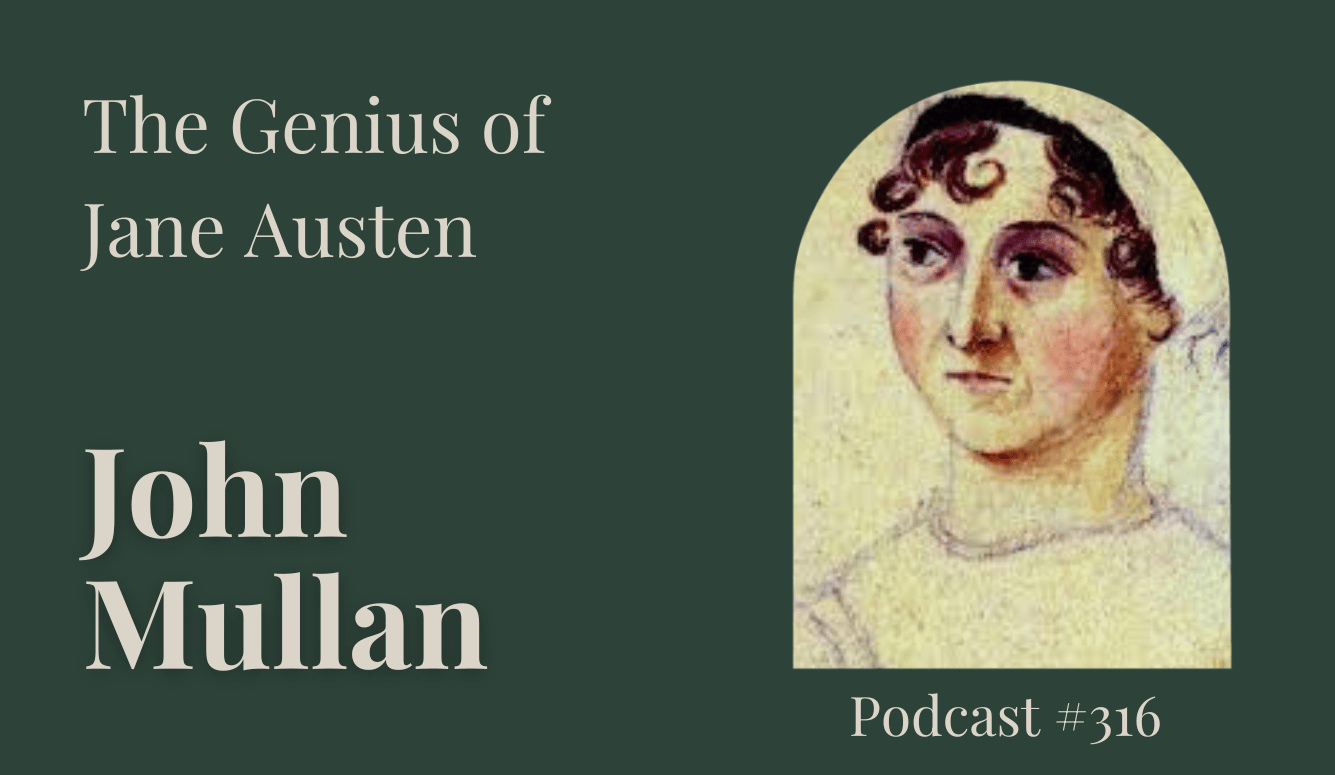
Podcast #316: The Genius of Jane Austen
Iona Italia talks to English Literature professor John Mullan about the innovative genius of Jane Austen.

Introduction: I’m Iona Italia, Managing Editor at Quillette. And today, we’re bringing you an episode from the Areo Magazine archives, which is an interview with John Mullan, Jane Austen scholar, to celebrate the 250th anniversary of Jane Austen’s birth. I hope you enjoy my interview with John Mullan.
Transcript
Iona Italia: Hello, everyone. My guest today is John Mullan. John is a professor of English literature at University College London. He’s a regular TV and radio broadcaster and a literary journalist. John is the author of a number of books, including Sentiment and Sociability: The Language of Feeling in the Eighteenth Century; How Novels Work; Anonymity: A Secret History of English Literature; and The Artful Dickens. I’m going to talk to John today about his work on Jane Austen and his book, What Matters in Jane Austen. Full disclosure: for his sins, John was also my PhD supervisor, when I was doing my PhD at Jesus College Cambridge back in the early 1990s. He is definitely the English literature academic whom I most admire and one of the most beautifully lucid writers and speakers I know of. It’s a pleasure and a privilege to talk to you again after all these years, John.
John Mullan: Thank you very much. “Lucid” is good. That is an aspiration that I have. It’s certainly very kind of you to say so.
II: It’s a really rare quality among academics.
JM: Well, I like to think it’s a quality that, in Britain at least, is becoming a little less rare or has become a little less rare over recent years. I’m not sure that the quest for lucidity has become particularly popular in North America yet amongst academics, but I think obscurity used to be admired and valued by literary academics a bit more in the eighties and nineties than it now is. I hope so anyway.
II: Yes, I hope so too. This is a particular bugbear of mine. I wrote an article on this which I’ll link in the show notes. Basically, you are the exact opposite of the academic whom I’m describing in that article.
JM: I’ll read it with pleasure then.
II: It’s called “Writing Wrongs,” the article. I’m going to talk to you about your book on Jane Austen. As I often do with writers, I’m going to begin by reading a small passage from your book. But in this case, I’m going to supplement it with a brief passage from Austen’s work, which illustrates some of what you’re talking about.
This is from the introduction to your book. Just before this passage, you’re talking about the fact that Austen, almost uniquely among well-known writers of that period, had basically no contact with the literary world, with other well-known writers. The closest she got to that was that Walter Scott reviewed, I can’t remember which, I think Emma.
JM: He discussed two of her previous novels as well. It was a round-up review, but it was mostly about Emma.
II: Yes, he did a little bit of overview, but he doesn’t mention Mansfield Park, I think, in the review. Unlike almost everyone else who has survived to posterity, she wasn’t part of a literary coterie or clique, or even really had correspondence with other writers. You write:
Jane Austen’s obscurity among her contemporaries is all the more striking when one considers her technical audacity. There was nothing so surprising about the fact that she wrote novels. There was something miraculous about the fact that she wrote novels whose narrative sophistication and brilliance of dialogue were unprecedented in English fiction. She introduced free indirect style to English fiction, filtering her plots through the consciousness of her characters. She perfected fictional idiolect, fashioning habits of speaking for even minor characters that rendered them utterly singular. She managed all this with extraordinary self-confidence and apparently without the advice or expert engagement of any other accomplished writer …. It might be a wrench to think of Austen, the conservative literary genius in a revolutionary age, as an experimental writer, but such she was. This has nothing to do with her subject matter. Indeed, provide some bare plot summaries of her novels, and they can be made to sound rather less daring than those of contemporaries such as Maria Edgeworth or Mary Brunton. Her brilliance is in the style, not the content. Even when it comes to her characters, her success is a matter of formal daring as much as psychological insight. We hear their ways of thinking because of Austen’s tricks of dialogue; their peculiar views of the world are brought to life by her narrative skills.
Virginia Woolf, a reader completely alive to Austen’s fictional intelligence, said that “of all the great writers, she is the most difficult to catch in the act of greatness.” Woolf meant that it was nearly impossible to take a single scene or single paragraph as an epitome of that greatness. The apparent modesty of Austen’s dramas is, though, only apparent. Look closely, and the minute interconnectedness of her novels is a bravura achievement. This interconnectedness is the reason why, when you reread her novels, you have the experience of suddenly noticing some crucial detail that you have never noticed before, and realising how demanding she is of your attention. … And when you do notice things, it is as if Austen is setting puzzles, or inviting you to notice little tricks, which do justice to the small, important complications of life. … the apparently trivial pursuit of the answers to quiz questions about Austen invariably reveals the intricate machinery of her fiction.
I skipped over a little bit and a couple of sections there. I think a good place to begin would be with Austen’s stylistic innovations, particularly with free indirect style and then maybe with idiolects, which I know you’ve got a lot to say about.
I’m going to read a very short passage from Persuasion. Perhaps not the subtlest example of this technique, but I think it’s a very clear and obvious example of the way in which she describes things through the eyes of her characters rather than as an omniscient author. At this particular moment, Anne Elliot’s old lover, Frederick Wentworth, who has returned to town and who she has met after an eight-year gap … she is talking to her sister—her sister who’s very thoughtless and often quite callous in her thoughtlessness—about him. And this is what her sister says:
“Captain Wentworth is not very gallant by you, Anne, though he was so attentive to me. Henrietta asked him what he thought of you, when they went away, and he said, ‘You were so altered he should not have known you again.’”
Mary had no feelings to make her respect her sister’s in a common way, but she was perfectly unsuspicious of being inflicting any peculiar wound.
“Altered beyond his knowledge.” Anne fully submitted in silent, deep mortification. Doubtless it was so, and she could take no revenge, for he was not altered, or not for the worst. She had already acknowledged it to herself, and she could not think differently, let him think of her as he would. No: the years which had destroyed her youth and bloom had only given him a more glowing, manly, open look, in no respect lessening his personal advantages. She had seen the same Frederick Wentworth.
“So altered that he should not have known her again!” These were words which could not but dwell with her. Yet she soon began to rejoice that she had heard them. They were of sobering tendency; they allayed agitation; they composed, and consequently must make her happier.
Frederick Wentworth had used such words or something like them, but without an idea that they would be carried round to her. He had thought her wretchedly altered, and in the first moment of appeal, had spoken as he felt. He had not forgiven Anne Elliot. She had used him ill, deserted and disappointed him; and worse, she had shewn a feebleness of character in doing so, which his own decided, confident temper could not endure. She had given him up to oblige others. It had been the effect of over-persuasion. It had been weakness and timidity.
He had been most warmly attached to her, and had never seen a woman since whom he thought her equal; but, except for some natural sensation of curiosity, he had no desire of meeting her again. Her power with him was gone forever.
JM: It’s a good bit, no doubt about it! For our listeners, you could have carried on. Just leave me out.
II: Well, reading your book has made me want to reread all of the Austen novels now. I think it will be about my third or fourth rereading as well, but they don’t get old.
So, talk a little bit for listeners about how she uses that free indirect style.
JM: Right. Well, listeners should know that I didn’t know you were going to choose this passage. So, it’s a good test. All sorts of extraordinary things are going on in it, but I suppose the most striking thing is that Anne is told this thing by her utterly inconsiderate sister Mary. It’s quite important—whenever you choose a little sliver out of Austen, there are things going on in plot terms as well as psychologically, stylistically. Contrary to what people sometimes assume, she’s a novelist who plots quite densely.
One of the points of this exchange with her sister is that her sister was away at school when Anne eight years earlier had her courtship with Captain Wentworth. So, she has no idea that she’s saying anything quite as cruel as it is—although she should know that it’s hardly a very cheering thing to be told, “You’re 27 and you’re dead in the water.” But anyway, “so much altered he wouldn’t have known you again.” What the narrative does is—as so often in Persuasion—it takes up the story, sees the world we might say through Anne’s eyes, but through her mind, through her consciousness. She essentially is trying to persuade herself that—she’s doing something very natural in one way—which is to persuade herself that it’s actually a good thing that he doesn’t fancy her anymore. “What a good thing. I’m pleased.” Because it’s Austen, you can see absolutely the logic of this. “Deep mortification.” She is a self-mortifying character in many ways. She is responding to Captain Wentworth’s reappearance by trying to smother her own feelings, trying to smother her own still completely burning love for him. So, she’s got to convince herself, because she is what we call a “good person,” she’s got to convince herself that there’s no hope. This is the psychological paradox of at least the first part of the passage that you read, Iona.
It’s a complicated reaction. Austen is stylistically brilliant, but psychologically complicated. Anne is trying to persuade herself—persuasion being the activity that is so important throughout the novel—she’s trying to persuade herself that she should be pleased that he’s not interested in her anymore and that this evidently doomed romance is all over. She’s trying to stop herself living in hope and that’s a self-punishing thing, but it’s not an irrational thing. There’s a great modal verb which Jane Austen makes a wonderful use of when she’s doing free indirect style. “Must.” Can you read again what it says?
II: “These were words which could not but dwell with her. Yet she soon began to rejoice that she had heard them. They were of sobering tendency; they allayed agitation; they composed, and consequently must make her happier.”
JM: Yeah, they “must make her happier.” In that little simple moment, you can hear the pressure of her thoughts, of her consciousness. They must make her happy. Yes, must, must, because I say so. Jane Austen is not present at all in that. Anne Elliot’s wishes are in control of the narrative. It’s one of those little signs of this technique which basically did not exist before Austen got hold of it.
Where you started this session, Iona, talking about how she was unusual in not belonging to any literary group and not corresponding with other writers. Most writers who invent clever new technical things spend their time discussing them with their peers and sometimes boasting about them. But Jane Austen had nobody to do that with. She did it on her own. She pioneered this extraordinary technique of letting the narrative take on the thoughts and feelings and crucially delusions of one or other of the characters.
Persuasion, although it’s narrated in the third person, apparently by Jane Austen, it’s narrated from Anne’s point of view. The interesting thing is Anne is often wrong about things—not morally wrong, but factually wrong. At the end of the passage you read, Austen does this extraordinary thing, which is, just for a little bit, she takes you away from Anne, who’s almost always present in the novel. It’s a very unusual occasion. As it were, the camera goes off, pans away, and we get Captain Wentworth talking to his sister, Mrs Croft. He’s talking about the fact that he’s looking for a wife and he’s pretending that he’s very easy about who it should be. He says a great thing, which I think you missed out, which I think many a young man has thought since, or perhaps should have thought, which is, he says, there are two things he’s looking for in a woman: “a strong mind and sweetness of manner.” The implication being, you quite often get one, but you very rarely get both.
Also, although Mrs Croft doesn’t understand this, the point of it is that he now thinks that Anne Elliot didn’t have a strong mind. She didn’t stand up to those, particularly her advisor, Lady Russell, who said, “No, don’t marry him. It’s a bad idea.” But it takes you into this conversation and it briefly takes you into his mind. It’s the only time in the whole novel it does it. When Austen does it, she takes you, in free indirect style, to reflect his thoughts this time.
She ends the chapter and that extraordinary passage with a statement, which is not true. It says—and this is Captain Wentworth’s thoughts, “Her power with him was gone forever.” And that’s the last thing you’re told about Captain Wentworth. Spoiler alert—but I think any astute reader should be guessing this from very early on—it’s completely untrue. Her power with him is not gone forever at all. It turns out to be stronger than ever actually. But it’s such a quiet … to use a word you used much earlier, piece of audacity to end the chapter with a sentence which is the opposite of the truth. The first-time reader has to discern this. There is no indication at all that it’s the case.
II: Actually, it’s not the end of the chapter, I ended my reading there, but there’s a couple more paragraphs. I’ll read them.
It was now his object to marry. He was rich, and being turned on shore, fully intended to settle as soon as he could be properly tempted; actually looking round, ready to fall in love with all the speed which a clear head and a quick taste could allow. He had a heart for either of the Miss Musgroves, if they could catch it; a heart, in short, for any pleasing young woman who came in his way, excepting Anne Elliot. This was his only secret exception, when he said to his sister, in answer to her suppositions:—
“Yes, here I am, Sophia, quite ready to make a foolish match. Anybody between fifteen and thirty may have me for asking. A little beauty and a few smiles and a few compliments to the navy, and I am a lost man. Should not this be enough for a sailor, who has had no society among women to make him nice?”
He said it, she knew, to be contradicted. His bright, proud eye spoke the conviction that he was nice [which means “choosy” in this context]; and Anne Elliot was not out of his thoughts, when he more seriously described the woman he should wish to meet with. “A strong mind, with sweetness of manner,” made the first and the last of his description.
“That is the woman I want,” said he. “Something a little inferior I shall, of course, put up with, but it must not be by much. If I am a fool, I shall be a fool indeed, for I have thought on the subject more than most men.”
That amazing confidence with which he ends!
JM: As you know, because they’re so rich and subtle, these passages of Jane Austen, you can spend easily an hour on just that passage, which we mustn’t do. But when he says, “I have thought on this more than most men,” as you rightly say, it sounds very confident, but there’s a subtext to that, which is when Anne turned him away, having first accepted him, he brooded on that. That’s what he’s been doing. He’s been off at sea killing Frenchmen and making a great name for himself as a man of action, but he’s been brooding on this. When he says, “I’ve thought on this more than most men,” he’s referring to the fact that, after this terrible disappointment in love, he’s been dwelling on it. He’s a man of feeling as well as a man of confidence.
II: Yeah. Just to avoid confusion, if anybody’s listening who’s not familiar with Jane Austen, a lot of writers relate the thoughts and feelings of characters or describe characters and describe what is going on within their minds. But what Austen does is very often something slightly different, which is: she relates the story through their minds. The story itself, the account that we get is already inflected by their thoughts, feelings, biases, and, as you say, by their errors. Especially perhaps in Emma.
But I even notice it in that very famous sentence at the beginning of Pride and Prejudice: “It is a truth universally acknowledged that a single man in possession of a good fortune must be in want of a wife.” Who is saying that? It’s all of Meriton. It’s people like Mrs Bennet, one of the most contemptible characters in Austen. It’s pronounced with this air of authorial authority. That’s a pleonasm. It’s pronounced with this air of omniscient authority, but it’s not the author speaking at all.
JM: That’s right. One of the little things you get in most Austen novels—you get it a lot in Pride and Prejudice, even more in Emma, both of which are based in villages, which are actually more like small towns—is you get these statements, which are often either impersonal or in the passive voice. “It was soon widely agreed that ….” This happens a lot in Emma because there’s a world of gossip and speculation. These statements are always ironical, I suppose. People always say they’re ironical, but they’re ironical not so much because it’s Jane Austen saying them in a very arch way—although we can imagine that if we like—but more because they represent, as in that opening sentence in Pride and Prejudice and as always in Emma, the asinine consensus of a community of people who as individuals we don’t know, but who all agree on this, that, or the other. The things they agree on are usually either questionable or simply downright wrong.
I can’t remember the exact sentence, but one of the chapters in Emma opens with some statement like, “It was soon agreed that Mrs Elton was a fine young woman.” Mrs Elton is a monster, a monster of vulgarity and vanity. But of course, most of the people in Emma, most of the people of Highbury, which is the town/village in Emma, they just see her at church and see that she’s wearing expensive clothes. That’s good enough for them. That’s good enough for them to say apparently nice things about her.
One of Austen’s tricks is this sort of this voice, which has produced, ironically, probably the most famous quote in all Austen. Even then, “A single man in possession of a good fortune must be in want of a wife.” Even there, it contains its own little detonation because these novels are all centred on women, but they’re all about men who want wives, aren’t they? Often, they do what Captain Wentworth says he will do—but we know he won’t—which is they marry foolish wives because they fancy them probably, usually. Mr Bennet, who’s one of the cleverest, subtlest men in all Austen, marries a fool. Mr Palmer, in Sense and Sensibility, who’s bad tempered but intelligent, marries the very foolish Charlotte Palmer, a woman who can’t stop laughing at absolutely everything, including the fact that her husband’s constantly rude to her.
That’s what some men do—because men want wives and, unless they’re rakes like Willoughby in Sense and Sensibility or Wickham in Pride and Prejudice, to put it very bluntly, if they want to have a sex life, they’ve got to get married. They’ve got to find somebody, preferably somebody attractive, also somebody with money, but somebody attractive, who is willing to marry them. There’s a great sentence in Emma about the odious, smooth-tongued vicar, Mr Elton, whom the reader immediately sees is odious, but Emma doesn’t at first—doesn’t for quite a long time. It says, “Mr Elton, living alone and not much liking it.” What a world of meaning there is in that. These men aren’t just “in want of a wife” in your opinion or my opinion. Quite a lot of them really are in want of a wife.
II: A remark that you made when I was an undergrad, which has been with me all my life …
JM: Oh no. Oh no. Oh no no no no. Noooooo.
II: No, but you actually repeat it in the Jane Austen book, decades later.
JM: Gosh, I’m on a loop tape.
II: Which is that people underestimate the importance of sexual motivations for men in Austen’s novels. We’re talking about Charlotte Lucas’s marriage to Mr Collins, who is this pedantic, self-important, bumbling idiot—although he’s actually quite a young man. He’s 25 in the novel, as you point out, whereas usually in TV and film adaptations, he’s played by somebody who’s at least middle-aged. He’s a young fogey. I don’t know if people still use that term, but he’s old before his time. She decides to marry him because she’s getting older herself, by the standards of Austen’s society for marriageable young women. And she also has very little money coming to her, so she needs to secure her future. She marries Mr Collins—the novel kind of glosses over it and she tells her friend Elizabeth, she’s actually quite happy with Mr Collins because she has managed things such that they avoid each other all day. She sits indoors while he’s in the garden. When he comes indoors, she goes outside. They never actually intersect in any one space. Then you said to us, “But have you noticed that she is pregnant by the end of the novel?”
JM: Well I bet you hadn’t. I bet you hadn’t.
II: I hadn’t, no, and the horror with which that idea seized my mind has never left me.
JM: That goes for the other students too, I’m sure.
II: Yes, I’m certain. It was one of the more traumatic moments.
JM: Because we find out via a weird euphemism, which was not so unknown in the period in one of Mr Collins’s letters, where he says, “We’re getting a new branch of the laurel crown” or something like that, which is his way of saying that his wife is pregnant.
II: It makes it even worse. It’s wink, wink, nudge, nudge. Eww.
JM: And he’s so pleased with himself about it. We might think that first-time fathers-to-be are allowed to be a little pleased with themselves when their partners are pregnant, but we still are so ungenerous that we’re not prepared to allow Mr Collins to feel it, are we?
II: No. Well, because he is such a pillock.
JM: Yes, he is awful. Actually, the funny thing is—I was thinking about this when we were talking about free indirect style and that wonderful bit of chapter seven, I think it is, of Persuasion that you read out, which is another must, which is when Charlotte Lucas has had this proposal from Mr Collins. Again, I can’t imagine really there is anybody out there listening who’s not read Pride and Prejudice, but just in case, Mr Collins—again, it’s carefully plotted and comically plotted—Mr Collins turns up at the Bennets’ house, Longbourn because he is a distant relative of Mr Bennet and Mr Bennet has had five daughters and he has inherited the estate himself, on condition that it’s entailed. That means he can’t leave it to who he wants. By law, it goes to his closest male relative. He’s had five daughters, so none of them are going to get it. And Mr Collins is his closest male relative. Mr Collins is going to inherit everything. He writes this fantastically absurd letter—I do recommend it to everybody—saying that he’s coming to visit.
He’s casing the joint really. He’s come to see what he’s going to get, but it also becomes clear, he wants a wife. He’s in want of a wife. Mainly because his monstrous patron, Lady Catherine de Bourgh, who is even funnier than Judy Dench’s enactment of her, I can promise you, has told him, “You must get a wife.” So, he’s come to get a wife. It’s carefully plotted because he’s announced in advance how long he’s going to stay. Basically he’s there ten days. So he’s got ten days to court and propose to and get an acceptance from one of the daughters. Mrs Bennet makes it clear very rapidly that the oldest one, Jane, who’s mild and pretty and would be a good prospect and she’s 22 years old, that’s fine, that he’s already taken. Because Mrs. Bennet has high hopes that Jane will get a proposal from the very rich young Mr Bingley. So, Mr Collins changes his target to the next daughter down, who’s Elizabeth.
There’s a wonderful sentence, which I’ll get slightly wrong, about him changing his mind after Mrs Bennet in the drawing room tells him. He says something like, “It did not take him long, no longer than it took Mrs Bennet to turn a log on the fire.” If that was Samuel Beckett or Kafka, people would just thrill with delight at the deadliness of it, wouldn’t they? But you hardly notice it in Jane Austen, but it’s nonetheless deadly. Then he goes for Elizabeth, and anyway, to cut the long story short, he wastes eight days courting her, and then, of course, she famously turns him down. So, now, blinking heck, he’s only got two days left. It’s a real race against time. There’s a big dinner party on day eight. Elizabeth’s very relieved to see that her great friend Charlotte Lucas, who has, like Anne Elliot, reached a hugely advanced age of 27, has taken Mr Collins on and that she doesn’t have to talk to him. But of course Charlotte Lucas has an ulterior motive, which is, now that everybody’s found out—because Lydia has gone and told everybody—that Elizabeth’s turned him down and Charlotte Lucas sets about being pleasing to him.
It’s one of the shortest courtships in world fiction. It lasts the course of a dinner with the Lucases and the Bennets, which may be maximum five hours. That’s it. That’s their courtship. Of course, if this was a French novel and it was a coup de foudre and it was an affair of passion, you would think, “Yeah, great. Five hours. Of course, you know your partner for life, of course you do.” But Charlotte Lucas is being entirely prudential. Next day, Mr Collins sets off to Lucas Lodge, where Charlotte lives, and she’s looking out an upstairs window and spots him. And it says something like, “And she goes down so she is able to meet him accidentally in the lane.” Then he proposes to her and she accepts and it’s a done deal. And at the end of this—I have actually looked this up. It would be impressive if I knew it off by heart, but I’ve found it in the novel.—Mr Collins goes off really, really happily. She’s accepted the proposal of marriage. It says, “Her reflections were in general satisfactory. Mr Collins, to be sure, was neither sensible nor agreeable; his society was irksome, and his attachment to her must be imaginary. But still he would be her husband.” It’s good to see how funny it is, isn’t it? Because people write such po-faced stuff about it—in student essays, I’m afraid, as well as academic articles—about “This shows the terrible price women paid in the early 19th century for marriages of mere convenience.” And of course, it’s not completely wrong—but it’s comic, it’s absurd. One of the reasons it’s absurd and funny is because Austen is doing that free indirect style thing again.
Think about the brilliance of this utterly unnecessary phrase, “Her reflections were in general satisfactory. Mr. Collins, to be sure, was neither sensible nor agreeable.” Now, if it just said, “Mr. Collins was neither sensible nor agreeable,” we might think Jane Austen was just telling us something. But “Mr. Collins, to be sure,” that is what lets us into the drama of her thought. She’s thinking this, “Mr. Collins, yeah, it’s true. He’s not sensible and he’s not agreeable.” Then that killer word “must” again. “His society was irksome.” She’s just agreed to spend the rest of her life with him. “His society was irksome, and his attachment to her must be imaginary.” It’s just a brilliant use of word “must,” isn’t it? If it said, “his attachment to her was imaginary,” that’s information that the narrator is giving you. But in fact, it’s not information, it’s the internal drama, the weather, W-E-A-T-H-E-R, of Charlotte Lucas’s thoughts. It’s as if she’s thinking to herself, “He seems very attached to me. That just must be imaginary. That must be. Yes. What am I thinking? Of course it is.” “His attachment to her must be imaginary.”
And it’s all brilliantly in character. Charlotte Lucas is such a practical person. She says earlier on to Elizabeth, “I am not romantic, you know.” Meaning not just “I’m not into lovey dovey stuff,” but “I don’t let my imagination ever run away with me. I don’t succumb to wishfulness.” That’s what “romantic” meant at the time. So, even at this moment, she is too, too much herself to allow herself to believe even for a second that his professions of affection for her have any basis in reality whatsoever. It’s fantastic.
Of course, all this is done in one of these moments in Pride and Prejudice. Austen does this differently in different novels, where you go away from the heroine and you’re not with Elizabeth. Elizabeth doesn’t know anything about this. This will enable Austen to stage, very soon afterwards, one of these great little scenes where Charlotte Lucas has to tell her friend. It says, “One of the worst things about accepting the proposal of marriage from Mr Collins is that you have to then go and tell Elizabeth Bennet about it.” And Elizabeth—do you remember what she says, Iona? I haven’t got it in front of me, but I think she says, “Mr. Collins? Impossible!” Exclamation mark. And then she eventually realises what she says and backs off and backs off and backs off, because Charlotte Lucas says, “Are you saying that, because Mr. Collins was not happy to win your affections, that he couldn’t win anybody else’s?” Elizabeth is embarrassed and guilty at her outburst—but her outburst is prompted by her realisation of just how irksome Mr Collins’s company indeed is.
II: Yes, I found it.
The possibility of Mr. Collins’s fancying himself in love with her friend had once occurred to Elizabeth within the last day or two; but that Charlotte could encourage him seemed almost as far from possibility as she could encourage him herself, and her astonishment was consequently so great as to overcome at first the bounds of decorum, and she could not help crying out:
“Engaged to Mr. Collins? My dear Charlotte—impossible!”
JM: Impossible! Yes.
II: I think that’s what she says to Mr Collins himself also, when he proposes to her. Yeah. “I thank you again and again for the honour you have done me in your proposals, [this is Elizabeth to Mr Collins] but to accept them is absolutely impossible. My feelings in every respect forbid it.” That’s when he says, “You are uniformly charming!” He thinks she’s just being coy, flirting with him, teasing him.
JM: Dare I say, it’s a comic version of that Me Too thing of thinking that when women say no, they don’t really mean no. But it’s in a comic situation since, because Elizabeth Bennet is Elizabeth Bennet, Mr Collins is no kind of threat at all to her, no threat whatsoever. She knows what she thinks and she’s absolutely not going to say yes to somebody like him. Indeed, we rapidly find out that her father very much agrees with her. So, it’s an entirely comic thing, but Mr Collins has apparently been taught or has read in books that when you propose to a young woman, she doesn’t go, “Oh yes, please.” She goes, “Well, I don’t know. I’m not very willing.” That that’s absolutely standard. It all means yes.
II: I was thinking, as we were talking, about the fact that for the men in Austen’s novels and in Austen’s age, your options were being a rake or being celibate. In that passage that I read from Persuasion, where Frederick Wentworth says that his eight years at sea as a sailor have made him less nice, less choosy, that now he just needs a woman.
JM: I’m sure social historians will tell you that, in real life, Mr Knightley—however good a chap in Emma—would have been unlikely to reach the age of 37 without having had any kinds of sexual relations and that perfectly respectable men had such relationships, if not with prostitutes, then with their servants most often. Sailors and soldiers in Austen’s age, as in other ages, would find and probably pay for sex in the places that they went to on service. In their eyes, that would not in any way spoil them for the prospects of a conventional and perhaps indeed faithful marriage afterwards. As Austen herself reflects at the end of Mansfield Park, attitudes at the time were much more tolerant towards men than women when it came to sex before marriage, particularly. Sex outside marriage is a slightly different thing. So, perhaps in reality, it is unlikely that somebody like Mr Knightley or Captain Wentworth, who’s 31, I think, in the main action of the novel, would have reached those ages without any sexual experience. But that’s excluded from the novel. That’s just not a factor in the novel. We just have to accept that, I think, just like we have to accept the fact that when they find the right woman, their “amorous propensities,” as Dr Johnson called it, were awakened.
Every time you look at Austen, you see something new. You’ve alerted me now to that word “impossible.” I had forgotten that it was the word that, as you rightly say, Elizabeth Bennet uses herself to Mr Collins. It reminds me of a wonderful passage in Emma where Emma, who is twenty years old and, as it were, the queen of the village and the most eligible—she’s “handsome, clever and rich,” she is eligibility itself. At a certain key stage late in the novel—spoiler alert again—she realises that she loves Mr Knightley, who is a family friend who’s sixteen or seventeen years older than her, who is the only person who ever contradicts her, the only person really whose opinion she ever cares about. She realises that—again, another wonderful “must,” “Mr. Knightley must marry no one but herself.”
But she realises this at the moment when she’s become convinced—for reasons that I won’t go into—that this brainless young woman called Harriet Smith, who’s seventeen years old and whom Emma has cultivated, made her protégée. Because she’s at the local boarding school, where she’s been put by her father because she’s an illegitimate child. She doesn’t even know who her father is, except that he’s decent enough to pay for her education. She’s an absolute nobody. Emma has cultivated her, like Frankenstein and his monster, because although Harriet is a dimwit, she’s sweet natured and she’s pretty, maybe even sexy. Harriet comes to see her to say that she’s interested in Mr Knightley. This is after Emma’s tried to marry her off to other people. Emma says to her, “Have you any idea that Mr. Knightley might return your affection?” Harriet says something like, “Yes, I rather think I do.” Harriet is too stupid to lie. She always tells the truth. And Emma suddenly realises with horror at that moment that she loves Mr Knightley. But maybe Mr Knightley is going to end up with Harriet Smith.
There’s this great bit of sort of dramatic monologue in Emma’s head with lots of exclamation marks. “Mr. Knightley and Harriet Smith!” There’s this bit where it says something like—it is her thought, she’s thinking this—“Could it be?” And then she goes, “No. It was impossible.” Full stop. And then it says, “And yet it was far, very far, from impossible.” It’s like a Shakespeare soliloquy, where a character says something that they’re thinking and then immediately contradicts it. “No, it was impossible. And yet it was far, far from impossible.” Because she’s thinking, “Oh my goodness, men do marry sexy young women. That’s what they do. So maybe this is going to happen.” And she’s been the very one to bring up this young woman, to give her ideas above her station, to encourage her to think well of herself and in doing so, Emma has, she thinks at this awful moment, destroyed her own happiness. And Mr Knightley is very comfortably off. He can afford to marry whoever he wants. Maybe he’s going to marry the sexy fool.
Impossible. So, there’s a whole there’s obviously a whole article to be written, isn’t there, Iona, about “impossible.”
II: Yeah. Also in defence of the idea of marrying for sex in Austen. Despite the fact that you could have affairs with servants and prostitutes if you were a single man, I think even today, most sex is within relationships. People who are single might have greater variety of partners, but statistically I think people who are married or in relationships have a lot more sex.
JM: Do they?
II: I think they, according to research.
JM: According to research. According to people doing much more interesting PhDs than the one I did.
II: Yes. Of course, no one has really proven this.
JM: I remember seeing a wonderful survey, which perhaps Jane Austen would have been amused by, in a woman’s magazine many years ago, which asked married men and married women separately, what was best and worst about marriage. The women who were asked what was best about marriage said companionship and the men said regular sex. So, there you go. I don’t know if that was the kind of survey which produced its own answers, as it were.
Crucially though, before we do get into Cosmopolitan land, one big thing in Jane Austen, which is a convention of her novels, but also a fact of life in the 19th century and which completely shapes the drama of her fiction is that once you marry somebody, that’s it. There is, of course, a divorce in Jane Austen. In Mansfield Park, Mr Rushworth divorces his wife, Maria, formerly Maria Bertram, because she’s been conducting an affair with Henry Crawford. He divorces her for adultery. He could do that because he’s rich. You have to bring a private bill before the House of Lords and you have to be very rich to do it. But also it gets in all the newspapers. Indeed Fanny, the heroine, is staying with her family in their very cramped abode in Portsmouth and her father, who’s a former marine on half pay and who smells of gin all the time. He reads aloud about it from the newspaper. It’s the entertainment of any boozer in Britain, this absolutely scandalous divorce.
So, it did occasionally happen, but only in that particular way. It was nearly impossible for a woman to divorce a man, nearly, because she had to prove not only adultery but also physical cruelty. That was often very difficult to prove. But anyway, there were very few divorce cases. Those were almost entirely amongst very wealthy people. So it’s all or nothing. Those short courtships—in Emma, Mr Elton proposes to Emma in a wonderful, hilarious scene in the back of a carriage on Christmas Eve with all the confidence that he’s going to be accepted, just like Mr Collins’s confidence that he was going to be accepted or Mr Darcy’s even greater confidence in his first proposal to Elizabeth that he’s going to be accepted. And you know, don’t you, Iona, the rule of proposals in Jane Austen.
II: If you’re certain you’re going to be accepted, you’re not going to be accepted.
JM: If a man proposes as if he cannot imagine the answer will be no, then the answer will be no. Those proposals that we do see in Austen’s novels—and there are a couple we don’t ever see, we don’t ever actually hear what’s said—but the proposals that do occur, Mr Darcy’s second proposal, Mr Knightley’s proposal to Emma, they all are hesitant, reticent. None of them say, “Will you marry me?” I think Mr Knightley says, “Have I any reason to hope?” That’s how you have to propose.
So, after Mr Elton’s rejected, he’s very grumpy and he says basically, “I’m going to get a wife who’s not you.” He goes to Bath, which is a good place to find a wife. Four weeks later, he writes a letter to Mr Cole, who’s an acquaintance in the village, announcing the fact that he’s engaged. Four weeks it’s taken to go from not knowing somebody to them agreeing to be with him forever. And it is forever. It’s a massive decision. Somebody once said to me when they were teaching me, not particularly about Jane Austen, but about the whole of 18th and 19th century fiction, “Liberal divorce laws may have been a good thing for a society, but they were very, very bad for the English novel.” Because as soon as you can say, “Actually, you know, this isn’t working out. Should we scrub it and we both try again with somebody else?” As soon as you can do that, it does rather take the electricity out of the decision.
II: Right. It means you have to come up with a different plot structure because, you know, tragedies end with deaths and comedies end with marriages. Both of those were almost equally permanent endings.
JM: But also—and I think that you can see the intimations of this in Austen—in the 19th century, some of the greatest European, not just English, novelists discover ways of writing novels about marriage. Sometimes as in Madame Bovary or Anna Karenina, that means writing novels about adultery, but not always. Middlemarch is, amongst many other things, in a way a novel about two unhappy marriages, both of which are resolved when the husband dies, setting the woman free. Mr Casaubon’s death sets Dorothea free from a marriage she has foolishly entered into. But also, Lydgate’s death much later in the novel sets Rosamund free from a marriage which she and Lydgate entered into with a good degree of passion, actually. But anyway, novelists find ways of writing novels that inhabit marriages as Austen doesn’t. But, necessarily, unhappy marriages and marriages that have no prospect of divorce—Dorothea and Mr Casaubon; Emma Bovary and Charles Bovary, they can’t get divorced. So how is this going to end? Well, in a terrible death in the case of Madame Bovary, but in more ordinary ways in English novels.
The novel of the unhappy marriage relies on the difficulty, perhaps even impossibility of divorce. You get that in Dickens too. Dickens indeed was a campaigner for more liberal divorce laws, not least because of his own growing unhappiness about his marriage. We all know about his terrible behaviour over it, but anyway, another story. With Austen, there’s traditional comedy, they end in marriage, but you can see in the marriages that are there in the book—I talked a bit about Mr and Mrs Bennet, Mr and Mrs Palmer, Mr and Mrs Elton—there are lots of married couples and people often say that only Admiral and Mrs Croft in Persuasion who have a childless marriage—and it’s quite important that they have no children so Mrs Croft can always go off on ship with him—they seem the only compatibly married people in the whole of Jane Austen.
II: Hmm, that’s interesting.
JM: There are some poisonously compatible people. Mr and Mrs Elton are compatible, but how horrible they are, like two vipers. Mr and Mrs John Dashwood in Sense and Sensibility: John Dashwood, the half-brother of the Dashwood sisters, he’s got this absolutely poisonous wife, Fanny, and she manipulates him to do whatever she wants. So they’re not exactly unhappy together, but they’re hardly a model of marital contentment for other people to chase.
II: In the last ten minutes, I’d like to talk a little bit about idiolects because I think this is one of the most fun aspects of Austen. The way in which she is able—sometimes with only single utterances or only a few sentences—to show you a great deal about a person’s character from their way of speaking. I don’t even know if it’s still on there—but perhaps you could talk about the Austen quotation that was on the £10 note, I think it was, and that’s a quotation from, it’s Caroline Bingley, I think. “I do declare there is no pleasure like reading.”
JM: Not, “I do declare,” “I declare” and it’s “enjoyment,” not “pleasure.” Anyway, almost there, Iona, almost. That’s the Jane Austen quote, which—until the pandemic stopped any of us using cash—that was more frequently reproduced than any other. Listeners might remember that there was a big argument and indeed a big PR campaign about Jane Austen being put on the £10 note. It was one of the first things that Mark Carney did when he became governor of the Bank of England. It seemed like a sign of his modernising tendency. It was one of those rare things that everybody was happy about. Feminists were happy about it. Traditionalists were happy about it. The Guardian was happy about it, but the Daily Mail was happy about it. It was all win-win. They’d already done Churchill on the five-pound note and established a pattern where you had a picture of the person and then a quote underneath it. The Churchill quote was—I might get these nouns in the wrong order—but it’s something like, “I can promise you only blood, sweat, toil, and tears.” They need a Jane Austen quote. In a way, exactly because of what we’ve been spending quite a long time talking about them, the way that so much of the novels is filtered through the characters and is not Jane Austen speaking at all, it’s actually really hard to find a Jane Austen quote. It would be easy to find a Dickens quote or very easy to find a George Eliot quote because she’s always speaking to you in the novels. But Jane Austen is really hard. So, they came up with this quote, which was duly stuck on the £10 note and is there millions and millions of times over. The quote is, “I declare after all there is no enjoyment like reading!”
And lots of Janeites, as they’re called, were up in arms about this because it’s Caroline Bingley. It’s a bit like having a picture of Shakespeare and then a quote from Lady Macbeth underneath it. Caroline Bingley is a self-serving, vindictive, scheming, dishonest person who doesn’t like reading at all. Indeed in context it’s even worse because she says this when Mr Darcy is trying to read and she plonks herself on the sofa next to him and takes up volume two of the book he’s reading volume one of, and starts appearing to read it. But of course she doesn’t read it because she’s going chatter, chatter, chatter. Because all she’s interested in is acquiring Mr Darcy as husband.
And after she’s gone on and on for a bit, she says, “I declare after all there’s no enjoyment like reading!” It’s completely disingenuous. But it’s such a Caroline Bingley thing to say because, why does somebody say, “I declare”? “I declare” … you know that what comes after that must be untrue, if somebody’s found it necessary to say, “I declare.” “I declare after all,” and why does she say, “after all”? It’s as if she’s been spending the last hour reading, but she hasn’t, she hasn’t been reading at all. “After all, God, that was wonderful!” But she hasn’t been reading. She’s been chattering. “I declare after all there is no enjoyment like reading!”
In fact, she, soon after that, is having a go at Elizabeth Bennet for reading because they play cards. This is at Netherfield while Jane Bennet is ill upstairs and Elizabeth is visiting and they play cards. They play a game called loo and they play for money and Elizabeth decides she won’t join in because she can’t afford to lose the money. So, she picks up a book and Caroline Bingley says lots of sneery [things]. Mr Hurst says the only sentence he says in the whole of the novel—or rather the only sentence that’s reported. He’s often talking, but what he says is so inconsequential it’s never reported. This is the one time that his words are given. He says the immortal sentence, “Do you prefer reading to cards? That is rather singular.” That’s it. That’s his contribution to world discourse. That’s him forever, those two sentences—“That is rather singular”—sum him up.
And Caroline Bingley has a go, she says, something about “Miss Elizabeth Bennet, she prefers reading to absolutely everything.” As if she’s a socially awkward, intellectually superior bluestocking or something. That’s another great thing in Austen’s novels about the way people speak, she captures this extraordinary sense of—not just what’s distinctive about how they speak, but how they contradict themselves from one moment to the next. Isabella Thorpe in Northanger Abbey says—and she was a calculating minx—says to her supposed friend, “We’re such friends. I love you so much.” She says to her supposed friend, Catherine, the naive Catherine, “I hate money.”
II: It’s the most absurd thing.
JM: It’s the most absurd thing to say. And “I hate money” equals “I love money.” Only somebody who loves money would say, “I hate money.” But anyway, she says, “I hate money.” But two chapters later, she says, “There’s no doing without money, you know.” As in life, Iona, characters blithely contradict themselves, including the heroines. At the end of one of the early chapters of Pride and Prejudice, after the assembly ball in Meriton, Mrs Bennet is slagging off Mr Darcy. She’s chuntering on and she says to Elizabeth, “Don’t you ever dance with Mr Darcy!” Elizabeth says, “Ma’am,” she says, “I can promise you, I will never dance with Mr Darcy.” Yeah. What’s the most famous thing that every dramatisation of Pride and Prejudice spends all its time and money on? Elizabeth dancing with Mr Darcy, of course. Well, we’re all fools, we all say things which we contradict the next minute. We’re slightly slipping away from idiolect, but it’s to give you the sense that not only does Jane Austen produce these distinctive patterns of speech, which are distinctive of a character, but also everything they say is part of a drama of how they’re behaving and how they’re contradicting themselves and what they’re doing. That’s often very difficult to put your finger on, but I think she’s second to none.
II: In your book, you talk about the pleasure of being made to feel as intelligent and wise as Austen while one is reading the Austen novels. I think that a large part of that comes from the fact that you always have to read between the lines. You’re very rarely just told something straight. You quickly realise that you always have to interpret. Who’s saying this? What’s their point of view? How likely is it to be true? That gives you this sense of putting together the puzzle yourself in your own mind as you’re reading, rather than having it handed to you. That’s very pleasurable.
JM: Yeah, it makes your faculties tingle. I think she’s matchless in that capacity, in that other writers, who might do the same thing, it involves much more complicated manoeuvres and often much wordier prose. There’s no doubt that a novelist like Henry James on the one hand or George Eliot on the other offers just as much psychological complexity as Jane Austen does—or Tolstoy for that matter. But what she is unrivalled at is the mixture of managing to do that complexity, those demands you’re speaking about on the reader, with such simple means and often with such simple sentences.
I remember—it must’ve been one of those 200th anniversary radio programmes, I think it was probably on the 200th anniversary of the publication of Pride and Prejudice, so this was nine years ago, 2013. There were all sorts of discussions and I was in some discussion programme on the radio and the person sharing it asked—luckily, not me, but one of the other panel members—“So, what’s it all about? Why is everybody still on about Jane Austen?” That sort of mug’s question. This person, who was a grande dame of Jane Austen studies and retired academic, definitely somebody who knows their stuff about Jane Austen. She said really accurately—and I wish I’d boiled it down so effectively myself before this moment—she said, “Well, the thing is, it’s really, really simple and it’s really, really complicated.” Then she went on to say, “A bookish thirteen-year-old girl can read Pride and Prejudice and completely get it and really enjoy it. But then you read it for the sixth time, in your fifties, and you see all these things you’ve never noticed before, all these complexities you hadn’t properly registered. When you read Henry James or George Eliot or Shakespeare or Milton, you know it’s complicated and difficult. But Pride and Prejudice isn’t difficult. It’s easy. You can do it for GCSE. Yet the technical and therefore psychological complexities are as great as in the work of any of those other authors I’ve mentioned. That’s the really singular thing about her.
II: Yeah, absolutely. That might be a good place to end on. Unless there’s something you’re dying to say that you haven’t had a chance to say.
JM: Well, no, the only thing I’m dying to say is that I’m now going to go through the word impossible through the speech of various of her characters, because it’s clearly a word that some of her heroines like to use. “Impossible.” They always use it of things which are not impossible at all. That’s given me something to while away the rest of afternoon with.
II: Thank you. I first read Jane Austen’s novels when I was twelve. I’m now about to reread them at the age of 53. I think I will definitely find new things in them.
JM: You definitely, definitely will. You’re going to reread all of them? Okay. Well, one interesting thing: it may sound a little pedantic, but you might find it interesting is if you’re going to actually reread all of them is to reread them in chronological order of their publication. One thing I think about Jane Austen, one of the axes I would like to grind academically is that when she started off, when she was writing Sense and Sensibility and to a lesser extent with Pride and Prejudice, she was actually quite influenced by other novels of her time and the novels that had gone before her, even if she was writing against them. Then by the time she got beyond Pride and Prejudice, the only person she was influenced by was herself, because she was so out on her own. I think she was conscious of that. She probably wasn’t so vain and foolish as to think, “I am the best novelist ever.” But I’m sure that she soon began to realise, once she got Pride and Prejudice under her belt, I think she began to realise that she wasn’t going to learn anything from reading novels by her contemporaries, not really. She still read them, but only to have a laugh.
II: I’m just looking to see when Elective Affinities was published.
JM: That’s before Austen I think.
II: That’s 1809 and Mansfield Park was in 1814. I don’t know if she read that novel in translation.
JM: I tried once to track that down and it seems almost certain that she did not read it.
II: Because there are a lot of thematic and plot similarities there, although they’re very different treatments. I find it more fruitful to think of Mansfield Park and Emma as a pair of novels where she explores two contrasting approaches, characterisations, heroines, et cetera.
JM: Mansfield Park, one very simple way of seeing it, is as a riposte to people who foolishly say, “Oh Fanny Price. She’s so dull and boring. I don’t like her. She’s such a goody two shoes.” Having written a novel, Pride and Prejudice, with the most vivid and irreverent heroine that had ever been written, ever been written in a novel, certainly, and is only rivalled on the stage by a few Shakespeare comic heroines. Elizabeth Bennet, this extraordinary creation a heroine who’s not afraid of anybody, who will always fight her corner, who can laugh at everything. It’s as if she goes, “Right, I’ve done that. Okay. So, the new one is going to have a heroine who most of the time can’t speak and nobody pays any attention to and everybody ignores and is put upon and bullied and shy and awkward and at the edge of everything.”
II: But mostly right about things. Whereas Emma is completely in the centre of everything and almost always wrong.
JM: Yes, yes, of course. But anyway, yes, she does something different every time. If she hadn’t died when she was 41, we would have had another ten novels.
II: Yeah, it’s very sad. Thank you so much for joining me, John. It’s been a real pleasure.
JM: Thanks for indulging me.
II: Have a wonderful week, everyone.
Jonathan Kay: Thank you for listening to this episode of the Quillette Podcast. For more Quillette content, please visit us at quillette.com.
Keep reading
Apocalypse ’92

Love and Theft
AI Is Not About To Become Sentient

The Innovation Trap

Treating Myths as Science