film
Roman Polanski’s ‘Chinatown’ Fifty Years On
Chinatown is noir at its bleakest, yet most stylish.

Nineteen seventy-four was a great year in the history of cinema. The American New Wave was in full swing, revitalising Hollywood after a long period of stagnation and decline. It was a year that gave audiences The Conversation, The Parallax View, The Texas Chainsaw Massacre, and The Godfather Part II. One of the finest films of this era is the captivating and disturbing Chinatown, written by the recently deceased Robert Towne and directed by Roman Polanski. Chinatown has probably the greatest screenplay ever written. It is the apogee of the noir genre. A noir emancipated from the demands of the Hays Code, allowing it to feature unsparing sexuality, together with a depressing ending and a powerful villain who gets away with it.
So, what makes Chinatown such a paragon of cinema? First, it is a masterclass in storytelling: quick, efficient, and yet suspenseful. Moreover, it is a genuine mystery, offering no easy answers to the questions it poses. It also features plot twists, startling revelations, unremitting suspense, and the most ironic of endings. In Chinatown, Polanski sought to recreate the ambience of the hardboiled detective novels and classical noir films of the early twentieth century. Just as the likes of Raymond Chandler and Dashiell Hammett had done at their best, Polanski and Towne adroitly highlight the juxtaposition between the gleaming surface of Los Angeles and the sordid foundation on which it rests.
At the beginning of the film, a mysterious woman introduces herself as “Evelyn Mulwray” and hires former policeman turned private detective J.J. “Jake” Gittes to investigate her husband, Hollis Mulwray, the chief engineer of the Los Angeles Department of Water and Power, who she believes is having an affair. Gittes then attends a public meeting at which Hollis rejects proposals to build a new dam because of safety concerns. Later, Gittes photographs the husband in the company of a young woman who is presumably the mistress in question.
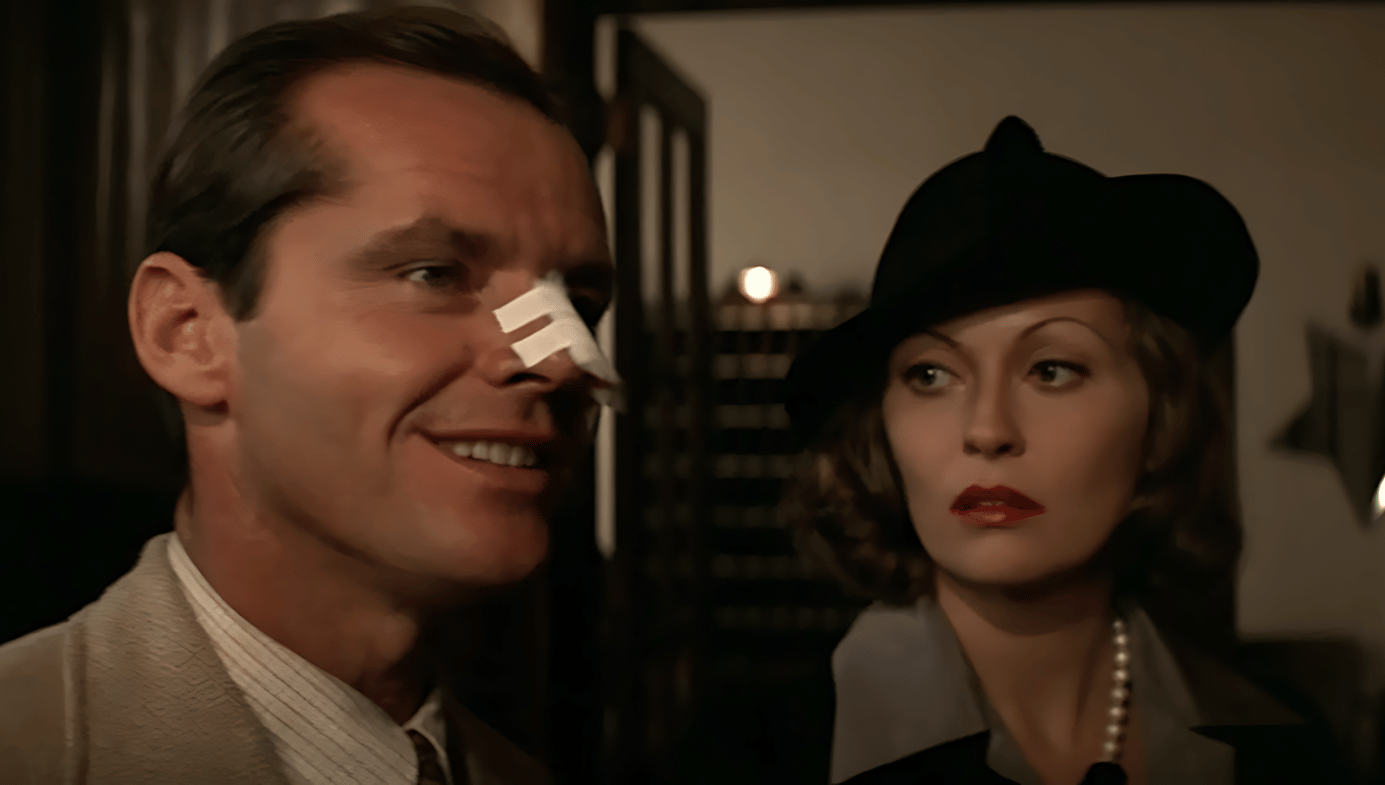
The photos are soon leaked to the local newspapers, causing a public scandal. Then, the real Evelyn Mulwray, played by a beguiling Faye Dunaway, shows up unannounced at Gittes’ office and threatens to sue him over the unwanted publicity. Soon afterwards, Hollis’s dead body is found at a reservoir. Gittes decides to work for the widow, to find out who is pulling the strings in what seems to be an elaborate scheme to frame her for the murder.
Gittes decides to investigate the proposed dam that Hollis opposed. He discovers that water is being suspiciously drained out of the reservoir at night, despite the fact that Los Angeles is in the middle of a drought. As he hangs around the reservoir one night to try to find out more, he is approached by two thugs who want to warn him off. One of them (portrayed by Polanski in a cameo role) slits Gittes’s nose with a knife.
This part of the plot is based loosely on the California water wars of the 1910s and ’20s, when Los Angeles officeholders led by William Mulholland, the then superintendent of the city’s Department of Water and Power, diverted water from the Owens Valley, through the newly built aqueduct, to meet the water demands of the rapidly growing Los Angeles metropolitan area. The water was used to irrigate the San Fernando Valley, large tracts of which had quietly been bought up by a secret syndicate. The city investors profited immensely at the expense of the immiserated farmers and ranchers in the Owens Valley, who briefly resorted to terrorism to try to regain their water.
In the movie, Gittes’s continued investigation into the murder eventually leads him to uncover a sinister conspiracy involving the deliberate waste of thousands of gallons of water, a plot involving the shadowy figure of Evelyn Mulwray’s father, Noah Cross. (Cross was played by John Huston, the director of noir classics like Key Largo and The Maltese Falcon.) Gittes gradually uncovers a plot involving corruption among the city’s elites and the cover-up of an incestuous rape. His quest for justice puts him and his client Evelyn in grave danger, as he moves relentlessly toward a final showdown, the consequences of which he barely understands.
Chinatown showcases many great performances. Jack Nicholson skilfully expresses the multiple dimensions of the character of Gittes. Like any hardboiled detective, Gittes is a loner, a cultural middleman, neither cop nor criminal, detached from the society he lives in. He is an observer who doesn’t take sides and prefers not to get involved in people’s problems—hence the motto he lives by: “as little as possible.” But Gittes is flawed even by his own standards. The film’s tragic ending is set in motion by the fact that he has gone against his own mantra by wading knee deep into other people’s issues. His cynical quietism has been replaced by an idealistic crusade for justice. He doesn’t heed his own advice to the fake ‘Mrs Mulwray’ that “you’re better off not knowing.” His curiosity, together with his desire for redemption for his past mistakes get the better of him. His initial failure as a beat cop in Chinatown is reproduced on a larger scale; just as he struggled to keep order in a neighbourhood populated by Chinese immigrants whom he didn’t understand and upon whom he looked down with racist contempt, he struggles to understand and combat the powers that govern his society.
As Evelyn Cross, Dunaway channels the beauty and elegance of a 1930s Hollywood star, right down to the thin drawn-on eyebrows. But one of the things that makes Chinatown unusual is that it subverts the femme fatale trope. Cross isn’t a manipulative villain, as a character like hers would be in a typical noir film, but a heroine and a victim. As critic Sam Wasson puts it in his 2021 book, The Big Goodbye: Chinatown and the Last Years of Hollywood:
Towne would introduce the blonde as a femme fatale, then reveal, by the end of the picture her actual goodness and innocence, not the other way round... And in keeping with the fate of real-life ideals, she, too, would have to be sacrificed. She wouldn’t kill – as in detective movies of the forties—but be killed.
But perhaps the most outstanding performance in Chinatown is that of John Huston, who exquisitely conveys the faux bonhomie that is central to Noah Cross’s character. Behind a facade of affable respectability, Cross is a menacing, narcissistic megalomaniac.
The defining moment of Chinatown is an exchange between Cross and Gittes, after the latter has discovered that Cross raped his own daughter, Evelyn—an act for which he not only shows no remorse but does not even attempt to justify. This is the moral crux of the film:
GITTES: I want to know what you’re worth—over 10 million?
CROSS: Oh, my, yes.
GITTES: Then why are you doing it? How much better can you eat? What can you buy that you can’t already afford?
CROSS: The future Mr. Gittes... the future… You see, Mr. Gittes, most people never have to face the fact that at the right time and right place, they’re capable of anything.
It’s intriguing to think that it was Roman Polanski who wrote these lines about the unlimited potential of even ordinary people to commit evil under the right circumstances. Polanski’s own life is a testament to the power of the darker side of human nature. Polanski lived through the Holocaust: his mother, Bula Katz-Przedborska, was killed at Auschwitz; his father, Maurice Liebling, survived the Mathausen concentration camp. He also experienced the brutality and impunity with which the Stalinists ruled post-war Poland. He knew the atrocities people are capable of committing. He was not only a victim but a perpetrator of the latter. In 1977, Polanski drugged and anally raped 13-year-old Samantha Geimer. Before he could face trial, he absconded to France and has never yet been tried for his crimes in a court of law. In fact, he was defended by most of Hollywood—and even lionised as an auteur unjustly persecuted by an overbearing US justice system.
 Quillette
In 1969, five years before he directed Chinatown, Polanski’s pregnant wife, Sharon Tate, was savagely murdered by the Manson cult. Chinatown was the first film he made in Los Angeles following the tragedy. It’s probably no coincidence that he decided that the film needed a bleak ending—a decision that caused Robert Towne to leave the project in protest. It also seems quite telling that Faye Dunaway uncannily resembles Sharon Tate.
When Noah Cross talks of how people in the future will venerate his name and legacy, he is revealing his hubristic, almost imperialist, mentality. Like Cecil Rhodes in Southern Africa, he wants his name to be remembered as a founding father of a civilisation erected upon virgin soil. Hollywood has produced many films about Faustian figures—Charles Foster Kane from Citizen Kane and Daniel Plainview from There Will Be Blood among others: ambitious, visionary, yet ruthless individuals who helped make the American dream possible through what the Austrian political economist Joseph Schumpeter—borrowing the idea from Karl Marx—called “creative destruction,” violently dispossessing the common people to feed their own avarice. As Balzac famously said, “Behind every great fortune lies a crime.”
For contemporary audiences, Chinatown no doubt evoked the Watergate scandal, which was being investigated as it the film was in production. Nixon resigned in August 1974, less than two months after the release of Polanski’s film. The criminality, corruption and deception on the part of people at the centre of power—who were supposedly upholding respectable norms—that the Watergate investigations exposed heightened the anti-establishment sentiments that were already prevalent in the early seventies, especially among the radicalised youth of the baby boomer generation.
Kevin Mims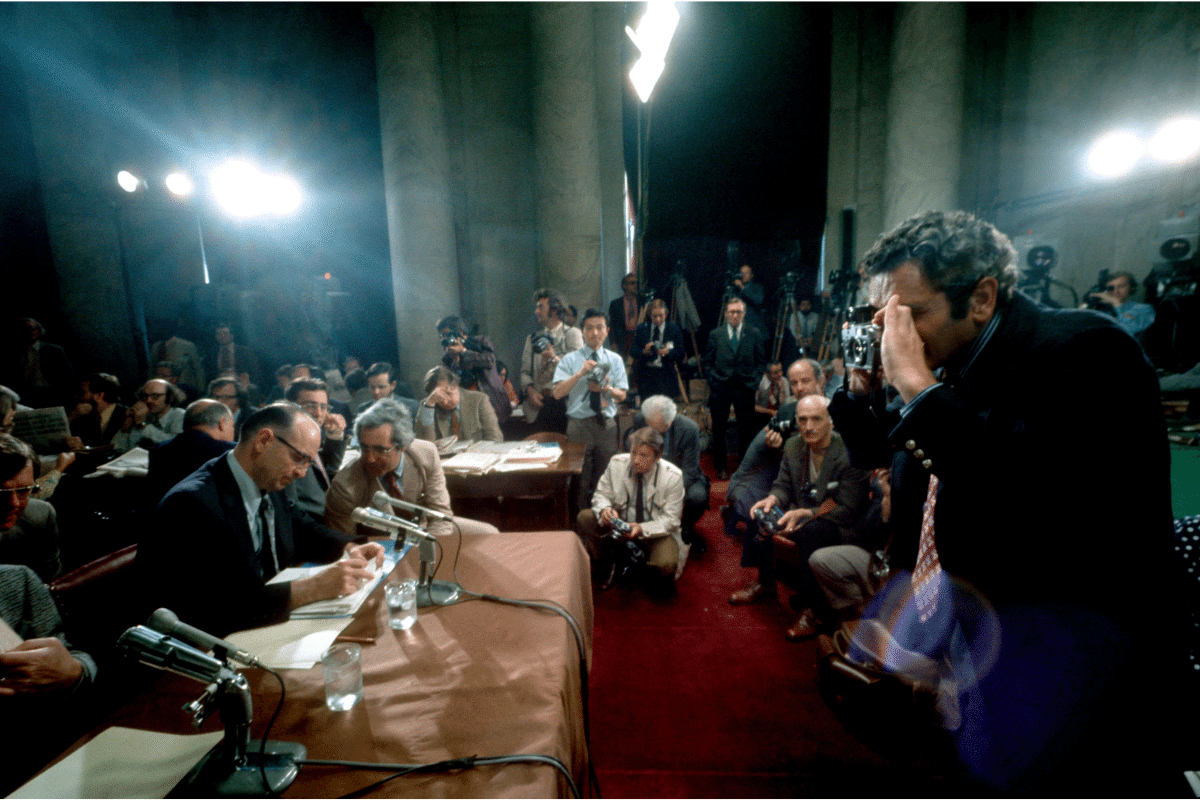
Of course, the venality of elites and their sense of impunity have existed for much longer than cinema has. But it is interesting that Chinatown is filmed in colour with natural lighting, instead of the black and white of classic noir, as if to denote that the fiendish inner workings of corrupt power are no longer hidden in the shadows but are now out in the open for everyone to see.
Los Angeles is a frequent setting in noir and neo-noir films like Double Indemnity and L.A. Confidential—so much so that it is almost a character in its own right. On the surface, L.A. seems almost paradisical with its bright sunlight, warm weather, blue oceans, and rows and rows of suburban developments housing nuclear families with plenty of free space to roam. And, of course, can anything be more glamorous than Hollywood itself, where anyone can become a star?
But Los Angeles is also a city where people come to find their dreams, and wind up living their nightmares. A place that, in the words of Mike Davis, was “the ultimate city of capital, lustrous and superficial, negating every classical value of European urbanity.” In noir films, Los Angeles is no different from any other troubled modern metropolis, characterised by social dislocation, alienation, crime, and racial anxiety. And as Chinatown contends, founded on violence, corruption and dispossession.
Kevin Mims
The noir genre arose as a retort to the image of postwar America as an idyll sustained by Fordist economic growth. It uses a crime as a metaphor to explore the darker, subterranean impulses and anxieties that lie beneath the veneer of civilisation. Its central message is that avarice and violence are ubiquitous and that anyone can turn to evil, under the right conditions. The genre developed in the aftermath of the Holocaust and the bombings of Hiroshima and Nagasaki. It showed violence inflicted abroad in war reflected in murder on the streets at home. Chinatown is noir at its bleakest, yet most stylish. Fifty years have done nothing to abate the film’s power.
Keep reading


Doomscrolling into Adulthood

Podcast #331: The Ayatollahs’ Assassins

The Disgrace of Tariq Ramadan

Apocalypse ’92