
Recent turbulence in the US and global financial systems has riveted public attention on financial crises: their recurrence, the damage they inflict, and the calls to prevent them. Silicon Valley Bank, Silvergate Bank, Signature Bank, and Credit Suisse have lit up the media as possible precursors to systemic instability. It’s impossible to say what will happen next, but to paraphrase Voltaire, God is not on the side of the central banks’ big balance sheets, but on the side of the most adroit crisis responders.
Surprise about financial crises is, well, surprising. We’ve seen versions of this movie before—in fact, many times. But what have we learned? What can we learn from the history of financial crises? They seem so idiosyncratic as to bar generalization. However, I argue that one can learn a lot.
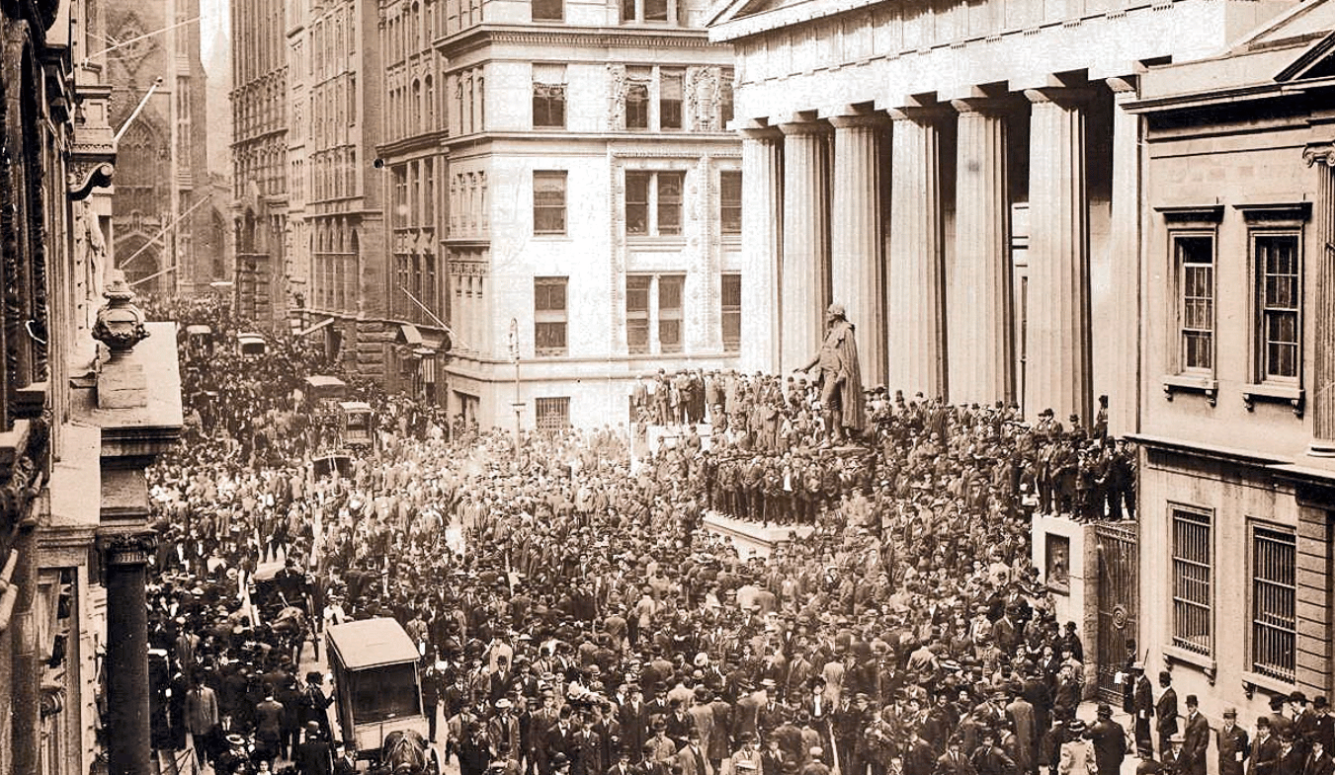
In The Panic of 1907: Heralding a New Era in Finance, Capitalism, and Democracy (2023), Sean Carr and I tell the dramatic story and present new findings by us and some four dozen studies published since our first edition in 2007. This look into the past helps to inform the present and one’s outlook to the future.
Published this week: second edition of "The Panic of 1907: Heralding a New Era in Finance, Capitalism," and Democracy by Sean Carr and myself. https://t.co/ZCeOwobaw3 pic.twitter.com/0yzty3xCss
— Bob Bruner (@Bob_Bruner) March 11, 2023
The Panic of 1907, in brief
To really understand a financial crisis, you must study not only its epicenter, but also its long antecedents and consequences. Thus the Panic of 1907 had roots in an economic boom from 1897 to 1906 that helped to vault America into the status of a world economic power. But the boom also strained the global financial system because of its demands for capital. Then, the San Francisco earthquake on April 18th, 1906 shocked the global financial system with large claims on insurance companies and demands for capital to rebuild the city. A credit crunch ensued, as did a smallish stock market crash in March 1907. By May, the US was in an economic recession: major corporations curtailed dividends and cut back on capital spending. New York City found it impossible to refinance its debt and turned to J.P. Morgan to help prevent a default.
Then, on October 16th, 1907, a failed speculation triggered the collapse of two brokerage firms. Depositors began to run on banks associated with the leaders of the speculative ring. The New York Clearing House stepped in to rescue those tottering banks. But trust companies—which were similar to banks in that they took deposits but were dissimilar in that they were more lightly regulated—were not members of the Clearing House. Depositors began to run on those trust companies rumored to be associated with the leaders of the speculative ring. From October 20th to November 3rd, J.P. Morgan organized a series of rescues of trust companies, New York City (again!), and even the New York Stock Exchange.
The crux of Morgan’s interventions was to organize a risk-sharing pool among the trust companies, much like the banks enjoyed in membership in the New York Clearing House. This effort at mobilizing collective action was exactly what theory and practice would suggest. Yet it was frustrated by the number, imperfect information, and differences in interests, incentives, and ideologies of the day. Finally, in an all-night meeting of the trust company presidents (at which J.P. Morgan locked the door to prevent defectors), Morgan gained a binding agreement for collective assistance.
That same weekend, Morgan saved a tottering brokerage firm by persuading U.S. Steel to buy the firm’s shares in Tennessee Coal and Iron. But the directors of U.S. Steel imposed one condition: President Theodore Roosevelt had to consent not to sue the firm under anti-trust laws. The next day, TR heard the appeal, and consented.
Upon the news of the trust company pact and TR’s approval of the acquisition, the financial markets cheered and the panic began to subside (though it would take months before panic symptoms truly ended.) The recession lingered until June 1908. Spillovers into the real economy (bankruptcies and high unemployment) lingered longer. And the stock market did not return to pre-crisis levels until late 1909. Our research suggests that the Panic triggered a long period of “hysteresis,” an economic term for lingering malaise.
Financial crises are typically hard on elected incumbents; the Panic of 1907 marked a turning point away from the post-Civil War Republican Party hegemony and toward the Progressive ascendancy in the Democratic Party. Congressional hearings lambasted Theodore Roosevelt for his consent of U.S. Steel’s acquisition of Tennessee Coal and Iron. TR’s hand-picked successor, William Howard Taft, sued Steel for a combination in restraint of trade. And other hearings pilloried J.P. Morgan and his circle of financiers for constituting a “money trust” that controlled the nation’s credit system. This ideological pivot reached its apotheosis in the Federal Reserve Act of 1913, which established a central bank in the US. Though the Progressive Era produced many innovations, Carr and I argue that founding the Fed was the high tide of progressivism.
Reflections and lessons
So, what can the Panic of 1907 teach us? Historical events rarely map perfectly onto the present day—they don’t repeat, only rhyme, as Mark Twain allegedly said. Yet several recurrent lessons stand out:
1. Think critically about booms.
Economic booms seem so nice: they create jobs, expand businesses, and juice the financial markets. But booms can breed financial crises, affording the grist for morality tales: just as nemesis follows hubris. But not all booms lead to crises. What seems to set crisis-prone booms apart from other economic expansions are excessive growth in credit and over-investment in the private sector, such as railroads in the 1900s and housing in the 2000s. Preceding 2023 was the flood of fiscal and economic stimulus during the pandemic years that then had to be countered by monetary tightening by the Fed to fight inflation. Rapid credit growth, banks’ declining cash reserves, vaulting optimism, and rising speculation in the stock market foster vulnerability to economic shocks.
2. Banking by its very nature creates fragility.
Banks serve an economy by assuming the risks of a maturity mismatch: they borrow short-term from depositors and lend long-term to debtors. In normal times, a small percentage of depositors will want to withdraw their funds from the bank. But if all depositors want to withdraw simultaneously, the bank faces a liquidity crisis. One response by the bank would be to sell its loans and other assets to raise the cash to meet needs of depositors. But a “fire sale” of assets during a crisis typically incurs a loss that reduces the equity capital of the bank. If the losses are sufficiently large, the bank becomes insolvent—this seems to have been the story of Silicon Valley Bank.
Add to the story of structural fragility the fact that banks are complex systems that make it difficult to know exactly the condition of the bank at any moment. Even more, banks are linked to each other through transactional commitments: this linkage means that trouble can travel from one bank to another. The architecture of the system sets the stage for contagion. What makes such a system prone to crisis is the lack of resilience due, for instance, to inadequate shock absorbers such as cash reserves (to maintain liquidity) and capital (to maintain solvency).
Booming economic conditions demand a great deal of a financial system. Banks may stretch to meet the needs of customers, thus running down their cash reserves and lending beyond prudent standards. Such was the case in the boom of 1897–1906 and the housing expansion of 2003–2007.
3. Only certain kinds of economic shocks matter.
Shocks of some kind are all around us, yet the financial system wavers relatively infrequently. But what constitutes a shock sufficient to trigger a crisis? The Panic of 1907 suggests that a true economic shock is real (not cosmetic), large and costly, unambiguous, and surprising. The San Francisco earthquake surely qualifies as such a shock. And the decline in house prices of the 2000s soon followed Hurricane Katrina in 2005. As for 2023, the Fed’s dramatic increase in interest rates might qualify. I use the word “might” because it was clear from the outset of the Fed’s tightening cycle in early 2022 that it was determined to keep raising interest rates until inflation subsided. So, after the first few interest rate hikes, where was the surprise? During the ensuing months, Silicon Valley Bank held on to long-duration bonds only to see them sink deeper in value.
4. Crises start in the shadows.
Financial crises are hard to detect in their early stages. To what part of the financial system might one look for the outbreak of a crisis? And how and why do they spread quickly?
Crises tend to originate in the periphery of the financial system among firms that are smaller, marginal, and/or new, not in the center where the big well-established firms are. In 1907, 2008, and 2023, crises began somewhat beyond the gaze of the guardians of prudence and stability—not only regulators, but also accountants, securities analysts, journalists, and even shareholders, few of whom were material influences on corporate governance. Hugh Rockoff, a longstanding student of crises, argues that “it is always the shadow banks,” unregulated or lightly regulated financial institutions, whose failure seems to herald crises.
The contagion of economic fear spreads like a pandemic. Emotion influences the occurrence and severity of financial crises. This echoes the perspective of a range of authors whose books’ very titles argue the case: Irrational Exuberance (Robert Shiller); Extraordinary Popular Delusions and the Madness of Crowds (Charles Mackay); The Crowd: A Study of the Popular Mind (Gustave Le Bon); and Manias, Panics, and Crashes (Charles P. Kindleberger).
5. Intervene quickly, appropriately, and powerfully.
Effective crisis response requires speed, flexibility, and clout. To dawdle in quelling a crisis is to give contagion the time to spread. In 1907, J.P. Morgan seemed to hesitate at first, and then became quite proactive. In 2008, government officials seemed to wait for a clear reason to react and then found themselves in trouble. In 2023, the speedy closure of SVB seems to have pre-empted other runs.
Like generals always being prepared to win the previous war, regulations and supervisory playbooks often fail to anticipate ways in which financial innovations render the current playbooks obsolete. In 1907, the responses of J.P. Morgan and his circle seem so ad hoc—yet they dealt with real-time conditions, not conditions as they used to be or were supposed to be. Morgan was on the ground, at the center of the crisis and had good information as it was unfolding. His ability to anticipate problems was crucially important. In 2023, government officials altered the playbook by sharply expanding deposit insurance.
“Clout,” or the ability to deploy large financial resources, matters to persuade depositors, investors, and other market participants that the crisis will be quelled. “Shock and awe” was a phrase popularized by Under Secretary of the Treasury, Larry Summers, during the Mexican Peso Crisis of 1994. He wanted to dispel doubt that the US would respond forcefully to Mexico’s distress. In 2008, Treasury Secretary Henry Paulson referred to the value of a “big bazooka” (financial reserves) in restoring market confidence. In 1907, the aura and financial resources of J.P. Morgan lent similar confidence.
6. Financial crises have long coattails.
Keep reading
A Clockwork Filmmaker


The Insight Trap

Cornell and Consent
Robert Lynch on Status, Humour and the Apes We Pretend Not to Be | Quillette Cetera Episode 74