
The term anitya (अनित्य) refers to the impermanence of all worldly things, and according to Wikipedia, it first appears in verse 1.2.10 of the Katha Upanishad. Buddhism and Hinduism share this doctrine, though they disagree on whether or not the Self exists. I was first made aware of the term and concept aged 24 during a meditation retreat in the Himalayas in April 1991. After 11 hours of meditation practice, we were sitting crosslegged on the floor, listening to the deep, patient voice of our absent guru, SN Goenka, issue from the speakers of a battered Ashram blaster.
Goenka was emphasising the difference between understanding the reality of universal impermanence as a theoretical proposition—such as one learned in quantum mechanics, astro-physics, or the history of light entertainment—and grasping it on a more personal level, integrating it into one’s life, and leaving it on in the background like Alexa to monitor and mitigate one’s emotional reactions to life’s irritations. The difference, he said, was profound. It was everything.
My impulse was to shrug. So what? Yes, things change. I’ve noticed. Yes, the sands of time will run through the hourglass and the desert winds will blow away the dust of my bones and raze my vainglorious monuments to the ground. Big deal. I like change. New things replace the old and the world would be boring were it otherwise.
Well, I’m 57 now, and I’m less sanguine than I was about this sort of thing. To some changes, I am reconciled. Others sadden me, but I have accepted that it is less than politic to complain. But I am having particular difficulty accepting the slow disappearance and death of a cultural edifice I had always assumed to be eternal—rock music. Nor I think am I alone. Many from my generational cohort—Boomers before me and Gen-Xers after—seem to be stuck in the first stage of grief: denial.
I’m the same age as rock music—maybe exactly the same age. I was born on Sunday, May 9th, 1965, among the first members of Generation X. That was also the day The Beatles first saw Bob Dylan play live, at the Royal Albert Hall. The large gamete encountered the small and something entirely new was created. The same weekend, Dylan began scrawling the lyrics to ‘Like a Rolling Stone’ on a napkin at the Savoy hotel—a free-form screed of scornful contempt for his own generation’s Beautiful and Damned, which evolved over subsequent weeks into what is now (statistically, at any rate) the most acclaimed song of all time. Bruce Springsteen once described it as “a torrent that comes rushing towards you. Floods your soul, floods your mind,” and when it was released in July, it changed everything. That summer, rock ’n’ roll, folk, and blues, drugs, poetry, Byronic peacock swagger, disdain, and conceit all coalesced into the greatest sound the world had ever heard.
It didn’t last. The art historian Kenneth Clark once wrote somewhere that every artistic movement lasts a generation if you’re lucky. You get between 15 and 25 years before the candle begins to gutter. 1965–80 is the short rock century. 1955–80 is the long one, if you want to start with The King rather than his Jester. In his 2016 book, Never a Dull Moment, music journalist David Hepworth convincingly places rock music’s peak at 1971 (and in Uncommon People the following year, he dates the end of the rock star to 1994). So by the time I started hearing LPs that belonged to friends’ older siblings in 1977, the bloom was already coming off.
My full induction occurred on November 17th, 1979, when the Friday Rock Show’s Tommy Vance played through a listeners’ poll that lasted fully two hours. I remember my parents turning off the TV and generously leaving me to it, no idea of the irreversible changes being made to my brain. I already knew ‘Smoke on the Water,’ ‘Child in Time,’ and ‘Stairway to Heaven,’ but I was now introduced to ‘Shine on You Crazy Diamond,’ ‘Supper’s Ready,’ ‘Layla,’ and ‘Free Bird.’ It was like seeing the Taj Mahal, Hagia Sophia, and Chartres for the first time all on the same evening. I have never entirely come down since. But six months later, according to the Clark Formula, it was all over. Rock, like Axl, was a blown Rose.
Sure, there were aftershocks–Guns N’ Roses among them. America’s Indie scene produced REM, Pixies, and Sonic Youth, while grunge produced Nirvana. Troopers like AC/DC and the Stones kept on keeping on like nothing had changed while a handful of names from the ’70s like Ozzy and Aerosmith enjoyed successful second acts. But the whole scene increasingly resembled a postmodern pastiche, like the Disneyfied, castrated facsimile of Vegas at the end of Martin Scorsese’s Casino. Springsteen remains glorious but he is leading a revivalist prayer meeting, not imparting the original revelation. By the mid-’90s, the Rock and Roll Hall of Fame was honouring talent faster than Rock and Roll could generate it.
And now? A few good men have not deserted their posts but they are dying in their boots. The reinforcements never came. “Just about every rock legend you can think of,” Damon Linker wrote in an essay for the Week, “is going to die within the next decade or so.” The stats are grim and foretell a “tidal wave of obituaries”:
Behold the killing fields that lie before us: Bob Dylan (78 years old); Paul McCartney (77); Paul Simon (77) and Art Garfunkel (77); Carole King (77); Brian Wilson (77); Mick Jagger (76) and Keith Richards (75); Joni Mitchell (75); Jimmy Page (75) and Robert Plant (71); Ray Davies (75); Roger Daltrey (75) and Pete Townshend (74); Roger Waters (75) and David Gilmour (73); Rod Stewart (74); Eric Clapton (74); Debbie Harry (74); Neil Young (73); Van Morrison (73); Bryan Ferry (73); Elton John (72); Don Henley (72); James Taylor (71); Jackson Browne (70); Billy Joel (70); and Bruce Springsteen (69, but turning 70 next month).
A few of these legends might manage to live into their 90s, despite all the …wear and tear to which they’ve subjected their bodies over the decades. But most of them will not.
That essay was published four years ago. It’s not dark yet, but it’s getting there. And as these totems of cheerfully complacent youth and vitality meet their maker, Linker writes, it “will force us not only to endure their passing, but to confront our own mortality as well.” Concert attendances remain high, but demographics toll the bell. Those tickets, album sales, and streams are so heavily skewed towards the elderly now that the whole project is just one cold snap away from oblivion.
Many bands have recovered from the loss of a member, and some have even recovered from the loss of a frontman. A dead rock star is one thing—that was always part of the package. The loss of a generation and a dearth of regeneration is quite another. This is not the death of a chorister, it is the death of the Church. The kids have rejected rock. Country music has somehow maintained its bloodline and even folk and indie still have their breeders. But not rock music. The mosh pit is now reserved for those who can’t manage the stairs.
My sadness is not purely selfish. My son is an outlier—a 15-year-old who loves Fender guitars and Marshall amps with all his young heart. He is aching to be a rock star. He’s a great lead guitarist and during lockdown, he mastered the solos to ‘Comfortably Numb,’ ‘Sweet Child o’ Mine’ and ‘Voodoo Chile.’ He even built his own Telecaster from a kit. But he might as well have nailed the art of carving Egyptian hieroglyphs. I took him to see Guns N’ Roses last summer and the crowd reminded me of the time my grandmother dragged me to the Bingo in the ’70s. I believe in my boy and maybe he will spark the revival. But it is poignant, to see him staring at posters of heroes on the wall, a watcher of the skies mapping stars that died millions of years ago.
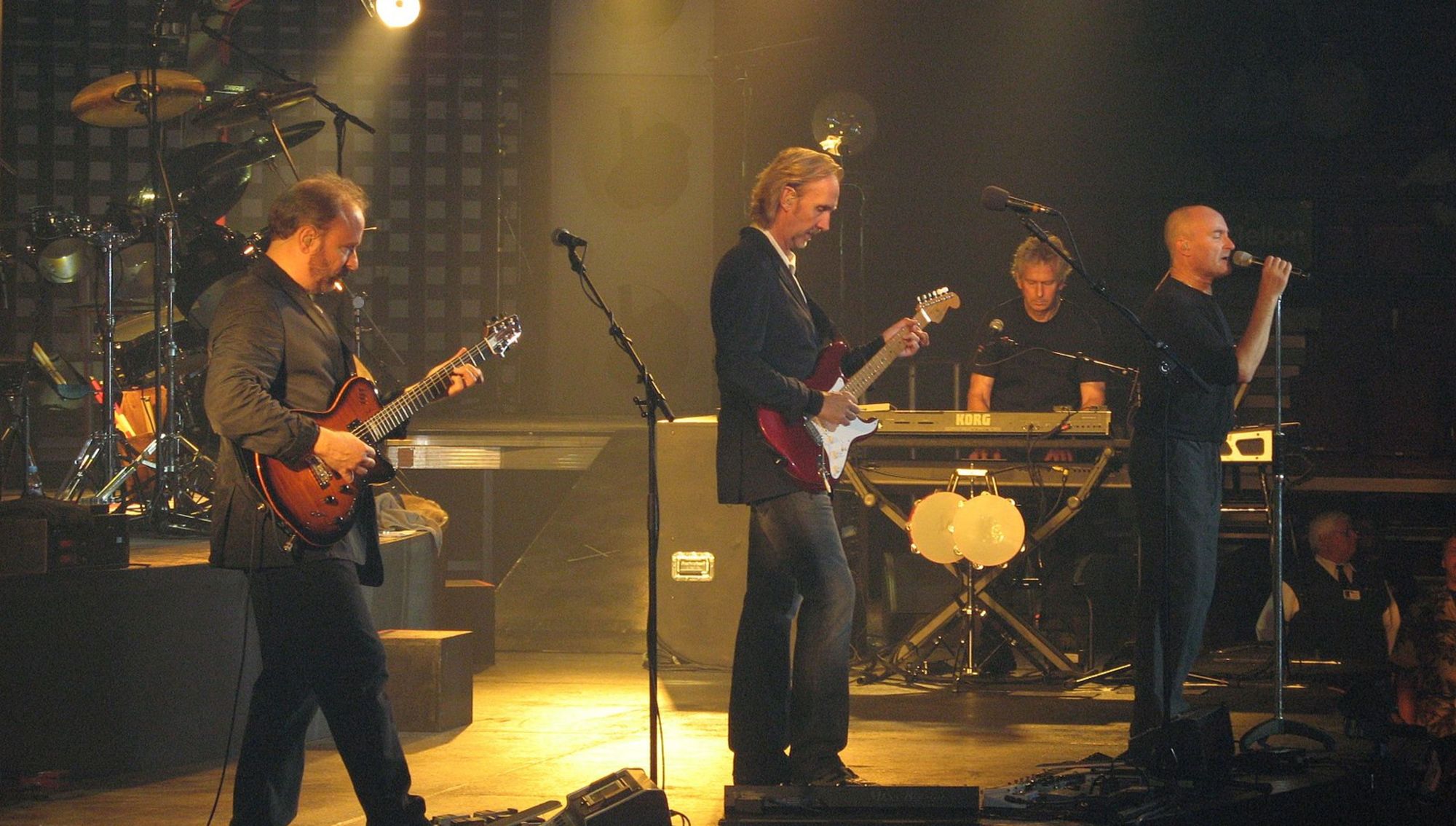
In October 2021, I shared some intimations of mortality in these pages following a visit to the Manchester Arena where I saw a painfully diminished rock behemoth of my youth in its final death agonies. Genesis’s farewell tour was battered—as all such undertakings were at that time—by the capricious surging and subsiding aftershocks of the pandemic. But in their case, it was also compromised by the physical decline of that once-eternal cockney scamp Phil Collins. Coiled in a wheeled chair, he was now incapable of commanding so much as a tambourine with authority. From a backscreen projection a hundred feet high, he loomed over his assembled fans, spasmodically air drumming and raging against the dying of the footlights. Part-Lear, part-Cnut, he defied them to notice his lack of sovereignty over the tides of time. It was, however, a grimly dignified—not to mention hugely profitable—reckoning. Genesis had finally reached Revelation.
But some of those who read that piece came forward to whisper that a New Hope did exist—an underground Resistance to the Imperial tyranny of modern pop and the remorseless passage of time. Temporary respite, at least, was to be had in the form of the tribute acts. My reaction to this suggestion was, of course, a resounding No. Tribute bands are fundamentally naff and quite possibly—to return to the five stages of grief—some bastardised version of bargaining.
If there is one thing rock demands it is authenticity. Cover versions? Yes, of course—a noble tradition. During the late ’90s, Jagger and Co. even performed ‘Like a Rolling Stone’ during their Voodoo Lounge tour, as did Hendrix at Monterey. But there is a difference between dropping the occasional nod into a set of originals and make believe. A tribute is a toll paid to the Emperor to continue to enjoy his peace. It is not dressing up in his Purple and prancing around in his shoes.
Not so fast, they said. The big-budget shows are now both lavish productions and slavish reproductions, replete with high standards of musicianship and stagecraft. They convince, I was reassured. Given a following wind, you can suspend disbelief for a few precious hours, and once again fill your sails with what Spinal Tap called “the majesty of rock and the mystery of roll,” performed by youthful musicians not decrepit pensioners.
I remained dubious. Sure, that might work for pop music because authenticity doesn’t matter in pop. “Voyage,” the holographic ABBA extravaganza, feels more like their inevitable destiny than a compromise. So much better than the meat puppet prototype we had to put up with in the 1970s and ’80s. But that couldn’t work for Jim, Janis, Jimi, or The Clash. The Doors were always at least 75 percent a framing device for the possibility of a wardrobe malfunction. A Clash gig risked becoming an actual riot. If that’s all been pre-programmed into the motherboard, it loses much of its appeal.
Still, I wanted to believe. Could this be rock music’s Lifehouse or its Mars mission? Terraforming the future with the music of our golden past? Enough moping! And Genesis, I was assured, were singularly well-served by this phenomenon. This made sense. Unlike the Stones or the Stooges or the Doors, golden era Genesis never played off the raw sexual energy or threat of the lead singer. Their lead guitarist played sitting down. Their music was almost classical in scope. Ever since the Manchester gig, my hope that their music could survive the band had been hovering like a fly, waiting for the windshield on the freeway. Last Saturday, that windshield finally arrived when I went to watch tribute band The Musical Box perform Genesis’s 1974 double-disc rock opera, The Lamb Lies Down on Broadway, in its entirety.
But first, a few notes for the uninitiated. The Lamb Lies Down on Broadway was the album that broke that incarnation of Genesis and arguably also ended the First Epoch of Progressive Rock. It remains an endlessly fascinating album. Like almost all the classic double albums of the vinyl era, it is a house of many mansions in which one can get happily lost for hours. And like almost all classic double albums of the vinyl era, it is almost exactly one side too long. (An exception to this rule is Exile on Main St., which is also among the least conceptual albums ever made.) Unusually, there is a fair amount of consensus about which songs should go and which are indispensable. One track, ‘The Carpet Crawlers,’ sits in my most prestigious “Miracle” category, along with ‘Like a Rolling Stone,’ ‘Northern Sky,’ and Debussy’s ‘Clair de Lune.’
The album has a peerlessly confabulated concept that makes Dark Side of the Moon look positively unambitious. Peter Gabriel was an unusually strange and imaginative lyricist, even by the heady standards of England’s psychedelic era, but The Lamb Lies Down on Broadway reached new heights of bemusing incomprehensibility. Stitching together multiple weird fantasies, allegories, and literary allusions, the story is loosely structured as the passion of a martyred NYC subway graffiti artist called Rael. It is part Pilgrim’s Progress, part The Third Policeman, and part everything that Gabriel had read or dreamed over the previous 18 months (contrary to popular assumption, he rarely experimented with drugs).
Concerned that the storyline was still too obscure after the songs were recorded, Gabriel wrote the full scenario out inside the gatefold sleeve, which clarified things in much the same way that poking the mud at the bottom of a pond with a stick clarifies the water. As music critic Stephen Thomas Erlewine notes on the record’s allmusic.com entry:
Gabriel made some tentative moves toward developing this story into a movie with William Friedkin but it never took off, [and] perhaps it’s just as well; even with the lengthy libretto included with the album, the story never makes sense. But just because the story is rather impenetrable doesn't mean that the album is as well, because it is a forceful, imaginative piece of work that showcases the original Genesis lineup at a peak. Even if the story is rather hard to piece together, the album is set up in a remarkable fashion, with the first LP being devoted to pop-oriented rock songs and the second being largely devoted to instrumentals. This means that The Lamb Lies Down on Broadway contains both Genesis’ most immediate music to date and its most elliptical.
To perform the album Gabriel teamed up with conceptual artist Geoffrey Shaw to devise a stage show that in 1975 wowed critics and fans alike. One described it as “stunning … overwhelming … elevated to an even more exalted level than we’re used to from Genesis.”
This then, was the show The Musical Box brought to Hammersmith. They certainly recreated the original performances with extraordinary fidelity. Or at least, so I presume—there is scant footage, but many stills, and on that basis, the recreation was eerily close. And the slideshow projected behind the band—over 3,000 images that included gritty Broadway photo-journalism, Dali oils, and parodies of sexual-health infographics—were all the originals. So is it unfair on the band to complain that the stench of mortality was, if anything, more overwhelming here than at the Manchester show?
Keep reading
How France Lost Control of Its Streets
How to Suppress Men’s Writing
Back to the Dark Ages

Prison or Peer Review

France’s Imaginary Austerity