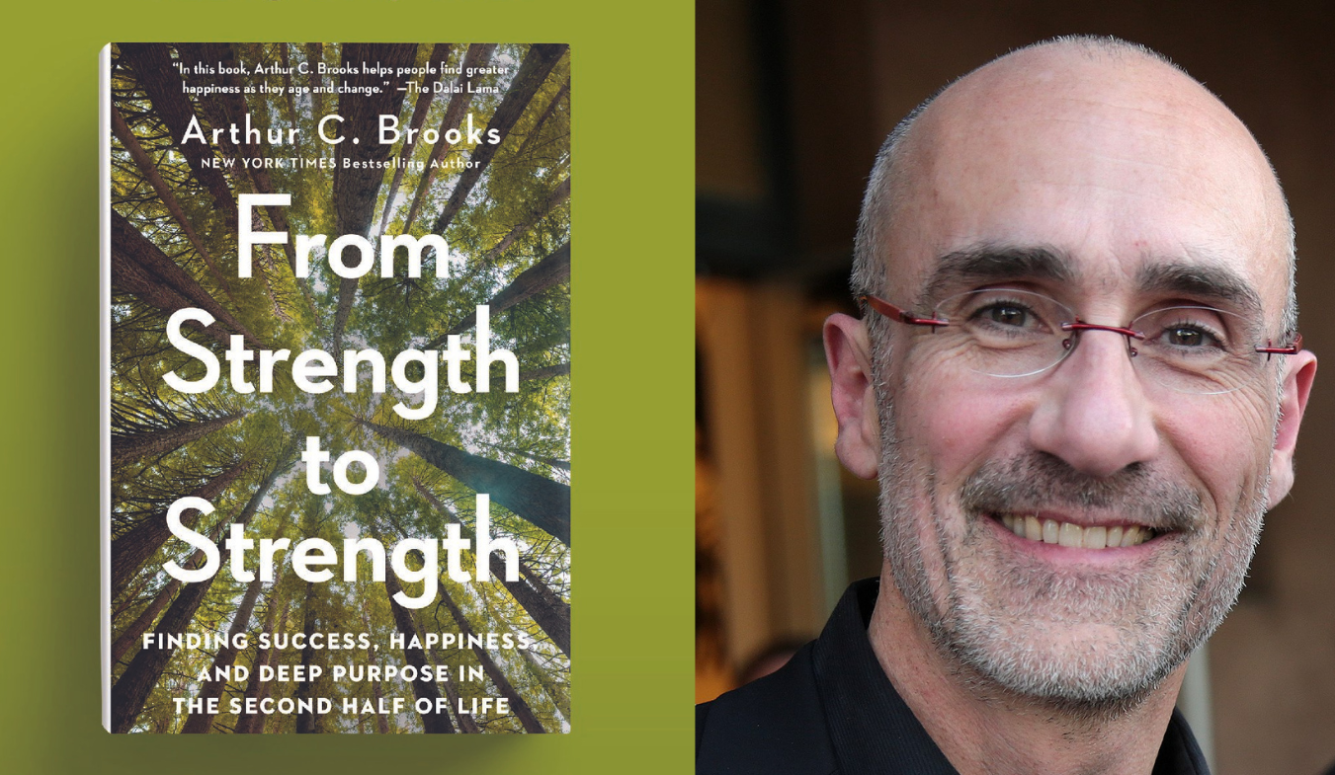

The man on the plane wished he were dead. Despite being a household name in America, the elder statesman feared being lost to the sands of time. He confessed to his wife that he felt unneeded and useless. The world had moved past him. His life—his entire being and sense of self-worth—were anchored in the past during a time when he meant something, when he got things done, and when people respected him. But as he left his seat, passengers began to murmur words of veneration. The airline staff recognized and thanked him.
Arthur Brooks was seated just behind the man watching all this, and the whole episode struck him as bizarre. In the introduction to his latest book, he recalls wondering: “Which more accurately describes the man—the one filled with joy and pride right now, or the one twenty minutes ago, telling his wife he might as well be dead?” That conversation stuck in Brooks’s craw for a decade, and finally provoked him to ask the same question of himself.
As a successful writer, bestselling author, and think-tank impresario, Brooks had life by the balls—money, notoriety, prestige. He’d mastered the hedonic treadmill better than most. But unlike the man on the plane, Brooks knew there was an impending expiry date. Cognizant that intelligence peaks for many in their 30s and 40s, he makes reference to the distinction drawn in the 1940s by British psychologist Raymond Cattell between smarts (fluid intelligence) and wisdom (crystallized intelligence).
Brooks has spent the last decade fixated on this dilemma, embarking “on a personal quest to turn my future from a matter of dread to an opportunity to progress.” From Strength to Strength is the upshot of a philosophical pilgrimage that sent Brooks across the globe in search of a cure for the “striver’s curse,” which afflicts those who have achieved success but who are eventually forced to step back from it. Some are even forced to do so because they’ve become too slow, old, and feeble to stay in the game.
It’s not just Harvard professors like Brooks that confront this crisis. Joe Rogan has spoken about the hole left in fighters’ hearts when they leave the limelight of the Octagon:
One of the things I think about sometimes with all the great fighters that I’ve seen come and go is just how difficult it must be for some of them to leave behind the incredible excitement and intensity of the world of being a professional fighter and then reset your life and find yourself something else to dedicate your time and interest to. … When it’s time to move past that and into a new phase of life I would think that for some it must be incredibly difficult.
It is, and so the book’s remaining nine chapters offer a roadmap towards a deeper and more durable sense of meaning. Building on his premise of inevitable professional decline, Brooks uses the contrasting examples of Johann Sebastian Bach and Charles Darwin to teach us about the art of aging gracefully. Bach holds a special place in Brooks’s heart. Brooks himself aspired to be the best French horn player of his generation, and even landed a prestigious gig with the City Orchestra of Barcelona at the age of 25.
However, unlike his idol, Brooks never achieved the stardom he sought. Not only did Bach publish a thousand compositions, but he also managed to father 20 children (yes, you read that right). One of his litter, Carl Philipp Emanuel (CPE), became the new generation’s greatest composer, ushering in his own father’s musical obsolescence. Bach could’ve moaned and fretted about this, but he didn’t.
Overshadowed by his own son, Bach couldn’t imagine that, today, he’d be the more famous composer. When Mozart said, “Bach is the father, we are the children,” he was reportedly referring to CPE. Thankfully, Bach didn’t hang up his harpsichord; instead, he found time to write The Art of Fugue, which was rediscovered a century after his death and is still performed in concert today.
The elder Bach died mid-sentence, writing music. He aged gracefully, enjoyed two loving marriages, and when he reached what Brooks calls the “Second Curve,” where one’s fluid intelligence recedes, he fell back on his crystallized intelligence. Rather than resenting his inability to stay with the times, Bach “reinvented himself as an instructor,” Brooks writes. “He died beloved, fulfilled, respected–if not as famous as he once had been–and, by all accounts, happy.”
Darwin, on the other hand, failed to manage the Second Curve. At 22, he joined the scientific expedition of a lifetime aboard The Beagle and spent the next five years traveling the globe collecting “exotic plant and animal samples.” Over the coming decades, Darwin contemplated how life adapts to diverse environments, and ultimately published his life’s work, On the Origin of Species, at the age of 50.
Most people would be satisfied with such an astonishing accomplishment. But Darwin was addicted to success and unable to live up to the high bar set by his own discovery. Still famous, Brooks writes, Darwin “was increasingly unhappy about his life, seeing his work as unsatisfying, unsatisfactory, and unoriginal.” Darwin said as much. “I have not the heart or strength at my age to begin any investigations lasting years, which is the only thing which I enjoy,” he confessed to a friend. “I have everything to make me happy and contented, but life has become very wearisome to me.”
To most readers, Darwin’s displeasure will seem incomprehensible. His work remains relevant today. He was buried in Westminster Abbey “a national hero,” yet his last years were filled with depressing thoughts of decline and uselessness. While Bach embraced his Second Curve, Darwin didn’t know it was there and crashed right off it. He thought, as Brooks once did, that we are our work and that our intellectual powers never wither or retreat.
Keep reading
Robert Lynch on Status, Humour and the Apes We Pretend Not to Be | Quillette Cetera Episode 74
The Radicalisation of Tucker Carlson
A Pop Fiction Master and Monster
Australia’s Coming Censorship Machine

Anatomy of a Book Promotion