Education
Affirmative Action Conundrums
People of goodwill tie themselves into the most absurd intellectual knots as they attempt to discuss affirmative action without acknowledging its inherent unpleasantness.
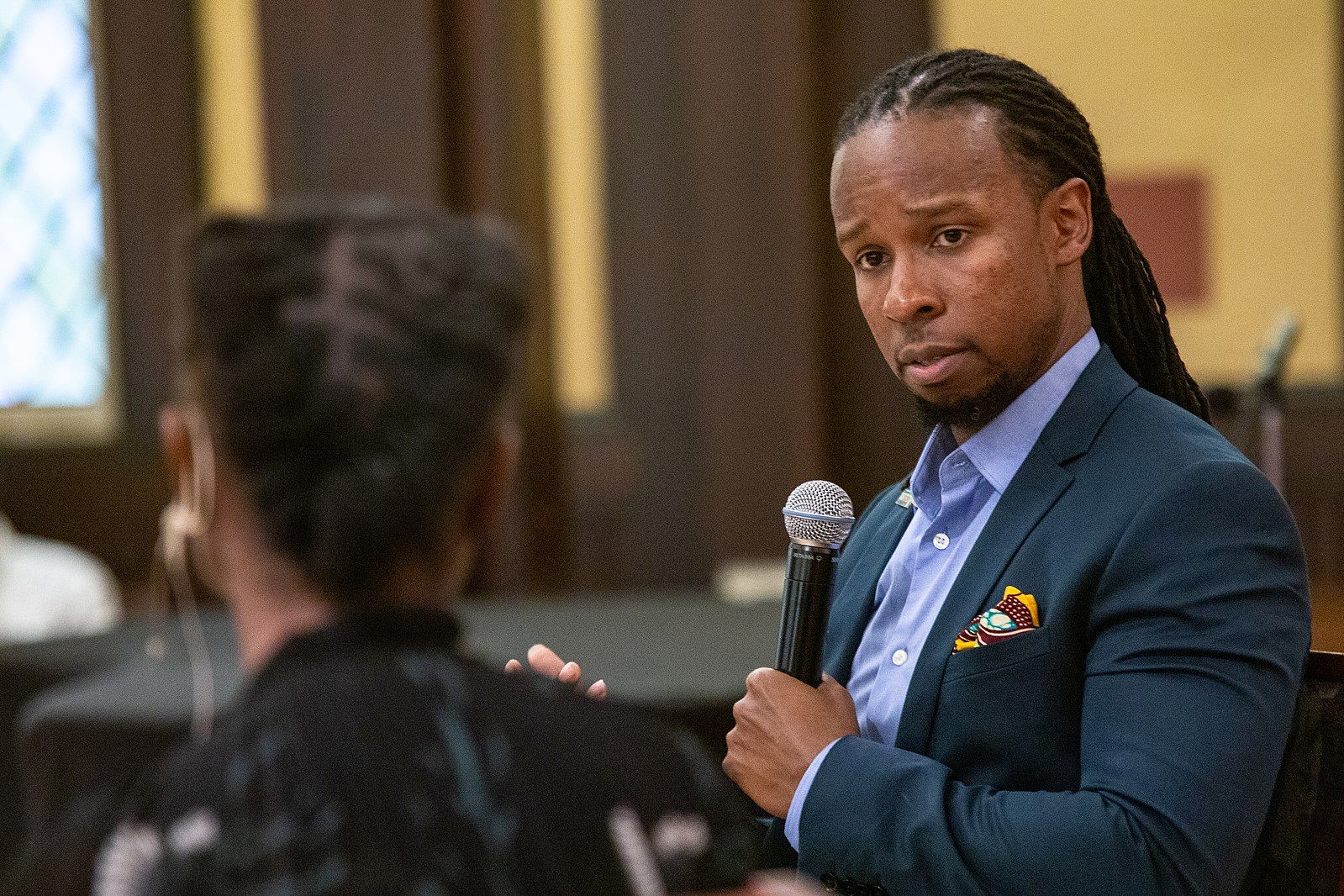

Historian, anti-racist activist, and recently named MacArthur “Genius” Grant awardee Ibram X. Kendi made waves on Twitter recently with the following (since-deleted) tweet:
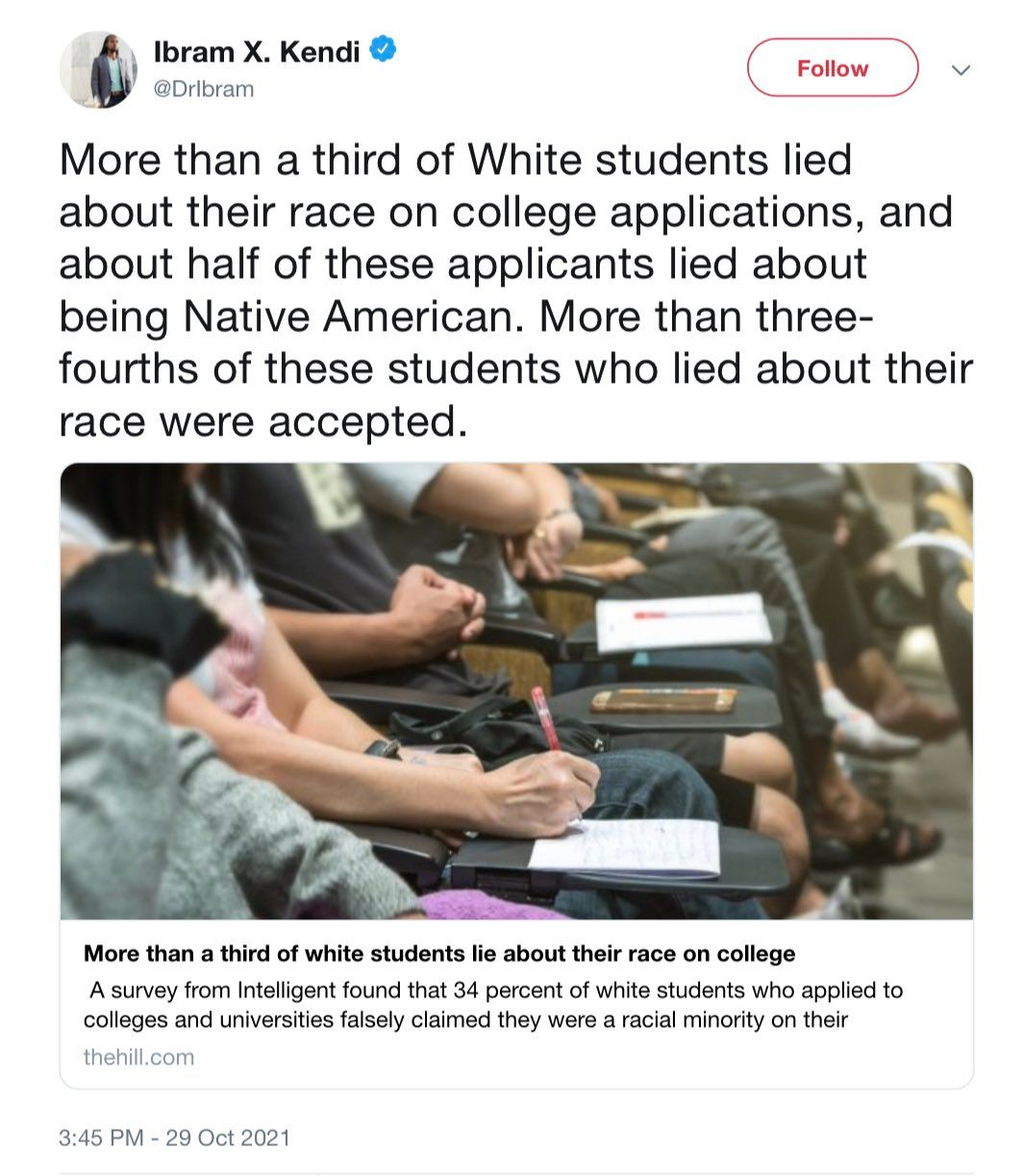
The survey results to which Kendi referred were highly dubious, but his critics seized on a different point. Taking them at face value (as Kendi seemed eager to do), didn't these numbers contradict the central claims of Kendi’s work and indicate that the United States was not, after all, comprehensively bound up in an ideology of “whiteness” and “white supremacy”?
Following three days of viral ridicule, Kendi responded with a 14-tweet thread in which he sought to explain his critics’ “tortured line of thinking” like this:
When White applicants *think* they have an advantage by lying about being a person of color then that means they *do* have an advantage which then means structural racism doesn’t exist. They imagine White people are disadvantaged while White people are on the higher end of nearly every racial disparity. They imagine Black and Native people have racial advantages at the same time Black and Native people are on the lowest end of nearly every racial disparity.
There is one plausible thing in here, and two puzzling things. The plausible thing is that the presence of one advantage for a group does not indicate the absence of a net or structural disadvantage. The puzzling things are, first, that Kendi seems to be suggesting that his critics had inferred an advantage for members of under-represented minority groups in college admissions from a single (probably unreliable) study and not from the widespread practice of affirmative action itself. And, second, that Kendi seems to forget the plausible thing he said and goes on to aver that members of marginalised groups can’t have any advantages at all if they are structurally disadvantaged.
But Kendi’s defensive salvo raises broader issues about affirmative action. Why would an anti-racist activist affect skepticism about the existence of an anti-racist policy like affirmative action? And what explains the existence of affirmative action—a policy that powerful universities and employers litigate to continue implementing—in a country in which racism is purportedly endemic?
During the Trump presidency, the relatively young Supreme Court Justices Neil Gorsuch, Brett Kavanaugh, and Amy Coney Barrett were appointed to replace Antonin Scalia, Anthony Kennedy, and Ruth Bader Ginsburg, respectively. Consequently, the political and jurisprudential makeup of our nation’s highest court is about as conservative as it has been in my lifetime. One issue some commentators expect the conservative Court to reassess is the legal status of affirmative action in college admissions. A group calling itself Students for Fair Admissions has already launched lawsuits on behalf of white and Asian college applicants against several prominent American universities, including Harvard, Yale, and the University of North Carolina. So far, they have lost their Harvard case in court and in an appeal to the First Circuit.
From 2009 to 2010, I was in law school myself, and spent a lot of the year prior to that on a law school admissions message board—one of those old forums from the age before Twitter and Reddit, but after the age of Usenet and telnet servers. Unsurprisingly, affirmative action was a topic of constant debate there. Well, how could it not be? A new user’s first post would often be their “numbers”—their grade-point average and standardized test scores—and they’d ask the rest of us for advice about where to apply. And we’d have to ask in return: What race and ethnicity are you? The question was of monumental importance to the advice we’d offer.
Though the debate still focuses on college admissions, affirmative action is also an important part of the hiring and promotion processes used by all kinds of employers. It can’t plausibly be something that gives disadvantaged people a leg-up at just one particularly important stage of life; rather, it is a procedure that is recapitulated more or less whenever any decision is made. But, notwithstanding its omnipresence, the policy has become entangled in a conundrum—even as affirmative action becomes a fixture of virtually every institution in the country, it is denied credit for its own accomplishments. Why? Because its beneficiaries—no matter how supportive they are of the policy—still do not want to be associated with it. Yes: no matter how much the dialogue has changed, everyone hates the idea of affirmative action. Even Kendi seems to dislike it. The claim that someone has benefited from affirmative action is generally treated more like a scandalous accusation than a neutral statement of fact, even by affirmative action supporters—not what you would expect from a treasured and successful policy.
Affirmative action fails ballot measures even in the most liberal states, and people of goodwill can tie themselves into the most absurd intellectual knots as they attempt to discuss it without acknowledging its inherent unpleasantness. At the same time, the ethos of affirmative action has made it past admissions and hiring into our approaches to interpersonal encounters. Robin DiAngelo and the other handsomely remunerated hucksters in the you’re-so-problematic anti-racist cottage industry basically train people to be individual loci of affirmative action psychology in everyday life. And studies bear out that white liberals do in fact exhibit this psychology: they use shorter words with black people than with white people and judge them by less exacting standards. Such studies seem to bother everyone, but why should they? This condescension is just the same policy extended into the personal sphere.
Back in 2009, it was a point of general agreement that affirmative action policies were prima facie discriminatory and hence undesirable, and that they needed a compelling justification to overcome this fact. Even a deviation from colourblindness had to pay respect to the colourblind ideal by justifying itself on other grounds.
This, of course, is how courts have always treated affirmative action. Three justifications were floated at the time. First was the diversity rationale, a relatively centrist justification enshrined in actual law. Schools, it was said, had a particularly compelling interest in ensuring diversity because it made the learning experience better for everyone. A rising tide lifts all ships or whatever. Then there was the historical reparations rationale. The United States had a duty to compensate black people in particular for the injustices and atrocities committed against their ancestors (and the disadvantages they had inherited), and affirmative action was a reasonable means of doing so. Finally, there was the role model rationale, according to which the relative paucity of black professors, administrators, graduates, and so on constituted an additional obstacle for black students since they lacked role models whose success they might wish to emulate.
None of these rationales informs much of the discussion about affirmative action today outside of court decisions. The idea that affirmative action helps white students by bringing the diverse perspectives of black students into the classroom is seen as tokenism that concedes too much to white interests. Affirmative action is no longer really considered a reasonable vehicle for reparations, either; the right way to achieve reparations—if they’re justified at all—is to pass a reparations bill. And I don’t hear much talk about the role model rationale anymore. If I had to guess, I’d say the hip view is that it misdiagnoses the problem or even blames black people. Plus, years of affirmative action ought to have ameliorated the role model problem, so continuing to use this rationale would be to accept an increasingly limited role for the policy (or would constitute a tacit acknowledgement that the policy had failed to produce its intended results).
So what justifications for affirmative policies have replaced them? Well, none, as far as I can tell. The current conversation about affirmative action denies that there is any sort of tradeoff or that the policy requires any compelling justification at all. Instead, its necessity is substantiated in three new ways.
First, affirmative action is straightforwardly anti-racist, since anything that helps black people is anti-racist. Second, affirmative action cannot possibly be racist, since the people against whom it discriminates are not considered powerless in a way that would make discrimination against them objectionable. Third, affirmative action does not really discriminate at all because the whole idea of merit or student ability is itself a racist or otherwise prejudicial notion. Or, at the very least, every current metric we use to assess merit or student ability is racist, maybe even intentionally so. So how could affirmative action possibly discriminate against white or Asian students in favor of black or Hispanic students? By reducing focus on the false concept of merit, affirmative action actually makes the whole system less discriminatory. I find these claims highly unpersuasive, but they’re what I tend to hear.
Since I teach at a college myself, I should make clear that I personally have never really found there to be a systematic difference in the quality of the work submitted by students of different races and from different ethnic backgrounds. But firstly, my own limited experience has hardly any evidentiary value whatsoever, and secondly, this is very different from saying that there isn’t such a thing as differentiating quality of work at all. On the contrary, I have certainly had extraordinarily good students and extraordinarily bad students over the years. Any college professor will say the same, unless they are trying to muddy the waters.
How could affirmative action play an important role in an allegedly racist, white supremacist society? Critical race theorists hew to the interest convergence thesis, which holds that policies that help nonwhites are only able to pass when they also help white people. For this reason, some writers, like Kimberlé Crenshaw, one of the originators of the theory of intersectionality, have claimed that the group that benefits from affirmative action the most is white women (in Crenshaw’s words, the “principle [sic] beneficiaries”). But at least in college admissions, white women do not benefit the most from affirmative action. They do not benefit more than members of underrepresented minority racial and ethnic groups; they could not possibly based on average grades and test scores and admission rates for the different groups. Compared to white men, white women are admitted to college at rates roughly proportional to their representation in the population; they have only slightly lower SAT scores, and they have higher grades. So it is virtually impossible to read into college admissions statistics an energetic affirmative action program for white women. A Vox article making this claim cites only Crenshaw to substantiate it, and Crenshaw’s own article has no footnotes whatsoever—a very rare thing in a law review.
Keep reading

What the Navigators Knew

Gemma Tognini on Australia’s Political Revolt

Rubio in Athens

How France Lost Control of Its Streets