Culture Wars
Watching America’s Crack-Up
America was born of the virgin Liberty, and like the son of God in which it still largely believes, will always rise from the dead.

When you have lived long enough in a foreign country, you eventually begin to realize that the one you left behind, once accepted as utterly unique since it was all you knew, is not particularly different from anywhere else. One can call this perspective, but it is more a recognition of the essential contingency of any nation.
This is especially true when observing a country like the United States, which raises its children to believe that it is exceptional and, being exceptional, also immortal. Indeed, living in a country like Israel, which must be ever-vigilant about existential danger, I am struck by America’s extraordinary sense of invulnerability. An unthinkably bloody civil war did not break it, nor did Pearl Harbor or even 9/11. America and Americans, by and large, think they are going to live forever. Like most Americans, I grew up reflexively believing this. It was never said or taught outright, but it was a kind of cultural assumption. America was born of the virgin Liberty, and like the son of God in which it still largely believes, will always rise from the dead.
From afar, however, you eventually realize that, just as no man is immortal, nor is any nation. It is possible, of course, that it may survive for a very long time—much longer than the lifespan of any individual citizen. But even Rome fell, and while the Jews and perhaps India and China appear to prove the possibility of perpetual existence, it is in the nature of existence itself that survival is by no means inevitable.
This disillusion has been much on my mind lately, as I gaze from this great distance at the country of my birth. Because from over here in Tel Aviv, it looks like America is in the midst of a crack-up.
I doubt that it is necessary to present a complete list of the symptoms of this collective nervous breakdown, but there were certain inflection points that seem important in retrospect. Over the past 20 years, America threw itself into two wars, one necessary and the other wholly not. It saw the rise of an anti-war movement that asserted, quite stridently, that a relatively innocuous president was the equivalent of Hitler. It watched as its overclass, through greed and short-sighted pursuit of profits, nearly destroyed the economy. It elected a messianic leader who proved all too human and followed him with a narcissistic, bloviating, entirely unscrupulous incompetent who was indifferent to the basic conduct required to sustain a democracy. It witnessed a direct attack on one of the great institutions of that democracy, now defended by a great many who ought to know better. It fostered an opposition composed of radicals prone to censorship and street violence. It has been riven by racial divisions that appear to admit of no obvious solution. And now it must contend with the fact that approximately half the country believes that a presidential election was stolen because their mendacious leader told them so.
The results of all this are not too difficult to discern: A significant segment of the American Left and Right have both, to a great extent, given up on the republic and its institutions. Something like a low-intensity race war has broken out both on the streets and in rarified cultural and academic institutions. Half the country considers their opponents godless, pagan heathens who are—at times literally—in league with Satan. The other half considers their opponents Nazis who are seeking to rebuild and re-enforce a white-dominated racial hierarchy. Both believe, quite sincerely, that the victory of the other side will mean the triumph of evil and therefore must be prevented at (almost) any cost.
All of this has led me to contemplate a depressing but perhaps inevitable possibility: I don’t see how America gets out of this. I had hoped that the Capitol attack might finally break the fever, and that some measure of sanity might prevail. But the opposite happened, and the Right has, with some noble exceptions, doubled down, proclaiming that the mob were peaceful protesters and Ashli Babbitt is the new John Birch. The Left, meanwhile, has gone about gutting the right to free speech and destroying the lives and reputations of anyone who ventures that there are, for example, only two sexes. Neither side, then, is willing to admit the obvious, and is determined to impose an alternative truth—that is, lies—by coercive means, if necessary.
This all seems to add up to something like a sign of the end. Republics, and especially democratic republics, rest not only on the written law but also on an unwritten law: “Thou shalt submit to reality.” This brand of Enlightenment-born politics requires citizens to assent to the laws of the republic, the institutions of the republic, and the results of its regular elections, secure in the knowledge that there will always be another one. In other words, citizens are expected to conduct themselves as reasonable human beings. No one, however, appears to be reasonable anymore. One side believes that the moral imperative of equity overrides all other values and considerations, including the Bill of Rights; the other side submits to nothing but the dictates of its spiteful demagogue. This is unsustainable.
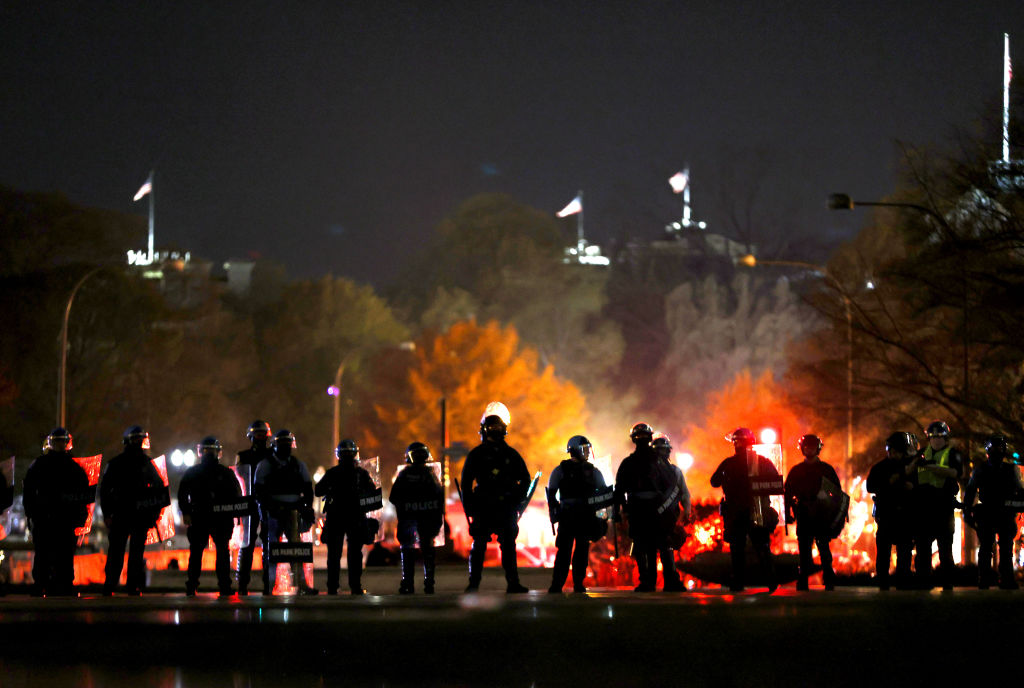
There are, of course, reasons for this—some good and some not. America may simply be a society so traumatized by recent history that it can no longer contend with reality. 9/11 and the 2008 financial meltdown would have been bad enough, but now a once-in-a-century pandemic has claimed over 600,000 lives. That large numbers of Americans are losing their bearings—rejecting common-sense measures to contain the disease or burning down their neighbors’ homes and businesses in the name of social justice—should not be entirely surprising. Perhaps America has simply been through too much.
 Niranjan Shankar
It should also be admitted, however, that some of Americans’ grievances are understandable. Today’s neo-socialists, for example, are surely correct to argue that a society as wealthy but unequal as the US is profoundly unjust. The younger generation’s susceptibility to this argument is unsurprising—as Douglas Murray has said, “It’s not clear why people who don’t have any ability to accumulate capital will love capitalism.” This has happened in the past, of course. In the 1970s, the social democratic New Deal consensus began to show diminishing returns; in 2008, the neoliberal market fundamentalism that replaced it did the same. But no viable replacement has emerged this time, and almost nothing has been done to address the seething discontent that has resulted.
Nor, despite activist excesses, is the race question necessarily posited in bad faith. It is cruel and false to tell black Americans that their experiences of racism are a lie; or to deny, for example, that slavery and Jim Crow prevented them from accumulating the legacy assets that other American ethnic groups enjoy. One can debate what ought to be done about this, but the Left is surely correct to insist that something must be done.
The Right, meanwhile, nurses its own grievances. The prevailing culture has become reflexively hostile to traditional, religious, and even patriotic beliefs, and the growing tendency to demonize white heterosexual men is bound to produce a ferocious backlash. If you keep telling people they are terrible human beings, they will eventually tell you to go fuck yourself. The white poor and working classes look at themselves and see none of the privilege they are accused of possessing, and they are understandably tired of seeing some of their most cherished beliefs derided and denounced.
There is another, darker anxiety, which lies beneath the surface of contemporary right-wing radicalism—very soon, white European Americans will be a minority in the United States. One may see this as a good thing or a bad thing, but it is nonetheless inevitable, and carries serious implications. It is difficult to think of a moment in history when a majority has submitted to becoming a minority without a fight. A diverse, multi-racial nation has much to recommend it, and might well be more free, vibrant, and prosperous than a mono-racial one. But this does not change the human impulse to separate into in-groups and out-groups, and history has shown that when a previously dominating group finds its status threatened, the results are usually violent.
It must also be admitted that, while the current hysteria may be unprecedented, the phenomenon itself is not. American history moves in cycles, and every few decades it is gripped by some kind of moral panic, during which rationality goes out the window. As the philosopher John Gray has written, our current moment owes as much to Salem as it does to Marx. It’s a Burned-Over District out there. This is, in other words, an indigenous problem: America is a democracy and, as such, must often submit to the whims of the crowd. But crowds are often either stupid or mad, and so we have a new McCarthyism in the form of cancel culture and a new Protocols of the Elders of Zion in the form of QAnon.
In America’s past, reason and reality have eventually reasserted themselves against the madness of crowds, be they the Weathermen or the Satanic abuse panic. At the moment, however, with both sides hermetically sealed in their cultural, ideological, and political bubbles, this seems all but impossible. The embrace of mass self-delusion has become a badge of honor, a form of personal identity, and people do not surrender those things easily, if at all. To the true believers, giving up their hallucinations feels like a kind of death. In such cases, the self dissolves in the face of rationality, and there is little that people will not do to prevent this from happening. There are those who have built their lives around refusing to wear a mask or making sure to check their privilege, and it provides them with a sense of righteousness and belonging that every human ultimately needs in order to feel whole.
So, both sides of the crowd have points to make. If the legitimate could be separated from the indefensible, some kind of consensus could probably be reached, or at least the maddest among them marginalized. At the moment, however, neither side is assimilable by the other, because they disagree on the basic structure of reality itself.
The rival tribes naturally have their respective solutions to the present dilemma. They are not especially edifying, but they do exist. Among the groundlings of the Right, there is simply the admonition to, as the QAnon slogan puts it, “trust the plan” and have faith in Jesus and his earthbound representative, Donald J. Trump. Among the more intellectually minded deplorables, there is the equally strident admonition that perhaps a monarch, Caesar, or dictator would be preferable to leaving the progressives in charge. Then, of course, there is always the sometimes—and lately more than sometimes—mooted option of secession.
The less fervent Trumpists float solutions that are barely less radical. There is the idea, much discussed, of formulating a “common good” and then engineering a government—by fair means, one hopes—that will impose it. This common good seems to mostly involve a return to traditional religiosity (that is, conservative Christianity) by the general culture, and—among the non-monarchists—a kind of pure federalism, driven by their opposition to what some have begun to refer to as “the regime” and “the oligarchy.”
Among the particularly strident partisans of the common good, this becomes an unmistakable form of atavistic illiberal nationalism that is, in many ways, alien to the American tradition of liberal republicanism; in that it is not a civic creed but a populist cult of the “real Americans” with distinctive, and more and more openly spoken, racial and ethnic undertones. I doubt it is lost on any black person, for example, that “America First” is unlikely to include the America in which they live. Nonetheless, like all messianic movements, this “national conservatism” provides a rush of transgressive adrenaline to otherwise anodyne intellectuals, as well as a holy cause—a righteous rhetorical uprising on behalf of the downtrodden. And, of course, it identifies the essential enemy in the form of the “Deep State,” which is said to be responsible for enforcing the progressive oligarchy’s doctrines. In classic Marxist fashion, this must be smashed if the blessed society is to be successfully rebuilt.
The progressive hysterics are less honest, but in many ways smarter about what is to be done. They usually confine themselves to denunciation, and tend to be painfully vague about what might follow the overthrow of the Ancien Régime. But their actions indicate that they wish to extend the pattern of conduct they already practice in the institutions over which they exercise hegemony. This would be something like a soft totalitarianism, enforced without gulags or firing squads, but rather through public shaming and the power to annihilate a person’s reputation and livelihood on a whim. The hoped-for result seems to be a re-educated population in which—among the non-pragmatic—absolute racial and sexual equity will have been achieved. However, what equity might look like in practice appears to be a secret guarded only for the initiated. It sometimes feels as if, were one of them to reveal it, they would likely end up like Valerius Soranus when he spoke the secret name of Rome.
The activist vanguard are preoccupied with identity politics, but it is not true that they neglect economics, although they are as vague on this issue as on any other. What appears to be in the offing is a kind of Sandersism—a quasi-socialist system ostensibly based on the Scandanavian model, but which (given American radicals’ reaction to the recent protests in Cuba) would likely include an unhealthy dose of Fidelism. At the farthest end, of course, is the Green New Deal—as messianic a fantasy as the Right’s common good.
It is easy enough to simply dismiss all of this as ideological fanaticism, but that would be somewhat unfair. Serious people are advocating these things, and they deserve to be taken seriously. Still, the only serious response is that none of it is workable.
The Right’s idea of a return to God and a nostalgic vision of the traditional order, for example, won’t and can’t work. The theocrats can stand athwart history yelling “stop” as much as they like, but a very large part of the United States has no wish to follow their advice, because they are either indifferent to religion or intensely opposed to it. One of the fastest growing “religious” groups in the US is those of no religion or unaffiliated. Anyone who thinks that those who consider God either dead or a fool’s invisible friend in the sky are going to start filling up churches again is simply deceiving themselves.
As for those who wish to see the creation—for one has never existed before—of a kind of ethno-nationalist Americanism, one can set aside the considerable moral complications of such an ambition, and simply point out its impossibility. Several constitutional amendments, numerous Supreme Court rulings, and various acts of sweeping legislation have made the formal or informal imposition of a single ethno-nationalist group as a hegemonic power illegal. To change this would require the abrogation of every one of those amendments, rulings, and laws. And anyone who thinks the suddenly non-hegemonic groups would not fight to regain their previous status has not been following the events of the last two years with any great attention. An ethno-nationalist US would simply exacerbate existing racial and ethnic tensions, and America does not need another race war on top of the one it already has.
The desire to destroy the Deep State, on the other hand, has a certain irony and even humor to it, because for most of the last half-century, it has been the Left that entertained fantasies about overthrowing what they preferred to call the “military-industrial complex.” Granting the Right the indulgence of assuming that the Deep State actually exists, what they are advocating can be nothing less than a wholesale purge of all institutions of government and bureaucracy—including the previously revered FBI and Justice Department—in which anyone deemed non-conformist to the “common good” will be sacked and replaced by someone like Tucker Carlson (if America’s lucky) or Sidney Powell (if it’s not). This would require something like a coup d’etat, which may well be why the likes of Salazar and Ashli Babbitt have suddenly emerged as revered totems in certain circles.
None of this lets the progressives off the hook. Soft totalitarianism is still totalitarianism. It may not be openly murderous, but this is essentially irrelevant, because it can murder everything that makes men free, and with it essential things like thought, creativity, and dignity. And a totalitarian America with the facade of a republic would be even closer to collapse than it already is. Whatever their other flaws, most Americans still care deeply about their freedoms, and will eventually fight for them should they deem it necessary. In such a culture, and especially such a heavily armed culture, any attempt to impose a soft totalitarianism faces the prospect of a hard resistance.
On the issue of equity, it is certainly possible to envision a more equal America, but absolute equality is, like all absolutes, a utopian dream—a laudable goal would become an unending Quixotic quest driven by perpetual bitterness and grievance. The campaign for reparations, for example, strikes me as eminently justified, but it is so vehemently opposed by many of the people who would have to pay for them (and indeed, by some of the intended recipients), that the backlash against their enactment would set racial progress back at least a generation.
Pressing the nebulous concept of “systemic racism” is likely to have a similar effect. For reasons that remain fiercely disputed, American blacks continue to be disproportionately disadvantaged. But the maximalist claim that the American project is racist in its entirety—or, as the 1619 Project has argued, in its essence—will, I suspect, turn out to be a disastrous miscalculation. Despite everything, the majority of Americans remain patriotic, and will not assent to the vilification of their country. In fact, it is more likely to make them hostile to repairing those areas of American society in which racial injustice does persist. A great many Americans earnestly wish to see greater racial progress, and the critical race theorists cannot afford to alienate them if they are actually going to get anything done. At the moment, they are alienating them, which only sets both sides on the path to mutually assured destruction.
Progressives’ economic ambitions are, if anything, even less edifying, given that they rest on the resurrection of an ideology that could not be more profoundly dead. That it is being advocated mostly by geriatric limousine radicals like Bernie Sanders and those too young to remember the Cold War is telling. A radical socialism in almost any form simply cannot be advocated by anyone except those who have either learned nothing from—or know nothing about—the 20th century.
Neoliberalism may be stumbling, but socialism has lost both its legs, and there is no realizing its ambitions without a radical rethink. Remarkably, its current advocates refuse to engage in anything resembling this kind of reassessment. A more equal and altruistic society remains a laudable goal, but an attempt to realize it via a system that has never realized anything like equality or altruism is either delusional or simply an argument in bad faith—the act of those who seek raw power even as they tell themselves otherwise. It looks, in other words, like a species of nihilism, a suspicion fortified by its advocates’ rampages through American cities, destroying private property for no reason at all.
That all this is more or less wishful thinking seems to be summed up by the Green New Deal, which advocates dismantling the US’s entire energy infrastructure, while promising that sources of energy wholly unable to provide for our current energy demands will replace it. Nuclear power—the only practical replacement for fossil fuels—remains ignored.
Hundreds of thousands and perhaps millions would be thrown out of work by this creative destruction. They are assured that they will be given good jobs in the new and greener energy industry, but such jobs could not possibly exist during the decades needed to build such an industry, and even if it were successfully constructed, these discarded workers would have none of the skills necessary to take part in it. The Green New Deal would, in other words, hurl them into abject poverty. One must give its advocates the benefit of the doubt—they surely believe that nothing like this catastrophe would occur. But this cannot be of much comfort to those afflicted as a result. To steal a line from Brecht, give me bread, and then talk to me about renewable energy.
What we are being offered, then, from both Left and Right, is not very much. Nevertheless, they are sincere in their beliefs, fervent in their advocacy, and often fanatical about their messianic ambitions. All this presents a terrible dilemma, because both sides are dedicated to ideas that cannot possibly meet the challenges of the current moment. Worse, they are determined to thwart and destroy their rivals’ ambitions. And there is every reason to believe that neither side will remain standing once the inevitable collision occurs. Perhaps only sane people will be left to pick up the pieces, and a more pragmatic and cooperative zeitgeist will prevail by default. If so, the mess the sane stand to inherit will be exceedingly difficult to clean up.
Keep reading
A Clockwork Filmmaker


The Insight Trap
Cornell and Consent
Robert Lynch on Status, Humour and the Apes We Pretend Not to Be | Quillette Cetera Episode 74