History
Sex and the American Presidency
What does all this have to do with the sexual follies in the White House? Like the Bolshevik Revolution, sex is nothing if not leveling.

This essay was first published in the French literary journal America, on July 8th, 2020
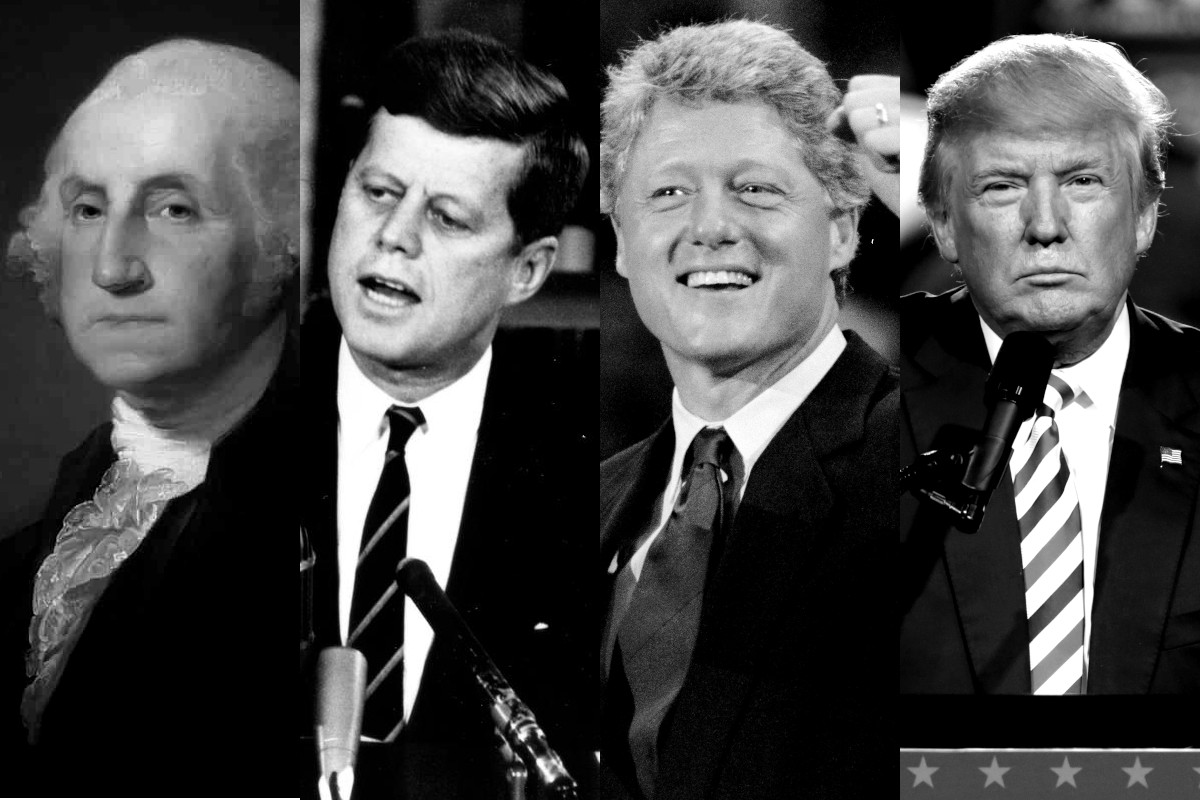
America was founded by an austere religious sect for whom sex was anathema. America invokes God on both its coinage and paper money. In 1630, John Winthrop declared America to be “a city upon a hill,” gilded words that borrowed from the Sermon on the Mount and were famously echoed centuries later by Ronald Reagan. And yet the current occupant of the White House, Donald Trump, has appeared in not one but three softcore pornographic videos. Mercifully, he remained clothed for the duration of his time onscreen and did not engage in actual sex, yet one must ask: How did we arrive at such a louche and ridiculous place, a carnal funhouse where the individual on whom the hopes of 330,000,000 of his fellow citizens are pinned is someone who once posed for a photographer while reclining on a bed clad in a bathrobe that looked to have been filched from a stripper’s closet, subsequently married a former model a simple Google search will reveal writhing stark naked on a bearskin rug, and has been credibly accused of sexual assault by multiple women?
I am no Puritan. But it has nonetheless been a surpassingly head-spinning transition. America has long been a deeply sentimental country. Not the intelligentsia, of course, the serious writers, artists, and intellectuals that always pride themselves on their complete lack of sentiment. But they are vastly outnumbered by the mall-going, superhero-loving, happy ending-addicted legions in its thrall. This sentimentalism is manifested in our popular culture and politics and the president plays a particular role in this pageant, one of not just leader but avatar, an individual whose qualities his fellow citizens are meant to admire, one they can direct their children to emulate (the Caligula-like Trump, obviously, has scrambled this equation and please be advised I will have more to say about him). As a result, until deep into the 20th century, sex was not something that played a significant role in the history of the presidency. To be sure, it was not entirely absent. During the 1884 presidential campaign, Grover Cleveland, who was reputed to have sired a child out of wedlock, was greeted on the trail with chants of “Ma, Ma, where’s my Pa?” To which his supporters responded: “Gone to the White House, ha ha ha.” But the libertine Cleveland was the exception. Presidents were meant to be married, have families, and refrain from sexual profligacy.
Abraham Lincoln, perhaps the most revered president after Washington, presents a provocative footnote to presidential sexuality in the pre-modern era. Although he is known primarily for issuing the Emancipation Proclamation that ended slavery and surehandedly guiding the nation through the Civil War, a vocal minority of contemporary scholars have made the case that he was gay. I had been under the impression that this was an entirely modern notion and more an outgrowth of university Gender Studies programs and wishful thinking on the part of gay scholars until, while researching this essay, I ran across a tidbit from the pen of poet and Lincoln biographer Carl Sandburg who in the 1920s wrote of his subject’s “streaks of lavender, spots as soft as May violets.” To be sure, prior to his marriage to Mary Todd, Lincoln shared a small bed with his friend Joshua Speed for four years and for decades this was considered simply a colorful detail, clearly a reflection more of his limited housing options than any proclivities he may have had. Of course, the modern mind does not have to take a far leap at this point. But if Lincoln was in fact the first gay president, this is not something being taught in American public schools since homosexuality is not congruent with the civic religion of which the president is high priest. No president had even been divorced until Reagan broke that taboo, and this was a time at which the divorce rate was already around 50 percent. It is worth noting that in the Democratic presidential primary of 2020, Pete Buttigieg, a gay man, won the state of Iowa, so attitudes appear to be slowly evolving, although many Americans cited Buttigieg’s sexuality as a sign of his inability to get elected. Nevertheless, what Buttigieg accomplished was earthshaking because until he came along, a gay president would have been unfathomable. And should the belief in Lincoln’s homosexuality ever become more accepted, it is unlikely to be a point of emphasis for most Americans.
George Washington, our first president, was reputed to have been a paragon of virtue, the enduring myth of his life the inability to tell a lie. One associates Washington in the popular imagination with winter camping at Valley Forge and standing in an open boat while crossing the frozen Delaware River. The famous Gilbert Stuart portrait depicts a bewigged, stern-looking man on whom it would be difficult to project a sexual thought, even were you not to imagine his wooden teeth. As if to further burnish the notion of heroic self-restraint, the so-called “father of the country” had no children. To President Washington’s eternal good fortune, he served well before the dawn of Freudian theory and was thus during his lifetime spared that variety of scrutiny. But this conspicuous absence of offspring nonetheless adds to his enduring image of genitalia-free masculinity. George Washington established the prototype for the office of president: courageous, strong, ascetic; a perfect chief executive for a less complicated epoch, one nearly unimaginable now.
The president occupies a unique place in American life. He is at once the most visible American citizen and yet his true self (and we will use masculine pronoun here since, to the abiding shame of any remotely enlightened citizen, there has yet to be a woman in the office) remains a mystery, and cloaked in this mystery is his sexuality. Let’s spend a moment on the idea of presidential image making. First there were oil portraits, then newspaper photographs. Most citizens had never heard a president speak but that changed with radio, and the tone of a leader’s voice gave Americans a more palpable sense of the individual. When cinema swept the country, presidents appeared as figures in newsreels along with other stories of the day but movies were never a part of the actual political process. Then: Television. None of the prior visual vocabulary had the power of television in terms of conveying the totality of the person. The introduction of this new instrument of communication completely changed how Americans perceived their chief executive. Although television was invented in the 1920s, television sets were not ubiquitous in American households until the 1950s and it was not until the election of 1960 between John F. Kennedy and Richard Nixon that the medium played a major role.
It was the campaign of 1960 that saw the first televised presidential debates. The political opinions these candidates espoused were reflected in the visual image each man presented to the camera. Nixon was dour, dark, and sweaty. Not a handsome man, he was uncomfortable and awkward in most circumstances and his lack of grace and charm was particularly apparent under the hot glare of television lighting (Nixon would eschew televised debates in his future campaigns). John Kennedy did not have these problems. Scion of a wealthy family, Harvard graduate, and war hero (his memoir of that experience, Profiles in Courage, had naturally been a bestseller), Kennedy was as handsome as any movie star. And his personal bounty did not stop at handsome because he was keenly intelligent and had charm to spare. Do you see where this is going? With John F. Kennedy, sex, after nearly 200 years, finally bloomed at the White House. I’m not referring to sexual intercourse because we know that had been occurring for years within those hallowed walls. But the idea of sex, the notion that the occupant of the Oval Office was a sexual being capable of inspiring lust in millions of his constituents, was entirely new.
In 1960, President Kennedy was as sexy as Elvis and Frank Sinatra; as sexy as Marlon Brando. Kennedy’s pheromones broke the mold not only in America, but the world. De Gaulle was the prime minister of France in 1960. The occupant of 10 Downing Street was Harold Macmillan. Whatever their ability as leaders, when it came to carnality, Kennedy’s advent left them in the dust. Flash forward to 1962, President Kennedy’s 45th birthday. A celebration at Madison Square Garden is tightly packed with throngs of his admirers, all of whom watch raptly as Marilyn Monroe, at the time the world’s reigning sex goddess, stood at the microphone clad in a sequined dress so form-fitting she had to be literally sewn into it, and sang “Happy Birthday” in tones so redolent of the boudoir that hearing it nearly 60 years later can shorten one’s breath. Everyone acted like it was innocent entertainment and only the most gimlet-eyed onlookers could even imagine that the two were having an affair, much less know that it was true (it was). Kennedy and his advisors were masters of image-making and the American public was treated to a cavalcade of pictures of the president with his beautiful, sophisticated wife and adorable children. There they were playing touch football on the White House lawn, gamboling on the beach at Hyannis Port. But while all of this wholesome fun was being performed, Kennedy may as well have had a revolving door installed in his bedroom, so busy was he performing the Kama Sutra with the willing women that his enablers shuttled in and out of the White House as if they were supplying succulent morsels to an insatiable glutton. It has since been reported that he required sex once a day or headaches would ensue, and perhaps his Catholicism precluded masturbation. A few members of the press corps were aware of his shenanigans, but the rules were different then and it remained unspoken. The quiet suffering of Jacqueline Kennedy had the same root.
Bill Clinton was a great admirer of President Kennedy. An ambitious rube who clawed his way from the Arkansas backwater in which he was raised to Georgetown, Yale Law School, and a Rhodes Scholarship saw in Kennedy everything he hoped to achieve in his own life. A formative Clinton story is the one in which, as an awestruck 16-year old, he shakes the hand of President Kennedy; he touches the actual flesh. One wonders what secret mojo passed between them that day. Did Clinton have any idea that his hero was what my father would have called a “swordsman”? Certainly not at the time. Clinton reportedly cut a sexual swath through Arkansas as governor and the tang of sex followed him on to the presidential campaign trail in the form of Juanita Broaddrick, Gennifer Flowers, and Paula Jones. He is alleged to have had a protracted affair with Flowers and was credibly accused of rape by Broaddrick. As for Jones, she claimed he exposed himself to her in a hotel room. While Clinton admired Kennedy, it is abundantly clear that his erotic escapades were not conducted with the elan of his predecessor. It was the summer of 1998 when President Clinton’s sexuality streaked like a supernova across the American sky. As Philip Roth memorably described it in his novel The Human Stain, it was:
The summer of an enormous piety binge, a purity binge, when terrorism—which had replaced Communism as the prevailing threat to the country’s security—was succeeded by cocksucking, and a virile, youthful, middle-aged president, and a brash, smitten, 21-year-old employee carrying on in the Oval Office like two teenage kids in a parking lot revived America’s oldest communal passion, historically perhaps its most treacherous and subversive pleasure: the ecstasy of sanctimony… It was the summer when a president’s penis was on everyone’s mind, and life, in all its shameless impurity, once again confounded America.
For a description of how much of America reacted to President Clinton bringing the morals of an Arkansas barnyard into the ostensibly more refined precincts of the Oval Office, it is difficult to improve upon Roth. If President Kennedy was the first to introduce a newly-minted political glamour with a soupçon of subtle sexuality that was baked into his virile charisma, Clinton put the sex front and center and the blowback, even among many Democrats, was fierce. Presented with a president as an overtly sexual being, the response of the American public was a resonant No, Thanks. That Bill Clinton and Monica Lewinsky were two consenting adults did not trouble the millions of people who reacted as if they were still living in the Colonial era with leather-bound volumes of Cotton Mather sermons on their collective bedside table and images of witches being hanged dancing in their heads. Never mind that Americans are, and have long been, obsessed with sex. Never mind that one of the fastest growing American industries at the time was pornography. Visualizing The President and the Horny Intern taking place in the White House led to a spasm of collective pearl-clutching which entirely belied the far more libertine reality of the American sexual landscape. Although the reaction across the political spectrum was extreme, on the Right it was deafening. The Speaker of the House, Newt Gingrich (who was having an affair at the time because of course he was) valiantly led the fight to impeach so as to preserve the dignity of the republic and virtually every Republican fell in line behind him. That Clinton was not convicted can mostly be attributed to Democrats controlling the Senate at that time and enough members of the opposition concluding that lying under oath about oral sex was ultimately not punishable by removal from office.
What the normally shrewd Clinton failed to understand was that the rules had changed in 1988 when Gary Hart, then the frontrunner for the Democratic presidential nomination, was photographed cavorting on a yacht named, too perfectly, “Monkey Business,” with a woman not his wife. After halfhearted denials, Hart finally admitted that he was having an affair and that was the end of his campaign. The era when journalists allowed for a bifurcation of a politician’s personal life and the public one was resoundingly over.
For many liberals, myself included, Clinton’s behavior, while not exemplary, was at least on a certain level defensible. Monica Lewinsky may have been young but she was an adult at the time. She was responsible for her own behavior and to say otherwise would deny her agency. This caused all kinds of problems for feminists who did not know what to do with Monica. Was she a victim, or an adventurous, high-spirited young woman looking to experience her sexuality to the fullest? And who knew what was going on with the Clintons? Everyone’s marriage is a foreign country and there is no need for further speculation. Was a sitting president not entitled to a little relief from the stresses of the job? The debate among liberals raged and continues to this day. Now would be a good time to mention that a lot of people who defended Clinton during the time of his tribulations lately take a more nuanced view of the power dynamics inherent in the situation. I count myself among them.
It is not uncommon to hear the loss at a time of peace and prosperity of Clinton’s vice-president Al Gore to George W. Bush in the election of 2000 be attributed to the political stink of Bill Clinton’s sexual incontinence which can easily lead one to conclude that a blowjob performed by a White House intern indirectly caused the bumbling response to the devastation inflicted on the city of New Orleans by Hurricane Katrina, the war in Iraq, and migrant children in cages at the American border. It is a carnal interpretation of the Butterfly Effect, an aspect of chaos theory which holds that a butterfly flapping its wings in the Amazon will set off an incalculable chain of events around the world; fellatio in the White House, say hello to the Battle of Fallujah.
As for the historical perspective on Clinton’s libido, that it is perceived as of a different order than Kennedy’s in public imagination can be attributed to the fact that JFK appeared to have been born in a tuxedo whereas Clinton’s nickname was Bubba, which is shorthand for redneck. Given America’s love affair with the upper classes, it is easy to understand why the popular retrospective view seems kinder to Kennedy. As for President Warren G. Harding who served briefly from 1921–23 and whose erotic love letters to his mistress Carrie Fulton Phillips only recently came to light, his behavior is simply fodder for esoteric comedians. (I would be remiss if I did not provide a sample of President Harding’s oeuvre, without comment: “Honestly, I hurt with the insatiate longing, until I feel that there will never be any relief until I take a long, deep, wild draught on your lips and then bury my face on your pillowing breasts.” Feel free to take a moment to have a sip of water before we continue.)
 Christopher J. Ferguson
One of the saddest side-effects of President Clinton’s habitual lapses in judgment was the serial public humiliation of his wife Hillary. Although she remained stoically at his side, her suffering redolent of medieval Christian saints (if those saints verbally lashed out at their tormentors), anyone with the slightest degree of humanity could sense the degree to which she was shriveling inside. Along with the public vivisection of her marriage that became an ongoing facet of American life and has remained so for decades, Hillary Clinton evolved into the most prominent First Lady since Eleanor Roosevelt and perhaps the only one that was more accomplished. Surviving her misfortunes as a political spouse squarely positioned her to run for the Senate where she served two terms, and to ultimately come within a whisker of being president. What did she and Eleanor Roosevelt have in common besides their turbulent marriages? Having their physical appearance besmirched? Sure. Being loathed for their outspokenness by large swaths of the country? Absolutely. But most fascinatingly, to me, is that both of these fiercely intelligent, deeply accomplished women were bedeviled by speculation that they were lesbians. Eleanor Roosevelt was a passionate advocate for civil rights for African Americans (something very much not a mainstream position at the time), wrote a daily newspaper column, held regular press conferences, hosted a weekly radio show, and was the first presidential spouse to speak at a national party convention. She set the template that Hillary Clinton followed in her own unique way. There were murmurings about Mrs. Roosevelt’s lesbianism at the time (I’m not going to weigh in on whether or not they were true although if you’re interested, Google “Eleanor Roosevelt, Lorena Hickok, love letters”). And once again, Mrs. Clinton’s experience mirrored Mrs. Roosevelt’s and has trailed her to the point where she most recently denied rumors of her purported lesbianism during a radio interview with the popular media personality Howard Stern in 2019. This is a good time to point out that one never heard salacious chatter about Jacqueline Kennedy, Lady Bird Johnson, Pat Nixon, Laura Bush, or Michelle Obama, all women that embodied more traditional notions of their public role. When I discussed this phenomenon of First Lady lesbian rumors with my adult daughter, she pointed out that “lesbianism is how most Americans metabolize powerful women.” Consider that a trenchant explanation which has the added virtue of being largely true.
While we can thank President Clinton for introducing the words “blowjob” and “rape” to the lexicon of the American presidency (to be fair, the rape accusation of Juanita Broaddrick, however credible, remains unsubstantiated) along with the semen stain on the blue Gap dress that figured so prominently in his impeachment and probably belongs on a wall in some parallel universe version of the Smithsonian Institution, it is President Trump who can lay claim to gifting political journalists with “porn star,” “I moved on her like a bitch,” and the immortal “you can grab ’em by the pussy,” the last utterance nearly derailing his campaign shortly before the election of 2016. Alas, it did not derail his campaign, and here we are: With Trump.
Keep reading
Anti-Catholic Social Panics, Then and Now
A Dishonest (and Dangerous) Nobel Laureate
Common People
How Genetics Rewrote History
Equal Pay, Unequal Work