Nationalism
The Virtue of Nationalism — A Review
The second and most impressive section of the book lays out Hazony’s principled arguments for adopting a vision of the world order characterized by an 'order of independent nation states.'


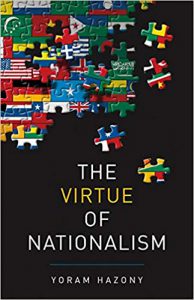
A review of The Virtue of Nationalism by Yoram Hazony. Basic Books (September 2017) 304 pages.
The last 30 years have witnessed many arguments about the end of nationalism and the nation state, ranging from Fukuyama’s end of history thesis to Thomas Friedman’s claim that globalization was making the world “flat.” But, as they say, reports of the nation’s death now appear to be exaggerated. Over the past few years, from Brexit in the United Kingdom, to the rise of right wing nationalists such as Donald Trump in the United States, Viktor Orban in Hungary, and Poland’s Law and Justice Party, the specter of nationalism looms once again.
Yoram Hazony’s welcome new book The Virtue of Nationalism analyzes this political shift and offers a defense of its value. Hazony’s book is by far the most interesting and compelling articulation of the nationalist case put forward thus far. This makes The Virtue of Nationalism an important book, since those looking to defend the nationalist cause will surely want to arm themselves with its formidable intellectual resources, while those (such as myself) who are critics of nationalism must now contend seriously with its arguments. Moreover, the book is exceptionally readable, always thought provoking, and includes a number of passionate and touching asides which explain Hazony’s reasons for writing the book. Needless to say, this is unusual in an academic work, and Hazony deserves praise for being as forthcoming about his personal motivations as he is.
Before I discuss Hazony’s main arguments and offer some objections, I should offer a qualification. The book is clearly written with an inclination to defend Israel against criticism from international institutions. While important, I will not address these issues here because a substantial discussion of those debates exceeds the purview of this review.
Arguments
Hazony’s book is divided into three sections. The first, “Nationalism and Western Freedom,” is primarily a historical account linking the emergence of Western freedom and self-determination to the moral and spiritual influence of the Old Testament Bible, and later Protestantism’s emphasis on national self-determination. The second, “The Case for the National State,” is the longest and most powerful section. Here, Hazony puts forward a more principled argument for the nation state, drawing on an impressive combination of philosophy, Biblical analysis, history, and international relations theory. Finally, the concluding third section, “Anti-Nationalism and Hate,” is designed to rebut critics who believe nationalism abets violence and hatred.
The first section of the book—“Nationalism and Western Freedom”—establishes the basic antagonism framing much of The Virtue of Nationalism:
For centuries, the politics of Western nations have been characterized by a struggle between two antithetical visions of world order: an order of free and independent nations, each pursuing the political good in accordance with its own traditions and understanding, and an order or people united under a single regime of law, promulgated and maintained by a single supranational authority.
Hazony understands the first vision of “free and independent nations” to be a product of two primary influences. The first is the Biblical nationalism of the Hebrew Bible, which he argues has continuously softened Western aspirations to universal empire, by ensuring “that the idea of the self-determining independent nation would be revived time and again.” Unfortunately, Hazony does not discuss this link between the Hebrew Bible and nationalism in much detail, though I suspect it is treater more thoroughly in his earlier books such as The Philosophy of Hebrew Scripture. Still, more elaboration would have been helpful since Professor Hazony consistently emphasizes the importance of the Old Testament, while expressing a much more mixed appreciation for the New Testament.
Having discussed the Hebrew state and its holy texts, Hazony moves on to criticizing the Western desire to establish a universal Christian Empire, a project which he claims was most ambitiously attempted by the German Holy Roman Empire and the Roman Catholic Church. This aspiration was abetted at the end of the Thirty Years War, which marked the end of both the Holy Roman Empire and the Church as the primary political actors of Western Civilization. According to Professor Hazony, the Treaty of Westphalia ended the Thirty Years War and inaugurated the “Protestant Construction of the West.” Countries like England and the Netherlands worked to re-found “the entire political order” on the basis of Westphalian nation states. These, it was hoped, would impose limits on government and support principles of national self-determination.
However, Hazony admits that this “re-founding” was troubled and inconsistent, as many of the Protestant European states were quite content to preach nationalism at home while engaging in vast imperial projects abroad. He also has a mixed appreciation for the Protestant emphasis on individualism and economism, best embodied in the thinking of John Locke. Hazony admires capitalist markets and free exchange, believing the experimentalism and empiricism they embody contrasts favorably with the rationalistic desire of socialists to impose a given redistributive order atop the market. However, he also argues that the Lockean emphasis on individual self-interest as the basis for political legitimacy contributed to a growing indifference to tradition, shared values, and responsibility. He notes with approval Edmund Burke’s striking declaration that Locke’s Second Treatise on Government was “one of the worst” books ever written. This lukewarm appreciation towards liberalism extends to the present day. Hazony notes that modern liberals, wherever they sit on the political spectrum, have increasingly accepted a kind of radicalized Lockeanism which aims to “subordinate the independent nations” to the control of international federations such as the EU and liberal super-powers such as the United States.
The second and most impressive section of the book lays out Hazony’s principled arguments for adopting a vision of the world order characterized by an “order of independent nation states.” Simplifying somewhat for the sake of brevity, Hazony argues that the traditional liberal individualist model of political legitimacy is wanting. He is especially critical of contractarian authors such as Hobbes, Locke, and Kant who believe that self-interest and/or hyper-individualism are or could be the legitimate foundations of the state. However, Hazony is not entirely willing to forgo the consent-based models of legitimacy these liberal authors rely on. Instead, he wants to socialize them by suggesting that it is in fact groups who are the foundational actors in politics by consenting to establish the nation state which is to govern them.
 Alexander Zubatov
Hazony develops a four-pronged typology of groups which I present in order of escalating scale: families, clans, tribes, and nations. Hazony argues that, historically, the formation of the nation-state proceeded through a gradual process of inclusion. Families consented to form political associations with clans with whom they shared traditions, languages, and religions in common. These clans then consent to form larger tribes, and these tribes finally established nation-states. Hazony then argues that this historical process of consensual inclusion into broader political associations should stop at the nation state level. Hazony’s ideal political association is a “free state.” A free state is “one in which the cooperation of the ruled is given to the government voluntarily. This can happen is the heads of a coalition of tribes, recognizing a common bond among them as well as a common need, come together to establish a national standing government.”
While Hazony admits that nation states can fail to live up to this standard by becoming despotic, he believes they are less likely to give in to despotism than “universal” empires consisting of many nations. Moreover, Hazony argues that, even where nation-states are despotic, their propensity towards violence tends to be constrained relative to alternative political associations. Therefore, Hazony believes that national freedom should be the “ordering principle” of the world order, since even where it leads to disaster, it is freer and less violent than attempting to establish an international empire or law, whether oriented by liberal or any other principles.
The third part of the book is focused on rebutting those who immediately associate nationalism with hatred and violence. Hazony admits that under some circumstances, nationalism can indeed engender ethnocentric violence and brutal wars of self-interest. But he argues that such conflicts tend to be limited, because a proper nation state has little interest in expanding its authority beyond the confines of the tribes and clans of which it is comprised. When discussing the nationalist wars of Nazi Germany, Hazony maintains that these countries had more in common with the universalist internationalists than with nation states properly understood. Nazi Germany wished to establish an imperial hold on the different nations of the world, uniting them under the control of a single dominant race.
Unfortunately, the evils wrought by the Axis powers brought nationalism into disrepute and the philosophies of internationalists like Immanuel Kant into vogue. In his seminal essay “Perpetual Peace: A Philosophical Sketch,” Kant argued that nation states were primitive and lawless political associations that needed to give way to a global federation of states organized by a system of liberal international law. In the aftermath of the Second World War, many Europeans and Americans accepted Kant’s argument, leading to the formation of the international legal system and federations like the EU. Hazony argues that this was the wrong lesson to draw from the Second World War. A world order of free and independent states, as framed by documents such as the Allied Atlantic Charter, would have been far preferable.
Hazony goes on to argue that modern internationalists want to quash freedom and national particularity by establishing a new global empire in all but name. He brings up a number of examples, the most convincing of which are his criticisms of American interventionism. Unfortunately, Hazony also engages in needless hyperbole in parts of this section, a tendency captured in passages where he claims “the horror for the national and the particular, the hatred of emperors and imperialists, burns bright among liberal internationalists. They have taken up the yearning from universal empire, believing in it as Christians once believed, and as Marxists once believed.” This conflation of complex and different historical and philosophical movements, alongside the suggestion that they all hate the “national and the particular,” is unworthy of a scholar of Hazony’s ability.
Objections
There is a great deal to admire in Hazony’s book. The prose is sharp and lucid, the arguments always thought provoking, and the examples relevant. Moreover, Hazony is admirably undogmatic in many respects. He admits throughout the book that his order of nation states will never resemble any kind of utopia. Indeed, how could it? Permitting different nation states to pursue different conceptions of the good may lead to some unfortunate outcomes. But Hazony feels this is preferable to an “imperial” project which will have to be enforced by central authorities, and which he believes could only be achieved through immense repression. However, the book does have considerable problems which limit its capacity to convince internationalists such as myself.
Keep reading
How France Lost Control of Its Streets

How to Suppress Men’s Writing

Back to the Dark Ages

Prison or Peer Review

France’s Imaginary Austerity