Art & Culture
Tired Old Myths — The New Republic Slanders Jung
The ignoble tradition of Jung-bashing has had a steady following by lazy minds ever since, most recently evidenced in Jeet Heer’s article, Jordan Peterson’s Tired Old Myths.
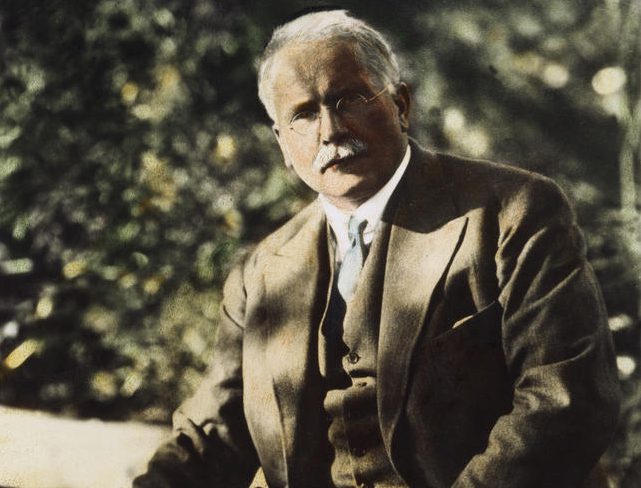

Recently, in The New Republic, Jeet Heer’s sanctimonious critique of Jordan Peterson led him to one of Peterson’s sources, Carl Jung. Heer is doubtless unaware that, in his dismissive misrepresentation of Jung and his work, he had joined a shameful tradition started by Freud. “So we are rid of them at last,” wrote Freud to his colleague in July 1914, “the brutal holy Jung and his pious parrots.”1 The ignoble tradition of Jung-bashing has had a steady following by lazy minds ever since, most recently evidenced in Jeet Heer’s article, Jordan Peterson’s Tired Old Myths.
What was the reason for Freud’s hostility? Jung, previously Freud’s designated “crown prince,” had strayed from Freudian doctrine. Jung’s interest in mythology and religion led him to posit as primary a universal drive for meaning and personal development he called individuation. Freud exhorted him not to abandon Freud’s “scientific” theory that the sexual drive is the basis for human motivation. When Freud asked Jung to make a “dogma and an unshakable bulwark” of the sexual theory, Jung became alarmed, as he later noted in his autobiography—
First of all, it was the words “bulwark” and “dogma” that alarmed me; for a dogma, that is to say an undisputable confession of faith, is set up only when the aim is to suppress doubts once and for all. But that no longer has anything to do with scientific judgment, only with a personal power drive.2
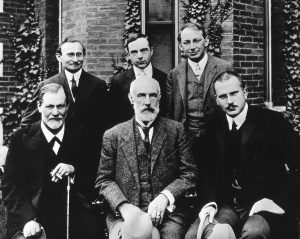
Freud’s effort to outflank Jung started with a secret committee established by Freud’s inner circle in 1913. The aim of the committee was to protect Freud from further defections and ensure his position as the unrivaled leader of the psychoanalytic movement — reminding us that no platforming and authoritarian groupthink have been with us for quite some time.
If imitation is the sincerest form of flattery, denunciation must be a close second. Although many since Freud have been almost as zealous in their efforts to discredit Jung, his writings, like an ever-renewing spring, continue to resist such attempts. Jung’s work, which concerns itself above all with the human capacity for transformation long chronicled in myth and religion, has rightly influenced many. It has inspired thinkers and authors like Joseph Campbell, James Hillman, Clarissa Pinkola-Estes, Jean Shinoda Bolen, James Hollis—and now Jordan Peterson.
Jung’s understanding of myth is foundational to his work, and Heer’s assumption that it can be casually dismissed as “outmoded” reveals a superficiality of understanding. Heer, astonishingly, misses the nature of the symbolic, central to the most basic understanding of Jung. He therefore grossly misapprehends Jung and embarrasses himself with his dismissal of the value of myth.

Myths from a Jungian viewpoint are stories of archetypal encounters in which the collective psyche tells us how it undergoes development. Myths are involuntary collective revelations based on unconscious psychic experience; they teach us that archetypal energy is supra-ordinate to human power, and are to culture what dreams are to the individual. Myths provide symbols – including those used by politicians and regimes – that dynamically activate the discovery of new possibilities. With Campbell, Peterson has elaborated on Jung’s understanding of myth to see in them the distilled, unconscious wisdom of ancient cultures. These authors appreciate his interpretations of myths both for their rigor and inspiration.
Heer reaches a new low with the accusation that Jung harbored Fascist sympathies, and does so without citing a single source. Jung excoriated fascism, Nazism and other dictatorial modes of governance and thought. Perhaps in keeping with today’s liberation from facts, this article seemed lacking in even cursory research. Heer’s statements about Jung’s political convictions are blatantly untrue and unsubstantiated. The New Republic should be ashamed of such a departure from journalistic integrity.
Jung’s inquiry into the psychology of dictatorship—which has relevance to the Trump regime – attempts to identify the destructive outcomes when a collective urge to flee from cultural chaos emerges. Idealized fantasies then possess groups as they yield individual rights to a charismatic leader. His observations on the psychology of authoritarianism are no more an imprimatur of Mussolini or Hitler than Freud’s sexual theory is an encouragement for sons to mate with their mothers.
Keep reading
How to Suppress Men’s Writing
Back to the Dark Ages

Prison or Peer Review

France’s Imaginary Austerity

The Limits of Perfectionism