Cancel Culture
Anatomy of a Book Promotion
How a LinkedIn spat over the “glass cliff” cost McKinsey partner Chris Bradley his leadership role, and became the centrepiece of a book launch.
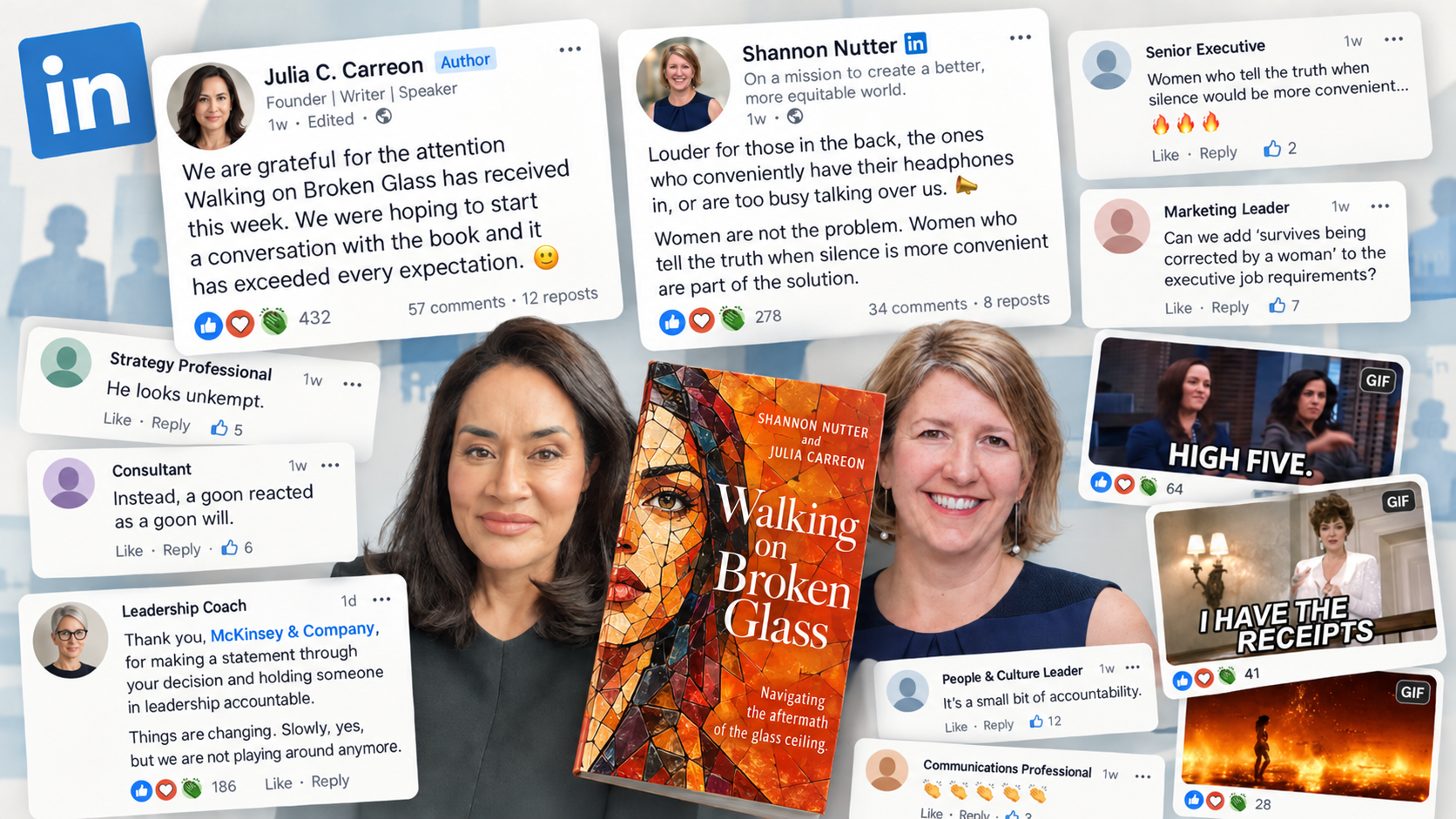

The trouble began with handbags.
On 24 September, a self-described founder and “adviser to CEOs” posted on LinkedIn about Gucci and Dior withdrawing their handbags from the Australian department store David Jones. After describing the store’s financial difficulties, she suggested that David Jones’s female chief executive was experiencing the “glass cliff,” a phenomenon whereby women are appointed to senior roles when organisations are in trouble.
“What on earth does the management’s gender have to do with it?” asked fellow LinkedIn user Chris Bradley, a senior partner at McKinsey and a director of the McKinsey Global Institute (whom I interviewed for Quillette’s YouTube channel in July).
It was a relatively innocuous question. But the ensuing debate would have a cascade of consequences. Within three weeks, Bradley had been stripped of his directorship and other leadership responsibilities at McKinsey, and had his face plastered across Bloomberg, the Australian Financial Review, The Sydney Morning Herald, the New York Post, Fast Company, and other international publications. Meanwhile, Julia Carreon and Shannon Nutter, whose new book had been recommended in the original LinkedIn post, enjoyed an unexpected burst of publicity.
LinkedIn is unique among social media platforms. Ostensibly a professional networking site, it is where people advertise credentials, look for jobs, and promote their workplace achievements. While other social media sites reward glamour and sexualisation, or anger and outrage, LinkedIn remains fairly bland by comparison.
Yet despite its corporate focus, LinkedIn has developed its own influencer economy. It is populated by people who write daily mini-essays about leadership and motivation. Among its subcultures is what might be called Feminist LinkedIn: a loose network of executive coaches and diversity, equity and inclusion advocates, who write about the obstacles women encounter in professional life.
Their profiles are often decorated with impressive-sounding but difficult-to-define job titles: “life strategist,” “chaos whisperer,” or “culture change advocate.” Some have substantial corporate experience, while others appear to have made a career out of commenting on careers. In this corner of LinkedIn, women post inspirational reflections, share personal stories of workplace adversity, and enthusiastically endorse each other’s posts. It was into this environment that Chris Bradley wandered.
“It’s not my job to educate you on what a Glass Cliff is,” wrote Julia Carreon, co-author of Walking on Broken Glass, tagging McKinsey & Company in her comment.
Bradley asked for clarification. “It sounds like you are saying that we once had a problem of female advancement to CEO, but now we have a new problem that the jobs they get are too hard? Is this actually a thing?”
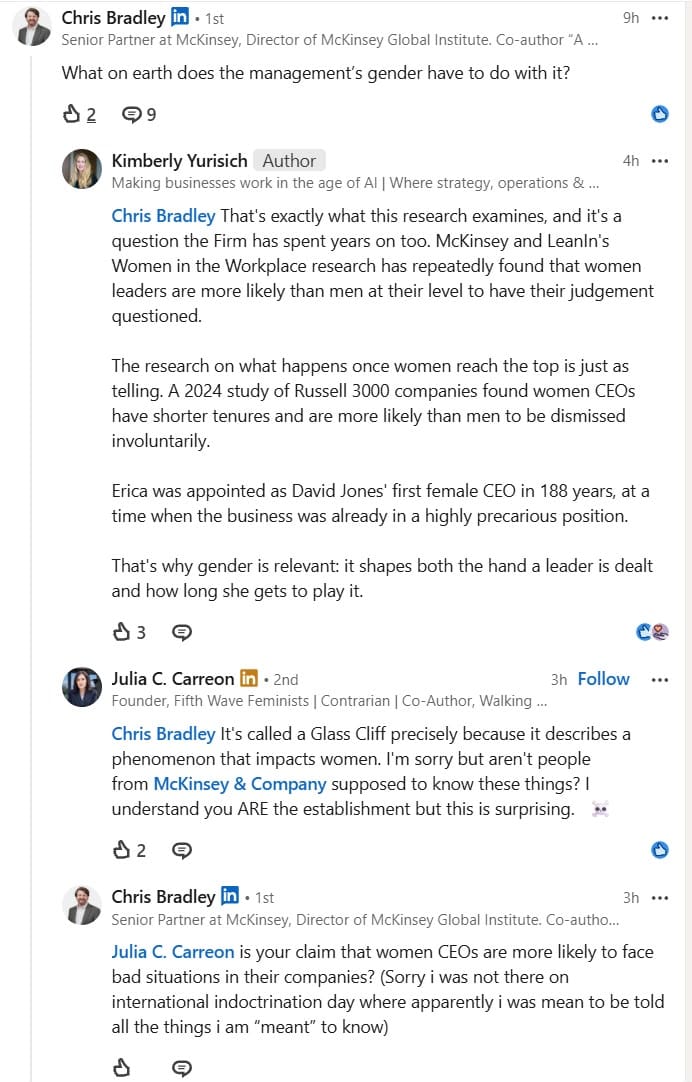
It was a flippant question, and Bradley later acknowledged that he was unfamiliar with the academic literature around the concept. But it wasn’t out of bounds for an online debate—it focused on an empirical question, rather than anything personal.
Bradley went on to describe the glass cliff as “a very convenient way to always be a victim in the rain,” a statement that was undeniably provocative. Carreon accused Bradley of choosing to remain “willfully ignorant.”
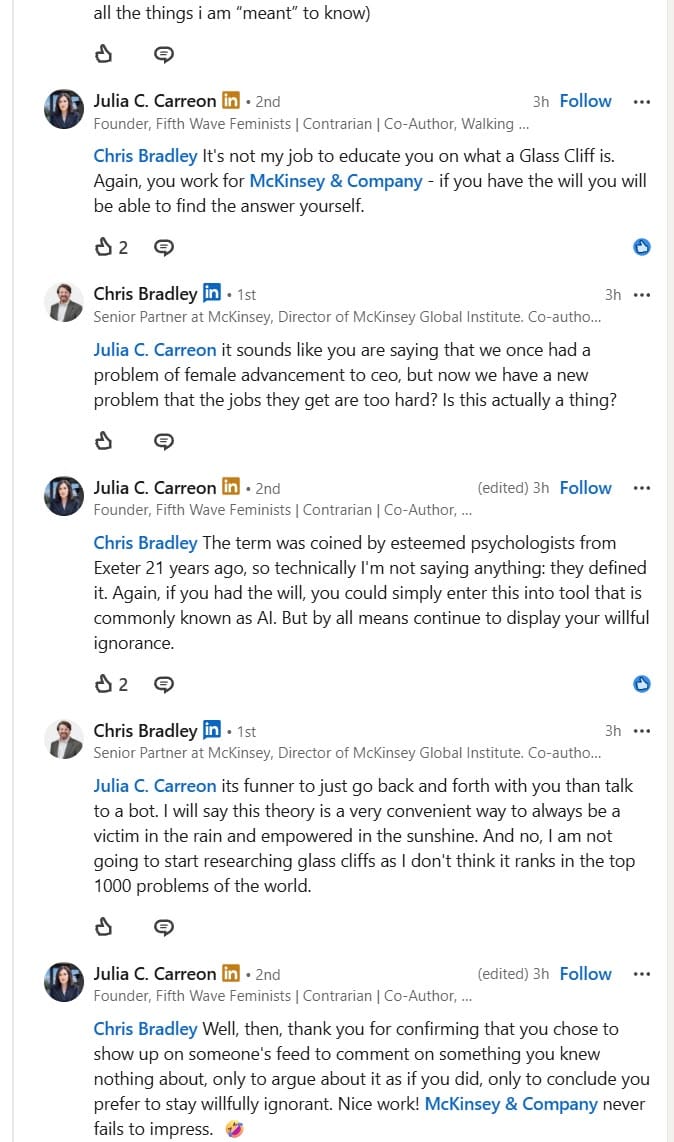
If Bradley had chosen to look into it, he would have found that the glass cliff was first proposed by psychologists Michelle Ryan and Alexander Haslam in 2005. But subsequent research has produced mixed results regarding the concept’s validity. A 2020 meta-analysis found a small effect that varied across organisational contexts. And a study of American companies, published in The Leadership Quarterly in 2025, found no clear evidence that women were disproportionately appointed to lead troubled firms. Two further studies published in 2026 found little evidence of the effect among chief executives, though one, of Britain’s largest listed companies, did find supporting evidence for female board chairs.
But even where the phenomenon can be demonstrated, the causes of the so-called “glass cliff” are not necessarily clear. Women might be offered more precarious appointments because of discrimination, or they might be more willing to accept them because they have fewer options. Perhaps organisations in crisis are simply more willing to consider unconventional candidates. Only one of these explanations points directly to sexism.
In other words, the glass cliff is a perfectly legitimate subject for scientific investigation. It is not settled science and there is no reason to suppose that anyone who expresses scepticism is necessarily hostile to women.
On 30 September, Bloomberg published a report by Matthew Boyle, Ambereen Choudhury and Amy Bainbridge, headlined “McKinsey Rebukes Partner Who Questioned Challenges Facing Women CEOs.”
The article quoted some of Bradley’s more dismissive remarks, alongside McKinsey’s statement that it was “disappointed” by them. But it did not reproduce a screenshot of the complete LinkedIn exchange, leaving readers to surmise Bradley’s conduct through selected quotations.
Nor did it mention the 2025 study published in The Leadership Quarterly, which found no clear evidence of a general glass cliff effect among American chief executives. Instead, Bloomberg cited McKinsey research showing that female leaders encounter greater resistance in the workplace, along with statistics indicating that female chief executives tend to have shorter tenures than their male counterparts—neither of which establishes a glass cliff.
Bloomberg also interviewed Michelle Ryan, one of the researchers who originally proposed the concept, yet no researcher questioning the hypothesis was quoted. Readers of Bloomberg would be left with the impression that the glass cliff was a settled theory, not a contested hypothesis.
Twelve days later, Matthew Boyle reported that Bradley had been demoted from his research position at McKinsey. Carreon and Nutter both shared the news with their LinkedIn followers, who celebrated.
“APPLAUSE and THANK YOU!” declared one follower.
“I’m so exhausted of this archaic way of thinking,” wrote another. “Truly, what will it take for humanity to evolve beyond this misogynistic hellscape?”
One supporter announced that she was standing on a rooftop, cheering herself hoarse and clapping until her arms fell off.
“THIS THIS THIS THIS THIS THIS THIS THIS THIS THIS THIS THIS THIS THIS THIS THIS THIS THIS THIS,” contributed another, followed by a fist emoji.
Underneath subsequent posts about the incident, Bradley was called a “dolt,” a “dope,” and a “goon” by Carreon’s followers. One commenter advised him to trim his beard and get a haircut because he looked “unkempt.” Another suggested publicising the identities of people defending Bradley so their employers, friends, and wives could be informed of their alleged misogyny.
There was, meanwhile, the matter of the book.
Several months earlier, Carreon had announced on LinkedIn that Nutter had done most of the heavy lifting on Walking on Broken Glass, including the writing and editing. Carreon intended to make up for this by taking charge of publicity. “I’ll get my payback by owning PR,” she wrote, “and I fully intend to crush that part.”
She did. After Bloomberg’s first report, various other media organisations picked up the story.
As news of Bradley’s remarks spread, Carreon and Nutter shared the media coverage with their LinkedIn followers, repeatedly explaining how the episode illustrated the arguments advanced in Walking on Broken Glass.
Nutter published a lengthy LinkedIn post describing his removal as “a small bit of accountability.” She went on to explain how the incident illustrated the workplace problems she and Carreon hoped to address in their book.
Beneath the post, Nutter supplied three links: one to an article in the Australian Financial Review, another to Bloomberg’s coverage, and a third to a website where readers could purchase Walking on Broken Glass for themselves. Carreon reposted the announcement.
The publicity was reaching at least some potential customers. Beneath another of Carreon’s posts, a commenter discussing Bradley’s conduct concluded: “PS: I’m going to buy your book!” In one LinkedIn post, Carreon described the McKinsey fiasco as having “gift-wrapped itself” for her.
There is, of course, nothing unusual about authors promoting their books. But using another person’s cancellation as a promotional vehicle is not a typical marketing strategy. So I wondered whether the publicity was simply a fortunate coincidence, or whether it had been orchestrated. I contacted Carreon by email to ask whether she or Nutter had provided the screenshots of the exchange to Matthew Boyle at Bloomberg, and whether she considered the resulting publicity beneficial to their book.
“Let’s establish something at the outset: There is no controversy surrounding me,” Carreon replied by email. She denied leaking the screenshots to the press or requesting disciplinary action against Bradley, insisting that she had “no involvement whatsoever” in McKinsey’s decisions. But a week earlier Carreon had posted on LinkedIn that she had direct contact with McKinsey. “The day before the article ran, I reached out to Bob Sternfels [McKinsey's global managing partner] in good faith. To say I was aware a story was going to drop & make clear that I was not the one who leaked the story to Matthew Boyle at Bloomberg News. I felt this was a teaching moment for McKinsey & I offered a conversation to his firm...”
McKinsey did not reply, according to Carreon. In the same post, she offered a theory as to why: she is pursuing a sexual harassment claim against Citibank (which Citibank vigorously denies), and Citibank’s chief executive is a former McKinsey partner. There is no evidence that McKinsey’s failure to respond had anything to do with her sexual harassment claim. But the theory itself is revealing. In Carreon’s account, an unanswered message to a consultancy firm is evidence of conspiracy.
“You ask whether I’ve used this situation to promote my book,” Carreon wrote to me. “The exchange occurred on a post about my book. Shannon Nutter and I spent two years researching the very dynamics Bradley was dismissing. Suggesting that discussing our work in that context is somehow opportunistic is an astonishing inversion of cause and effect.” She concluded with a postscript. “Shannon and I are starting some workshops on what it looks like to internalize misogyny. I suggest you sign up!”
There is no suggestion that either Carreon or Nutter engineered a LinkedIn spat in order to use it to promote their book. Nor is there evidence establishing who first supplied Bradley’s comments to Bloomberg. Neither Nutter nor Bloomberg responded to my queries about the matter and Bradley was unable to comment.
Nevertheless, once the story broke it came to dominate the book’s promotional efforts. Between the launch of Walking on Broken Glass in mid-September and 15 October, Carreon and Nutter published 29 posts of their own about the book on LinkedIn. Ten of them referred to Bradley or the McKinsey episode, and none of those appeared before Bloomberg first reported the exchange. After Bloomberg reported on Bradley’s demotion, the affair dominated the story: eight of the authors’ next nine posts about the book referred to it. “We didn’t ask for a McKinsey partner to wander over and dismiss women and their experiences, but here we are,” Nutter wrote.
On 15 October, Opportunity International Australia announced that Bradley had offered to resign from its board and that his resignation had been accepted. The charity had been fielding inquiries from Bloomberg about Bradley’s position.
The organisation’s announcement was brief. “For more than 25 years, Chris has passionately and ably supported our mission in empowering more than 10 million women and their families to lift themselves out of poverty with dignity,” it stated. The charity thanked him for his service. Bradley had been a voluntary director.
But for the authors of Walking on Broken Glass, the episode had already delivered what they wanted. “Anyone who’s written a book knows that awareness is hard to come by,” wrote Nutter on LinkedIn. “So we’re making the most of this moment because we believe the messages in Walking on Broken Glass matter.”
Quillette invites thoughtful responses to its essays.
Selected responses are published once per week as part of a curated Letters to the Editor feature. If selected, letters appear under the contributor’s real name and may be edited for clarity and length.
To submit a letter for consideration, please email [email protected].
Keep reading
Anatomy of a Book Promotion
They Walked in Line


Anti-Catholic Social Panics, Then and Now
A Dishonest (and Dangerous) Nobel Laureate

Common People