Skip to content

LGBT Rights

Lesbian Fragility, Then and Now

The tragicomic obsession with disability and disease on display at the Last Ditch bar isn’t a new phenomenon. It’s been part of militant lesbian culture since the Cold War.
· 11 min read
Lesbian Fragility, Then and Now
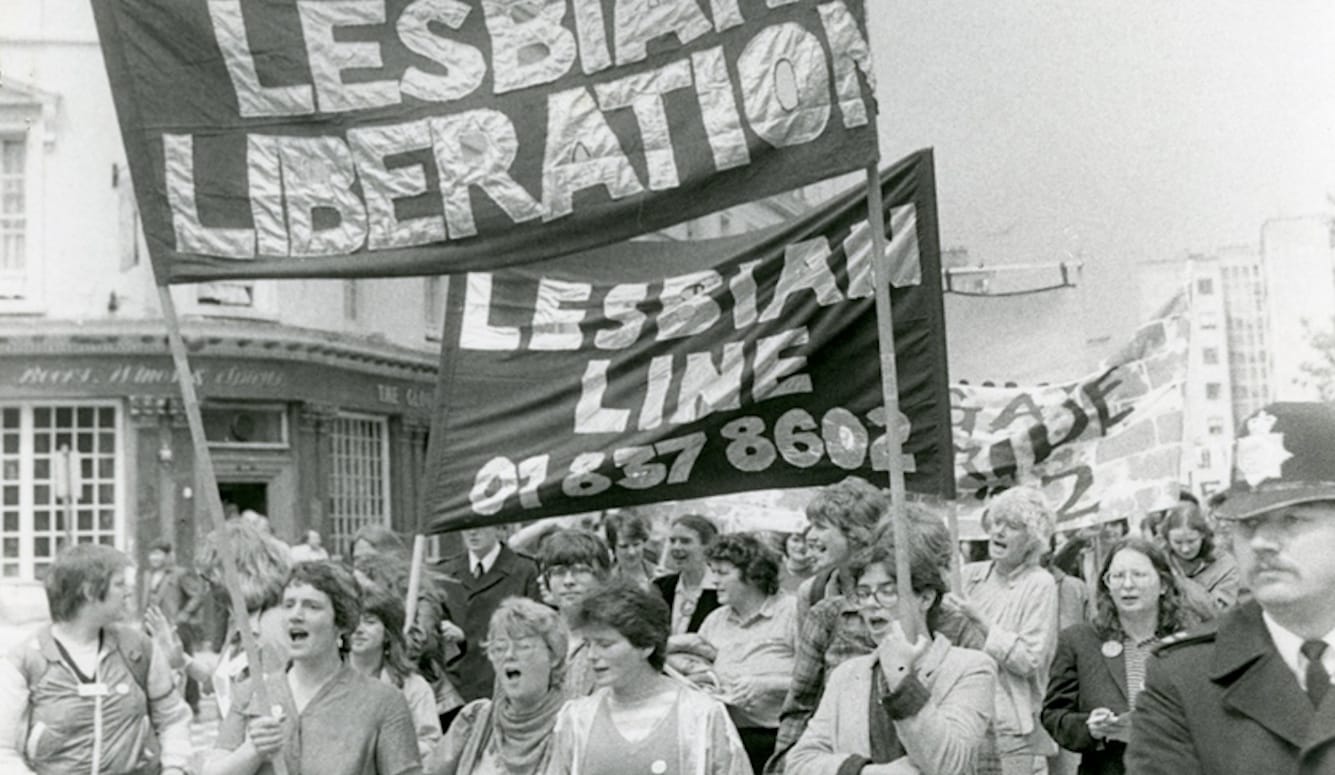
Detail from a photo posted to social media by the Bishopsgate Institute, depicting the Lesbian Strength March in London on June 19, 1982, as captured by photographer Robert Workman.

A bizarre kerfuffle at a lesbian watering hole in Massachusetts took over the internet last week. As most readers will know by now, the Last Ditch bar had formerly enforced a full-time mandatory-mask policy. All hell broke loose when the owner announced recently that, in an effort to stay afloat financially, she would be admitting non-masked customers on Saturday nights. Regulars claimed that the new policy would create a deadly “mass disabling event.” One particularly militant critic, a black artist self-identified as “Soe Noire,” claimed the move was fascistic, and reminded her of eugenics.

A Western Mass. lesbian bar required KN-95 masks. When it changed the rules, all hell broke loose. - The Boston Globe
Last Ditch Bar in Greenfield wanted to build community. They got a firestorm instead.

For most people, the sight of ultra-progressive (and ultra-“queer”) women yelling and crying over the question of whether to enforce six- or seven-day-a-week masking requirements seemed the height of post-COVID progressive self-parody. But in my case, it gave me a sense of déjà vu. This odd (and often performative) obsession with disability and disease isn’t a new facet of lesbian politics. It’s been with us since the Cold War.


I discovered the feminist movement in 1979 at the tender age of seventeen. Coming from a working-class community in the northeast of England, with no real education to speak of, I had difficulty navigating the sectarian identity-politics struggles that were building at the time. I’d become a feminist partly to fight for the rights of fellow lesbians, and to tackle male violence such as rape and domestic assault. I did eventually find my people. But for a while, it was impossible to avoid the insanity then playing out within the wider movement.

This era saw the birth of the Sisters Against Disablement (SAD), a London-based collective of disabled women that published something called The SAD Code. Published in the London Women’s Liberation Newsletter (which itself imploded in 1985 due to infighting over identity politics), this was an 18-point checklist for event organisers to ensure physical spaces were accessible to all women.
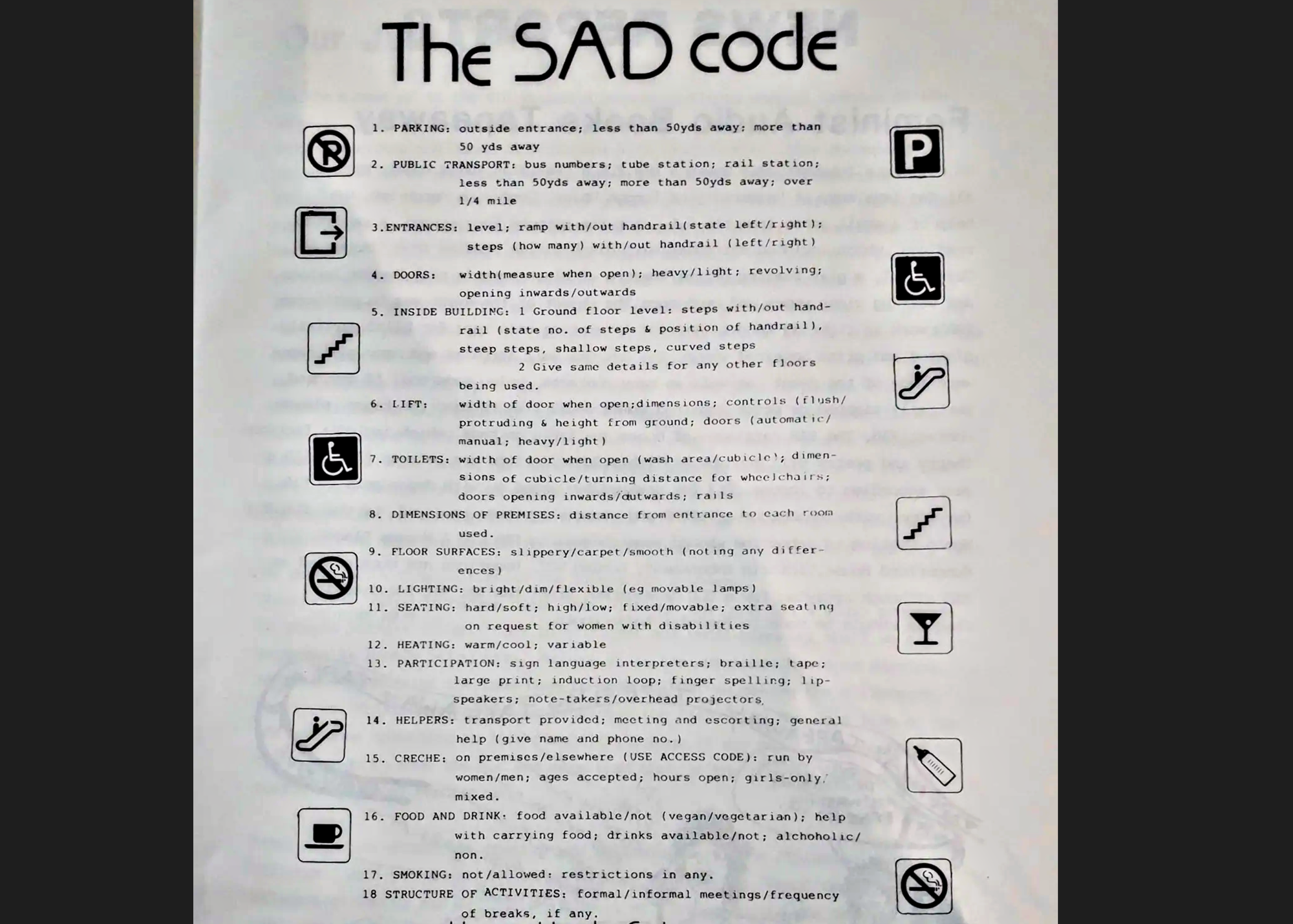
Every conference or meeting, including those held in individual women’s homes, required use of the code. How many steps was it from the bus station? Was it uphill? Did it require going over any broken paving stones? What were the widths of the doors?

Upon arrival at the venue: “What was the distance from the entrance to each door used?” Was the lighting “bright/dim/flexible (e.g. movable lamps)”? Would there be “sign language interpreters; braille; tape; large print; induction loop; finger spelling; lip-speakers; note-takers/overhead projectors”?

The original idea was to shift responsibility for access needs onto organisers, and take the burden away from individuals. A nice idea, but it got completely bonkers.

The women who enforced the code were highly militant. They’d turn up at events to harangue those who’d failed to provide a comprehensive point-by-point SAD Code rundown. For a while, they were extremely effective—in the sense that they terrified the hell out of anyone organising a meeting. If events were held in buildings that weren’t fully accessible, there was usually a protest outside. If one or more protestors happened to be black or working class, it was extra-dangerous to attract their ire. These women were inevitably lesbians, so they had the full deck of cards.

In April 1983, there was a big conference in London called “Lesbian Sex and Sexual Practice.” A protest outside was in full flow when I arrived, organised by Sisters Against Disablement, because the venue wasn’t fully accessible. Inside, there was also some kind of ruck going on about language.

At the time, many disabled women were insisting on being called “women with disabilities,” but then somebody argued that this was offensive because it was “too polite,” and that they were reclaiming the word “cripple”—but only women who were actually disabled were allowed to use it. A profoundly deaf woman gave a speech in which she referred to herself as disabled. For this, she was booed off by the SAD contingent, because apparently, in the world of radical disability rights, deafness is not a disability.

But the biggest controversy was caused by “Arlena,” an older Spanish lesbian who lived somewhere in the Welsh wilderness. She was extremely eccentric, to say the least. Arlena approached one of the SAD women, who was in a wheelchair, and started dancing around her, draping her with coloured streamers, telling her that it was all a state of mind: “You can walk, you can walk, just believe!”

At feminist meetings, there was a demand from organisers to introduce ourselves by reference to our multiple oppressions—or, in modern parlance, intersectionalities. At one meeting I recall, a well-known feminist announced that she was “a black, Jewish, working-class lesbian mother.” Even then, almost a half-century before today’s jokes about the “oppression Olympics,” these people were the objects of satire. In this case, my girlfriend at the time turned and whispered to me, “It’s a shame she hasn’t had a leg amputated—that would give her the prize.”

The London Women’s Liberation Newsletter was very much taken up with ticking off entries from the SAD Access Code when it came to any upcoming gathering—so much so that there was often little or no room in the publication to explain what the corresponding event was about.

I recall a big international lesbian conference in Geneva, Switzerland, in 1986. A group of anarchist lesbians turned up from their squats in the hardscrabble London neighbourhood of Brixton, and went out shoplifting every lunchtime as an act of rebellion against the capitalist state (or something like that). Our accommodation was in a converted nuclear bunker, which the Greenham Common Women’s Peace Camp contingent proceeded to decorate with graffiti proclaiming its anti-war, anti-imperialist postures.

I was occupying myself with one of the anarchists, a very appealing New Yorker who beguiled me with her accent. At the disco one evening, Sisters Against Disablement turned up. One of them pointed toward the dance floor, and sneered at “those able-bodied women with all of their limbs.”

I chatted to a blind woman, a lesbian I knew from London, and apparently said the wrong thing, because she snapped back about how I’d wrongly assumed that she would have liked to be sighted—a suggestion that she said offended her “blind identity.” I thought she was joking, but hesitated before laughing, as her face was set in stone.

The most annoying social events were those featuring any substantial contingent of attendees self-diagnosed with an “environmental illness.” Sometimes, they described it as “chemical sensitivity”; later, it became “multiple chemical sensitivity.” These women invariably claimed to be suffering from hidden disabilities, possibly so they could avoid getting on the wrong side of the SAD women, who were often in attendance.

They spoke about how just a whiff of perfume, or standing next to someone who had used deodorant, would give them headaches, breathing difficulties, dizziness, and nausea. This tendency was an offshoot of the women’s health movement, which had come about as a response to sexism in the world of medicine.

These “wombyn,” as they sometimes called themselves, would lecture us all about how we had to “believe women’s accounts of what is happening to their bodies.” You couldn’t challenge anyone regarding what they told you about their claimed medical conditions. These extremists began demanding places to lie down during weekend-long conferences, and organisers were harangued by women claiming to have ME—myalgic encephalomyelitis, also known as chronic fatigue syndrome—which I began to call me, me, me.

The eco-feminist politics that were emerging at the time gave narcissists, attention-seekers, and, quite frankly, mentally unwell women carte blanche to demand whatever they wished.

All you had to do was say you felt tired, and it meant you were disabled. Speaking for myself, I definitely became chronically fatigued by these hypochondriacs throughout the years.

Some lesbians started to claim that their environmental allergies were the result of industrial pollution, patriarchy, and the deliberate poisoning of women’s bodies. The eco-feminist politics that were emerging at the time gave narcissists, attention-seekers, and, quite frankly, mentally unwell women carte blanche to demand whatever they wished.

Gay men had their own particular identity politics. An article entitled The Road to Auschwitz Is Clearly Signposted, written in response to Section 28 of the Local Government Act 1988, was published in a left-leaning London listings magazine. Section 28 was not a legal provision to put lesbians and gays in concentration camps, but rather prohibited local authorities from “intentionally promoting homosexuality” or publishing material with the intention of promoting homosexuality. It was introduced by Margaret Thatcher’s government as part of a backlash to what was portrayed as the promotion of homosexuality in schools. It did not prohibit teachers from mentioning homosexuality, and it was repealed in England and Wales in 2003.

In response, I wrote a letter pointing out that teachers being unable to tell the kids to “Sing if you’re glad to be gay” was not quite the same as the extermination of six million Jews, much as it was discriminatory.

In 1989, I co-wrote an article entitled An Ism of One’s Own for a feminist newsletter, in which we argued that identity politics had gone so extreme that we appeared to forget we were supposedly fighting for the liberation of all women. I doubt anyone read it, however, as members of the intended audience were then busy arguing as to whether or not Irish-born women could claim to be an oppressed minority, alongside their black and Asian sisters.

It was around this time that a fellow lesbian and I set up a small catering company. We used to travel around conferences and social events, and anywhere else we could sell homemade hummus and fresh lemonade. We called it Eat, Eat Enterprises, and I don’t think we made any money at all in the entire six months we were in business. The lesbian mothers thought it was absolutely fine to come along, take one of our environmentally friendly paper cups, and ask for some juice and a cracker for their baby, as though we were a social service or charity rather than a business. If we sold anything that wasn’t vegan and organic, we’d be berated.

We got so sick of the demands to lower our prices (because “poor women are being excluded”—though not so poor that they weren’t still splashing out on booze at the bar) that we eventually closed up shop. In truth, I’d sealed our fate by putting up a sign above our stall, in revolt against the tight-fisted whingers, which read, “Please do not ask for discount, as a smack in the face often offends.” (Inevitably, I was accused of promoting violence against women.)

While I was going in for “direct action,” such as spray-painting sex shops and tearing up copies of porn magazines at newsagents, the cultural lot were growing their own mung beans, ensuring anything they cooked had no flavour to it whatsoever, and knitting their own sanitary wear.

A sanitary product called a natural sponge, which had come straight from these wombyn types, was becoming popular. Here was a chemical-free piece of absorbent material untainted by the patriarchy, which meant users could avoid going into the supermarkets run by capitalist pigs to buy tampons. To say they were totally ineffective is no exaggeration, and the women’s bathroom at some conferences and social occasions resembled an episode of Dexter.

I never got on with the wombyn, preferring to hang out with feminists intent on changing the law, such as criminalising rape in marriage, and protesting outside courtrooms when men were acquitted of murdering their “nagging” wives. We had no time for lifestyle politics or hypochondria.

I realised for certain these women weren’t my cup of tea when I visited a commune to attend a meeting about a terrible legal case involving a lesbian losing custody of her young children to a violent man (she’d left him for another woman, and he was vengeful). I’d turned up with a couple of tins of beer, and so was given a lecture about how alcohol was both a cause and a consequence of “the patriarchy.”

The worthiness of the lifestyle lesbians was wearing. Asking for salt to put on your undercooked baked potato, or ordering bacon with your breakfast at the greasy spoon were occasions for lectures.

There were weekly consciousness-raising sessions run by the wombyn, which focused a lot on health. I suppose it was the early days of what we now call the “wellness” movement, and there was an expectation—almost a requirement—to be vegan, because eating animal products was considered a crime on par with rape. The first and last time I went, everyone was sitting on the floor cross-legged, while the convenor passed around hand mirrors, so the women could look at their own cervixes. In the spirit of hidden disability, I think I pretended to faint.

I found a different consciousness-raising group, at which party cans of Tetley’s would be passed around while we’d talk about picketing strip joints.

Unfortunately, there was little focus on (real) mental health in those days—which is too bad because a lot of women I met were a little crazy. This is probably because many were emotionally wounded figures who’d gravitated toward the movement as a place of safety, having experienced some form of childhood sexual abuse or violence in adulthood.

I remember one meeting where we were talking about setting up a lesbian phone line, because the men had their gay switchboard and lesbians were more isolated. I started asking who had a landline telephone (it really was that long ago, the early 1980s); and I was screamed at by somebody who called herself Sandy Moonspirit, who said that was an elitist, middle-class question. (Presumably, she was planning on running the three-hour-a-week lesbian line from a phone booth.)

In 1989, activists held a Fat Liberation Conference—out of which sprang a 29-point Fat Dykes Statement. This celebration of being obese (to challenge “patriarchal beauty standards”) was held at a women’s centre I happened to be visiting at the time. I saw women wandering around the building crying because they’d been told they weren’t quite fat enough to attend.

This was the world of British lesbian politics in the late Cold War period: on the one hand, we were being force-fed unseasoned vegan food and staring up at our cervixes for health purposes, yet it was seen as absolutely wonderful that many women were so fat that they were headed for a massive heart attack or stroke.

These were all sub-plots in the larger lunatic contest of who was the most authentic lesbian. The idea was that a butch-presenting dyke who had no history of heterosexuality was the most oppressed, and therefore the most celebrated, while the more feminine-presenting women who had a history of dating men were the least oppressed, and therefore the least authentic. Being vegan, fat, or disabled gave you bonus points. In some circles, apparently, it still does.

I sometimes wonder what became of the militant wing of Sisters Against Disablement. I like to imagine them still out there somewhere, abseiling down the side of an inaccessible conference centre, demanding to know whether the ramp gradient meets code, while somebody’s ME support llama waits patiently in the car park.

Soe Noire and all her friends from Massachusetts, I suspect, would fit in perfectly—assuming, of course, that everyone agreed to wear masks.


Quillette invites thoughtful responses to its essays.
Selected responses are published once per week as part of a curated Letters to the Editor feature. If selected, letters appear under the contributor’s real name and may be edited for clarity and length.

To submit a letter for consideration, please email [email protected].