Climate Change
Net Zero Won't Fix Climate Change. Technology Will
Treat a warming planet as an engineering problem rather than a moral failing, and it starts to look solvable.

On 15 June 1991, the volcano Mount Pinatubo on the island of Luzon in the Philippines erupted violently, releasing an ash cloud on a scale so vast that seeing a photograph of it boggles the human mind. The eruption spewed out something north of 17 million tonnes of sulphur dioxide. For context, that's roughly equivalent to 1,700 Eiffel Towers' worth of material ejected out of the ground and into the sky.

The effects were global, albeit quite temporary. As a result of the explosion, NASA estimates that temperatures worldwide fell by about half a degree Celsius on average over the following fifteen months.
I lead with this because it reveals climate change as something that can be physically reduced. How does that work? Well, in this case the aerosol particles released by the volcano reflected sunlight back into space, reducing the amount that reaches the planet.
The Earth is warmed by sunlight. It cools by radiating heat back out into space. This is a delicate balance. Greenhouse gases absorb some of that outgoing heat. Raise their atmospheric concentration and the planet retains more energy, thus leading to warming.
The greenhouse effect, of course, is partially responsible for making this planet habitable in the first place. Atmospheric water vapour, carbon dioxide and other such gases keep the surface far warmer than it would otherwise be. That's essential for life as we know it.
But industrial civilisation is changing the balance of the equation. Before industrialisation, the atmospheric carbon dioxide level stood at around 280 parts per million. The global monthly mean exceeded 428 parts per million in April 2026. This, obviously, is a rapid increase in a relatively short time span.
Effectively, current estimates are that human activity has raised global surface temperature by roughly 1.4°C on average compared with the second half of the nineteenth century. And so the public—especially in the West—has been relentlessly told by climate activists, science communicators, governments and so forth: take one fewer flight. Turn down the heating. Plant a tree. Check your “carbon footprint”. Get ready for “net zero”. But these efforts take place inside a global energy system moving decisively in the opposite direction.
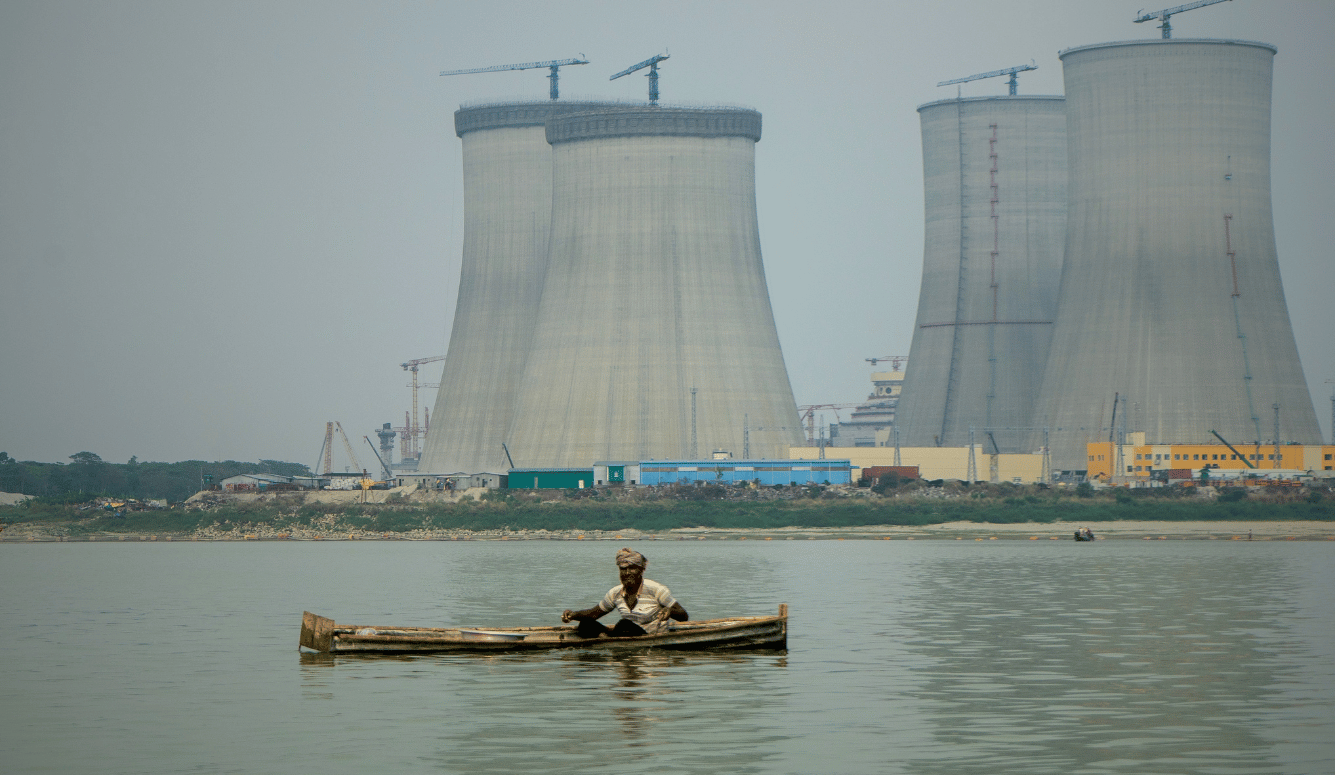
In China and India, by great contrast to the West, energy demand has been rising rapidly for decades, and shows no sign of this pattern abating. China already consumes more electricity than any other country by a wide margin. The International Energy Agency expects it to add roughly another 2,600 terawatt-hours of annual demand by 2030. That's about as much electricity as the entire European Union uses.
This is a staggering figure, and it really puts our efforts in the West into perspective. What difference does Europeans sacrificing their economic growth for the sake of climate change make when China is adding so much capacity? China has 1,195 active coal-fired power stations.
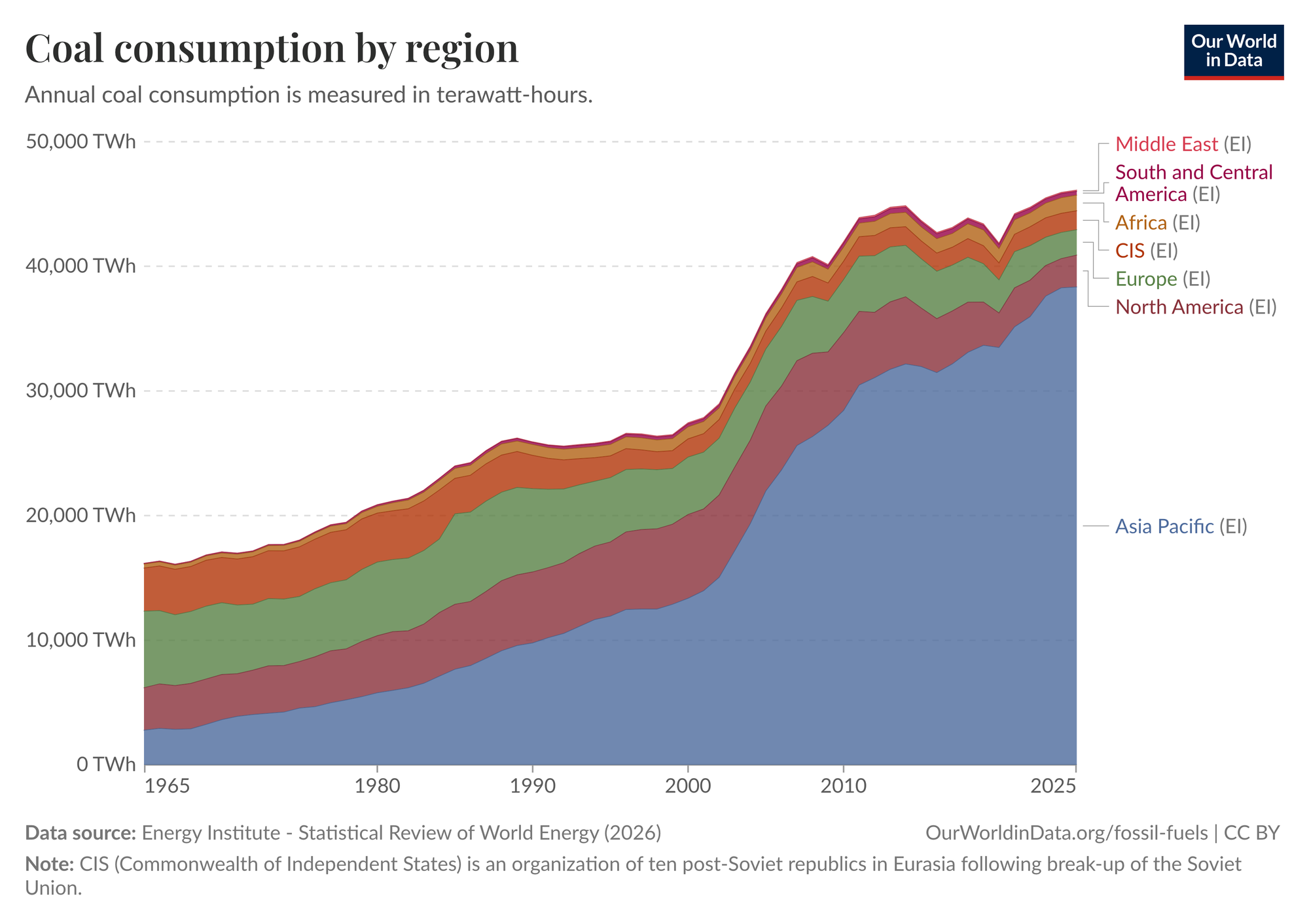
Economic development requires energy usage. The West has spent recent decades trying to encourage restraint while Asia has continued to modernise and develop.
And so a Briton or a German can fly less, or even not at all. They can heat the house less. They can scold their less fastidious neighbours to no end about how much plastic they are recycling, or how driving a car or using air conditioning contributes to climate change. They can vote for far-left ecologically minded political candidates in the Greta Thunberg mould who would go much further even than the current and previous governments.
But the effect on global carbon emissions will be negligible so long as the rest of the world just wants to build vast numbers of coal-fired power stations and run them. The brutal truth is that what is effectively a planetary problem won't get solved through marginal acts of European, American, or Australian abstinence.
Not to mention that Western countries need economic growth, too. Every society does. A society that shies away from energy usage, I would suggest, is heading towards stagnation and decline. Britain has reduced its greenhouse gas emissions by 53 percent since 1990. Yet over the same period, it has fallen into a long and discontented economic slump.
To be clear, I am not necessarily blaming climate policy entirely for that. Economic growth is a multifactorial equation. Planning restrictions, high taxes, Brexit-related trade frictions, an ageing population, and poor infrastructure have probably all played a role in the malaise.
But, yes. Energy is also a factor. A very powerful one. Britain has some of the highest energy prices in the world. And energy is needed for everything we do. For transport. For refrigeration. For lighting and heating. No wonder it's hard to do business here when the basic costs of keeping the lights on are so high.
Eventually, people in countries like Britain are going to get sick of expensive energy and years of low economic growth.
We can all see the megacities that have been built in China in the last few years. They are broadcast to us through TikTok livestreams. New metro systems, hundreds of apartment towers, high-speed rail, vast factories, and neon-lit skylines—and all of it rests on the expansion of the energy supply. Energy gives you the capacity to do things. That's good.
And this raises an awkward question. Why is rapid material development fine when it happens in Shenzhen or Chongqing, but somehow vulgar or environmentally irresponsible when people in Britain ask for cheaper electricity?
Britain has already started to shift in the direction of questioning the status quo. The current Labour government is backing a substantial expansion of nuclear power, and the new prime minister has faced pressure to approve new North Sea gas production.
There is something deeply regressive about asking people to reduce their activities in the name of saving the climate. Cheap energy gives ordinary people warm homes, private and comfortable transport, refrigeration, air conditioning and access to goods that earlier generations would have considered extraordinary luxuries. Developing countries now want the same transformation that developed countries already enjoyed. And frankly, I can't blame them. Who are we in the West to tell countries like China, India, the Middle East, and Africa not to develop? That's the height of arrogance.
And it wouldn't even work, because the governments of these countries have no interest in slowing down their development. But I don't think this needs to be a problem. The good news is that humans have been through some strikingly similar transitions before.
And the doomers have got it incredibly wrong before.
In 1798, the prototypical doomer and clergyman Thomas Malthus argued that population growth would eventually outrun the food supply. Human numbers, he thought, could grow exponentially. Meanwhile agricultural output would rise much more slowly. This, he suggested, would then result in hunger, falling living standards, and eventually mass starvation.
 Robert Zubrin
This was, it turns out, a terrible prediction. Malthus, of course, disregarded the capacity of human beings to change the terms of the problem. He looked at the agricultural productivity of his own age and simply projected it forward. In reality, over the following two centuries, farmers learned to produce vastly more food from the same amount of land. The development of industrial fertilisers jacked up yields. Machinery multiplied the amount each worker could produce.
The result was that the world population grew from around one billion people at the start of the nineteenth century to more than eight billion today, while the average person also became far better fed. Life expectancy rose dramatically, while things like infant mortality greatly declined.
The key Malthusian mistake was mistaking a limit that could be broken by improving technology for an unbreakable natural one. Western climate politics seems to have spent the last thirty years repeating this kind of error. But we can produce vastly more energy. We can produce it without even increasing carbon emissions—via wind, solar, nuclear, geothermal, and so forth. Take solar energy, for example. In just one hour, the sun delivers to our planet roughly as much energy as all of humanity consumes in an entire year. Most of it goes unused. But it can be captured, used, and even stored.
What's more, we can remove carbon already released from the atmosphere. And, if necessary, we can intervene further in the physical processes that determine atmospheric temperature.
The current rising panic over data centres repeats the old Malthusian error in miniature. Criticism of data centres tends to focus on their appetite for electricity, their carbon emissions and, in some cases, their water usage. These are real constraints. But they are constraints that can be overcome via technology.
Carbon emissions depend on how the electricity is generated. Water use depends on the cooling system, and how efficient it is. Grid congestion depends on the electrical grid, and how much generation and transmission capacity has been built. If you build enough capacity, these things aren't problems.
If demand for AI is consuming vastly more power, the answer cannot be to get by with an electricity system designed for the era before AI and modern data centres. The answer is to build an electricity system capable of supplying the needs of the modern world.
And data centres will only be the first instalment. More than half a million industrial robots entered service worldwide in 2024. That's more than twice the number installed a decade earlier. China alone installed 295,000; Britain installed a relatively meagre 2,500. Both of those numbers can be expected to increase rapidly as humanoid projects like Tesla's Optimus shift into production.
Such developments could produce an extraordinary increase in industrial capacity. Machines can run for longer than a human worker, and will tend to become more capable as software improves.
It seems like we are getting closer to the era of AI folding your laundry, cleaning your house, and doing your drudgery. Seen from that perspective, anxiety over the electricity consumed by AI looks peculiarly short-sighted. Demand for electricity will rise. The challenge is to satisfy that demand while controlling the climatic consequences of producing the energy.
So what would it mean to treat climate change as an engineering challenge, rather than as a political problem?
In hot cities that still lack air conditioning, it means installing sufficient quantities of air conditioning. This also requires building enough generating capacity to run it during the hottest hours of the year. While tropical climates have for the most part invested in air conditioning already, many European cities like London and Paris learned this year the discomfort of struggling through heatwaves without it.
The next step is to work on becoming able to manipulate the composition of the atmosphere itself. If excess carbon dioxide is what keeps pushing temperatures upward, then why not deliberately draw the concentration back down closer to the pre-industrial level of 280 parts per million?
A direct-air-capture plant can do this with currently available technology. Large fans push air through filters or chemical solutions that bind CO₂. The plant then compresses the captured gas and injects it into rock formations deep underground. Done on a sufficiently large scale, this would gradually reduce the amount of carbon dioxide in the atmosphere. At present, such technologies are prohibitively expensive—costing hundreds of dollars per tonne of CO₂. That wouldn't be economically feasible. But through research, experimentation, and scaling up mass production we can drive costs down just as has been done across so many other industries.
Another plausible technique (unpopular with certain well-known American conspiracy theorists) is to use aircraft to release small quantities of sulphur compounds into the stratosphere, where they would act as reflective aerosols similar to those produced by a volcanic eruption like Pinatubo. Such techniques carry risks, such as termination shock, and certainly should be carefully tested before any widespread rollout. They also do nothing about ocean acidification. But here, too, technology offers some plausible solutions. Removing CO₂ directly from the atmosphere would itself reduce the amount entering the oceans. And techniques such as ocean alkalinity enhancement can directly counteract acidification.
Any attempt to control global temperature would also raise the political question of who gets to control the thermostat. The UN? The United States? China? What happens if two countries disagree? Could countries try to cancel out each other's mitigation efforts? Could these technologies be adapted and used as weapons of war? These are challenges that will each have to be navigated.
But once we admit that we need to engineer technological solutions, and that we can't simply get out of this with vague promises to reduce emissions or achieve “net zero”, this serves as a huge step in the right direction.
The central mistake of climate politics, in my eyes, has been to conceive of human influence on nature mainly as something to minimise. As if we are somehow unnatural creatures who should be embarrassed by our existence, and our impact on the universe.
I propose a different ambition: let's build without feeling guilty for it, and without feeling like our existence is somehow a burden on the planet. No. We are part of the planet. As a species, we came this far by taking control of our environment. Not by being apologetic, or capitulating to doomers, or to the various high priests of self-flagellation. We should produce vastly more energy. We should develop infrastructure to remove greenhouse gases at industrial scale, and develop the capacity to influence temperature directly.
Quillette invites thoughtful responses to its essays.
Selected responses are published once per week as part of a curated Letters to the Editor feature. If selected, letters appear under the contributor’s real name and may be edited for clarity and length.
To submit a letter for consideration, please email [email protected].
Keep reading
Equal Pay, Unequal Work

The Genetics of Crime and Punishment


Jerry Kaplan on AI Doomers