Education
What an Eighth Grader Taught Me About Status
Comparing yourself to others locks you into a contest you can never win and makes other people’s wins feel like your defeats.
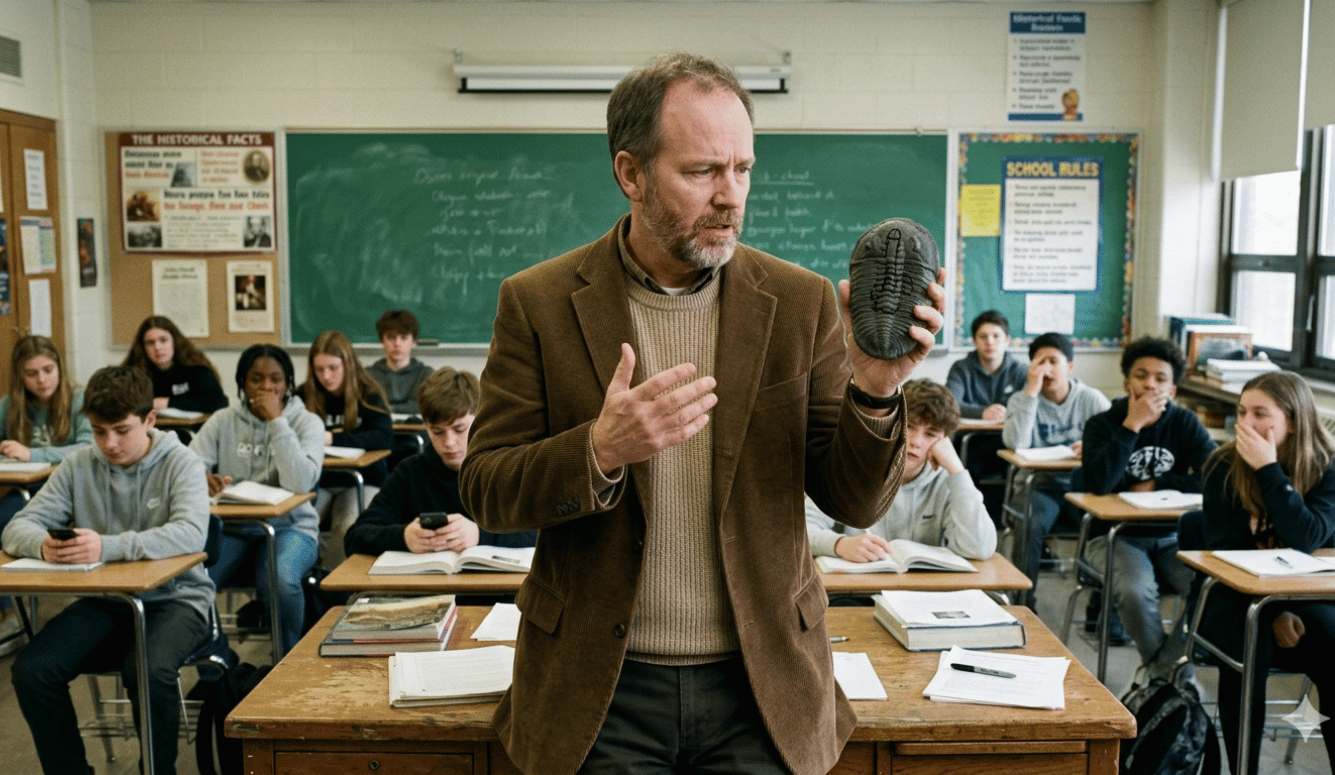

I brought a 510-million-year-old trilobite I’d split out of Cambrian shale four hours north of Las Vegas to show a class of eighth graders. I passed it around the room and explained what it was: an ancient arthropod called Bristolia, from the same branch of the tree of life as every insect and crab alive today, that lived in a warm shallow sea that used to cover Nevada. It predated the dinosaurs by 250 million years. It was older than plants on land. It had what was probably the first real compound eyes that ever evolved on Earth—and when I split the shale, I was the first thing that had looked at it since it died.
A few kids looked at it with interest but most of them passed it along the way you’d pass along a co-worker’s vacation photos. At the end of the day, I picked it up off my desk to put it in my bag and noticed that one of them had drawn a penis on it in permanent marker. Two balls, long shaft, black Sharpie. It wasn’t going to come off. I’d spent a week in 110-degree heat with a pry bar and a rock hammer. When it comes apart and there's something inside, it’s a religious experience. I spent two decades studying evolution and most of it was theory. This was the imprint of the animal in my hand. Eighteen months ago I was a scientist; now I was the guy whose stuff you drew on.
Everyone wants to matter. My great-aunt Laura, born in 1896, used to boast about being listed in Who’s Who. That book was several inches thick, full of names nobody remembers, and she was an entry on page something or other. At the age of ten, I thought that sounded pretty important. She was doing the same thing humans have always done. Thirty thousand years ago people put their hands on the walls of caves and blew red pigment around them. I was here. Now we count likes, refresh followers, and check to see if anyone responded to the hilarious comment we posted at 2 am.
For a while I thought I mattered too. Ten years ago I was a Wall Street trader with a PhD in evolutionary anthropology who had trained under Robert Trivers, one of the most important evolutionary thinkers since Darwin. Now I substitute teach for $160 a day in North Carolina where nobody cares about my credentials. Full-time teachers walk past me and look through me the way you don’t look at people who clean the bathrooms.
Status is funny though. You can be Norm in Cheers one minute and the guy cleaning up someone else’s half-eaten hot dog the next. Anthropologists who study status hierarchies in small-scale societies measure at least four types—relational (how many important relationships you have), material (how much stuff you have), somatic (how strong you are), and noetic (the stuff you know that other people don’t). You can rank high on one and low on another. I might not care about your golf handicap, but I'll find a way to mention I bench 280 (which is pathetic at the gym I go to). Last week I lost 2-6, 0-6 in tennis to a guy I should have beaten. I threw my racket four times. What kept me from walking off the court were the women playing doubles next to us, who had noticed how unhinged I’d become. One of them was my neighbour.
Status is also zero-sum. In capitalism the pie can grow—there’s more money in the world today than there used to be. But status is fixed. Even in Star Trek’s post-scarcity utopia, where they’ve abolished money and ended hunger, not everyone gets into Starfleet Academy. Like Harvard, if everyone got in, it wouldn’t mean anything.
Of course, it's hardly a revolutionary insight that people buy things to show off, or that getting into Princeton is prestigious. What’s harder to admit is how much of what we say and do is reflexively playing the same game. It’s easy to spot the asshole with the Ferrari or the Rolex but harder to acknowledge the NPR tote bag, the pronouns in your email signature, the dog you rescued, or the copy of Anna Karenina on your coffee table. Or the “we made fools of ourselves after finishing a bottle of mezcal at this place in Oaxaca a friend kept saying was the real deal—my Spanish absolutely fell apart” anecdote you've been telling for two years. The Atlantic article you casually mention at dinner. The lifted F-150 and prison tats you need for your job as assistant manager at the T-Mobile store. Me wearing a Dartmouth sweatshirt at the airport because it’s comfortable, while I secretly hope that I get asked who went there. Or mentioning that I trained under Robert Trivers (which if you’re counting is now the second time I’ve mentioned him in this essay).
But playing the status game isn’t even the worst part. It’s handing my worth over to people and circumstances I don’t control.
Keep reading
Jerry Kaplan on AI Doomers


Payback Time for Steven Galloway

War Stories

Life in The Grim Old Days