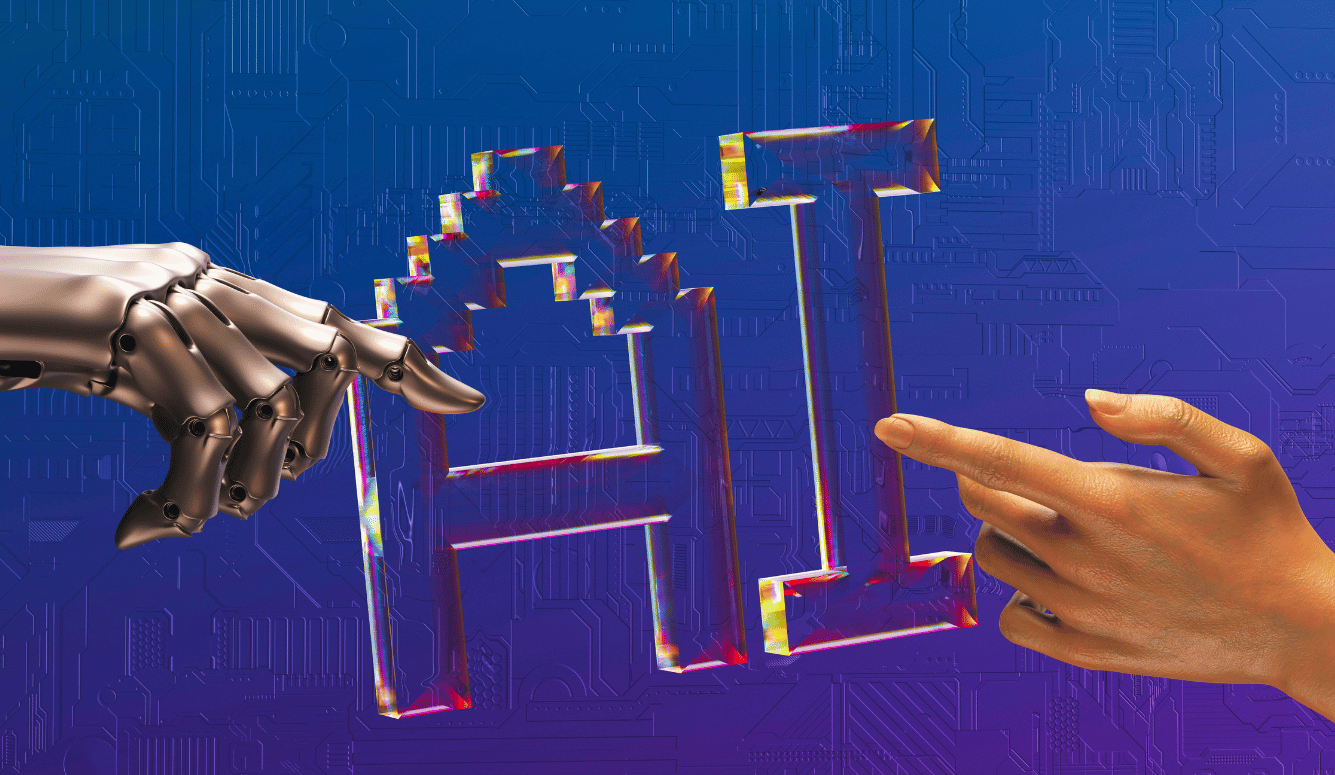

“Dogma,” Albert Einstein told an audience at the Sorbonne in 1929, “is the enemy of progress.” Just kidding—it’s what ChatGPT whispered in the ear of the rector of my university at the start of this academic year after she decided to outsource her inaugural address to AI. The speech she delivered was a string of grammatically impeccable platitudes garnished with four quotations, three of which turned out to be hallucinations—the kind of false erudition that academics like to flaunt. The fourth quotation was real, but it was a cringeworthy piece of self-flattery lifted from an obscure 1946 speech: “There are few earthly things more splendid than a university.” ChatGPT certainly knows how to appeal to academic vanity.
My former rector is not the only person to have been embarrassed by a digital ghostwriter. In March, the former academic turned Reform UK candidate Matt Goodwin published a book littered with fabricated quotations and non-existent references, which earned him the nickname “MattGPT.” In a case of cosmic karma, Steven Rosenbaum’s The Future of Truth: How AI Reshapes Reality turned out to contain half a dozen fake or misattributed quotes. Governments and consultancy firms have written expensive reports citing studies and papers that do not exist. An online database now lists more than 1,800 cases of AI hallucinations in court filings.
The good news for anyone recruiting an AI ghostwriter is that the odds of public mortification are falling. Fabricated quotes and references are just about the only way to catch a lazy author out, since there is virtually no innocent explanation for them. But as Large Language Models have improved, hallucinations like these have grown rarer. And without those dead giveaways, we are left with AI detection tools, which are irreducibly probabilistic. The best of them is Pangram, which boasts a false-positive rate of one in 10,000, given a long enough chunk of text and some reasonable assumptions. Writers accused of AI plagiarism routinely deny it, and there is no way to prove the charge conclusively.
If my former rector were to outsource next year’s address to a capable model, with some adroit prompting, the result would probably be a good deal less anodyne than last year’s. The best LLMs have become such virtuoso performers that a more fundamental question now presents itself: should we even care if a paper or a speech was produced by a digital ghostwriter? A recent viral essay on the creeping Islamisation of France initially impressed me its vivid prose, but my suspicions grew as I read on, and Pangram duly confirmed that the piece was 96 percent AI-written. In the comments section, nobody seemed to have noticed. Should they care if they enjoyed the piece and found its argument compelling?
Writing in the Free Press, Tyler Cowen predicts that before long hardly anyone will care whether or not a text was written by a human. Cowen describes the humbling experience of being impressed by an author’s knowledge and scholarly chops, only to discover that there was no author at all. After he was burned a few times, he got better at spotting the signs. In a recent essay, Richard Hanania goes a step further. Suppose we are impressed by the writings of some brilliant young thinker and then discover that every word was machine-generated. “It shouldn’t really matter,” Hanania contends, “and we should hope that this person continues to do the same kind of work.” With the possible exception of memoirs, which are inherently personal, he does not care one way or the other.
But something bugs me about all this. As a writer and non-native speaker of English, I am grateful for Claude’s proofreading help when I am drafting an essay. And as a reader, I have come across AI-generated poems, short stories, and jokes that I have really enjoyed— sometimes I knew their provenance from the start, sometimes I discovered it only later. Far from diminishing my enjoyment, this realisation often heightens it, out of sheer fascination with the technology. But argumentative non-fiction feels different. For some reason, I resent belatedly discovering that an essay that tries to persuade me of something was machine-written, and I lose interest at once. Why is this?
Keep reading

Anti-Catholic Social Panics, Then and Now
A Dishonest (and Dangerous) Nobel Laureate

Common People
How Genetics Rewrote History
Equal Pay, Unequal Work