Books
Gloomy Optimist
Jefferson emerges as a man who doubted democracy's permanence yet placed his faith in future generations. Onuf and Cogliano rescue him from caricature—even if one dimension of his thought remains in shadow.
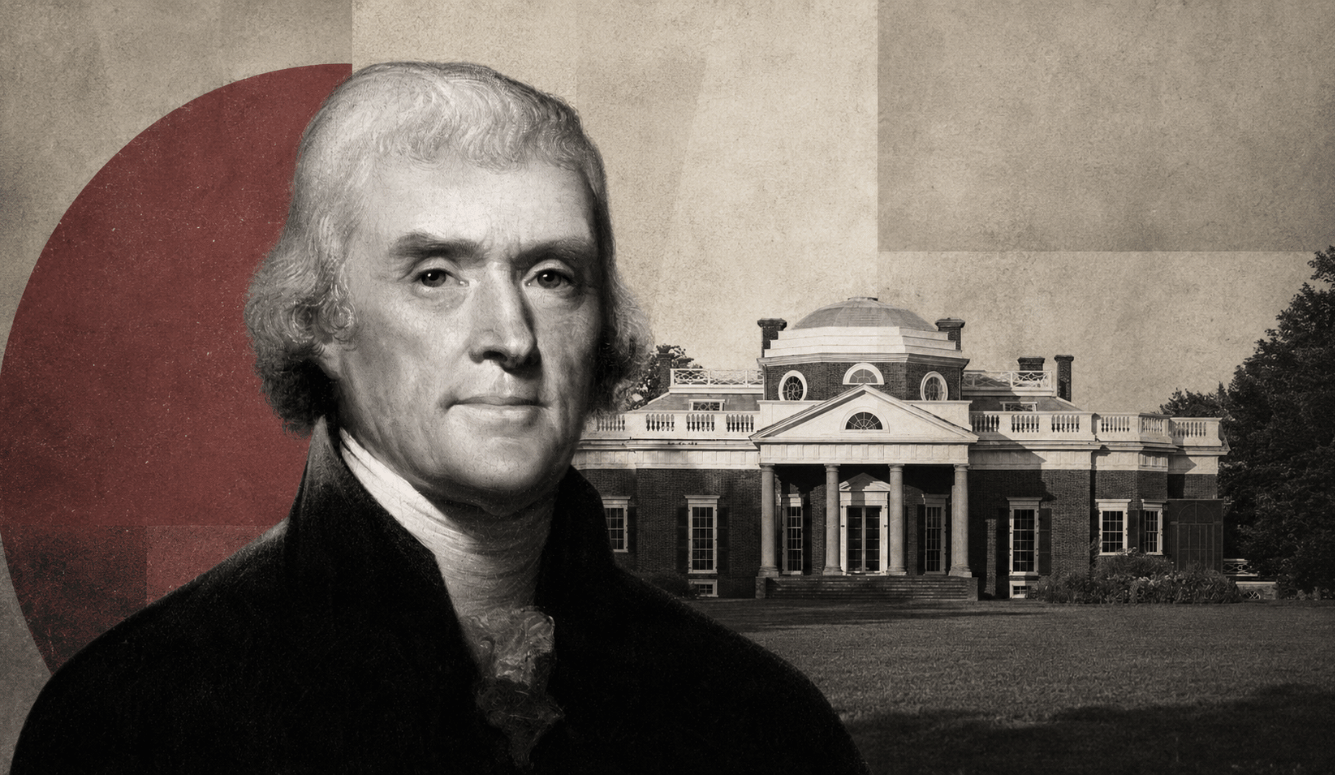

A review of Thomas Jefferson Survives: American Independence in His Time and Ours by Peter S. Onuf and Francis D. Cogliano; 256 pages; Liveright (June 2026)
The three essays in this new volume about Thomas Jefferson hope to show that Jefferson remains relevant to our time while they rescue him from trite generalisation. “Across generations,” write historians Onuf and Cogliano, “Americans have reinvented and reimagined Jefferson according to their contemporary needs and concerns, effectively taking him out of history and making them their contemporary.”
A historiography follows that illustrates how Jefferson has often been used and misused as a flag of convenience, and how his reputation has fallen in and out of fashion. Until the Civil War, advocates and opponents of slavery both enlisted him as a spokesman. Pro-slavery groups highlighted his support of states' rights. Abolitionists “drew on Jefferson’s antislavery writings and the egalitarian premise of the Declaration of Independence.” After the Civil War, the authors write, Jefferson’s reputation suffered, owing to his perceived support for secession, and because he was “the spokesman for agrarian democracy in a nation that was rapidly becoming more and more urban and industrial.”
By World War II, Jefferson’s reputation had rebounded. President Franklin D. Roosevelt was an ardent admirer and called him “a universal advocate of global liberty.” Of this period, Onuf and Cogliano write: “Jefferson was no longer the author of secession but rather the embodiment of the values for which the United States and its allies were fighting in World War II.” But between the 1960s and the present day, Jefferson’s reputation went into decline, particularly on the Left, which rejected him as “a plantation patriarch and enslaver who epitomizes the hypocrisy of the founders of the American republic.” The Right, led by Donald Trump, now champions him as a victim of “cancel culture,” maligned in death for views and practices that were not unusual in his time. But unlike FDR, Trump “ascribed Jefferson’s beliefs to his supporters and not to all Americans.”
The use of Jefferson in this way, the authors write, is a “zero sum game for both sides.” But as “a historical figure situated in his own time and place, Jefferson has important things to say to us in our own radically uncertain and equally epochal historical moment.” They note that he believed that the “survival of the republic had to take precedence over everything else,” but that he also “challenged Americans with the question that every generation must confront: Are we capable of governing ourselves?”
Jefferson felt it essential that each succeeding generation live up to the principles enshrined in the Declaration of Independence. That document was conceived as a “narrative” for a “new nation,” and he believed that it was incumbent upon Americans to overcome life’s obstacles without abandoning the ideals that unite them: “Crucially, Jefferson had faith in the capacity of future generations to write their own histories and correct the mistakes of the past. ... He believed that each generation is sovereign and, guided by the lessons of the past, must confront its own unique challenges.” And each generation, he believed, owed it to the next to bequeath them a “better country” and a “safer world.”
On the other hand, like many of his contemporaries in the revolutionary generation, Jefferson was “anxious about the future,” not least because he did not regard democracy as “fixed and permanent.” He was not, the authors concede, always a “consistent thinker and his actions often fell short of his words.” But he was still “the foremost advocate and the most vocal among the revolutionary leadership for an optimistic, democratic future for the new nation.”
Jefferson was not, however, an automatic supporter of independence from the British Empire. As a subscriber to the Whig school of history, he believed that time was a directional march of progress. But he also believed that King George III was being misled by a corrupt parliament and that the colonies ought to remain joined to the mother country. His mind was changed by Tom Paine’s influential 1776 pamphlet Common Sense. Paine believed there was nothing democratic about remaining a part of the British Empire—the King was not elected, there was no true constitution, and the House of Lords was cut off from the people. Only the minuscule House of Commons gave the people a voice and it was hardly representative of the populace in Britain or the New World.
Keep reading
Australia's Coming Censorship Machine

Anatomy of a Book Promotion

They Walked in Line
Anti-Catholic Social Panics, Then and Now
A Dishonest (and Dangerous) Nobel Laureate