Books
In Bad Faith
The US vice president’s new memoir leaves an unflattering impression of its author.
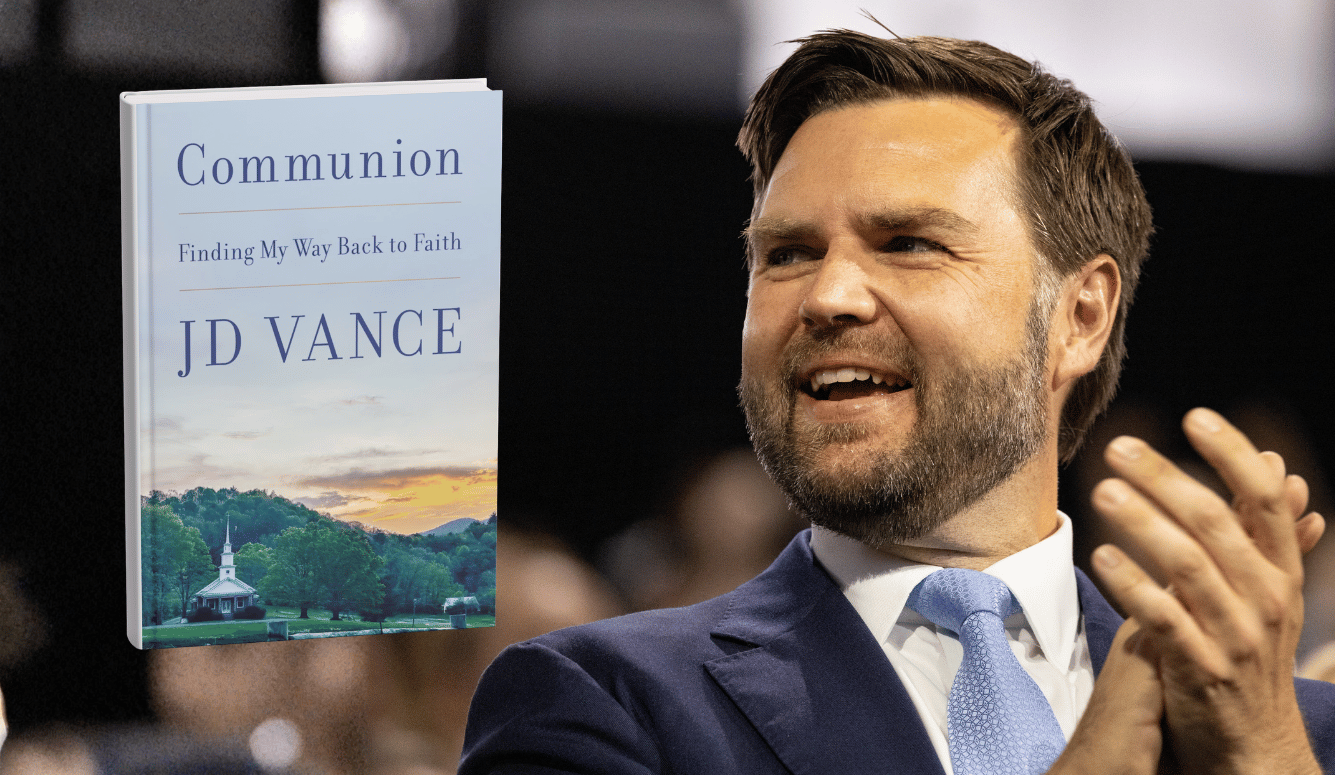

A review of Communion: Finding My Way Back to Faith by JD Vance; 288 pages; HarperCollins: New York (June 2026)
The novelist Evelyn Waugh was once asked how he reconciled his lousy personal behaviour—which included drunkenness, antisemitism, and cruelty to friends and foes alike—with his Catholic faith. No one could imagine, Waugh replied, how vile he would have been were he not a Catholic. That retort came to mind as I read US vice president JD Vance’s new book, Communion, about his conversion to Catholicism. Since joining the Church of Rome in 2019, Vance has not exactly been a paragon of virtue. Once an outspoken critic of Donald Trump, whom he called “America’s Hitler,” he changed his tune as soon as he needed Trump’s endorsement. (“I need to just suck it up and support him,” he confessed.)
When the press debunked one of Vance’s more scurrilous claims—that Haitian migrants were eating their neighbours’ house pets—Vance insisted that it had been a noble lie: “If I have to create stories so that the American media actually pays attention to the suffering of the American people, then that’s what I’m going to do.” Now that he’s vice president, Vance has taken it upon himself to serve as Trump’s rhetorical rottweiler, snarling at any perceived threat. In the past few months, he has called Obama speechwriter Jon Favreau a “dipshit,” mocked Alexandria Ocasio-Cortez for freezing on camera, and warned Pope Leo “to be careful when he talks about matters of theology.” If this is the pious, God-fearing JD Vance, I can only imagine what he was like before he became a Catholic.
According to Vance, he was a pretty decent fellow. When his grandmother could no longer afford medical insurance, he paid for it. When a friend got dumped, he took him out for a drink, then “gave him a hug, listened to him in his driveway for about half an hour, and told him to just keep putting one foot in front of the other.” When his mother fell off the wagon and began popping pills again, he “didn’t mutter insults under my breath and hang up the phone. I offered to help.”
Spiritually, though, he was lost. As a boy, he’d tried out several different flavours of Christianity—Baptist, Pentecostal, nondenominational worship—but allowed religion to slip away from him as an adult. “Faith seemed nothing more than sobbing grown men who had deluded themselves into thinking that thoughts and prayers could cure broken human nature,” Vance writes. By the time he entered Yale Law School in 2010, he was an atheist, with a fondness for the novels of Ayn Rand. But Objectivism—Rand’s philosophy of reason and economic self-interest—left him emotionally adrift:
I had no idea why I wanted to go to law school or what I wanted to do with my life. In my atheism, I fancied myself enlightened and rational. Yet all of my talents and energies were focused on obtaining, at best, a good option to guarantee financial security and, at worst, the prize in a competition I was unable to comprehend.
Thus began Vance’s journey back to God. He didn’t have a great epiphany or suffer the kind of dark night of the soul described by journalist Sohrab Ahmari in his 2019 memoir, From Fire, By Water. Ahmari, who was born in January 1985, just six months after Vance, embraced many belief systems when he was young. At various times, he was a nihilist, a Nietzschean, a Trotskyite, a postmodernist, and a Reaganite. But they all left him struggling to make sense of the world and his place in it. Then one day, after a night of heavy drinking, Ahmari wandered into a Capuchin monastery in Manhattan and discovered, as he sat listening to the Mass, that tears were streaming down his cheeks: “These were tears neither of sadness nor even of happiness. They were tears of peace.”
Vance’s conversion was nowhere near as dramatic. Indeed, he makes finding faith sound like finding a new car or an expensive home appliance. “I knew I wanted to raise my kids in some church,” he explains, “but I didn’t know which one.” So he started reading: Thomas Aquinas, G.K. Chesterton, C.S. Lewis. He attended services now and then to see what it was like. And he “nerded out” with a helpful priest. “I didn’t meet Jesus on my way to Damascus,” he writes in the introduction. He adds later: “I am most comfortable engaging with the intellectual elements of the faith.”
You wouldn’t guess it from reading Communion. For all his supposed erudition, Vance fails to make a cogent argument for either Catholicism in particular or Christianity in general. “Religious beliefs are less like certainties such as the boiling point of water—which can be verified through testing—and more like claims about complex systems,” Vance writes, before using an odd example to illustrate his point:
Keep reading

The Insight Trap
Cornell and Consent
Robert Lynch on Status, Humour and the Apes We Pretend Not to Be | Quillette Cetera Episode 74
The Radicalisation of Tucker Carlson